I live in São Paulo (the city mentioned in the article) and I always find it amusing how you can tell exactly where São Paulo ends and the neighboring city (Guarulhos) begins just by the billboards.
Here’s São Paulo’s welcome sign coming from Guarulhos. There are lot of billboards before it, but exactly none after.
“Advertisement is the rich asking for more money. They disfigure their towns in order to decorate their houses.”
— G.K. Chesterton
The correct amount of advertising in a society is not zero - we all like finding out about things which will actually help us - but it is not unbounded either. The advertising machine acts according to its incentives, and will not rest until every spare surface, every quiet moment, every gap between thoughts is up for auction. It must therefore be restrained so that other uses of space can flourish.
> “Advertisement is the rich asking for more money. They disfigure their towns in order to decorate their houses.”
> — G.K. Chesterton
> The correct amount of advertising in a society is not zero - we all like finding out about things which will actually help us - but it is not unbounded either. The advertising machine acts according to its incentives, and will not rest until every spare surface, every quiet moment, every gap between thoughts is up for auction. It must therefore be restrained so that other uses of space can flourish.
Wow. That was perhaps the most eloquent thing I've ever read on the hacker news. Thanks for posting it!
I don't think advertising is the right way to raise awareness about products and services - it is biased, untrustworthy and obtrusive. (Non-shill) reviews, word of mouth and other grassroots methods are both more effective and less obtrusive, the problem is if you've got a half baked product and you're burning money you need to ram your junk down people's throats RIGHT NOW or you'll go out of business, and thus advertising.
I stole the quote and tried to pass if off as my own work to a pawn broker I know, but he said he'd already been offered the same quote by another author and since he wasn't sure of the origin of the quote he suggested I put it back till its provenance could be established: wouldn't you know, with my luck I had chosen Chesterton's fence.
Not to be too meta, but it's slightly more common these days than it was a decade ago I think. Likely impossible to avoid with the sheer growth of the place. That said, that kind of very smart humour has always been around here
> we all like finding out about things which will actually help us
That's pretty easy to achieve with a pull model rather than push though, especially with modern technical advances Chesterton couldn't have dreamed of (search and ubiquitous internet). Under the backdrop of restraining advertising except insofar as it offers a legitimate discovery service, given how easy it is to operate such a service, is it still reasonable to populate websites, billboards, and magazines with intrusions into unrelated aspects of life?
In modern parlance, word of mouth is a form of marketing. Advertising is “an openly sponsored, non-personal message to promote or sell a product, service or idea” [1]. (Also, word of mouth has strong incumbency bias. The printing press was revolutionary for a reason.)
There isn’t a single correct answer, because English. But in modern parlance, particularly in policy and commercial contexts, the paid part is key. “Word of mouth” encapsulates the difference: if they’re paid, they’re a spokesperson. If your friend pitching a product doesn’t disclose they’re paid, most would consider that dishonest.
I guess but not initiated by sales and marketing people trying to flog stuff I don't need, but actual satisfied customers who I can trust because they're my friends.
If you ban all other forms of advertising, you will get fake "friends" trying to sell you stuff. I suppose "influencers" and MLMs are existing versions of this, but they are rightly seen as tacky and parasocial. Do you really want to force all advertising down that route?
I'm against most advertising as well, but affiliate advertising is a very known thing. Consider MLMs as a model (a disgusting one at that) but friend-marketing is a thing.
Advertising that informs can be a net positive. Advertising that does anything else is a large waste of resources, IMHO.
that's a good point. i don't like advertising either. but friends trying to sell me stuff so they can make a living somehow feels worse. or imagine advertisements be replaced with door-to-door salespeople.
i think a good way would be more markets. imagine "market-day" on a tech conference. everyone at a conference who is selling services in a room sitting at a table, and you can walk up to them if we are looking for some service.
Around here, the Reservations are not covered by state billboard laws. There's one billboard on the Res that is adjacent to and faces I5 and is composed of light bulbs that are blinding to drivers.
I very, very rarely take conscious notice of billboards. If every one within a 100 miles of me were to disappear without a trace over night I'm honestly not sure I'd notice.
Do you ever do anything outside at night? The digital billboards are not something you'd miss. They're too bright and attention grabbing to be anything but obnoxious.
But what I find the worst these days are ultra-bright large LED screens. At night they are blindingly bright. One in particular in my area installed at a shopping plaza, is so bright I need to look away when walking by. Its "ad light" floods the whole area.
There is literally a billboard on the highway in British Columbia that is a pair of skidmarks descending into a valley with large font that says "KEEP YOUR EYES ON THE ROAD". During the night this sign is lit like a christmas tree, very bright.
I could never get over how difficult it was to ignore that stupid billboard every time I crossed it.
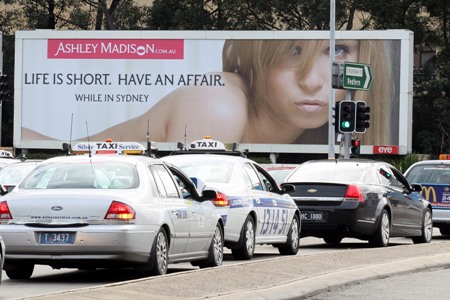
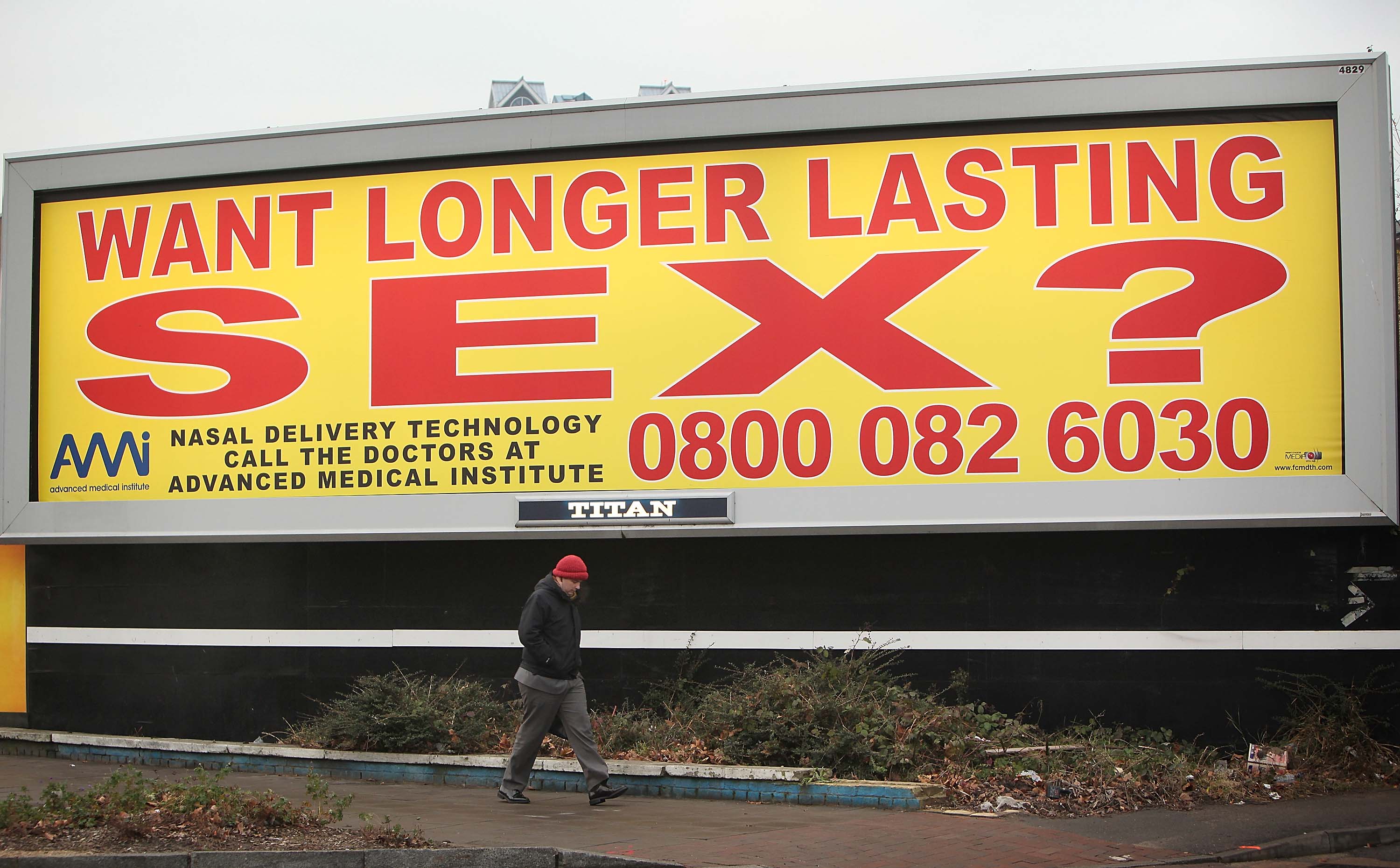
At a gut level, I would love for outdoor advertising to be banned in my city. I resent the constant intrusion into my mind when I encounter them on the street.
That said, I do recognize that from the perspective of advertisers and consenting property owners having the (assumed) right to do trade however they wish, this may not be a fair or reasonable policy to enact. Truth be told, I haven't thought about this very much.
But the thing that I'm MOST interested in is what will be the secondary consequences of banning outdoor advertising? If advertisers cannot use billboards or posters, how will the space change and where will their behavior be compensated for elsewhere? Are there any unwanted secondary side-effects that might occur do to this prohibition? Like online advertising intensifying, or paid sponsorships for online content creators, or perhaps something completely different?
A city could set limits for the quantity, size, and prominence (eg no digital displays, illumination must be lower than X nits) in a reasonably fair and neutral way, so they're not banned altogether but the excesses are trimmed.
Restricting huge intrusive ads seems very close to the building code and zoning laws which cities seem to have no problem going completely overboard with.
They should be banned, and not because people are automatons, but because advertisements are invariably objectively distracting and increasingly garish as firms attempt to outcompete one another for attention. It's really just a question of what kind of society we want to live in - my own view is that people should have the option not to be bombarded by hawkers, whether it's homeless people, Mormons, or corporate shills, while they move about public spaces.
I would support some kind of Right To Not Be Accosted. I don’t know what that would look like exactly but people who want to sell or market something to me ought to have to obtain my consent first. It doesn’t seem right that you can go out and try to mind your business and be constantly under assault by things and people looking to take your attention. Like pollution laws, we should have a right to live life without all that in our environment.
People ought to have a right to go, again, into public spaces and mind their business. They should be free to go about without being accosted or harangued or, for example, inconvenienced because people have chained themselves to the doors of commuter trains or have decided to lay in the middle of the highway.
Kind of the old 'your rights end where they interfere with my rights' kind of thing - going about my normal business in a public space is never likely to interfere with anybody, at least not in a purposeful way, whereas protests are by definition intended to interfere with my right to enjoy public spaces. They are, quite literally, intended to 'shock' normal people into changing their viewpoints or behaviour. Where I live (Melbourne, Australia) protests in the CBD often disturb private citizens in their homes.
Sure. I’m not a big fan of protests, in particular ones that intrude and disrupt me trying to simply go about my life. Petitions are just variations on sales pitches, like religious proselytizing, which I also would not consent to if I had the choice.
And not just billboards. Did I ask to have ads put on my gas pump? No, I did not. (I didn't ask for Maria Menudos to be put on it either. Why, every time that I pump gas, do I have to watch her on the gas pump?)
I didn't ask for ad-blaring TVs to be in airport waiting areas.
In fact, both of those are worse than billboards. Billboards mostly don't move and talk.
I went to Cuba and there was no advertising allowed on the roads. It was really refreshing, and it made our excursions feel a lot more engaging. The government did have some propaganda billboards on the roads, but it was ridiculous stuff like Uncle Sam getting punched in the face. I found those pretty entertaining…
> Meanwhile, a spokeswoman for another trade organisation, the Advertising Association, says that "all advertising plays a crucial role in brand competition, drives product innovation, and fuels economic growth".
You know what actually drives product innovation? Not being able to lean on advertising to drive sales, so you're actually forced to improve your product and get the benefit of positive word of mouth instead.
Sounds like the position of a developer who has never had to advertise. Building things doesn't automatically make people gravitate toward them. Believe it or not, you have to go places and promote things.
Yes, talking about or inserting something into conversation is promoting. It's advertising. And guess what--almost none of your users or buyers are going to say a word about your product.
People need to stop believing this stuff and just accept the dirty fact that if you want something to get used, you HAVE to advertise. You HAVE to promote.
Edit: You know what word of mouth is? Worthless for people who don't have eyeballs on a product.
Go read around HN and tell me about a product you just heard about being praised that you don't already know about today that is not already the de facto solution or product in a space.
You know what word of mouth is? Word of mouth is a signal you have already won. It is absolutely nothing for growth.
Spoken like a marketer / salesperson. I am indeed a developer and run a successful, bootstrapped software business. I agree that you need to initially get the word out that your product exists at all. However, this can be so targeted and the scope so small that I doubt most people would put it in the same category as the advertising practices that many find objectionable.
Once you've got some interest bootstrapped, you CAN in fact rely on unprompted word of mouth for growth. My users and buyers spread the word about my product simply because they find it useful. Many bring it to their new employer when they switch jobs.
So no, I disagree with the blanket position that you have to advertise -- especially in the intrusive fashion that's the subject of the article -- to get people to use your product. (Though I don't dispute that doing so can be a good shortcut.)
But all that is irrelevant to my claim above: my position is simply that a dearth of advertising options is what drives product innovation, by necessity. And hence, limiting advertising is likely to actually be good for consumers.
Many products require massive investment to get to the point of being able to sell a product. Waiting around for word of mouth means your debt will overwhelm the business.
Bootstrapping only works if you haven't taken on much debt to finance the development and manufacturing of the product. Software can be developed with very little debt (which is what I did).
I wonder if there are generalities about the products that "require" advertising and those that don't. Perhaps we would find that, on the balance, those products are not worth their externalized costs.
My project (a new kind of data management system designed to replace file systems and relational databases) is a bootstrapped project. I self funded it, but that means it has taken several years to get it to its current state. There are many features still on the TODO list, but it can do some amazing things so far. The 'if you build it, they will come' is a great movie line, but rarely works in business.
It is difficult to raise awareness for it. Newsletters, blogs, demo videos, presenting at conferences, etc. are all means for trying to spread the word. I have considered taking out some paid advertisements, but you wonder if anyone but bots will actually see them.
> You know what word of mouth is? Worthless for people who don't have eyeballs on a product.
As a customer, I'm tired of hearing this excuse. I get wowed by free, open-source software dozens of times a week. You want me to put eyes on your product? Wow me! I'm tired of "enterprise-grade fart apps" and "B2C photo storage" garbage getting touted as life-changing or impressive technology. If you want to compete, do something impressive. If you want people to look fondly upon your product, consider giving back to the community instead of paying to become their adversary.
Given that most of the software I use consists very clearly of one-man passion projects where the author struggles to support themselves: nobody. (Remember OpenSSL?)
Yes, most software. A piece of software being bigger or doing more things, does not make said piece of software count more. A program is a program; it's something you learn how to use separately, download/update separately; something which is separate from a project-maintainership and bug-filing point-of-view; etc.
I use four big fat codebases (browser, OS, etc); maybe 10 decently-sized language runtimes like the JVM; and then 800+ rinky-dink CLI utilities. Half of which came from a Github Gist, or which I had to compile from source from a repo containing just some bare source files and no documentation. Yet many of these little CLI utilities individually take up just as much mental space as my browser or OS does; and I get just as much use out of them professionally as I do my browser or OS. (In fact often more, because many of these utilities are multi-platform, such that I use them regardless of which browser or OS I happen to be using.)
Individuals do, clearly. I don't use Google-funded malware. I suppose the Linux kernel may qualify, but plenty of people in real industries also work on that.
> You know what word of mouth is? [...] It is absolutely nothing for growth.
When I joined the company some years ago, we were the 5th largest in our sector. We since grew to 2nd largest using almost entirely word of mouth for sales. We didn't have any dedicated sales people, and did hardly any advertising.
Instead, users would call friends in the industry and tell them to get our software. If they switched jobs they'd persuade their new boss to get our software.
Since reaching #2 spot we got some sales and marketing people, and we're now at the top.
So while I'll disagree that word of mouth can't be used for growth, I've seen first hand how good sales and marketing can put you on a steeper curve.
> Go read around HN and tell me about a product you just heard about being praised that you don't already know about today that is not already the de facto solution or product in a space.
Easy. This morning in the "Ask HN: So you moved off Heroku, where did you go?" thread I saw multiple users mentioning a open source project I have never heard of but seemed very close to what i was looking for. I have it now running since 12 hours and I already recommended a friend to check it out.
I reckon about 70% of things I use are from recommendations of people (but usually not from the internet). From what command-line shell I use to what music I listen to.
Tesla used to run billboards in LA and SF and paid influencers to shill their cars. They still market quite heavily today though not through billboards (AI Day is a marketing event.)
GMails invitation system was it's marketing, back in the day when people were excited about Google products.
Rolls Royce sponsors athletes, which is considered marketing. They also bring cars to auto shows and to various events targeted to the luxury crowd.
Tupperware's original business model was literally 100% about marketing. Most people would call it a multi level marketing scheme today.
Well there is now a massive group of people that never sees online advertising anymore. Due to adblockers and piholes. Thanks Raymond Hill <3
For me the only advertising I see is on billboards because I never watch live TV either (and haven't for years). And many products are way too niche to advertise that way.
This group will get ever larger because it's just a great thing to live in an advertising-free world. If your business can't cope with it I would suggest making that a priority to adjust to :)
Food for thought: The user you're responding to is the founder of Reviewable. I use his product and found it through word of mouth. It is not the de facto solution in the space.
I'm not seeing how it's relevant whether or not the word of mouth of this particular product has reached you.
You were telling someone that he's out of touch for thinking that he can sell a product on word of mouth alone. I'm providing evidence that he can sell a product through word of mouth because I bought his product based on word of mouth.
Whether or not you've also heard of his product is irrelevant. There's a near infinite number of successful products in the world that you've never heard of, so you being unaware of a particular product does not indicate anything about whether that product is successful.
> Building things doesn't automatically make people gravitate toward them.
No, but the two barber-shops in towns spending $X each on net-even advertising is a net-negative for me, because the only thing I get out of it is a higher bill when I cut my hair.
Some advertisement creates new markets. Some is a negative-sum game. None of it can be assumed to be honest, because of the obvious profit motive involved.
Who do you assume to be honest? The politician wanting your vote? The prospective employee telling you about his job skills? The public schools telling you they do a great job? Dr. Fauci? The customer who tells you "the check is in the mail"?
You are begging the question, in the logical fallacy sense. You have to advertise and promote because advertising has been allowed to grow unbounded like a cancer and drown out everything else. It's a tragedy of the commons.
If advertising were toned down a couple orders of magnitude, word of mouth might actually get more traction.
While that's obviously true, I'm not sure it's some sort of optimum state. I think if you're in the ocean, it is understandable that you would keep treading water to stop yourself from drowning, but perhaps a better solution is to look for ways to leave the ocean. I'm entirely unconvinced that this isn't a local maximum that we're stuck in.
Even if I leave room that advertising (and capitalism) is the only stable system, that doesn't mean it can't be limited and restricted for better outcomes for people on the whole.
I get if you're trying to starve for a buck out here in a crowded space like tech, but on the consumer side of things I have never put deep use in any product that was marketed (i.e. someone paid for it to get to my eyeballs.)
It may be true that for a bunch of you to make money, you need to put money in marketing. But for us who want good products, marketing mostly only gets in our way. Good products really do sell themselves with word of mouth, or me actively seeking out good things.
Look at Rockstar's Red Dead 2. Cost about $540 million to produce. Split almost down the middle for advertising and development costs. For every dollar spent on dev, a dollar was spent on advertising.
It's now one of the most successful games ever made. The advertising did nothing to hurt innovation, and in fact proved Rockstar's hypothesis that the market is ready for this kind of innovation, but needs to be sold on the idea.
The boundary between useful advertising and word of mouth is exceedingly thin and contextual. When Uber turned off $100m of advertising and found no meaningful change to its installation growth, had it already won? Clearly not then and not now; it's barely posted an operating profit and it still a couple billion away from positive net income. Rather, it's in a duopoly in the US and an oligopoly in some other markets and facing a pretty gnarly advertise (defect) or not (cooperate) prisoner's dilemma. Word-of-mouth can be a form of promotion. Most products have obvious entry pathways which smart and experienced marketers will readily identify; few of these are display ads, fewer still are billboards.
The space of advertising decisions is high-dimensional and dependent on too many factors to succumb to generalization. Many awesome businesses have thrived without it; others would've starved without it.
>Uber turned off $100m of advertising and found no meaningful change to its installation growth
This is misleading. Ad networks were defrauding Uber by generating fake clicks so such that organic installs of Uber would be attributed to these ad networks despite the install not being from an ad.
The problem was the ad networks and not advertising itself.
Those two notions aren’t the same, nor interchangeable. Advertising is about pushing something to a public and expanding the attention the product receives. “ There's no such thing as bad publicity” is advertising.
Promoting is about making a product’s (alleged)merits better known and enticing people to use said product for their benefit.
As a society, we want promotion, not advertisement.
Not all advertising is the same. Yes every product needs to promote itself, but there are countless organic ways to do so, most of them being industry dependent. How many of the most popular tech products today got to where they are because they put up billboards in the middle of cities?
Would you be in favor of, in principle, obtaining consent from the people you market to? If what you say is true (people want to learn about new products) then surely most people would consent to these promotional messages.
Word of mouth is increasingly the only source I trust for product recommendations. Once advertisers figure this out I imagine they'll start sponsoring my acquaintances to lie to me about their products in person and I'll have to narrow the field even further.
If my friend referred a dentist to me just for $50 without mentioning that they were only doing it for the incentive, we wouldn't be friends much longer.
That's one of the things that's confused me about those sorts of programs. Is the friend supposed to mention that they are getting paid for their recommendation? It's such a weird thing.
Why don't you want to tell more people about it - wouldn't that help them? (and you?)
Seriously asking - like I get it if you only want to make $x and call it a day but can you help me understand why you wouldn't want to help more people with your superior offer?
That's an easy one: your product is good only for some people, who happen to have the problem you're solving. You could tell everyone about it, but you'd reach a lot of people for whom wasting time hearing about your product is a net negative, and it's entirely possible that the overall value to other people's lives of advertising in that way would be negative as well. Of course you could try more targeted advertising to mitigate the negative externalities, but that carries its own costs in terms of invasion of privacy, etc.
So yes, it's certainly possible that advertising raises the overall well-being of the recipients, but it's by no means a given.
Yes, the tragedy of the commons. The only way to win is not to play. It may not be rational, but I refuse to do something bad just because the alternative is somebody else doing something worse.
There could be per-unit CapEx costs that mean that you actually can't scale up to serve traffic very much faster than organic viral growth allows.
Imagine a small cake shop running a Superbowl ad. That'd be dumb, right? Even if they had the money to run the ad, they can't fulfill the number of orders that ad would generate.
What you're saying is just not true. It's also not what capex means.
Most companies do not and cannot "go viral"
that is a fantasy for most offers. Unfortunately it's just not that easy
There's a reason that millions of Americans work in some form of sales. At big, medium, and small companies of all types. It's not an accident or a mistake actually. Any offer worth enough profit to be worth a human pitching it will get pitched - and so too will many offers that aren't worth pitching for that matter
Per-unit-amortized CapEx costs, sorry. (Typo.) Think: labor acquisition costs when you're providing a high-touch service. You can only hire so fast. Or acquisition/expansion costs for facilities and capital equipment (factory mechanization), in the case of the small bakery. You can only make so many cakes per hour, by hand, in a room of a given size.
And it's 100% true. Look at any consultant. Look at any maker of artisanal goods. If you have "inelastic supply", then there is a certain amount of demand that is saturating, at which point you don't need any more demand — you only need better demand. Every customer you acquire from that point on replaces a lower-value customer on your fixed timetable. Untargeted outreach (advertising) does nothing to make that happen. You need targeted outreach (sales) at that point. Or just some very aggressive lead-qualification of your organic inbound traffic.
I see what you're saying but the analogy isn't very good
The reason a local bake shop doesn't do superbowl spots is because they're wasting their spend on millions of people who their offer is irrelevant to. I don't think it's because they can't scale up to fulfill
there could be local bakeshops that advertise on local tv or a billboard for example. But bakeshops don't usually make enough profit to justify these efforts
to further emphasize this point - there's no rule a company has to fulfill an order on their own. if you can't figure out how to fulfill - many companies will sub that work out/outsource it. the highest touch services - think biglaw partners - those type businesses don't really scale and are more jobs than actual businesses
My hypothetical was that the bakeshop was given an opportunity to run a superbowl ad that it didn't have to pay for. There's still no point in running the ad (vs. paying to run an ad on local TV), because, despite theoretically being able to eventually scale up to becoming a global cake-factory megacorp (think https://en.wikipedia.org/wiki/Continental_Baking_Company), there are discontinuous CapEx costs in the way of doing that scaling; and nobody's going to trust this tiny bake-shop enough to loan them the money necessary to do that scaling-up, in advance of fulfilling orders, in order to build up to meet said demand; when they haven't even proven that they know how to scale.
> if you can't figure out how to fulfill - many companies will sub that work out/outsource it
Yeah, but if they're coming to you, specifically, it's probably not just because you've ran a superbowl ad, but also because you're offering something nobody else does offer, or is set up to offer, or even knows how to offer.
If you ran a superbowl ad for your little sandwich shop, that wouldn't make a million people interested in flying out to you to get sandwiches; your sandwiches are probably good, but so are many people's — there's no USP to what you're doing. Sandwiches are fungible-enough that the ad will just make people want a sandwich from their own local place.
But, well — you know the "pink sauce" lady? She's got a USP. You can't get pink sauce anywhere but her (for now.) And she's certainly trying to outsource her production to a big condiment corp, due to the massive accidental viral demand she's triggered for her product; but there wasn't anyone already set up to make pink sauce, so she couldn't actually just turn around and immediately buy it on the market, or subcontract its production (AFAIK there's no "condiments mixed to order" job-shop factory; only "we put your label on our pre-made condiments" factories.) Right now, she's just trying to meet millions of orders from all over the US, from her kitchen, and everything's going to hell as a result.
Exactly. Advertising is an arms race. Coca Cola doesn't spend billions on ads because nobody had heard of Coke. They do it to suppress the more innovative competition.
And to make people feel good about their purchase.
BMW doesn't really need to advertise as their new cars are only affordable for a small subset of the population. They advertise to re-enforce to their customers they made a great decision parting with their money.
And interesting point I learned from a documentary recently, that I rarely see mentioned: New Coke failed mainly in the American South, among people who considered Coke to be a wholesome and traditional part of their lifestyle — kind of like sweet tea. But it failed so hard there, with people there getting so angry, that the media capitalized on that failure, running constant articles about it, giving an impression that New Coke was just failing in general.
New Coke was actually decently successful in the rest of the world; and especially in younger, more urban markets — i.e. the markets Pepsi is more popular in. New Coke did exactly what it was designed to do: steal market share from Pepsi.
Coke's mistake was never really in launching New Coke. Their mistake was in removing the "old" Coke at the same time. If New Coke was positioned differently — not as a replacement for Coke, but just as a "kind" of Coke (like Coke Zero is a "kind of" Coke), they would have cleaned up.
It took a few days for me to put my finger on it, but lack of advertising was something that stood out to me when I visited Cuba almost a decade ago. Your visual environment has space to breathe. Although, another difference in Cuba was the presence of regime propaganda in some of that visual space.
Growing up in Chicago's suburbs, the highways are awash in billboards. I never noticed it until living elsewhere. But in the town I grew up in, public ads were much less common.
It's interesting the ways in which the commercial exploitation of the visual environment plays out differently in different societies. But I'm a fan of far less advertising in public spaces, where you can't really consent. And I think it's interesting that the ways in which the internet attention economy lays bare the commodification of attention might bring more awareness of that mm dynamic in contexts where it has been underexamined.
This article seems to want this to look like a unified movement, but it seems more like a bunch of small groups in different areas who aren't working together, and may not even agree with each other if you get them in a room together. The issue-specific people ("no car ads!", "no gambling ads!") may not go to bat for someone else's issue, and may look at the "no ads whatsoever" people as extremists who distract from their specific cause.
I guess my point is this seems like a bunch of weakly-related data points, rather than a strong signal of a movement. Too bad, since I'd love to see drastically fewer ads in public spaces.
I want fewer signs in general. Fewer billboards, fewer road signs, fewer placards posted by control-freak authoritarians.
I drove in Scandinavia a few years ago. They have a lot fewer road signs. Speed limits are by default and drivers are supposed to know them: 50kph in town. 80kph on rural roads. 100kph on motorways. Only if limits are different are there signs.
The signs they do have are mostly iconic, so other than street names, you don't have to read words. That is also more pleasing to the eye somehow.
I was reading an article just today about a guy who got his catalytic converter stolen while parking at the airport. He told the reporter that there should at least be a sign warning of the possibility. I was thinking, "No, not more pointless signs!" They are an easy way to appear to do something about a problem.
I visited São Paulo before and after the ban (I'm not sure if the ban is still in effect). The difference was staggering. The city was more alive with people. You could see more, you could feel more. The sky was clearer, people were less distracted, it was great.
I'd be quite alright with banning (or at least heavily regulating) illuminated billboards. Those are indeed very distracting, and the light pollution concern is valid.
Billboards in general, though? I live in a place with lots of billboards and they're pretty easy to ignore. I don't really see the upside here to what would constitute a freedom of speech/expression infringement.
I think the more reasonable emphasis should be on regulating the light escaping from a property, not micromanaging the property itself. Limit the lumens or whatever in various protected directions (into the sky, onto roadways, etc.) and that would address the entirety of the actually-valid concerns.
Online ads are hard to ignore specifically because they use system resources to display - especially when they're JavaScript-heavy, but even without JS they still often entail image downloads and such that do add up. Billboards ain't really analogous; obnoxious lighting notwithstanding, they're no more obtrusive than a building or a tree or a sculpture or anything else that might exist on some plot of land - and while I'd personally prefer to see a building or tree or sculpture, I don't feel strongly enough about there being a billboard instead to desire outright criminalization (read: use of violence by the state in response) of billboards entirely.
I lived in a place where they were banned and roadside signage highly regulated and it was awesome, some much less visual clutter and noise. Every time I would travel I’d be shocked at how much advertising there was.
Rather than a ban, would a very large tax for any ad spend work as a policy? This would seem to both reduce the overall number of ads, and force advertisers to allocate more resources to making better targeted ads that are more profitable per impression. My opposition to ads is not that they have no utility, but rather there is not sufficient compensation for the human attention that they (nearly) freely exploit and waste.
IMHO it's misleading and unhelpful to talk strictly about advertising. Instead we should be talking about marketing, for which advertising is one (hugely significant) part.
Marketing is a key component of building, growing and maintaining a business. There is no "build it and they will come". Many an interesting product has died on the vine because of poor or lacking marketing.
Marketing is a two-way street. It's about understanding who your potential customers are, how large your market is, who your competitors are, what is important to your potentiaal customers, who buys your products, why they buy them and so on. The other side, which includes advertising, is making people aware of your product or brand. It may include a direct call to action (eg "buy this widget now") or it may just be creating a perception for your brand. A lot of Coca-Cola and even Apple advertising falls into this category.
It's really disappointing to see some of the comments on this thread. Comments like "I built a business with no advertising so you don't need it either". The only way this is likely true is if you sell to a small number of businesses and your initial customers were former colleagues or otherwise known to you via networking. This is not representative of how business growth and marketing works and shouldn't be taken as such.
There can and should be limits on advertising. When, where, what, that sort of thing. I personally think that advertising in children's shows for example should be banned. So should pharmaceuticals (a uniquely US problem). Some things are understandably heavily restricted (eg gambling, alcohol, tobacco, cannabis).
But a ban on billboards? What does this achieve? The objections seem to be largely aesthetic. That seems highly performative.
It's not really performative. Billboards occupy a lot of space, both mental and physical. I've had the privilege to walk through ad-free cities and it's like night and day. Once you return to the rest it suddenly becomes clear how garish and vile the ads we've become used to are, and how amateurish the deal we've struck is. Billboards don't bring in that much revenue to the collective compared to what they do to cities.
From your perspective, you want to grow a business and become wealthy. That's fine, but why should we participate in that goal and tolerate a significant negative externality for very little reward? The idea that your business should be able to blot the public space for profit is a false premise, just one that people have grown used to for historical reasons.
> He points to the impact of Transport for London's ban on such adverts since 2019 across its entire network of tube and overground trains, buses and trams. A study last month found that the policy had prevented almost 100,000 obesity cases.
How do you measure that even remotely accurately? It's certainly not as if there was some sort of confounding factor between then and now.
No. But cities should have strict policies around where and how it’s possible to set up billboards.
In the end I’m all for advertising money spent on ads that aren’t tracking me.
I’d switch the question around and ask: are there enough ads on billboards, bus stops? If not then maybe we haven’t regulated online ads enough to make the billboards attractive.
We did it in São Paulo, Brazil a long time (15 years?) ago. It was a relief and I'm always a bit bothered when I'm on cities that allow it. It might be the case that some places in some cities should still keep it, but otherwise I'm still all for it
There are no billboards in Maui from what I could tell, which was quite pleasant. From a further search it looks like Hawaii doesn't stand for billboards at all, nor do Alaska, Maine, or Vermont.
I'll be the controversial one here and say... I actually like billboard advertising?
Most of them are not being built in particularly scenic areas, and they add a lot of visual interest. Especially as a chronic user of public transit, I have SO MUCH appreciated having something to look at in a subway or bus stop. Each city and location has their own flavor, and it can actually be kind of fun to see what is in other cities/countries.
I agree that on or in public transport is fair for advertising- but I strongly dislike billboards that block interesting views of buildings, poke their brightly coloured cheeks into the skyline or glare brightly into lofts and apartments.
One of the differences is that advertisers on public transport are often highly censored- where as the car-yard or similar can go for the cheapest artist, horrid paint, off-colour humour. Some advertising- like some tv, is actually quite good, as a form of art. For examples of this, - and some general roasting of the advertising industry, check out episodes of "the gruen transfer" by Australian national broadcaster ABC.
I don't use Facebook or Twitter, though from a sibling it sounds like uBlock works just fine.
This is another key differentiator: if I want to go anywhere, I have to pass billboards. The only other choice is to stay home. On the internet I can actually avoid bad sites.
Same link. It took me half a second to find it. It's hard to believe that you're asking in good faith at this point, so I won't be checking back in for more comments.
Mass advertising has a big tragedy of the commons problem. Attention is limited, and every mass ad, digital or otherwise, takes attention away from any other mass ad. (I distinguish mass ads from advertisements for cigars in Cigar Magazine).
That's why it should be used to "advertise" something that is really beneficial to society, like info on road constructions planned for the following week or directions to the nearest hospital.
One of the nice things about traveling on the Autobahn is the dearth of billboards. Basically only PSAs about drink driving or wearing a seatbelt, which I think we could do without too (the signs, not the seatbelts).
There's a big difference between passing a law banning all billboard advertising (including those who erect billboards on their own property) and banning it on publicly owned land/properties.
Billboards are depressing, especially in the countryside. It feels like a form of theft of my attention. They hurt everyone but a small group of people, but we still can't seem to ban them.
This is the most sensible comment I've read in this thread. Running to tell teacher whenever something slightly bothers you is not something we should be encouraging. Ads are annoying, wasting time worrying about them is a waste of everybody's time
It can create a vibe in certain situations, but overall I find it quite annoying and exhausting to have rude billboards constantly intruding in on my attention.
I think a compromise I could live w/ would be you can have outdoor advertising, but it has to just be a logo and a brand.
E.g., a giant sign with the coke logo is fine. But a sign that's basically clickbait w/ a dumb joke that you won't be able to avoid reading: absolutely not allowed.
Another example of outdoor advertising gone very wrong is in Monterrey, Mexico. It is a large city surrounded by gorgeous mountains, but in some places when driving can't even see them -- the road is just a wall of billboards. Very dystopian.
The opposite of this is most developing countries, where free signage given out by consumer brands like Coca Cola/Pepsi/P&G are literal visual pollution in what used to be beautiful small towns and cities.
I hate ads. I really do. I use ad-blockers and vastly prefer billboard-free zones. On the other hand, I like getting a paycheck, and I don’t know how our company would have ever gotten off the ground without advertising itself.
I am working for a for-profit company - I have done so for pretty much all my life, including companies that either rely on, or are directly involved in advertising.
However, I don’t try to justify it in any way (even though my current client is actually completely independent of ads). I know and agree that my contributions to that field are bad for society and try to do better whenever possible, including fighting back when my contractual obligations allow me to (and avoiding contracts that would prevent me to do so).
So not really a complete “dig” to the parent comment, but rather that we might have done wrong but we should strive to do better instead of trying to justify it.
Consider GP's company may (at least in his opinion) make some kind of positive contribution to society, but wouldn't have the opportunity without using some advertising to get off the ground.
Yes, agreed. That’s fine if that’s the case and if it is then I misunderstood and my comment doesn’t apply (see my other reply for an explanation).
IMO, it’s one thing to be involved in harmful advertising, it’s another to try and justify it. I don’t mind if you are involved because you have no other choice, but if you have other options, tired to unsuccessfully steer the ship around and you’re still there, then it’s where there’s a problem.
Let's say for the sake of argument that all of the people who are not 100% consistent in everything they do all publicly recognize their hypocrisy and failures, no matter how minor, and praise the intelligence, perceptiveness, and moral uprightness of the people who pointed them out.
What then?
The problems still exist, still need to be dealt with. This is why it's not helpful to let the perfect be the enemy of the good or to focus on proving people to be hypocritical to shut down discussion.
Even a person who is perfectly willing to make all of the sacrifices for maximum consistency would find it extremely hard if not impossible to avoid helping ad companies, since these have grown so powerful and omnipresent like Google for instance.
I do actively avoid Google for any of their products outside of search. Not because of some underlying belief system. But because the products suck compared to the alternatives in every category besides search. Even searching on Google sucks without an ad blocker.
I could also avoid any one of the other Big Tech companies without the loss of convenience. I could definitely avoid both of the Ad tech companies - Google and Facebook.
Before I get called out, I couldn’t just avoid 1 of the other three because they allow me to exchange labor for money to support my addiction to food and shelter. But if I didn’t work for them I could.
Look, I don't want to badger you. I'd say at the end of the day the important point is to band together to try to limit the influence of adtech and traditional ad companies. Most of this effort will have to take the form of collective engagement because there's only so much personal sacrifice can do. I'll fully admit I am a hypocrite myself. I simply don't have the resources or energy to do much more than fix the emergencies in front of me. But that's why it's so important that even inconsistent people be allowed to voice their opinion and do something about these things, because it's not their personal consistency that matters but the power of the ad oligopolies and the vileness of modern advertising.
within the first paragraph my alerts went on... '...and the ads are for things people can't afford, or don't need'... seriously? Did she just say that and everyone is fine with it? So... you are to save poor stupid people from being unduly influenced by advertising?
This whole article reads like a dystopian mind-warp campaign of 'controlled influence' >>> "messy capitalist freedom promoting things we don't think is good for people". Who is we? People with university degrees having too much time on their hands because they got the useless ones?
"Let's ban flying ads, diesel car ads, gambling ads, burger ads, the masses can't be trusted, adds for veganism, social justice, yoga, and gym memberships? ... Well... sounds good! Let's have some of those!" The latter are of course fully informative, only have your best interests at heart, are not selling a lifestyle with brand imagery abusing decades of market research to push their product for financial gains?
I for one welcome our new ad-regulators. I definitely don't want to be victimized any longer by meaty burger-ads that make me fat and hurt the environment... /s
That being said: I'd like less ads.
As someone who uses an adblocker + noscript heavily, consumes next to no media (except books, old movies downloaded from the net), has no television, doesn't go to the cinema, doesn't follow the news, read magazines or have social media... really the only time I ever am exposed to ads might be outdoors. I'm sure they influence brand recognition without me noticing. I'd like less of them, but when someone argues for 'less ads... especially less of the wrong ones'... please go away from the hole you crawled out of and let people live their lives!
Ban them outright or take measures to limit their number indiscriminately of what they're about. Or don't, but don't impose your moral standards unto me and the world!
Yes, please. Thank you. I'm not sure which is the better argument: that they are a safety menace due to distraction from driving (video billboards?) or that they are profoundly ugly (including but not limited to aesthetically). Either would suffice for me. The quicker the better.
This is stupid on so many levels. There's the obvious idea that governments shouldn't be involved in telling people what they can do on private property (I can see the argument that community associations or designated areas could have special regulations, and I expect they already do, there are no billboards on the pyramids).
Almost worse (as it is always for dumb ideas of this kind) is the enforcement. Are we going to have a whole system of definitions of what is billboard (when is it just a poster), jurisprudence, inspectors, etc. The kind of 0th order thinking of '"they" should ban X' has no relationship with reality, even if it sounds like a good thing if you dont think about it (personally I hate advertising) This is the same class of stupid idea that makes no practical sense that we see in various populist political campaigns
Edit: I have to admit, I didn't anticipate so many seemingly angry (and condescending - the guy talking about animal cruelty laws and "we encode complex things...", lol) replies. Anyway, the above is just my perspective, I guess if you want your tax dollars working towards something like this, there is a pathway to a billboard free future
> There's the obvious idea that governments shouldn't be involved in telling people what they can do on private property
The government literally tells people what to do on private property all the time. See zoning rules, smoking bans in restaurants, alcohol sales to minors, food safety laws, animal cruelty... the list is almost endless. I can't even fathom the kind of thinking that suggests that laws end on a property boundary.
> Are we going to have a whole system of definitions of what is billboard
Yes. It's not that hard. We encode complex things in regulations all the time.
Never said it was. History was (and continues to be) littered with terrible law.
If you want to argue that government shouldn't regulate billboards, fine, that's a valid argument. But the general principle of governments setting rules over private property is pretty well established, I would have thought.
I come from a place that bans billboards. Arguably it’s fairly practical, no one seems upset about it and property owners seem to get by. Also there don’t seem to be issues of enforcement because everyone is more or less on the same page about it.
I'm not a total libertarian nor a total communist, but I don't know why an elected government is worse than an unelected corporation at deciding what gets done with private property.
I'm with you on this one. The less the government messes with freedom the better. I'd rather a bit of visual pollution over a loss of even a small amount of freedom.
I would agree with you, if - and only if - the government also refrains from messing with my freedom to deface those billboards, so they no longer pollute the commons.
In this hypothetical world of maximal freedom, I suppose you could. I couldn't very well stop you, and the government obviously wouldn't be messing with your freedom to paint other people's houses.
The less the government messes with your freedom the better, eh? I suppose that if I didn't like the color, perhaps I'd repaint your house in retaliation. What a mess it'd all be.
Well, okay: now we can have a reasonable discussion. It's not actually about freedom, it's about how big a deal it is to pollute the commons with advertising. This is a question on which reasonable people may have differing opinions. How are we to sort it out? A majority vote might be one mechanism. Selection of representatives who can research the issue and negotiate compromises might be another.
My uneducated theory on this is that the problem with government interferences is proportional to the distance between you and the bureaucrat making the decision.
For example, if a world government said we don't want anyone wearing yellow hats. That's a problem because over the globe there are going to be some odd folks that care very much about their yellow hats (insert hypothetical religion / cause here). But if you get together with your neighbours and say let’s create a pact to legally require that all people remove their yellow hats from our gated community, well fine if you love yellow hats, you probably don't like these yellow hat haters anyway, who cares if they don't let you into their street.
That same could be done in local areas. But I think central business districts or areas that have a huge number of commuters there are just too many people involved. You now must have a lot more of a justification for the freedoms that are lost.
That said if all the building owners want to put that restriction in I'm all for it.
You can see from some of the comments the sort of nonsense that is standing in the way of just being left alone. I don't know when or how things got this bad, but i suspect HN comments are not very representative of reality, even amongst the readership here, just some vocal kids
How would you define being left alone? It is currently based on a very specific mixture of laws and customs that foster private property and other such concepts. You're also dependent on the safety and/or infrastructure in your local area. The wealth that makes this all possible in a developed country isn't attained by leaving people alone, either. I would contend that the idea of being conceptually separated from the community in a Randian sense IS the childlike fairytale in a way.
Besides, there is a perfectly libertarian or even ancap way of looking at the advertisement problem. Billboards affect the quality of a city, and most of the people it affects aren't getting paid proceeds. So they can gang up together to ask for a better deal. And if they can't then they are being restricted by some non-libertarian force.
There's a ton of freedom already taken from you for the benefit of society, like driving on one side of the road or stopping at intersections. I don't think you mind those?
Each case has it's own cost benefit. I think the road rules have benefits that outweigh the costs. I don't think the government should be able to dictate how people dress their building. Be that painting them bright green or putting up advertising. Just as they shouldn't tell me how to dress.
Governments do have rules about the look of buildings. There are zoning regulations about commercial vs residential properties. Many places around the world will require that your building conforms to the character of the local environment.




Here’s São Paulo’s welcome sign coming from Guarulhos. There are lot of billboards before it, but exactly none after.
https://maps.app.goo.gl/Dw8AFJS2sNRW27PL9?g_st=ic