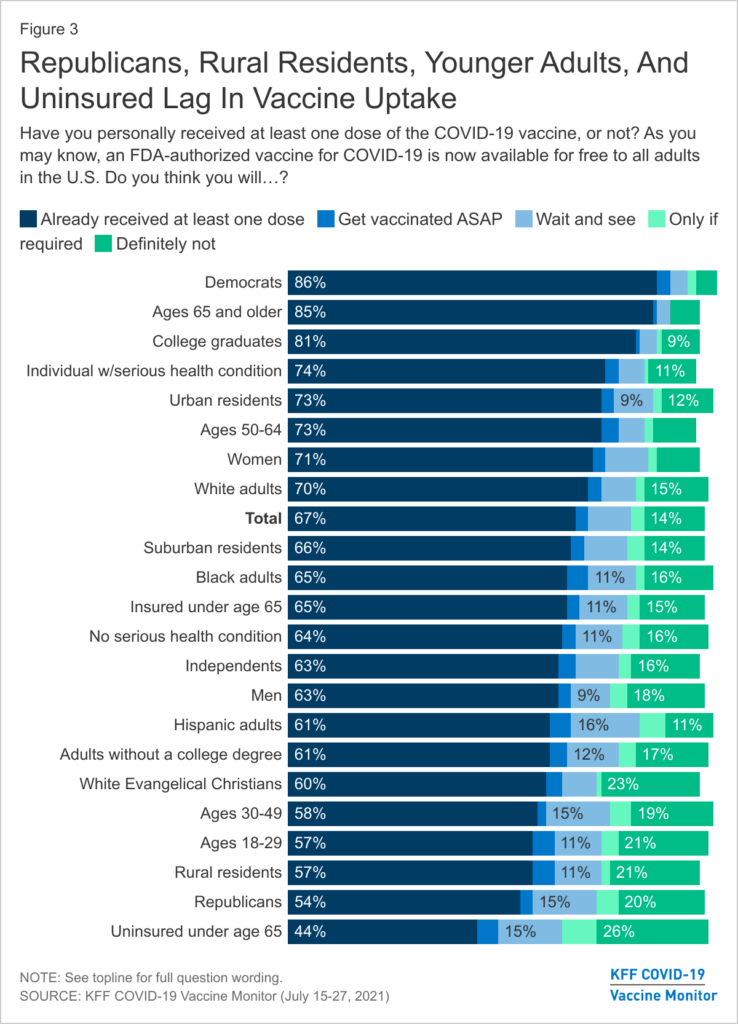
It's a shame that the mainstream has adopted the term "anti-vaxxers" to describe people who don't want to get a COVID vaccine. Many of my friends and colleagues have concerns about mRNA vaccines, but they have no issue with any other standard vaccinations. Despite this, they get labeled as "anti-vaxxers." This makes them defensive about being insulted, thereby reinforcing their existing opinions. It's a completely counter-productive cycle that may actually increase COVID vaccine hesitancy.
I think the issue with being hesitant about mRNA vaccines is that they're probably not as bad for you as an mRNA virus. The mRNA virus will definitely inject mRNA into you to make your cells do its evil bidding, and it is fairly unlikely that the vaccine, which only injects one part of the virus' mRNA into some cells, could somehow be worse than the virus, which injects everything in the vaccine plus mRNA encoding several other proteins, and replicates boundlessly to boot.
The mRNA that Pfizer puts in to the lipid nanoparticles isn't even as dangerous as the virus's equivalent - the version of the spike protein it encodes is mutated at a point to prevent it from making the conformal change that wrenches membranes open.
To play devil's advocate, the retort to this is that if you don't get the vaccine you're some <100 percentage more likely to get the virus, but if you do get the vaccine you're 100% likely to get the vaccine.
I think the related mistake some vaccine-hesitant people make is that they greatly underestimate their likelihood to get the virus in the future. This is reinforced by some pro-vaccine people (incorrectly) claiming we can eradicate the virus through high vaccination rate.
> This is reinforced by some pro-vaccine people (incorrectly) claiming we can eradicate the virus through high vaccination rate
A high vaccination rate of high efficacy vaccine(s) can most certainly eradicate a disease. A virus can't do a whole lot without a host to incubate and spread it. If potential hosts can't meaningfully incubate or spread the virus, it stops spreading.
Once the good vaccines (80+% efficacy) became available, if they could have magically been distributed to everyone, COVID would be entirely contained by now and on the way to being eradicated in the population at large. Only the most remote reservoirs would contain the virus at transmissible levels.
That is not saying some 70% vaccination rate will eradicate the virus. It will bring the infection rates down to below pandemic and epidemic levels. If someone is unvaccinated for medical reasons but everyone around them is vaccinated the virus has a pretty huge moat to cross to infect them. Even when the vaccinated get a breakthrough infection the odds of it being serious are very low as is its transmissibility.
It seems like you are basically agreeing with me while pretending to disagree. Of course we could eradicate the virus with a magically high vaccination rate using a magically effective vaccine. But that's not possible in our current reality.
By insinuating that we can eradicate the virus using current technology and current infrastructure, it causes vaccine-hesitant people to see their choice as a type of prisoner dilemma. When in reality, their choice is more like "do I want to get initial immunity via the vaccine, or do I want to (eventually) get it via the virus.
We can eliminate viruses with current technology and current infrastructure. We've done it with several diseases already.
The vaccine "hesitant" don't have a prisoner's dilemma. They're not understanding or being misled about probabilities.
A symptomatic COVID infection has a fairly high probability of a "long haul" case and a smaller but still relatively high probability of hospitalization. It should be painfully clear that with a high infection rate the hospitalization rate is high enough to flood hospitals and cause follow-on effects like non-COVID emergencies being unable to receive proper treatment.
Waiting to gain immunity to COVID through natural exposure has a high chance of a long haul condition, hospitalization, and death. On the other hand the vaccines have a chance of side effects so low as to be effectively none. Once vaccinated the chance of breakthrough symptomatic infection is low and the chance of long haul conditions, hospitalization, and death are extremely low.
There's no dilemma about vaccines for anyone being rational. Even if you're hesitant about mRNA vaccines (despite hundreds of millions of doses with no problems) there's viral vector vaccines readily available.
We cannot eliminate the SARS-CoV-2 virus with current vaccines. I would encourage everyone to get vaccinated if they can, but the virus is here to stay.
Again, it seems like you're basically agreeing with the trappings of argument. I am talking specifically about eradicating SARS-COV-2, not eliminating a virus in abstract. It's obvious that there are some viruses we are able to eradicate, but it is also obvious that there are some we are not.
The rest of your comment is punching ghosts. Keep in mind that most people are not rational, and empathizing with irrational people is a more effective method of influence than scorn.
This is the sort of argument that causes people to reject vaccination.
1. "a smaller but still relatively high probability of hospitalization."
The risk of hospitalization for COVID is (in the UK, other countries are comparable) something like 0.1% per week for the 65-75 age range [1]. It is much lower for younger people. Ignoring the actual probability of getting infected is not legitimate - people care about overall outcomes. Claiming this is a "relatively high probability" is the sort of false claim that creates resistance to vaccination, because it makes the people promoting vaccination look mis-informed. Especially when they claim to be more rational and have better information than the people they're criticizing, this is guaranteed to piss people off and make them double down on their position. After all, someone who tried to convince them they were wrong just demonstrated an incorrect understanding of risks, and vaccination vs infection is all about marginal risks.
2. "A symptomatic COVID infection has a fairly high probability of a long haul case"
Long COVID isn't even a definable thing, so talking about it will immediately reduce your credibility with those who don't want to take a vaccine. You really have no idea what the probability is given that long COVID isn't a real disease, in the sense of having a defined set of diagnosable symptoms.
Injuries from taking the vaccine on the other hand are definable. Most countries have databases with entries describing those injuries, but they are incomplete so it's hard to know the full risk. Most pre-COVID studies suggest the under-reporting rate is anywhere from 10x to 100x, so the true numbers are certainly quite high, especially as under-reporting for COVID vaccines is clearly much higher: lots of people claim the vaccine made them sick for a day or three, but don't report this. So people who talk about the risk of long COVID but never talk about the risk of long vaccine look biased and irrational (i.e. not doing a cost/benefit analysis).
3. "It should be painfully clear that with a high infection rate the hospitalization rate is high enough to flood hospitals"
There are quite a few countries have got through prior waves in which nobody was vaccinated without hospitals being overloaded. Switzerland for example publishes long term data on hospital capacity. As you can see [2], at no point did the country run out of beds or even come close. In fact ICU beds have been decommissioned over the past year because there were too many, and regular hospital beds were never more than 10% COVID occupied. Therefore, this is not painfully clear, especially as you're using vague terms like "flood" and "high".
4. "Waiting to gain immunity to COVID through natural exposure has a high chance of a long haul condition, hospitalization, and death"
The COVID IFR estimates published by the WHO is ~0.2%. This is not "a high chance ... of death".
5. "There's no dilemma about vaccines for anyone being rational"
You have just demonstrated that you don't understand the actual risk levels involved with COVID, so it would be wise to refrain from criticizing other people's rationality.
The death rates for COVID infections in the US is sitting pretty at about 1% [0]. The hospitalization rate is over 5% [1] on average and way higher in some regions.
Meanwhile influenza's IFR in the US, which includes pneumonia from an infection, is about 0.05% and the hospitalization rate about 1% [2].
As for vaccines, you're full of shit. Feeling sick for a few days after a vaccine is not in any way similar to actually being infected with COVID. Besides the symptoms being extremely mild and in no way debilitating they're not communicable! If you get vaccinated and go to work you won't vaccinate your entire office by accident.
So far in the US we've got about 40 million known cases of COVID with over 600,000 deaths. We have hundreds of millions of fully vaccinated adults with very few deaths from the vaccines. One of the two things is orders of magnitude safer than the other. Hint: catching COVID is not the safe one.
The death rate for COVID infections in the US has been 0.6%, almost all of which were unvaccinated. 40 million cases is a drastic underestimate; the best estimate of actual cases was 120 million as of July.
I encourage everyone to get vaccinated if they can, but vaccinated people can still infect an entire office by accident. It's possible that vaccinated people might be less contagious on average but we don't have solid data on that yet.
The numbers we're talking about are slightly different. You're referring to CFR but calling it IFR. There are many more infections than positive tests ("cases"). That's OK, the difference is quite subtle. Likewise your hospitalization stat is hospitalizations per infection and only in one US state, whereas the stat I quoted is the weekly risk of COVID hospitalization for everyone in that age band in the UK.
It doesn't matter much. The stats you cited don't change the point being made: whether it's 0.1% or 1%, neither number is "relatively high", "fairly high" or a "high chance". These are all quite low probabilities.
"Feeling sick for a few days after a vaccine is not in any way similar to actually being infected with COVID"
For many people it does seem to be the same. I know a few people who got COVID. They report the same experience as many people who got side effects from the vaccine: a day or two of feeling really rough, followed by recovery. But getting COVID, or at least COVID bad enough to notice, isn't that common. The cumulative number of cases is about 10% of the population where I live. Probably there were far more infections, but if those infections don't yield noticeable symptoms then they don't matter, so we can say 10%. By now I know more people who got sick from the vaccine than sick from COVID. It's not a massive surprise as far more than 10% got the vaccine. Given how they work, it makes sense that lots of people who get it report getting a form of COVID. The assumption that it's always drastically worse to get COVID itself does not match what I hear other people around me report. For example nobody who got COVID said it interfered with their periods. The vaccines have done this to several women my girlfriend knows.
This is what leads to problems and disagreements. People are pushing vaccines with claims about COVID that don't match the stats, and claims about the vaccines which seem to be contradicted by lived experience from the offline world. What are people to make of this?
Animal reservoirs are usually only meaningful if there's significant interaction with those animals and humans and a meaningful ability for the virus to spread between species. Most people don't snuggle up next to a white tailed deer every night so the chance of catching COVID from one is pretty low.
Even if clusters emerged from animal reservoirs, a vaccinated human population would help keep the r0 value below one and allow for containment. COVID had an r0 above one and little meaningful mitigations against its spread early on so it quickly got to epidemic and then pandemic levels.
I don't know the stats behind it, but I've heard from news that those with the vaccine do still host the virus when exposed and even continue to pass it along (although they experience lesser/no symptoms).
If vaccinated people do become infected at the same or similar rate to unvaccinated (and a whole lot of other assumptions), it almost seems like there is a scenario where the vaccine could be worse than the virus because we're essentially creating many Typhoid Marys that continue to host and spread the virus unaware that they're contagious, giving the virus a massive pool to mutate within.
> If vaccinated people do become infected at the same or similar rate to unvaccinated (and a whole lot of other assumptions)
They do not though. You getting sick from any virus is a function of your particular immune system, the viral load you're exposed to, the virus' infection mechanisms, and your manner of exposure.
Vaccines affect the first two points. They train your immune system to recognize the virus as something its seen before and it has ready antibodies to fight. Your immune system responds more efficiently to the virus and neutralizes it faster meaning that any point during your "infection" you've just got fewer virus particles to shed and spread to others.
If you're exposed to a high viral load you might become symptomatic, your white blood cells can only work so fast, with a breakthrough infection but since your immune system is pre-trained for the virus it'll be a shorter and likely a less severe infection than if you were unvaccinated.
The Typhoid Marys you're describing are the massive pools of completely unvaccinated people getting sick. The unvaccinated remain infected longer and end up producing more copies of the virus from their infected cells. If the virus generates a beneficial mutation (named variant) after a trillion replications and each unvaccinated person produces a billion replications (made up round numbers) then we'd expect a variant every thousand people infected. If a vaccinated person only produces a million replications then it'll take far longer for a vaccinated population to generate a variant. You may never even see a variant emerge if the infection rate drops below pandemic and epidemic levels.
That's not a retort, that's a question. "Do the odds of getting the virus attenuate its expectation value enough to make it equal to the expectation value of the vaccine?"
The answer to the question is related to the question of how many people are going to get this thing before it stops spreading. From what I've heard we're looking at 70-80% based on herd immunity estimations, which is not a lot of risk attenuation on the virus side. If someone wants to chime in with a better-justified estimate, I'd appreciate that.
Those herd immunity level estimates were based on R0 estimates for earlier variants. The Delta variant is so contagious that there will be no significant herd immunity effect to protect unvaccinated people. Almost all of us will eventually be exposed no matter what we do, but fortunately the vaccines are very effective at preventing deaths.
True, and also keep in mind that expectation value incorporates not just relative odds of occurrence, but relative harm as well.
The immediate harm of getting the vaccine is much lower than the immediate harm of contracting the virus, and furthermore the vaccine reduces both the odds and harm of the virus.
All that is factored into the comparative E(V) too.
No, it's not a question, because vaccine-hesitant people generally aren't doing the math like you are. They're just saying "<100 is better than 100, so I'll go with the option that might be fine."
We eradicated smallpox and (almost) polio because there were no animal reservoirs and the vaccines were highly sterilizing. Those criteria do not obtain with SARS-CoV-2. Many other mammal species can catch and spread the virus. The original bats which presumably transmitted it to humans are still out there. And vaccinated people can also still catch and spread the virus; there is probably some reduction in contagiousness but the magnitude is unclear.
Well, there are two groups roughly speaking of people with natural immunity. One group, those who have already had the virus, seem to be fairly well protected according to that one Israeli study. Obviously, going out and getting the virus to protect yourself from the virus is an idea straight out of Catch-22, so I assume you're talking about the other group. ;)
As for people with natural immunity but who haven't had it, that's everyone. Every person has what are called "naive B-cells," covered in random antibodies. One of them probably binds to coronavirus in some way, and that would be how your body would get started fighting the infection if you got it. However, the fact that people have some natural ability to fight it off explains why not everyone dies from it (every virus would kill you if you had no immune response, that's why HIV is deadly), but it's of little consolation to the people who found out too late that their natural immunity wasn't enough.
If there was a test to see in advance who would fight off the coronavirus without realizing they had it, I guess that would be a way to save some money and inconvenience giving them shots, but since we don't know for sure in advance who will or won't have an easy case, that's why we have to get vaccinated.
It would probably cost less to just administer a proven safe and effective vaccine anyway than it would to test that person even once.
3 shots of Pfizer ~ 60 USD < -- VS -- > 100+ USD ~ Single test to see if someone's infected, surely a test to see if someone is naturally immune at best costs this or more.
#
Pfizer seems to cost about 20 USD per dose, so even with the three dose regime (2 initial shots plus a later booster) is expected to cost under 100 USD; most of the other shots cost less.
As there is no currently known technology to reliably test if someone is immune I'll grab data for the next closest similarity: a test to see if someone is presently infected. Nearly all of those tests cost in the range of 100 to 200 USD, with some rare outliers above and beneath.
You have some natural immunity to viruses before you get them, that's why you can survive viruses. That's little consolation to anyone in the ER, of course.
They already beat the mRNA from the actual real "live" replicating virus. They have very little to fear from the mRNA in the vaccine.
Infection followed by an mRNA vaccine also acts as a boost which provides broad neutralization against mutated spikes and possibly some pan-sarbecovirus immunity.
For essentially all 'side effects' of the vaccine - you're substantially more likely to experience them if you get Covid. Not only is the notion of avoiding the vaccine to avoid the side effects misguided, it's actively increasing your chances of getting those very same side effects.
Sure, and your odds of injury from a car crash are lowest if you avoid getting in an accident, but if you're driving in a demolition derby you're certainly better off if you're wearing a seat belt and a helmet..
Oh come on. Even before the pandemic your typical anti-vaccine person also wasn’t universally against all vaccines. They usually had some subset that represented their favorite rationale for not getting it: those containing substances they don’t like, those developed with a process that had a fetal cell line somewhere nearby, those given in clusters in early childhood instead of spread later on, etc. Anti-mRNA vaccine sentiment is just another instance of the same thing. Sorry if they feel sad for having that label, but it’s the same behavior.
If they aren’t universally against all vaccines, then why is the term “anti-vaxxer” applied in deragatory ways? I was under the impression it meant they were afraid of all
Portions of what you mentioned seem like reasonable concerns to the average layperson
The Johnson and Johnson shot is not an mRNA vaccine, is freely available, and undergoing the same vetting process as the mRNA vaccines. The reason people are being labeled as "anti-vaxx" is because there aren't a lot of reports of the "anti-mRNA" crowd lining up to get the J-and-J shot.
I know quite a few people who got J&J due to their hesitancy about Pfizer and Moderna. It's anecdotal, I know, but so are all of my personal experiences :) .
That's a valid response to being mRNA hesitant. But my impression is that those people aren't being called "anti-vaxx."
The concern I share with many other people is not as much about people who prevaricate about mRNA and get J&J, but about those who are armchair quarterbacking their way into believing things like science / all scientists are corrupt, we have no expert / collective knowledge of the various mechanisms by which vaccines work, there is a nebulous "they" that don't want you to know things, etc.
We will see what happens when Sinopharm and/or Valneva become available in the EU. J&J is not mRNA but it's also not an old style inactivated virus vaccine. As far as I can tell viral vector vaccines are just a little bit older than mRNA, having only been used against ebola since a few years ago (2018?).
How much scientific evidence for mRNA vaccines being safe and effective would need to be gathered for continued concern and hesitancy to count as "anti-vaxxer" thinking?
Recipient of the highest civilian honor in the US with 15 million highly engaged listeners told them covid was just a cold hyped up to hurt the then POTUS politically.
no the goalposts that marks the amount of evidence proving safety. no matter how much evidence demonstrating safety somebody who doesn't want to get the vaccine will always demand more and then when they get that more they will demand even more. it's constructing and demanding evidence to fit a preseason idea not adjusting your ideas based on evidence
Exactly. Remember when the goalpost was "Bbbbbut it's not FDA approved!" The exact day that a vaccine became FDA approved, nearly every "hesitant" person suddenly moved the goalpost, so that they had some other excuse to be hesitant. These are not people with legitimate concerns. They already have their minds made up, and plan to keep cherry picking concerns such that they never have to change their minds.
For me? A couple of years. There have been plenty of “safe” new medicines that revealed horrific side effects a long way down the line.
I was vaccinated with Sinopharm 6 months ago, preferring the older vaccine technology; now I’m being vaccinated with Pfizer, because I need to travel to countries which don’t accept Sinopharm. I’m still uncomfortable with MRNA vaccines, and feel a bit like a beta tester.
When people use the term "medicine" or "drugs" when referring to vaccines it's a good indicator they're either being disingenuous or don't know what they're talking about.
The way drugs interact with your body is incredibly complex and difficult, if not impossible, to fully monitor. You're putting some molecules in your body and hoping they'll end up doing x without knowing what else they might be effecting. Throw in another drug or medical condition that might interact with the first and it gets very crazy very fast. This is why most drugs require prescriptions.
Vaccines on the other hand are very straight forward. They mimic a the natural process of a foreign virus or bacteria entering your system and being found and eventually neutralized by your immune system, training it to know what to look for in the future in the process. It's inherently vastly less complicated with essentially no long term risk that could crop up out of nowhere.
If a knowledgeable person was truly concerned about a vaccine causing long term issues, they'd be absolutely terrified of every virus or bacteria entering their system since those have had no previous testing and will multiply many, many times more than the contents of a vaccine.
A vaccine isn't a "medicine". You only are exposed to about 25-100ug of payload which is an incredibly small dose, once or twice. That doesn't compare to taking 100s of mg of something once or twice a day for weeks/months/years. Neither does it compare with eating whatever you buy off of grocery shelves that might be synthetic, which is going to be higher doses and more chronic.
The mRNA sticks around for a day or three and then its all effectively gone and the 'infected' cells are disassembled by the immune system. The only thing that remains is the immune reaction, and the side effects (other than the rare immediate anaphylaxis) will be autoimmune reactions triggered by exposure to the antigen.
And we have 250 years of experience with vaccines and we've studied autoimmune conditions for many years, and there's a whole field of medicine devoted to it. And based on all that experience we know what kinds of side effects there could be and that they all show up within 3 months of exposure to the antigen. That is why vaccines don't need more than 3-6 months of a trial in order to determine safety (they often need much longer to determine efficacy).
If you get sick 6+ months after getting vaccinated then it wasn't the vaccine.
I also would take the mRNA vaccine over the Sinopharm, there's far more antigens in Sinopharm or viral vector vaccines that your body has never been exposed to. There's much less different types of antigens in the mRNA vaccines to trigger autoimmune effects. You're likely thinking about the risks backwards. The worrisome thing isn't the american pharmaceutical industry, the bigger issue is the entirely alien (to your body) proteins in the pandemic virus.
Ranitidine (Zantac) was an extremely commonly prescribed and OTC acid reducer in the US since the 1980's, and was withdrawn in April 2020 because it was found to spontaneously break down into the carcinogen N-nitrosodimethylamine. Only discovered after someone bothered to test. It started with recalls as the carcinogen was detected in some brands, and then a total removal of the product. 40 years of carcinogens. Lots of people still have this in their medicine cabinets.
Alatrofloxacin (Trovan) was approved in 1997 and withdrawn in 2001 (USA) or 2006 (worldwide) because of serious hepatotoxicity leading to liver transplant or death.
Thing is though that the RotaShield case highlights that vaccines either cause side effects with 3 months or they do not:
> The results of the investigations showed that RotaShield® vaccine caused intussusception in some healthy infants younger than 12 months of age who normally would be at low risk for this condition. The risk of intussusception increased 20 to 30 times over the expected risk for children of this age group within 2 weeks following the first dose of RotaShield® vaccine. The risk increased 3 to 7 times over the expected risk for this age group within two weeks after the second dose of RotaShield® vaccine. There was no increase in the risk of intussusception following the third dose of RotaShield® vaccine, or when three weeks had passed following any dose of the vaccine.
It didn't affect them 5 years later, it happened 2 weeks after the vaccine.
This is typical, and why it isn't particularly necessary to do safety studies of vaccines longer than 3-6 months.
You can argue that the safety study failed in that case and wasn't broad enough and the side effect wasn't noticed so that it wasn't approved, but it was found very quickly after approval, and the rate was 1 in 12,000 vaccinated infants. That is difficult statistically to find in studies of only 25,000 individuals.
And we've had a massive "phase 4" trial of mRNA vaccines involving >100M individuals that has gone on for months now. We know they're incredibly safe.
These anecdotes are absolutely useless without mentioning how many drugs were approved in X year and not withdrawn. Really, it's my fault for humoring this line of thought in the first place.
What exactly is your point? Do you think the Thalidomide saga from seventy years ago is a good reason not to take a new vaccine? Or do you just think being able to name a single drug (that was net accepted by the FDA at the time) means we should be skeptical of all drugs?
I understand that I asked for a drug that had later side effects and you provided one. But, I do not think what happened with Thalidomide is a good reason not to take this vaccine...I'm not even sure if you do.
I already made my point. That, if I have a choice, I’d mildly prefer to wait a few years before taking a new type of medicine.
I’m taking my second dose of Pfizer tomorrow (I explained the expedience of this in my first comment). I’m not some frothy anti-vaxxer. I just have a preference for tried and tested methods over the cutting edge.
I also don’t sign up to beta software when there’s a stable or LTS release that meets my needs.
Ok but it seems like your reason for mild preference is at least partially based off of a saga involving a drug from seventy years ago that wasn't even approved by the FDA at the time of the saga
I don't base my feelings about deploying Linux today on my experiences with getting Gentoo to work on randomly cobbled together hardware with no network connection in the early 2000s
No. I’ve probably been unclear. Please forget thalidomide. Thalidomide was just an example. Everything needed to understand my position is contained in the post you just replied to.
You've only been unclear on /why/ you hold your position.
>I also don’t sign up to beta software when there’s a stable or LTS release that meets my needs.
This makes sense to me! I've had issues with beta software before. I think there is evidence for this position, with regards to software running on systems that need to have good uptime numbers.
What I'm trying to figure out is why you hold that position with regards to medicine. When asked for an example, you provided one that I don't think makes the case. Like I said, I understand your position, I don't understand why you hold it.
About 20 years of long-term safety data. How about we start with that before we even think twice about making anything mandatory?
It blows my mind that people only seem to be thinking about “does the vaccine kill you within a week”. That’s literally the least of your worries. How the vaccine affects your heart, brain, or reproductive facilities 20 years from now is what I’m concerned about. And I’ve heard nothing to address that concern. So as far as I’m concerned, until this vaccine has a track record as proven as measles, it’s still experimental and still worth being skeptical.
Coincidental variables are a major problem. If any vaccine or medication had side effects the only way it'd be noticed over that duration of time is if it occurred in a majority of recepients and not much at all in anyone else.
Most trial studies only follow subjects for about 6 to 12 months for the bulk of the study, and at longer intervals only to determine if already known good / bad differences between active an placebo populations persist and to what degree.
The number one thing that changes with X years of "long term" study data is the number of study participants.
Around the world we have seen an unprecedented 'Phase 4' trial in response to a global pandemic. In the USA alone over 100 million have been vaccinated with the new mRNA technology and most of us for far longer than it would take for new symptoms to show.
Contrast with placebo patients who shun the vaccines: They're overflowing hospitals right now causing real deaths to OTHERS who need emergency medical care for non-pandemic reasons. Those who survive are at risk of 'long haul COVID' symptoms at a greatly increase rate of occurrence and severity compared to the vaccines. Needless to add, the risk of death from the vaccine is far lower as well; even the J&J / AZ vaccines are still better than the risk of Delta (the variant that ravaged India).
Well, for standard side-effects, you'd be right. But we aren't talking about a normal viral-vector vaccine. We're talking about an mRNA vaccine. A delivery-method which "temporarily modifies turns the cells in a localized area into protein-producing machines". (A fairly non-scientific excerpt I found online)
But the big question (at least for me) is, can this actually modify my DNA? Because if so, that's potentially a Big Deal™ that we should be able to object to or at least discuss, right? But while the CDC is busy telling everyone that RNA cannot possibly ever change DNA, a group of scientists at Harvard and MIT accidentally found out—oops, maybe it can.[0]
Now look, there's still a lot of squinting and determining to be done here. By no means should we halt everything. But as long as there's still questions like this out there, there can be no reasonable mandate.
correct me if I'm wrong but the live virus is capable of killing you within a week right?
what level do you have certainty would you require before you think making something mandatory would be appropriate?
do you have any reason to believe any of those concerns are even rational or theoretically reasonable? or you just afraid of them because they might happen?
do you actually want me to answer this question or are you just trying to stir up shit? I'm going to give an abbreviated answer below but I can actually explain where your misconception comes from if you're not trying to stir up shit
The short answer is yes a vaccine's ability to modify DNA doesn't weigh very heavily on the ethics of it becoming mandatory because nothing has been said about if it's a good or bad modification.
and I'm not sure what "can we still bypass 20-year safety studies" means because I don't think anyone has advocated or believes bypassing any safety study should happen or will happen.
Well making a vaccine which doesn't reduce your infectiousness, and doesn't reduce your ability to contract the virus mandatory is asinine.
Literally the only thing the vaccine does is boost your own immune system's response to COVID. It doesn't protect others in any way shape or form. So making it mandatory is a terrible idea in general.
> Well making a vaccine which doesn't reduce your infectiousness, and doesn't reduce your ability to contract the virus mandatory is asinine.
I agree that the vaccine does not prevent all infections. but disagree that's the only thing that would give it value. the world of infectious diseases is not binary and attempting to evaluate or imply that a binary anything other than 100% efficacy is the only thing of value is either dishonest or negligent.
> Literally the only thing the vaccine does is boost your own immune system's response to COVID. It doesn't protect others in any way shape or form. So making it mandatory is a terrible idea in general.
Full disclosure I agree with the idea that mandatory vaccines are problematic. but I disagree with your argument about why it's problematic. and reject your assertions about the quality and usefulness of the vaccine. You define the vaccines capabilities as only improving an individual's immune system and then go on to assert that that doesn't protect others. Which is either a malicious argument or a gross misunderstanding of reality. if I have a vaccine that turns an infection from 2 weeks to 1 week I'm also infectious for half the time. thus in reality I would only be capable of infecting reasonably half the number of people.
you seem to me under the misunderstanding that because the vaccine doesn't prevent all infections and infectiousness that it doesn't prevent some infections and infectiousness. generally speaking the infection rate of a virus is low. as an example and hypothetically speaking for any virus one person will infect 1.01 people Which means the virus will spread if you could lower the infectivity rate of that virus by 2% you go from having a virus that spreads to one that dies out. so if the covid vaccine could lower the infectivity rate below one it would die out. and that's the average rate so if covids infectivity rate was 1.5 and the vaccine could lower it by half the impactivity rate would be 0.75 in other words it would die out in fact if only 70% of the population got the vaccine it would still die out. (assuming those number, I'm too lazy to look up the real infectivity rate from my phone)
1. My wife is currently seeing 25 year-olds in her pediatric ER because the adult side of the hospital is too full of unvaccinated adults.
2.Other study findings suggest that fully or partially vaccinated people who got COVID-19 might be less likely to spread the virus to others. For example, fully or partially vaccinated study participants had 40 percent less detectable virus in their nose (i.e., a lower viral load), and the virus was detected for six fewer days (i.e., viral shedding) compared to those who were unvaccinated when infected. In addition, people who were partially or fully vaccinated were 66 percent less likely to test positive for SARS-CoV-2 infection for more than one week compared to those who were unvaccinated. While these indicators are not a direct measure of a person’s ability to spread the virus, they have been correlated with reduced spread of other viruses, such as varicella and influenza.
If I didn't think that the ensuing violence would kill more people than it would save, I would absolutely vote for some level of mandatory vaccination.
It may not necessarily reduce you infectiousness while you are infected, but it does reduce how long you are infected compared to a person who is not vaccinated and has not had a prior infection. That will reduce how likely you are to spread your infection to others.
Why stop at 20 years? What makes that a magic number. Your kids, if vaccinated, will be concerned about heart, brain or reproductive issues in 30 years. It's funny you mention measles as there are many people that still don't trust the track record of the measles vaccine.
Since the vaccine only does a small subset of what the live virus does, why would you think it is safer getting the virus rather than taking the vaccine?
Yeah, as the other commenter mentioned—it's not a subset of the virus. They've already proven the vaccine doesn't stay local. That alone is concerning. Besides, I've already gotten COVID. Way before any vaccines were available. So I'll trust in my own natural immunity, and I should have the freedom to do that.
Where do you live that you don't have the freedom to do that? I'm trying to get a read on what mandates various people are seeing in various locations.
I'm not surprised. When your unvaccinated loved ones die or get sick because large portions of the population are choosing to not get vaccinated, it becomes a visceral response.
Vax hesitancy has a social cost. This is part of the price to pay. That it's not "totally efficient" is debatable.
I encourage everyone to get vaccinated if they can, but the Delta variant is so contagious that there will be no significant herd immunity effect to protect your unvaccinated loved ones. Everyone can expect to get exposed.
There is evidence that the vaccine significantly (and not just "statistical significance" - I mean really significantly) reduces the risk of severe infection. Many hospitals (including the 3 closest to me, in a state with 70% vaccination) are completely overrun by patients that are predominantly unvaccinated.
there is no social cost to the vaccine if it has no effect.
there is a social cost to any vaccine that has only negative effects.
The vaccine we're currently talking about has very limited negative effects but incredibly beneficial positive effects. so the social cost to the vaccine we're talking about is not getting it causes more harm than getting it.
I'm pretty pro covid vaccine. But I don't think your thesis is correct. VAERS tells a very different story. Even if the signal is overstated by an order of magnitude, it's still an incredibly important signal. The CDC is also concerned enough to have ordered Pfizer to undertake a multi year study as well.
We don't do any favors in terms of convincing people to get vaccinated by pretending or minimizing the potential risks. People see through this kind of dishonest behavior.
Re reading the parent, I'd also like to make sure it's clear in my original comment, I'm talking about his hypothetical where there was limited to no effectiveness in preventing infection or transmission. What's the social cost when the vaccine has no effects at all. The social cost of the vaccine is 0.
it's not minimizing risks. I work in computer security you don't have to fear a three letter agency. I am about a certain of that as I am you don't have to fear the vaccine. could there be a three letter agency after you absolutely could you experience negative effects from the vaccine absolutely, with the information I do have I can assert easily they're about as likely (many restrictions apply).
It's not reasonable for my mom to know about or be able to understand the risks of ransomware. Citing VARES without about at years worth of biomedical knowledge is, would be up there with her saying, but ransomware has hidden from this antivirus software before. While technically true, it's not a reason to not use antivirus, or to not trust that antivirus. Anyone who does security research would say the same thing... just like anyone who immunology research is saying about all the Cov19 vaccines.
No, but I am happy to make that argument if you'd like. Because strictly speaking... yes! I shouldn't value my interpretation over the consensus of domain experts, when I'm not a domain expert. Full stop.
But my argument was, much closer to raw data isn't as valuable as interpreted data. Humans instinctively weight loss with more value than gain. The vaccine will prevent 95% of all clinical infections. But has a 10% negative side effect rate. Which is the more important value in that hypothetical? If you get this vaccine you have a 1 in 10% chance to have a negative side effect... that sounds scary. The negative side effect might much more likely to be flu like symptoms, but that's not what you're gonna remember reading VARES. Where if no one gets the vaccine; IIRC the current case mortality rate is 1% you have a 1% chance to die if you get infected? VS flu like symptoms? That's what I mean. If you're not careful, it's very easy to be tricked by what you read because most people are not gonna hear 10% develop side effects, think flu symptoms. They're gonna thing thrombocytopenia, pericarditis, and anaphylaxis.
It definitely reduces infection risk and transmission risk substantially, even against Delta, and still mostly eliminates hospitalization (which puts health care workers and people who need urgent medical care at risk) and death.
We don't have solid data on whether vaccination substantially reduces transmission risk. It's possible but remains unproven. The vaccines are still very effective at preventing deaths.
Fair point. An overrun issue can be mitigated if a) hospitals would not dismiss unvaccinated staff thereby leading them to be understaffed (an unstaffed bed = not a bed, which is one reason why hospitals "don't have enough beds"), and b) US medical staff would accept more of the treatment options available in other countries (Japan, India, etc) such as ivermectin.
> Fair point. An overrun issue can be mitigated if a) hospitals would not dismiss unvaccinated staff thereby leading them to be understaffed (an unstaffed bed = not a bed, which is one reason why hospitals "don't have enough beds")
I don't believe this is actually a problem. I think you're either mistaken or making this up. Got a citation I might believe this is actually causing any meaningful effects? Because if not, I think hospital staff have a duty to do everything in their power, within reason, to not harm their patients, or make pandemics worse. Which is exactly what someone working with covid patents would do, turn one infection and 20 maybes into 22 infections.
> US medical staff would accept more of the treatment options available in other countries (Japan, India, etc) such as ivermectin.
I'm super hopeful ivermectin is proven to be a useful antiviral. Which it currently isn't. We're in dire need of useful antivirals, and it's only going to get worse. The US has a nasty history of experimenting on it's population, one we're rightfully very careful to make sure we don't repeat. So pretending ivermectin is anything other than uncontrolled experimentation is dishonest at best. There are times when experimental treatments are justified. Hospital capacity ethically speaking isn't one of them.
This may be me, but I like my first line treatments to be backed by large sample, peer approved research before they're used. Radical treatments for the critically ill is another topic; but that's not what we're talking about here is it?
I don't have time to read all of these articles but the first three I spot checked before I stopped said nothing about ivermectin so this is the most intellectually dishonest and argumentally malicious post I've read in a long time congratulations. I don't know what psychotic forum you pulled this copy paste off of but if you expect others to believe what you post perhaps you should at least try to do the most basic of investigations and just see if any of these articles actually mentioned the word ivermectin at all. I am angry I've spent as much time reading these articles as I already have.
So far clicking through a dozen or so from the top I've seen a mix of (a) review articles/lit searches outlining past research on ivermectin or other repurpose-able drugs as antivirals (b) in vitro studies (c) articles about the theoretical ways ivermectin could work [mostly about binding sites, with one long one going over the entire virus life-cycle] and (d) two or three like you saw that don't even mention ivermectin.
You cannot seriously be trying to advocate for hospitals being run with unvaccinated staff.
> We treated your asthma attack, sorry about the covid that you got while you were here, hope those two things don't affect each other
I have to agree with the other commenter that you're either not arguing in good faith, or you're so blindly ideologically driven that you've thrown basic reasoning skills out the window.
Unvaccinated staff get sick and die, and staff members of all sorts of vaccination status can get sick and miss work, and also transmit the disease to at risk loved ones.
I would encourage everyone to get vaccinated if they can, but vaccinated people can still transmit the disease to others. There is probably some reduction in risk but the magnitude is unclear.
Do these people have criteria for what evidence it would take for them to consider mRNA vaccines to be safe? I see a lot of FUD but nothing that seems to define what would invalidate or confirm these concerns.
The mRNA vaccines have been out for about a year or so. What evidence is there to indicate that it is safe even in the medium term (>2yrs) let alone long term?
In 2009, researchers conducted the first-ever trial on cancer immunotherapy using mRNA-based vaccines in human subjects with metastatic melanoma. The results of the trial showed an increase in the number of vaccine-directed T cells against melanoma (Weide et al., 2009).
Because autoimmune reactions to antigens either show up in 3 months or they don't.
Vaccines are tiny and you don't take them chronicially. They aren't like medicine.
The bad side effects are entirely your body attacking itself.
And there's a well-studied branch of medicine dealing with that. There's no autoimmune disease which emerges only >2 years after exposure to an antigen. In all of medicine that phenominon doesn't exist in order for to happen after an mRNA vaccine.
A 20 year track record that the virus doesn't eventually mutate to bypass the narrow protection offered by mRNA vaccines, and subsequent infections aren't worse compared with natural immunity gained after an initial infection. In particular when first infection occurs early in life, like is the case for other human coronaviruses that subsequently become an afterthought.
Re >> "This makes them defensive about being insulted, thereby reinforcing their existing opinions."
This is often the same mechanism that reinforces actual anti-vaxxers... and other beliefs that many of us would consider "out there" (e.g. Birtherirm, the Big Lie, etc...)
The Johnson and Johnson and AstraZenica vaccines are not mRNA; they are a more traditional "standard" vaccination (adenovirus vector). Are your friends willing to get one of those?
> they are a more traditional "standard" vaccination (adenovirus vector)
Are viral vectored vaccines “more traditional” and “standard”? They’re relatively new too aren’t they?
It’s a genetically engineered virus that injects its DNA into the cell nucleus which instructs the cell DNA to produce mRNA that instructs the cell to produce virus spike proteins.
By comparison, mRNA vaccines at least skip the cell nucleus step and inject mRNA directly into the outer cytoplasm, no need to interact with the DNA in the nucleus.
It seems the only really traditional and standard vaccines are the inactivated virus ones like Sino that inject dead viral material. Those are the type we’ve been using for decades.
Some of them did just that. (I've said this a few times -- not sure if it's considered spam to keep posting the same thing on different threads. Sorry if that's the case!)
The anti-vaxx movement has always had folks like this. Even freaking Andrew Wakefield only claimed that the MMR vaccines were bad and was personally involved in marketing an alternative.
IMO, "I don't hate all vaccines" is just ideological cover. Regardless of your opinion of other vaccines, resistance to the Covid vaccines is foolishness. End of story.
That definition doesn't make sense. If someone doesn't like steak, it doesn't make them anti-meat, and if someone doesn't like mint flavor ice cream, it doesn't make them anti-ice cream. That's the entire problem with the word -- its old definition meant anti-all-birth-vaccines (which made more sense). This new definition conflates people who are anti-all-vaccines with people are anti-just-COVID-vaccines.
This is not true. These people span the entire political spectrum, so it's not just those who watch Fox News. Not only that, I know a few of them who are vehemently pro-vaccine, so much that they won't even let their kids play with unvaccinated kids. The issue just isn't that simple.
The whole "How did they approve this so quickly" is definitely something I've seen from people across the political spectrum.
The other one I've seen is the person who works 2 jobs, 6 days per week and can't afford to miss 2-3 days of work from reacting to the vaccine because she gets no PTO. One person I personally know in this situation finally decided to get just the first dose.
And one person I personally know changed their mind when they missed several months of work after getting infected as they started seeing double for extended period of time. Got eagerly vaccinated afterwards despite of likely natural immunity :P
Black people and conservative Republicans both have (bad) idiosyncratic reasons for rejecting the vaccines. I don’t think this data contradicts the parents point about the partisan nature of vaccine rejection.
Well, you're wrong. It's interesting that you think you know what goes through everyones head.
Just because they were vaccinated as children "without a choice" and refuse a mRNA vaccine does not mean they did not get the flu vaccine, or HPV vaccine, or others later in life when it was their choice.
They're quite loud about it, it's not difficult to know what they're thinking. "They don't know what they're making", "it's big pharma selling to you", and a thousand unfounded conspiracy ideas to try to justify it.
If they had good reasons they'd find it in actual research, not 24/7 news, podcasts, and Facebook posts.
The research into mRNA COVID vaccines is tremendous, the scrutiny applied larger than probably any other medical treatment. More so than other vaccines. Yet it's the COVID one that gets the hate. It confirms that this isn't about facts or research, it's about feelings. They feel it's bad, and someone they trust told them it's bad too.
I would argue that being insulting to a significant number of people on the basis of false assertions and strawmen is both wrong and idiotic. To each their own yeah?
"insulting" when applied corr ectly, is another word for "I don't like being told strongly I'm wrong.". If someone jumped off a cliff because they didn't believe in gravity, they're stupid. We all socially benefit when stupid things are labeled as stupid, because humans are social creatures first and rarely based on information.
>They're not actually fine with other vaccines, they're "okay" with it because they had them as a baby without a choice.
This sort of thinking is designed to "other" people and shut down debate. You don't speak for other people, stop pretending to.
Further, it's intellectually dishonest to pretend that if you have skepticism about these vaccines specifically you must secretly be anti all vaccines.
They speak for themselves. I hear it every day. You can almost see the cognitive dissonance turning gears in their brain when you ask them how they know the vaccines they got we a kid are safe in comparison to COVID. They don't actually believe or know about vaccines. In 20 years it will be the same thing with COVID as it was with influenza and any other vaccine.
This is a strawman argument. Two of the most covid vaccine hesitant groups are healthcare workers and PhD's. I'm not sure those folks are the ones with cognitive dissonance here.
To be clear: I'm not arguing that the people hesitant about the covid vaccine are right. But I see no actual data that would indicate that a significant portion of these people are anti vaccine in general.
You're making a lot of assumptions about what a very large number of people think. People deserve to be educated and treated with some sense of understanding, not blamed constantly and made idiots, because you will never convince people to change their mind by insulting them and telling them that they are wrong.
You wont convince them with information either. The only thing that will convince them is when they and the people they care about are harmed, and even then they'll blame the wrong thing.
I can count the number of times I've been sick in the past 10 years on one hand. I've only had a few vaccines during that time. I take supplements that benefit my immune system, call it a day, and that seems to have done well enough.
Oddly enough, the people in my life who are vocal about getting vaccines and booster shots on a regular basis all get sick much more frequently than I do.
It's the same situation with my girlfriend. Both of us rarely get sick and we are apparently more confident in our immune systems than this relatively vocal group of people. I don't think our lifestyle choice makes us deserving of the "anti-vaxxers" slur and the animosity that comes with it.
It's not like I'm on social media posting evil "anti-vaxxer" content. It was actually a 2014 broadcast on WPFW 89.3 that made me aware of facts that many seem to be ignorantl of or actively suppress:
- The similarities between 19th/20th century recorded symptoms of polio sickness and similar symptoms of lead/arsenic poisoning.
- Lead/arsenic pesticides were used on crops back then, lead contaminated many things ingested by people, and people did in fact get paralyzed as a result of these things.
- Polio was declared an infectious disease on a very flawed experiment where spinal fluid from a paralyzed cadaver was injected into a monkey that subsequently became paralyzed.
- The resulting vaccines from this research resulted in more paralysis and deaths.
- Many scientists believed toxins were the cause of polio, but their voices were suppressed by the US government when national vaccine trials began in the 1950s.
- The government-approved polio vaccines caused paralysis and deaths.
One would be correct in saying that the foundations for government-run vaccine programs are shaky at best. The fact that 100 years later, researchers are still trying to nail down the polio virus, might make one wonder that the elusiveness of a solution is a product of a made-up problem. Yes, polio viruses have been "identified", but no one can say for sure how many of of those who were paralyzed before were the result of poisoning vs. a random virus.
Then you have Bill Gates experimenting on India's people with his polio vaccine investments - is an equal amount being invested to research toxins as the cause of polio-like symptoms there too?
Anyways, please excuse me for waiting a some months to get my COVID vaccine. I suppose it's been enough time to watch the antibody-dependent enhancement (ADE) risk play out. Next week I'm due for my 2nd Moderna shot. My girlfriend already has hers due to a questionable job requirement. Don't fault me for feeling uneasy about it, seeing how in Japan last month, Moderna doses were found to be contaminated.
You seem like someone who appreciates new information. You might find some new-to-you information here, https://en.wikipedia.org/wiki/Polio, here https://en.wikipedia.org/wiki/History_of_polio, or in the citations for these articles.
Polio pre-dates 20th-century pesticides by thousands of years. Polio vaccines are estimated to have saved hundreds of thousands of lives.
Having a nutritious (and/or well-supplemented) diet and healthy lifestyle are important. No one doubts that. But medical records and studies have shown that that only gets you so far w/r/t to things like the Delta Variant. The only way to tell if your immune system is up to that particular task is to see how it responds to being infected. Lots of people have made the mistake of overestimating just how much their immune response is under their control. The subset whose immune systems proved unequal to the task are the ones in emergency rooms.
Given that Salk gave away the Polio vaccine for free, you have to ask what the financial incentive would be to gin up a made up virus.
There's no legitimate reason to doubt the safety or the efficacy of these vaccines such that the benefits of immunity don't vastly outweigh the reason.
You seem like you're trying to normalize some midpoint between vaccine acceptance and anti-vaxxing to radicalize individuals here. Reddit went ahead and banned anything resembling your post to avoid anti-vaxx wolves amongst sheep. I hope HN does the same here too.
Edit: I’m okay with all the anti-vaxxers in this thread. I think you’re all arguing in good faith and I’m more than happy to compare information with you. You’re all to be commended for engaging in the marketplace of ideas. It’s just the guy I was replying to that I think is a bad-faith actor trying to perniciously sway otherwise moderate people to his side by misrepresenting his initial position on the topic to be more moderate than it actually is.
I mean, they're still working on getting data on efficacy/safety on children, it's not like they have years of data to point to. I can kinda understand why some people might be wary, even when faced with extremely rare odds of complications; mechanically it seems very similar to the sort of belief that leads people to play lottery games, despite the obviously low odds of winning.
What the GP is saying is that us-vs-them rhetorics have a tendency to make parties illogically double down on doubts (not just with vaccines, but with literally every topic under the sun). If one wants to claim the intellectual higher ground, not taking this phenomenon into account seems like a pretty big blind spot, especially if we're on the topic of method efficacy.
> There's no legitimate reason to doubt the safety or the efficacy of these vaccines such that the benefits of immunity don't vastly outweigh the reason.
This doesn't apply to all age groups, even if you trust the FDA implicitly. The vaccines are not approved for children under 12 because the proven benefits do not exceed the risks. The benefit of the vaccine slides dramatically with existing health and age; 12-17 year olds that are healthy will receive virtually no benefit from the vaccine.
There's no evidence of any risk of mRNA vaccines at all. The only issue so far has been extremely rare blood clot issues with the adenovirus vaccines (AstraZeneca & J&J).
The vaccines are not approved for children under 12 because the risks to young children from the virus are the lowest of any population group, so older groups were prioritized for efficacy and safety testing. It is being tested now in that age group (I know people with kids in the trial group) and will hopefully be approved shortly.
If this virus worked the way the flu does, doing the most damage to children and the elderly, then the vaccine would have been tested on children much sooner and would have been available to that group sooner. In that world, that's not because the vaccine was more dangerous to 25 year olds.
That is incorrect. The CDC believes that mRNA vaccines have caused myocarditis and pericarditis, mainly in young males. The risk is very low (possibly lower than the risk of getting those symptoms from a viral infection) but not zero. I'm not suggesting that anyone avoid vaccination for this reason but let's be honest about the risks. False claims that there is no evidence of any risk just leads to public mistrust.
The UK Joint Committee on Vaccination and Immunisation (JCVI) currently doesn't recommend universal COVID-19 vaccinations for healthy children ages 12-15 because the health benefits are marginal. That guidance may shift as more data comes in.
What is your opinion on these articles ? These are just some of many deaths and health issues immediately after mRNA vaccination which barely get any media attention.
> There's no evidence of any risk of mRNA vaccines at all.
You need to add "short run" since these vaccines have not been tested long term. Not to say it is likely at all since other mRNA vaccines have not had long run issues, but to say there is "no evidence" is cheap when long run studies have not been conducted.
Extraordinary claim: Vaccines cause negative side effects that can't be detected until years later.
Please cite a case where this extraordinary claim has held true. Where a vaccine has caused a side effect not noticeable within the first year.
Globally hundreds of millions have been vaccinated and we've had enough data to get really precise numbers on even the absolute rarest of side effects; which are vanishingly rare and pale in severity and incidence to the disease in the wild.
With all due respect there seems to be some rhetorical sleight of hand involved in transforming the claim "we don't know about the possible long-term effects of mRNA vaccines" into the extraordinary claim you wrote. The sleight of hand consists in not acknowledging the fundamental novelty of mRNA vaccines compared to traditional vaccines, which allows you to conflate them and use the proven long-term safety of the one as an argument for the long-term safety of the other. Not everyone agrees with this conflation, because the mechanism of action is quite different.
Are there actually concrete risks to children, or is this a political pressure thing (if the vaccine hurts children, then it will blow up badly in the FDA's faces if they approve it, so they're being hesitant)?
That is, are the "risks" real scientifically-documented complications (either from a clinical trial, or from solid arguments about mRNA vaccines and children), or are the "risks" just unknown-unknowns and a lack of sufficient data?
I don't trust the FDA. I believe they're subject to a bunch of nonsense political pressures. I believe they employ a bunch of good people trying to do the best job they can within a US federal bureaucracy and all the confines of that (including the inability to compete on salary with the private sector for skilled/experienced candidates). I have no reason to believe they're more competent than, oh, the DoD. So my distrust of the FDA doesn't extend to believing that they approve the vaccine, it's because they really want to implant microchips in us, but it absolutely extends to believing that if they don't approve the vaccine, it may well be for reasons entirely unrelated to its scientific merit.
if a child does not have an existing health issues the risk of covid itself is so low that even if the vaccine had no complications the cost of the vaccine itself would probably outweigh the individual benefits conferred to the child. it's very difficult to justify a medical intervention when the risk is so low. if you are taking a more utilitarian view then it is certainly better to be sending vaccines that would be given to children to other countries that currently have a shortage of vaccines for at risk groups.
the UK had a vaccine committee that authored a report on the benefit and risks of giving a vaccine to children. they concluded the benefits outweigh the risks but the benefits are so small that it is impossible to justify taking action.
The COVID-related risks around children are not to themselves, but to the families they will bring the disease home to. The benefit of administering COVID vaccines to children is not that it will significantly save their own lives, but that it will help save the lives of their older family members.
That is generally how arguments about claims of fact work, yes. If you genuinely believe that, say, the earth is round, then your position isn't going to be that the earth is probably round but there are valid reasons to believe otherwise, or that you can have the opinion that the earth is flat, or whatever. It's fundamentally not a matter of opinion, and part of your belief is that it isn't a matter of opinion.
I find this specific example a bit amusing. Remember when authority thought the earth was at the center of the solar system, and that was a fact and there wasn’t room for dissent?
> Heliocentric books were banned and Galileo was ordered to abstain from holding, teaching or defending heliocentric ideas.
Sounds familiar.
I don’t say that vaccines are bad, or unhealthy. I do say that banning one side of the conversation, even if they’re crazy, is a great way to end up on the wrong side of history.
> Remember when authority thought the earth was at the center of the solar system
Authority? Oh, you mean a church who espoused having a divine mandate and a monopoly on truth and therefore the only path to a good afterlife? The Catholic Church's fortunates were literally derived from common people and nobles giving them money and resources.
The Church's persecution of Galileo was about maintaining its monopoly position, it didn't actually concern itself with truthfulness. Maybe at some levels there were the extremely pious that actually believed Galileo was professing literal heresy but the actions of the Church were entirely about defense of their monopoly position.
But yes, other than all the details of the situation, anti-vaxxers, 9/11 truthers, COVID deniers, and all the other Dunning-Kruger conspiracy theorists are just like Galileo using detailed and falsifiable experiments to bolster their claims. They're being persecuted for their science and unflinching devotion fo truth!
That's my point exactly. Do you think Galileo thought there was room for dissent about whether the earth moved? Did he famously say "Eppur si muove, forse"?
There's no room for dissent. There's room for argument, and by all means we should argue about it and not ban one side of the conversation. But only one of the sides can be right.
What do you think argument is, but dissent? Science doesn't progress if there isn't dissent. If there is no dissent from the status quo, there's no reason to do any research.
Galileo also thought the orbits of the planets were circular, but he was wrong about that. It doesn't matter what he thought or said at the time. Newton's laws of motions worked well... until they didn't and Einstein gave us something better. We also don't think Einstein is 100% correct, either, because relativity breaks down in some important corner cases. But it's the best explanation we have at the time.
Science is fundamentally built upon the principle of falsifiability. Without falsifiability all you have is belief and dogma. It's also why there's a fundamental difference between a scientific theory and a scientific law.
Your "argument" that we should all just shut up and walk the line is, ironically, the true anti-science position.
Truly anti-vaxx behavior is a mental illness. They are being a danger to themselves and others and should be locked up.
I just want to live. This is not a political argument. People who purposely spread deadly diseases are criminals. It's just the same as firing a loaded gun at someone and pretending you don't know what a gun is. I don't care about what argument you're making anymore if I'm ending up shot either way.
It's interesting how almost all of the anti-vax propaganda has some weird kernel of truth which is then completely interpreted incorrectly or otherwise taken out of context. I suppose that makes it easier to rope people in.
That is because in real science it often turns out there are multiple sides to a story and more than one has compelling evidence. But with respect to corona it’s presented as if ‘science’, as represented by one blessed scientist or group, is the universal and incontrovertible truth and everything else is ridiculous idiocy.
Look at the messaging surrounding Ivermectin. It is medication that has been prescribed to humans for decades. But it’s also prescribed to horses. Now someone has done some study that appears to show it works against corona and people start trying it on themselves. What’s the answer? Haha those idiots taking that horse dewormer! Which of course is nonsense. Is it smart to take medication for a purpose for which it is not known (whatever that means) to work? Debatable. Is it lunacy to try medication that’s not dangerous for a potentially lethal disease? You could always try praying, I guess.
The thinking in this comment is incredibly muddled.
Scientists and doctors have not concluded that ivermectin is effective. Some studies have claimed efficacy, most have not.
The dosages of ivermectin claimed to be effective against covid is much higher than the dosage that's safe for humans.
Horse dewormer is not the same as Ivermectin. It contains ivermectin, at a dosage higher than what's safe for humans, and it also contains other compounds that have not be judged safe for humans.
Why trust the muddled science on ivermectin, and ignore the more conclusive science on vaccines? If the scientific process is good enough to discover ivermectin, why isn't it good enough to discover good vaccines?
One particularly interesting one I found was an oft-repeated story about Australia "forcing kids to get the vaccine without their parents present". This claim is repeated in almost every anti-vax comment section -- is it based on anything?
The answer is, there's a program where parents can sign a permission slip for kids at school to get the vaccine. So, it's taking a kernel of truth "kids are getting the vaccine without their parents present", adding a bit of completely false info (the "forcing" part), and then repackaging it into a highly repostable nugget of scary misinformation.
>One particularly interesting one I found was an oft-repeated story about Australia "forcing kids to get the vaccine without their parents present". This claim is repeated in almost every anti-vax comment section -- is it based on anything?
I appreciate how that person evidently just...stopped reading my comment halfway through to repeat the exact same piece of misinformation. Like clockwork!
1) Delta is enormously more contagious and so will tear through the unvaccinated faster and will create more breakthrough infections simply due to greater chances of exposure,
2) Delta is also more virulent and is more likely to put young people (who are less likely to be vaccined) in the hospital,
3) Breakthrough infections are more likely with the elderly or at-risk populations due to poorer immune response, and Delta being more virulent means they're more likely to land in the hospital, and
4) Assuming some reduction in vaccine effectiveness over time, that'll impact high-risk populations first since they've been vaccinated the longest. And those folks have a much higher likelihood of ending up in the hospital because of their high risk status.
The data out of Israel plainly shows that vaccinated people have significantly better outcomes: They are much less likely to get seriously ill and die.
I see the prevalence of antivaxxers from two angles: the failure of public education and the reasonableness of medical skepticism. Understanding the differences between efficacy and effectiveness, infection and transmission, and cases and infections requires solid understanding of biological and statistical concepts that are not even covered in most high school biology and maths courses. And I haven’t even mentioned the basics of the immune system, germ theory, or the difference between a bacterium and a virus, or RNA and DNA. Most anti vaxxers seize upon the half truths cited here because they don’t even have half comprehension of the terms in use. Don’t blame them; blame your local school. Second, skepticism of institutional medical claims is perfectly reasonable. The Faucis of the world are the same types who told you that OxyContin is not addictive, that your child needs Ritalin, that your hysterical wife needs a lobotomy, that your unborn child needs thalidomide, and that it’s totally reasonable to purposefully infect African Americans with syphilis. The Faucis are ultimately responsible for this outbreak as it was their job to stop it in the first place; the Faucis of the world love mask mandates and lockdowns because it flips the narrative of responsibility from them (Fauci has had his job for almost 40 years; Trump was an intern by comparison) to us: cases are rising not because every epidemiologist knew they would rise but because YOU failed to wear a mask and had the audacity to go to your mother’s funeral in person. The vaccines are free, highly effective against serious disease of all variants, and universally available. Why are we saying anything but that, and why are any more restrictions needed given those facts?
> Every time Twitter or YouTube blocked one of these videos, people commenting on it took it as proof that its misinformation was therefore true.
This is a big issue. Deleting conspiracy and fake videos may seem like a good way to stop misinformation, but I think it provokes exactly the opposite. If it is deleted from platform A, it will be posted on platform B, and so on until it stays. In the end this creates a lot of dedicated sites where all this content are aggregated (YouTube clones, telegram chats, etc) and where only people who believes in this content stays, without anyone else to discuss back.
And worse, they do have discussion but with the wrong conclusions, so people who want to analyze and don't believe anything without seeing both sides of the story, will only find that type of discussion there, and have the wrong conclusions and believe the conspiracy and...well, we all know.
Moderation like here, hn, where this type of content is flagged or sent to the bottom but not deleted allows users to explain and discuss, so people with doubts can see for themselves the whole story, but with the better conclusions.
>In another, I’m introduced as the head of the “UK bioweapons programme”, being caught admitting that the Covid vaccine could somehow destroy your immune system.
Opinions are undoubtedly protected by free speech(both the concept and the laws), but should misinformation like this be protected by free speech laws as well? Or can we carve out a narrow exception for just blatantly lying and writing fake news, like we already do in libel laws and in cases of phishing and fraud?
It feels like whenever this comes people seems to confuse opinions vs misinformation, whether intentionally or not, which serves their point.
I wrote about this a few days ago about how Reddit Inc. did that recently.
> should misinformation like this be protected by free speech laws as well? Or can we carve out a narrow exception for just blatantly lying and writing fake news, like we already do in libel laws and in cases of phishing and fraud?
Who do you trust to act as the arbiter of truth?
I could maybe get on board if it was required to prove that the accused was spreading information that they personally knew was not true, and that there was actual harm done, but even then I have little faith that such a law would not be abused in some way.
There is no way I would be on board with making it illegal to spread certain information simply because some entity decided to label it “misinformation”. We’ve already seen that things can very quickly change from “misinformation” to plausible theory worthy of serious consideration, e.g. the COVID lab leak theory.
The court system has come a long way since then, and does not usually enforce religious doctrine. If the next Copernicus or Galileo among the people writing fake news e.g. [1], [2], [3] presents evidence for their assertions being plausible, and the prosecution fails to prove their assertion was impossible then I doubt a judge would against them.
That's why I said narrowly written, to get the worst, repetitive and most obvious examples to stop, not cast a wide net. E.g. [3]
Well, they had reproducible scientific tests to provide their theories didn’t they? Seems like a slam dunk in todays world that they would be taken seriously.
At least by the majority of rational people.
Though I get the point you were trying to make, the fact that you gave two scientists as examples is deliciously ironic.
> Well, they had reproducible scientific tests to provide their theories didn’t they?
Not really. The heliocentric systems of Copernicus and Galileo didn't do much better at predicting heavenly motion than did the earlier geocentric systems such as the Ptolemaic system. They were still largely implicitly based on the assumption of an intelligent creator (God) who would make the universe follow laws that were aesthetically pleasing geometrically/mathematically. Any observations that didn't fit the pleasing laws of
a theorist's theory were dismissed as some kind of observational error or some kind of optical illusion or some such.
Galileo's trouble with the Church wasn't due to heliocentrism per se. The Church's position at the time was that if some empirical observation of the world (which God made) clearly contradicted their interpretation of something in the Bible it must be because they misinterpreted that part of the Bible.
Galileo's trouble was more due him being a genius who was also a major asshole with a big ego and a poor sense of politics.
His genius brought fame, which brought him to the attention of the rich and powerful. His ego fed on their attention, loving to play the roll of the celebrity. His ego also led him to be an asshole to people he considered lesser or his rivals. And his poor sense of politics made him clueless that some of those "lesser" people had a lot of political power and could make his life miserable if he kept being an asshole to them.
I'm convinced that the anti-vax movement in the US is fueled by foreign operatives. Initially I thought it was just organic hysteria. But then the "vaccine is 98% graphene" meme came out. If you look at a 2% graphene solution, it's dark grey, and yet the vaccines are transparent, so they are obviously not 98% graphene.
I decided to deep dive into some "sources" of the graphene story, and they are inevitably all on fly-by-night "conservative" blogs, with videos that look suspiciously similar to RT produced content. Grammatical errors everywhere. It is clear that these stories are not just a misunderstanding, but an intentional lie.
My theory is that Russia and China, and perhaps even local political party operatives, are involved in spreading these lies. For Russia, the goal is to divide and weaken the country, payback for the US propaganda campaigns that took down the Soviet Union. For local political parties, the goal is to corral their base for short term gain.
I mostly concur, though I suspect the Russian psy-ops have been grooming the US populace for this since the early 2000s at least, making people more open and susceptible to conspiracies. Amplifying emotional responses, biases, investment [1], tribalism, in-group out-group, etc. Now they’re reaping the fruit of that long game.
One thing they understand that I’m not sure US leadership does is that the fringe eventually becomes the center, and shaping the fringe has been a key to their long term strategy. Now in some respects it’s becoming the center.
I’m not sure the Chinese are involved though, b/c the CCP has never been very good at propaganda, simply because in China they don’t have to be. From their idiotic “wolf warrior” diplomacy to just about everything written in CCP mouthpieces like the Global Times, there’s a complete lack of subtlety, sophistication, and therefore believability.
It’s all produced from the point of view that the populace is required to think this, instead of having to convince the populace to believe this by anticipating and addressing the reasons they may not believe it.
But who knows, maybe they have some secret elite team somewhere that does understand how to do propaganda and psy-ops in the West.
There are definitely people in China that understand western culture and know how to do imperceptible propaganda. China is a huge country with long and deep ties to the west. It's probably intentional that they put out propaganda that seems naive. It diverts from more subtle programs. Look at TikTok. Does that strike you as not good at manipulating western audiences? My experience with China is that a large majority of people are simple and naive, but there is an elite core that is beyond most of the rest of the world in skills and knowledge, as you allude to.
Any sort of compassion I have for those who are nervous about getting injected with medicine they don't understand is overwhelmed by disgust at the lying and magical thinking that surrounds that.
Vaccines are not perfect. They are not guaranteed 100% safe. But they're the best thing we've got for dealing with epidemics.
Absolutely; I suspect it all comes back to cognitive dissonance.
"I am a smart and reasonable person" + "I'm afraid to get injected with a needle" metamorphoses into "clearly, my fear of getting injected is because I am so much smarter than everyone else", leading them to latch onto conspiracy theories as a coping mechanism to make them not only feel in control, but also make them feel like they're smarter than the average bear.
This strikes me as pretty much the reverse of reality.
> Some people just trust their natural immune system. It's the best thing humans have had for dealing with any sort of sickness since the beginning of time.
You don't think modern medicine is an improvement over our natural immune system?
> They've seen the risk and they are willing bet on a natural immune response.
Have they though? They deny it's a big deal at all and that the numbers are inflated.
> It's the pro vaccine people that push the issue and have an agenda.
I had a nice long reply to the parent but their post got flagged before I finished it. But there's no meaningful link between the HPV vaccines and infertility as best as any study could find. Here's the WHO's view [0] (emphasis mine):
> The details of the studies were reported to the Committee, which reviewed the evidence in the 9 articles (case reports, passive surveillance and epidemiological studies) and concluded that, although the safety of HPV vaccine has received considerable media attention, the evidence does not suggest a causal relationship between HPV vaccination and infertility.
It was FUD spread by people opposed to the vaccine because they did not approve of anything which could make sex safer. A large number of studies were performed on the topic as a result and it turned out to not be a thing.
I wasn't aware of that, as I've only ever heard it mentioned in conversation. I'll look into it and bring it up the next time it inevitably comes up in conversation. I'm so exhausted talking about this stuff all the time due to the rehashing, so it will be nice to have something new to add.
For sure. I'm interested in the truth, not in winning an argument. Recent times have resulted in a bombardment of information from an overwhelming number of sources, so I find my standards slipping here and there due to not having the time to verify everything. But that's fine. My theory is that adults learn slower than children in part due to fear of being wrong, and I have no interest in learning slowly. And here we are: I've learned something, and you're feeling refreshed ;). Not a bad outcome.