Not at all the message I got from this. Because judging by Safari on mobile and desktop, clearly the issue isn't Javascript, it's that for whatever reason, with all the insane resources behind V8 and Android, they're simply unable to get their interpreters to reach the speed of Safari or Edge.
I'd understand if nobody could make JS go fast, but clearly Apple and MS are proving in real-world-ready code that JS can be quickly parsed and executed.
given Android's execution model (closer to a desktop OS, with many things running in userspace, constant context switching) compared to iOS's "one thing running at a time" model (closer to a game console OS), my guess is that Android benchmarks are less reliable.
Not that it discounts the massive advantage to apple on perf.
$200 Android phone? Look at the Pixel XL and the Galaxy S7 Edge. They're also about 10x slower than the iPhone (hard to tell since the numbers aren't precise enough but it's a HUGE difference).
Basically the state of the art of Android is where the iPhone 5S was. Is that phone even on sale now?
I've made this point before. If you're starting a new project of any size today, developing for those low end devices probably doesn't make much sense because what's now high-end will be mid-range or low-end in a year or two. I.e., by the time you ship.
The problem with Android for the past few years has been that it hasn't really followed that rule: single core performance on current Android phones is not significantly better than it was on the phones of 3 - 4 years ago. This stands in stark contrast with the iPhone.
Now clearly this isn't just about raw processor performance: it's about the software running on those processors and here Safari clearly wins over Chrome.
Say my iPhone 5S, which is still my everyday phone after more than 3 years of heavy use, is (or should be) about the equivalent of owning a low-end Android device. Well, the problem is that in terms of performance, at any rate, it's not: it's streets ahead.
Now we all know that sooner or later Apple will run into a single-core performance wall and will have to scale outwards and, hopefully, when that happens they'll invest in a way that gets a better experience than developers and users have had with Android to this point.
(Also, hopefully things will significantly improve on Android - the article suggests so - because enough people have certainly been bellyaching about it, including me.)


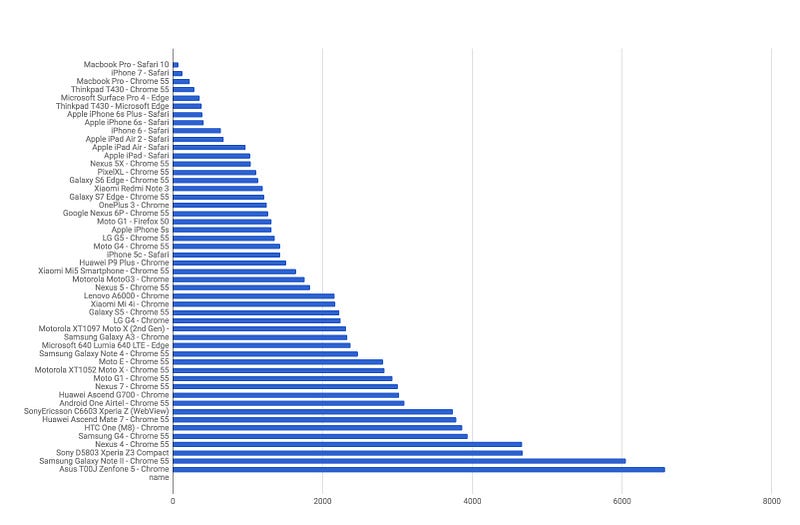
Not at all the message I got from this. Because judging by Safari on mobile and desktop, clearly the issue isn't Javascript, it's that for whatever reason, with all the insane resources behind V8 and Android, they're simply unable to get their interpreters to reach the speed of Safari or Edge.
I'd understand if nobody could make JS go fast, but clearly Apple and MS are proving in real-world-ready code that JS can be quickly parsed and executed.