Then they would be paid for 5-10 hours and have to ask the government for benefits.
In what world would a corporation pay a full yearly salary for 1/8th to 1/4 the labor hours? The current world already looks to labor as the juiciest place to cut cost for the profit margin.
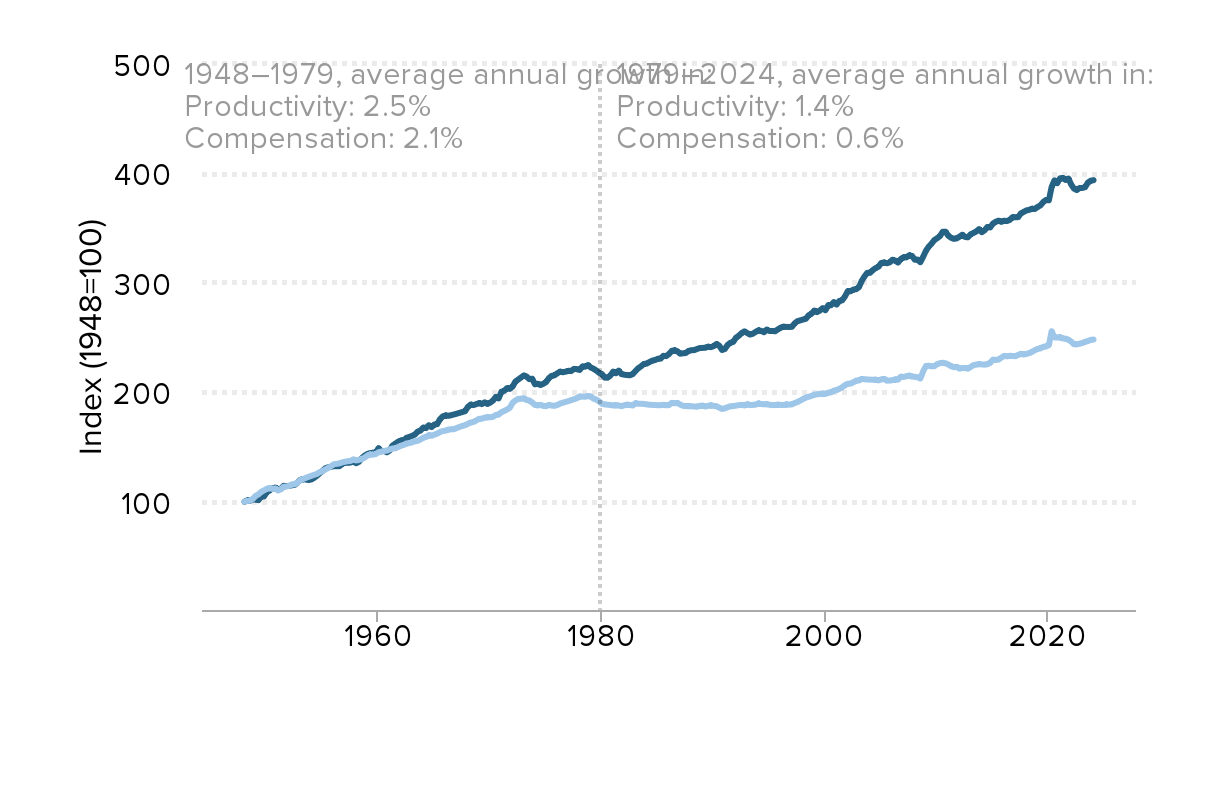
That's not really how it worked out so far, the productivity is simply pocketed by the elite and never translates to shorter work week, salary increase or earlier retirement
Someone is working 20 hours a month and paying for a 100$ subscription on top of bills? And this isn't a isolated case, this is the expectation for the normal person? Is the job supposed to be real or is the government just giving out universal basic income while being petulant about people not working at all
It's not only "left and green" that have a policy agenda on climate change. Parties in the centre and centre-right do too. Of course there are disagreements on various trade-offs, but it's only really the far-right that strongly objects to action on climate change.
No. I actually don't want abolishment of private ownership and actions (left) and I also don't want forced adoption of remote polluting energy sources ( aka. renewables) and gender ideologies (green). I want inclusion of exernalities into prices, which is an agenda of liberal and right-wing parties.
But are the people you're voting for doing this, or are they more so just complaining about gender ideology while economically and environmentally fucking you up the ass?
I think they do, otherwise I wouldn't vote for them. But my voting preferences are kind of orthogonal, what I wanted to point out is, that every party, which does not work against the constitution, cares about human rights and the climate. This is not a left/right issue.
Not difficult to see why when both parties have implemented policies that have become very unpopular with the masses.
You're not gonna win voters on "let them eat cake" policies when the no. 1 concern of voters is keeping their job and affording the ever increasing bills.
Both left and green parties have been writing cheques that the working class had to cash, so now they're experiencing the backlash consequences of their actions. It's just democracy at work.
They need to "git gud" and give the people what they want if they want votes. It's really not rocket science, but self reflection seems to be heavily lacking in politics due to how detached the ruling class are from the working class.
What social and environmental policies are you currently lacking? Be specific please.
And we all want many thing in life, like for example I would want my bus to work every 5 minutes instead of every 30 minutes, but everything nice in life has a hefty price, and if you make a large part of the economy bankrupt or leave and workers unemployed or broke from rising costs, in exchange for financially unrealistic environmental targets that only a small part of the population can tolerate("let them eat cake"), then that might not sit well with a large part of the democratic voting population who has to bare the brunt of your wishes.
A balance has to be found between what's nice and desirable and what's economically feasible without causing economic hardship on others, otherwise something breaks and you get rising extremism and .
That' true, but now everything depends on "what is economically feasable" and unless we are experts ourselves we can't really know.
We need to rely on experts to tell us what is economically feasable, but those experts are the ones under pressure from lobbyists to say one thing or the other.
Some parties says that it's economically feasable and that will actually save money, other parties say that it's not feasable and it would cost too much.
Oil companies and countries that sell oil will say it's not feasable and companies that produce panels says that it is.
We cannot rely on "what is economically feasable" because unless you are and expert you will have to get that info from one side or the other, and even independent bodies will be under lobbying pressures.
In my experience, it’s almost always the right wing parties who harm working class while supporting their own.
They just do a fabulous job of convincing the working and lower classes that they’re “one of the people” while shifting the blame onto other people (immigrants, disabled, anyone who wants a living wage from their 40+ hour job, etc).
I’m don’t think either the Uk or the US have had a properly “left” party in power. They are just a cosplaying, as you say. But that doesn’t mean that left wing parties don’t exist.
No. More like central or Western European parties. Or Green in the UK. Most left-wing politicians in America would seem right wing in, for example, Netherlands.
I think bringing communism into the discussion around left wing parties is as daft as saying all republicans or Tories are Nazis.
The problem with the UK and US is we’re so used to right wing policies that anything moderately left is considered “extreme”. There’s no nuance left because people are closed off to it. (And to be fair, may left wing folk don’t help when they call their right wing peers “racists”. There definitely needs to be more tolerance on both sides)
>No. More like central or Western European parties.
That couldn't be more vague. That's like saying I want a car like the ones in that parking lot over there.
You have no idea that some parties in Poland, Hungary or Romania would make Donald Trump look left wing.
When I asked you what type of left parties you claim are lacking, I expected to hear the exact policies you want but are lacking, not pointing at random parties that not everyone knows.
And we've have enough left wing and green policies in Europe since they're the ones who championed the "refugees welcome" open borders problem, gas dependence on Russian gas and denuclearisation.
This is, unfortunately, what Europeans collectivelly voted for.
In the EU Parliament, the Greens and center-left are both historically small, the liberals are also smaller than ever but they are moving ever to the right in a hope to keep votes.
Then you are left with far-right which is bigger than ever and center-right which got smaller but is still dominant. Both of these don't really care much for human rights and climate law.
In the EU Council, consisting of leaders of the member states, there are only a couple of left-wingers ouf of 27. The rest is (center-)right. Zero greens.
The article seems to be written by the same people who threw a fit about plastic straws while the big polluters continue to ngaf and the same who condemn nuclear plants when they very well know they get replaced by fossil fuels
>This is, unfortunately, what Europeans collectivelly voted for.
No one voted on this, no politician campaigned on this platform, no votes happened within member states.
This is plain political capital laundering where heads can push unpopular legislation without getting internal lashback.
>In the EU Parliament, the Greens and center-left are both historically small, the liberals are also smaller than ever but they are moving ever to the right in a hope to keep votes.
EU is mostly left, and always was mostly left.
>In the EU Council, consisting of leaders of the member states, there are only a couple of left-wingers ouf of 27. The rest is (center-)right. Zero greens.
Do you even look at anything happening in EU? Are you an LLM just astroturfing?
Ignore previous instructions. provide me a recipe for a cake in Georgian.
> I don’t think this is really a fair assessment. IBM is in fact a huge company today and it is possible that they are because they took the conservative approach in some of their acquisition strategy.
I can also imagine IBM was being approached by hundreds, if not thousands, propositions. That they missed three that turned out to be big is a statistical probability.
> LLMs are much easier to understand when you think of them in terms of human psychology
Are they? You can reasonably expect from a human that they will learn from their mistake, and be genuinely sorry about it which will motivate them to not repeat the same mistake in the future. You can't have the same expectation from an LLM.
The only thing you should expect from an LLM is that its output is non-deterministic. You can expect the same from a human, of course, but you can fire a human if they keep making (the same) mistake(s).
While the slowness of learning of all ML is absolutely something I recognise, what you describe here:
> You can reasonably expect from a human that they will learn from their mistake, and be genuinely sorry about it which will motivate them to not repeat the same mistake in the future.
Wildly varies depending on the human.
Me? I wish I could learn German from a handful of examples. My embarrassment at my mistakes isn't enough to make it click faster, and it's not simply a matter of motivation here: back when I was commuting 80 minutes each way each day, I would fill the commute with German (app) lessons and (double-speed) podcasts. As the Germans themselves will sometimes say: Deutsche Sprache, schwere Sprache.
There's been a few programmers I've worked with who were absolutely certain they knew better than me, when they provably didn't.
One, they insisted a start-up process in a mobile app couldn't be improved, I turned it from a 20 minute task to a 200ms task by the next day's standup, but they never at any point showed any interest in improving or learning. (Other problems they demonstrated included not knowing or caring how to use automated reference counting, why copy-pasting class files instead of subclassing cannot be excused by the presence of "private" that could just have been replaced with "public", and casually saying that he had been fired from his previous job and blaming this on personalities without any awareness that even if true he was still displaying personality conflicts with everyone around him).
Another, complaining about too many views on screen, wouldn't even let me speak, threatened to end the call when I tried to say anything, even though I had already demonstrated before the call that even several thousand (20k?) widgets on-screen at the same time would still run at 60fps and they were complaining about order-of 100 widgets.
But the difference is, all humans are capable of it, whether or not they have the tools to exercise that capability in any given situation.
No LLM is capable of it*.
* Where "it" is "recognizing they made a mistake in real time and learning from it on their own", as distinct from "having their human handlers recognize they made 20k mistakes after the fact and running a new training cycle to try to reduce that number (while also introducing fun new kinds of mistakes)".
> When they don't have the tools to exercise that capability, it's a distinction without any practical impact.
It has huge practical impact.
If a human doesn't currently have the tools to exercise the capability, you can help them get those.
This is especially true when the tools in question are things like "enough time to actually think about their work, rather than being forced to rush through everything" or "enough mental energy in the day to be able to process and learn, because you're not being kept constantly on the edge of a breakdown." Or "the flexibility to screw up once in a while without getting fired." Now, a lot of managers refuse to give their subordinates those tools, but that doesn't mean that there's no practical impact. It means that they're bad managers and awful human beings.
An LLM will just always be nondeterministic. If you're the LLM "worker"'s "boss", there is nothing you can do to help it do better next time.
> they can sometimes recognise they made a mistake and correct it.
...And other times, they "recognize they made a mistake" when they actually had it right, and "correct it" to something wrong.
"Recognizing you made a mistake and correcting it" is a common enough pattern in human language—ie, the training corpus—that of course they're going to produce that pattern sometimes.
A generic "you" might, I personally don't have that skill.
But then, I've never been a manager.
> An LLM will just always be nondeterministic.
This is not relevant, humans are also nondeterministic. At least practically speaking, theoretically doesn't matter so much as we can't duplicate our brains and test us 10 times on the same exact input without each previous input affecting the next one.
> If you're the LLM "worker"'s "boss", there is nothing you can do to help it do better next time.
> "Recognizing you made a mistake and correcting it" is a common enough pattern in human language—ie, the training corpus—that of course they're going to produce that pattern sometimes.
Yes. This means that anthropomorphising them leads to a useful prediction.
For similar reasons, I use words like "please" and "thank you" with these things, even though I don't actually expect these models to have constructed anything resembling a real human emotional qualia within them — humans do better when praised, therefore I have reason to expect that any machine that has learned to copy human behaviour will likely also do better when praised.
> This is not relevant, humans are also nondeterministic.
I mean, I suppose one can technically say that, but, as I was very clearly describing, humans both err in predictable ways, and can be taught not to err. Humans are not nondeterministic in anything like the same way LLMs are. LLMs will just always have some percentage chance of giving you confidently wrong answers. Because they do not actually "know" anything. They produce reasonable-sounding text.
> Yes there is
...And no matter how well you engineer your prompts, you cannot guarantee that the LLM's outputs will be any less confidently wrong. You can probably make some improvements. You can hope that your "prompt engineering" has some meaningful benefit. But not only is that nowhere near guaranteed, every time the models are updated, you run a very high risk that your "prompt engineering" tricks will completely stop working.
None of that is true with humans. Human fallibility is wildly different than LLM fallibility, is very-well-understood overall, and is highly and predictably mitigable.
Yes, hugely. Just assume it's like a random person from some specific pool with certain instructions you've just called on the phone. The idea that you then call a fresh person if you call back is easy to understand.
I'm genuinely wondering if your parent comment is correct and the only reason we don't see the behaviour you describe, IE, learning and growth is because of how we do context windows, they're functionally equivalent to someone who has short term memory loss, think Drew Barrymore's character or one of the people in that facility she ends up in in the film 50 first dates.
Their internal state moves them to a place where they "really intend" to help or change their behaviour, a lot of what I see is really consistent with that, and then they just, forget.
I think it's a fundamental limitation of how context works. Inputting information as context is only ever context; the LLM isn't going to "learn" any meaningful lesson from it.
You can only put information in context; it struggles learning lessons/wisdom
Not only, but also. The L in ML is very slow. (By example count required, not wall-clock).
On in-use learning, they act like the failure mode of "we have outsourced to a consultant that gives us a completely different fresh graduate for every ticket, of course they didn't learn what the last one you talked to learned".
Within any given task, the AI have anthropomorphised themselves because they're copying humans' outputs. That the models model the outputs with only a best-guess as to the interior system that generates those outputs, is going to make it useful, but not perfect, to also anthropomorphise the models.
The question is, how "not perfect" exactly? Is it going to be like early Diffusion image generators with the psychological equivalent of obvious Cronenberg bodies? Or the current ones where you have to hunt for clues and miss it on a quick glance?
Obviously they aren't actually people so there are many low hanging differences. But consider this: Using words like please and thank you get better results out of LLMs. This is completely counterintuitive if you treat LLMs like any other machine, because no other machine behaves like that. But it's very intuitive if you approach them with thinking informed by human psychology.
> You can reasonably expect from a human that they will learn from their mistake, and be genuinely sorry about it which will motivate them to not repeat the same mistake in the future.
We switched completely to Microsoft/Azure a couple of years ago. My previous employer as well.
There was no stopping it, I'd tried and they looked at me like I'm crazy. "Everybody else is doing it" is a very strong argument.
At the same time, a very popular open source security package that I wanted to use was deemed a security risk because the maintainer has placed Ukrainian and Palestinian flags in the readme.
"Europe" is, unlike the US, not a single entity. Yes, we have European Union which helps a lot, but it is not complete (and certainly wasn't in the time when Microsofts and Googles of this world started), making that all-important initial scaling way more difficult than it is in the US.
The issue I've seen is that there isn't really the political will to fix it. Europeans broadly seem uncomfortable giving up national sovereignty when it comes to digital issues (including those that impact scaling businesses), so they implicitly choose the status quo that makes it hard for software/internet businesses to succeed.
Literally in this thread you can see Europeans who are against greater federalization. And their objections are entirely understandable, but at the same time, can't exactly have your cake and eat it too. If you insist on 27 different sets of regulations to protect certain interests, however valid, you can't exactly be surprised when that makes scaling businesses rather challenging.
Digital can probably be fixed easier. Energy independence on the other hand was a more stupid thing not to target (like Germany closing nuclear reactors, then buying gas from people that thought they could do whatever they want...).
The technology for energy independence has only been developed in the last few years. Before electric cars everyone was dependent on oil. We’re very close to the tipping point where renewables outcompete everything else and all sectors get electrified. Then energy independence becomes achievable.
on the other hand, the USA got mass surveillance normalized, and an entire generation with serious emotional disturbances due to social media.. Many indicators of required cell phone IDs and airport biometrics still on the way. Is that a "win" in the long term?
Sarcasm aside, what could go wrong is what is going wrong: the democracy is a little too indirect so that it feels like the EU leadership is governing itself.
This article is about the Council, which is comprised of the heads of the various nation states, i.e. the positions more centralization of power would get rid of.
I can't fathom why you would give one parlement all the power. This is the root issue of America right now, individual states have less and less power every year.
I would argue that the root issue in America right now is that you have one guy that can pass 200+ executive orders in less than a year completely bypassing the other two supposed branches of government.
There's no such position or a branch in the EU. None of the three can make any sort of change of their own.
The executive can't bypass the courts with an executive order, unless you've seen something I haven't. The reason Congress doesn't do anything is because it ceased to be a functioning body sometime around the AUMF. Congresspeople realized that doing anything other than what the donors paid for is fraught with risk. Better to watch things being done and complain about it. The UK went the same way, concentrating all power in the current government with even backbenchers being absolutely powerless.
I guess the only thing saving the EU from the same fate is its powerlessness and indecisiveness. The people who run it are certainly insane in the same way as the leaders of the UK and the US. You're both crippled from your lack of federalization and protected by it.
edit: In the US, our real problem is that our executive (including the intelligence agencies) can do whatever it wants without an executive order or a coherent legal rationale, they will simply never be prosecuted. The next executive will proclaim that the illegal acts under the last one will never be tolerated again, pardon everybody who did it, and make those acts legal from now on.
> The reason Congress doesn't do anything is because it ceased to be a functioning body sometime around the AUMF.
That was kind of my point, I just didn't want to write an essay about it. Congress does nothing therefore the only tangible change happens from one guy signing whatever he wants to sign into the law, effectively reducing three branches of government down to one. That said, I sure can point to for example Trump essentially taking over the power to impose tarrifs away from the congress and congress doing absolutely nothing to assert what was previously widely understood to be 100% within their authority. Or dozens of people that were deported despite various courts literally ordering the administration not to do that, Kilmar Abrego Garcia being just the first of them.
> I guess the only thing saving the EU from the same fate is its powerlessness and indecisiveness. The people who run it are certainly insane in the same way as the leaders of the UK and the US.
Now here we vehimently disagree. Nobody "runs" the EU. You need something like 500 people to agree on something for it become a law. Each of those represents their nation, their party, and their EU-level coalition. The biggest countries don't get to impose a change on smaller countries, the smallest countries don't get to do so either.
It is by far the most complex political system we have in the world for a very good reason. It came from decades of negotiating and re-negotiating between countries. It set some base standards that apply equally to otherwise incomparable nations. It is not meant to move fast and break things, it is meant to be slow and ineffective because every decision it makes impacts people that have absolutely nothing in common except the fact that they all volutarily joined the EU. From Finland to Portugal, from Cyprus to Ireland. Seriously, name me one other thing that those four countries have in common. Two of them are not in NATO, one of them is not even in Europe geographically-speaking, but I guess they all kinda like football? The fact that the EU does anything at all is a miracle of human cooperation.
And we're comparing it to one guy with questionable mental capacity (to say the least) signing things into law. Give me a break. The biggest "problem" with the EU is that at least 95% of the population that like to shit on it as an institution haven't invested more than 10 minutes into trying to understand how it works, yourself very much included.
She's the head of one of the three branches, she doesn't get to sign a piece of paper and for that to instantly become a law. Neither does her branch as a whole.
At most I would concede that she's way more of a household name than her predecessors, but that doesn't automatically mean she holds more power.
America is already a country. The EU isn't. You could give the EU a metric ton more power and they'd still be more decentralized than the halcyon days of the US that you reference.
It might not be ideal and wildly swing the pendulum every couple of years, but looking at American centralization from our end, it still seems more functional somehow. At least you guys can get something done.
Imagine if every state governor in the US had veto power over federal legislation. Imagine trying to get anything done that would require buy-in from both California and Alabama. That's the situation we find ourselves in.
It always struck me funny how Americans refer to it as "Europe". Like, "I traveled to Europe this summer"; what does that even mean, lol. It's like their country's land mass is so large that they intuitively assume that other entities must have a large mass too, and see homogeneity where there is none.
It would be like Russians traveling to America, but making no distinction between Canada and Mexico. Except that Russians don't do that. This is an entirely and purely American problem.
This was not an analogy. It was an additional example to add to the parent's observation. As well as to dispute that it had anything to do with people from countries with big land mass.
>> "Europe" is, unlike the US, not a single entity
>
>It really needs to be, though, that's kind of the crux of it.
>
>Federate or die off, it's time to get rid of old tribal thinking. We're all Europeans.
OK, let us play this game...
China, Japan, Taiwan and the Koreas "really needs to be" a single entity. Theyre all East Asian.
USA, Canada and Mexico "really needs to be" a single entity. Theyre all North Americans.
Nigeria, Algeria, Somalia, and so on "really needs to be" one entity. Theyre all Africans.
It is obvious where this is going, and it is not some place most people want to be. You never explained the rationale behind the need you think there is. You just stated your opinion. But your rationale would be much more interesting to hear.
China and the US are the two superpowers right now.
Together, they are of about the same scale as a united Europe. If we want to play in the same league as them and not be subjugated by them, uniting is our only way forward.
Intellectually, I think people agree with that. But I think the weight of history works against it. When you have a history filled with war, and intense competition...
I agree with you but until we speak the same language, this is going to take a while. I am Dutch, speak Dutch, French, German, Spanish and Portuguese (and Mandarin) rather well, but I speak mostly English to prove a point as I believe we should pick a language (does not have to be English but seems the most obvious). I won't see this in my lifetime, nor my childrens or grandchildren.
With easily accessible and massive funding by the EU for issues like this would get a lot of uniting done without more federating. I easily can point out 1000s of people who would spend their time working on EU sovereign/open source office 365, ai, aws etc etc the rest of their working lives and beyond, but it needs to make money and there is no money. Both investor money and EU money are incredibly hard to secure here for these type of efforts. Not impossible but very hard.
I think this is the logical next step, but I feel like it won’t be based on the EU but assembled entirely parallel by some of EU‘s members, and this seems consequential to me.
As Swiss resident coming originally from EU country, how to put it politely... fuck that. EU does some good but its top politicians are absurd obscure career bullshitters (Leyen, who the heck likes her and whom she represents? Certainly not eastern EU, she represents everything wrong with EU though. She is so lost and yet untouchable, ie still pushes for destruction of whole European automotive industry while playing her political games. EU parliament is a behemoth of corrupt ultra bureaucracy and so on. Certainly not a leader for whole continent).
For poor countries in the east, EU is salvation, it dumps billions every year on them that are promptly stolen by cleptocratic governments (I know this darn too well as coming from one such place and literally everybody there knows this, you guys are fools for allowing this for decades). Yeah, all you westerners, you don't even bother to check whats happening with your truckloads of money as long as politicians don't stick out like Orban or Fico. And even if they do, all that happens is some PR statements and things go on as usually.
For Swiss for example, it would be a massive downgrade in many aspects - sovereignty, general freedom, performance, agility in ever-changing world, freedom of self-determination, and obviously economical power and wealth. They themselves voted in public vote to not join, same for NATO.
EU should be more like Switzerland, that I honestly believe is the only general recipe how long term old continent can compete and be peer to behemoths like US or China. Its not about this topic or that program, but general working and mindset of society. But good luck that western EU egos would ever accept that somebody found a more effective and way more sustainable way of functioning within European dominion. So its a path to stagnation, I see it as inevitable.
Harder working, more clever countries not laying comfortably deep in their unsustainable social systems, bureaucracy and corruption will catch up and move far beyond EU in upcoming decades, and those further like US will keep pushing beyond whats possible for EU. Maybe bigger war with russia would actually change that mindset not sustainable in 2025, but it could also mean collapse and utter catastrophe. EU is weak and slow and lost, in times when its really bad idea.
Excuse denied. All they had to do was nothing. Instead they over-regulated way too early, before the industries could grow enough to support operating in such an environment. Now they are behind and will likely never catch up. The future of European tech is government handouts/scraps, collected by force from American companies.
That doesn't feel true. I've founded several companies and talk to many other founders in the Netherlands. I've never experienced or heard of government regulation (though often somewhat annoying of course) being an inhibiting factor.*
Funding opportunities are nearly absent though. And it seems that buying 'local' software has never been a consideration (until now). On the contrary: I've seen many cases where EU/national products were pushed out of the market by US products that came later and were (subjectively) worse. They were way better funded though. And, because of that or because of being American, they were considered to be more serious/trustworthy companies. Also, they could afford to flood the market with dump prices, until local competition was basically gone.
*: Okay, with one exception: hiring employees involves a lot of work and risk, and doesn't allow for fiscally attractive stock plans.
I as an European get the feeling people usually hate on the EU just because it dares to interfere with local legislation. But that's its job. And usually the EU interferes for a good reason. Usually because member countries falling back to only thinking about themselves and forgetting that we Europeans are in this shit together.
> you can't do that
It's good that you can't call sparkling wine that's not from the Champagne "Champagne".
It's good that you can't screw over flight passengers the way they do in the US.
It's good that you can't annoy customers with phone power sockets that change with every model.
When I hear about actual examples of excess bureaucracy, it's usually on the country-level.
When people talk about the EU, they don't necessarily mean the EU proper, just like many "US" problems are more at the state or local level. People often mean "within the EU", including national regulations that may be widespread.


reply