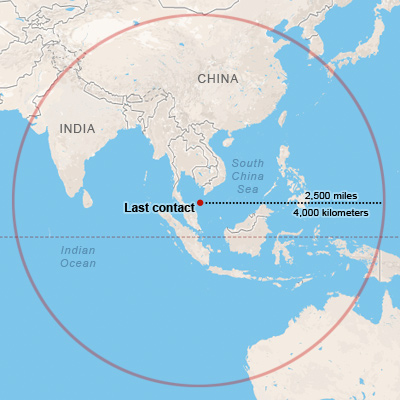
My guess is that the US, Russian, and Chinese militaries have the interest, and operational ability, to track every in-flight commercial jet all over the world. The IR signature alone makes a commercial jet obvious at any altitude as long as the engines are running. So MH370 is probably not lost; its final position is just being concealed by military protocol to avoid confirming satellite capabilities that have, in all likelihood, existed since the 1960s.
Why would the US deploy such satellites to view the southern Indian Ocean? I could understand deployment in potential areas of interest, but that particular area is about as boring as it gets.
My point is that even if those capabilities exist, it's not clear that they would be able to help in this particular case.
It's quite likely that the people in charge of military surveillance will prefer, and succeed, in getting continuous coverage of the entire Earth. Really want to avoid a "Sorry, Mr. President, we don't have coverage there" situation. And anyway, it's State-funded; cost is rarely a key constraint for these systems.
Unless the satellites are in geosync, it's likely they are orbiting and could just randomly come across the correct area at that time.
If not, I'm wondering why people like Skybox [1] didn't deploy resources immediately to start covering ground. It seems like that approach would be much more effective than ships in the ocean?
> Why would the US deploy such satellites to view the southern Indian Ocean? I could understand deployment in potential areas of interest, but that particular area is about as boring as it gets.
China has been venturing in the Indian Ocean, and the United States probably wants to keep an eye on their activities.
How paranoid would the U.S. have to be to keep those capabilities that have, in all likelihood, existed since the 1960s secret?
And they don't even to acknowledge their existence. "By chance, a satellite overflew the area. Here's what it saw" plus a blurred picture could be enough.
Well, it's a cold, calculated national security decision made by people who are naturally very secretive. They have nothing to gain (in their view), and something to lose, by revealing capabilities beyond those that are already public.
Would have to be a pretty hardened pilot to take a 777 down to FL 50 and keep her there anywhere except approach.
"Experts said flying a Boeing 777 in such a way would be dangerous, stressing the airframe and possibly causing those on board to be air sick and suffer from spatial disorientation."
This truly meets the definition of incredible. How could you be that good, but then end up crashing the plane? If you are that good, then you are not going to crash that plane.
Having read the article, I think the journalist got confused – what is stressful and requires insane skills is flying very low, following the terrain between mountains/hills.
However, flying a mile high is only slightly different from flying 6 miles high in terms of stress experienced or skill required.
Actually flying at 5000 ft is pretty easy and airliners obviously have to do some of that during descent. The stuff fighter pilots do clearing power cables and hills by a few feet is quite different. Airliners avoid flying at 5000ft so as not to collide with light aircraft mostly.
Military-style nap-of-the-earth flying, à la the raid on the bin Laden compound. Those SOAR pilots surely have practiced this stuff for years. How would a civilian pilot (or hijacker pilot) acquire these skills? Flight simulator perhaps?
The pilot had a fancy flight simulator at home.
Now, there are plenty of legitimate reasons that a pilot would have a simulator at home, so we can't pin too much to this discovery. Lots of pilots buy small planes after they retire because they still love flying and he might have built this simulator because it was fun. Other articles describe him as a hardware geek and mention his YouTube videos demonstrating his homebrew simulator consoles. Still, it seems suspicious to me, especially in context of the recent revelation that the transponder and tracking systems were disabled prior to MH370 signing off with Malaysian ATC.
Four days ago, I thought that a Central Asian hijacking scenario was next to impossible. Today, I'm not so sure.
I wouldn't call it fancy. I mean, it was Microsoft Flight Simulator running on a box with a joystick and four monitors hooked up and placed to look like a 777 cockpit.
As with the "two fake passports" discussion, my rational follow up is "what are the priors?"
If one picks a random similar flight, what's the probability of having people flying with fake IDs/of having a pilot who runs a flight simulator at home?
military pilots sometime become civilian pilots when they get out of the service. i have no idea the background of the pilots in question, but that isn't an abnormal thing.
Unless you're trying to commit suicide. But then why would fly northwards instead of southwards if you want to commit suicide? I've a hard time believing the 5000 ft statement. But if it's true, then well, damn.
Ignoring for the sake of argument the tragedy of hundreds of people getting murdered / kidnapped, this is the most captivating news event we've had in a while.
Russia stomping on neighbors to protect it's interests has been a common theme for years. Not right, and I expect some interesting outcomes of the whole Ukraine thing, but really not unexpected.
For me, the Malaysian 777 story is an interesting potential seque into the future of terrorism. Personally, if the airliner is in tact and ever is identified in the air again, I think it will be shot down. That said, the story has been one of mystery and mismanagement.
Sadly, a country invading the sovereignty of another is not a rare event.
Someone with technical skill to fly a Boeing 777 in such a capacity is the stuff the make movies out of. The slight possibility that the plane has actually landed makes it extremely captivating.
Ignoring for a moment the aspect of "going to vote against invaders under the watch of invaders": 93% - Eastern bloc polls always had this good results, probably because their leaders were so beloved that people kicked them out the moment they got the chance.
Ignoring the current polls an looking at historical "free" election results, the southern part of Ukraine seems to have more support for Russian than one might otherwise think.
Taken by Russian media. The military have cut off all communication links between the Crimea and the outside world and have been stopping independent journalists from filming.
I'm curious, is the possibility that the passengers are still alive being discussed by any major news outlet? I have read tons of coverage but the authors implicitly state the passengers are lost.
The only circumstances in which they would be alive would be if it was a hijacking, the plane landed relatively safely, and they were being held hostage & incommunicado somewhere. It does seem the unlikeliest of possibilities at this point.
However, nothing, so far, indicates that the plane has crashed. If the plane has actually managed, ON PURPOSE, to avoid radar detection, it could have as well landed in secret somewhere else.
True, but the only theories under which this would be a logical course of action are fucking stupid. Someone did this to steal a 777 to use in a 9/11-style attack? There are lots of ways to get a 777 that would be WAY easier, such as: leasing one.
We really don't know much more than comms went down, no problems were reported, plane went up/down in altitude in the extreme (killing passengers?), headed west into the Indian ocean and either headed north or crashed into the ocean.
What a poorly written article. It twice says that the plane "dropped/descended 1500m," when it should be written "dropped TO [an altitude of] 1500m." (assuming I'm understanding the article correctly). A newspaper should at least have sufficient grammar standards to clearly convey the main point of a story.
> What a poorly written article. It twice says that the plane "dropped/descended 1500m," when it should be written "dropped TO [an altitude of] 1500m."
As it turns out, only the headline suggests that the plane descended to an altitude of 1500m, not the article body, which always says the aircraft descended 1500m. The headline includes the words "MH370 flew as low as 1,500m to avoid detection" [emphasis added], but this language is never repeated in the article itself.
It's important also to say this article may have been translated from Malay, which could affect its readability.
> A newspaper should at least have sufficient grammar standards to clearly convey the main point of a story.
Fair enough, but I think the headline didn't originate with the source of the article.
"Descended 1500 meters, or even lower" has less substantive meaning than "descended to 1500 meters, or even lower". The same is true of the other phrase containing the 1500 metre measure. Bad construction, but I'll assume they simply left out the 'to' in both instances.
> Today, Reuters reports that the last words from the cockpit of missing MH370 – "all right, good night" – were uttered after someone on board had already begun disabling one of the plane's automatic tracking systems.
> Both the timing and informal nature of the phrase, spoken to air traffic controllers as the plane was leaving Malaysian-run airspace could further heighten suspicions of hijacking or sabotage, it said.
I've listened to a fair amount of air traffic control[1] and a phrase like that, especially when signing off of a frequency, is not at all unusual so I don't know why they're focusing on its informality.
[1] thanks to United offering it on one of their inflight entertainment channels
If you want to practice your radio comms skills or just want some soothing radio chatter to calm your mind, you can get live air traffic control feeds from here:
Indeed, informal greetings like the one mentioned in the article are not at all rare. Real life ATC communication is not the robot-like mechanical talking you might be used to from video games or movies.
I was under the impression that this was supposed to imply that, because the transponders were off, the pilot would likely be aware of _something_ being awry (if even just that the transponders were acting up). Thus, an informal, nonchalant response might suggest that the transponders were intentionally disabled, and that would feed a suspicion of foul-play.
I think they mean that because this casual phrase came after the deactivation of the ACARS system, it implies the guy who said "good night" knew it was disabled and likely had done it himself and concealed the fact.
I wouldn't necessarily read that in and of itself ominously. They said that as they were leaving Malaysian air traffic control jurisdiction. That the ACARS had already been disabled is what's interesting.
Getting rather bored with folks around me who seem to be treating this like it's another HBO boxset. I agree with you - and I think a lot of people just really seem to enjoy the experience of speculating and entertaining these fantastical, mysterious theories. The reality is that it probably landed in the drink some time ago.
As for the fantastical, mysterious theories, there are plenty of real conspiracies hanging around with verifiable support, that we don't need to make up bullshit ones.
As for whether or not this one is a conspiracy, we must refrain from pontificating until we get more evidence. The default belief must be disbelief.
That's only for the Andaman and Nicobar islands though which are very far from the mainland. I'd be surprised if there's no 24/7 radar for the mainland.
Still have to hit landfall. The chance of them threading that needle is low. I highly doubt the south east Asian mainland coast is not fully monitored.
I may be missing something, but this seems like a very misleading headline.
The actual article states that the plane "dropped 5,000 feet (1,500m)" and later that the "twinjet descended 1,500m or even lower". This simply means that the plane descended by a relatively small amount compared to 35,000 - 40,000 foot cruising altitudes, not that it was skimming the ground at 5,000 feet.
Yes, noticed this also, but I think the headline was written by someone other than the source of the article. I think the article is meant to say descended 1500m, not descended to 1500m. Nothing in the article body suggests a descent to 1500m, and that would be a very inefficient altitude to fly a big jet.
This is the article referenced by the guardian, its language is (properly) articulared in much better english.
Kuala Lumpur: Malaysia Airlines flight MH370 dropped to altitudes as low as 1524 metres (5000 feet) using a dangerous flying technique called “terrain masking” to avoid radar in at least three countries, investigators believe.
It's not a question of hard, it's just not an efficient way to fly such a big jet and it uses up fuel at a high rate. But various sources suggest that the plane really did fly this low, in order to evade radar, and the confusion surrounding this particular article is resolved elsewhere to mean "descended to 1500m" at least for a while.
China is pretty much the only (reluctant) sponsor of the abomination that is NK. They wouldn't kidnap a plane with 100+ Chinese citizens. Frankly, I think they'd rather try to nuke Seoul first. (Just my two cents.)
No, too far away -- the possible flying radius after contact was lost has been pretty well established, and North Korea is well outside that radius. Also, when last detected, they were flying in the opposite direction.
it isn't a type of the system i was talking about as ability, in flight, to disable a system excludes the system from the "security" category. Just for the sake of example, placing a battery powered device like always-connected satellite phone into unreachable in flight part of the plane (end of wing for example) would be like something alone the lines of "a security satellite system"
Point is a $100 spot device could be added (powered by Li AA's) as a backup system. This would have independent power supply and obviate the "need for cicuit breakers" being accessed. Or something like a lo-jack or whatever. Its completely embarassing to Boeing. Almost as bad as the pilot has a 64mb i phone and the [edit: voice recorders] holds only 2hrs? WTF. An Iphone might not itself survive, but the media allocations for the seem absyrdly low.
> Point is a $100 spot device could be added (powered by Li AA's) as a backup system
Li AAs... without a means of isolating them from the circuitry?
How many aircraft are you prepared to lose through in-flight fires for this 'benefit'? Reference: Ethiopian Airlines 787 fire at Heathrow originating from lithium cells in the ELT.
Who is going to check the battery status at regular intervals?
Who is going to certify and sign-off those checks?
Who is going to be qualified to change those cells?
What interfaces will there be with the aircraft avionics to relay data such as call sign and flight code? How do we protect those connections from overload? There's a reason every single electrical circuit on an airliner can be isolated.
Laugh all you want, but the tech is pretty simple. You need to look at what it is doing. Replacing a transponder with something that is much simpler than an epirb. The example I gave is a $100 dollar current piece of tech that weigs 150 grams including power-source, and if it was available to LOS througha window could track the plane for 4-7 hours off a single set of batteries. If you want to raise the budget for an order of magnitude or two, for 10k dollars you could surely create a redundant system for the transponder.
The larger point is that any "real situation" that would need the transponder turned off (power/fire/corruption) would have almost no bearing on the operability of such a simple system.
FYI the imarsat pings are not all that different, are they? Its just a simple ping with some data that including headers is going to be very minimal payload...like SMS text type level of data.
The spot device doesn't need to survive a crash, just needs to send out a GPS ping once every 10 minutes. ie to give a fix on where the crash is would be sufficient.
10 minutes isn't nearly enough. Remember you're talking about something moving at 8-10 miles per minute, 10 minutes, so worse case your solution will give a range about the size of Iowa.
You could increase the ping rate somewhat trivially. Look at what the trucking industry does to keep an eye on cargo. And in any event, the current 777 search area is how big?
You make it sound so simple, when in reality it is anything but simple. Every component in a plane is tested extensively before it can be installed and used. When it comes to electronic components in a plane, things like interference to other aircraft, other components on the plane, power usage and interference to ground devices (radio stations, emergency frequencies, etc) are all tested and considered.
Planes are massive powerhouses of technological wonder, adding something new into such a machine would take considerable amounts of time and even then once you've got it installed, who is going to maintain it? You've got to pay for access to a satellite for the data to be tracked, where is the data stored? Is the data encrypted? How do you make sure only the eyes intended to see the data see it and nobody else? What kind of redundancy is there if the satellite security system fails? Does the plane need bigger batteries to power such a device, where does the power come from?
There are rules and processes to follow in the aviation industry and they're very strict. And that's just the hardware, then you've got to write the software, make sure it doesn't interfere with anything else on the plane, then you've got to make it work for different planes, planes wired differently, different hardware/software, controls. You're testing two different halves that make a whole.
One does not simply just install a new piece of technology into a plane. There's no DIY kit you can buy from Tandy.
Then there is a cost vs risk calculation thrown into the equation here. How often does a plane just vanish like this? It doesn't happen very often and probably not enough to warrant spending hundreds of millions of dollars implementing a terrorist proof tracking/data collection system. Cars are stolen everyday, it's a common thing, for planes it is not.
If things were that easy, they would have already done so, trust me. Nobody wants to see their planes return more than the airline who paid for the plane, paid for the maintenance, paid for the staff & fuel and need it to help recoup the costs and make the business money.
Are we also not forgetting planes have quite good data capturing and positioning systems already? The transponder was disabled which was the easy one (a flick of a switch) but the ACARS maintenance tracker was also disabled and as already highlighted, without advanced knowledge of the planes internals, isn't something you can just disable with the flick of a switch. Other advanced fall-back tracking methods were disabled, this isn't something your standard pilot would know about.
With 1st hand experience on aeronautics devices, i can tell you the "tech moves slow on planned because of extensive testing" is pure disinformation used copiously by everyone in the industry benefiting from that lie. Yeah, it is tested, like in several other industries.
<quote> Then there is a cost vs risk calculation thrown into the equation here. How often does a plane just vanish like this? It doesn't happen very often and probably not enough to warrant spending hundreds of millions of dollars implementing a terrorist proof tracking/data collection system.
How do you make sure only the eyes intended to see the data see it and nobody else?
Why isn't this a concern with ADS-B, which allows anyone with the right equipment (or access to a flight tracking website) to track planes in real time?
And cost-versus-risk has been decided in favor of increasing cost (and safety) in numerous aircraft systems already.
Also, if one factors in the cost of one more huge deep ocean search, a few more cents per ticket won't seem so bad. Who pays for these searches and investigations anyway - the airlines or governments (privatizing profits and socializing losses)?
> from time to time planes crash over ocean and search for black boxes may take years like Air France 447 ...
Yes, and in that case, they knew within narrow limits where the plane went down -- the crew were doing what they could to let their position be known. No effort to sneak away with an airliner, as in the present case.
If only airlines employed someone with your acumen. You are most definitely the first person ever to have that thought. But now that that is out of the way there is nothing in the way.
people fit 239 passengers in a plane. Couldn't manufacturers do the same with cars?
Fallacy by analogy. It's a fair question (off hand), but it falls down when other factors are considered (cars don't normally drive for hours over water, for example).
The short answer, as I understand it, is:
1) Most communications technology, including satellites, is focused on where most people are communicating - ie, on land; ie, on 1/8th of the earth's surface
2) As you correctly point out, satellites over water aren't as obvious a problem as, say, mobile phone towers in the Indian Ocean, but the cost to retrofit existing aircraft is considered prohibitive given the rarity of this type of situation (ie, existing communication systems work well, and in this case seem to have been deliberately turned off anyway - so a different system is likely to have proved no more helpful).