If you think shelf life, QA, safety, blah blah blah matters when a rocket is 100 bucks, I have just three words: you will lose.
The Ukraine war is being fought with a bunch of cheap toy style drones dropping grenades everywhere. The US got their bases blown to pieces across the Middle East by cheap drones that gently float through the air like a paper airplane in comparison to absolutely any missile.
And let's not forget. The US had napalm, helicopters, bombers, incredible logistics, cutting edge equipment of all sorts. Vietnam had a bunch of sticks in a hole covered in poop. Those sticks sent Americans crying home and we still get movies and games with them crying about how bad it was.
In war between great powers, yeah, high tech works because it's scary and civilians don't want to have that kind of stuff coming home. In a war where civilians are being targeted by great powers who terrorize them by blowing up schools and hospitals, a lot of people are thinking about how many weapons they can make to defend their home and for cheap. If America thinks an invasion is a good idea, they're going to be bringing their 50 million dollar tanks face to face with a few $100 toy rockets. And those toy rockets will be picking off tanks like fish in a barrel while a drone streams it in 4K live to the internet. I really do not think American who support current happenings are ready for the absolute mental torment they're going to endure if this continues.
So much this. Reliability and durability only matters because the thing costs a million dollar a piece. When you have stuff with a mere 5-digits price tag or less, you simply don't care if half of them miss their mark or doesn't fire 10% of the time.
Half of munitions missing means doubling the logistical burden of delivering the munitions to where they need to be employed. The trucks/plains/ships that carry your munitions need to be fuelled and protected, too, so the expense is super-linear, especially when it's a distant war and not a war fought on the country's own soil, like in Ukraine.
Cheap munitions sometimes explode before they are launched, killing crews and destroying platforms.
Cheap munitions mean that CAS is a roulette. You waited for ten minutes for a support fire mission? Sorry, wait for ten more, whatever we launched has failed. Or maybe you're dead because the munition has hit you instead.
Cheap munitions can pin you down. Those cheap FPV drones that are supposedly cheaper than Javelins require dedicated immobile units to launch and guide to targets. Javelins are organic to infantry squads.
Cheap munitions are either very expensive or impossible. There's no cheap anti-ballistic missile and no cheap missile that can sink a warship in the Taiwan strait when launched[*] from Guam.
[*]: alright alright an LRASM would need to be flown closer by an F-35 but the point still stands
> Half of munitions missing means doubling the logistical burden of delivering the munitions to where they need to be employed
It means doubling the transport capacity, but not doubling the burden. A bunch of crates carrying 155mm shell (cheap munitions) is much easier logistically than a PAC-3 missile for the same weight.
> Cheap munitions sometimes explode before they are launched, killing crews and destroying platforms.
Ill designed/manufactured munitions do, but it's not proportional to cost (again, a 155mm shell is a cheap munition even though it's being manufactured and designed in a way to reduce the kind of risk you're talking about).
> Cheap munitions mean that CAS is a roulette. You waited for ten minutes for a support fire mission? Sorry, wait for ten more, whatever we launched has failed.
That's not how it works. You'd launch two at the same time to take the possibility of failure into account (in fact we already do that with expensive anti-air missiles).
> Or maybe you're dead because the munition has hit you instead
Every munition can do a blue on blue strike, we mitigate those through engagement rules, which are calibrated by weapon types.
> Cheap munitions can pin you down. Those cheap FPV drones that are supposedly cheaper than Javelins require dedicated immobile units to launch and guide to targets.
They don't "require" it, it's how they are being employed today in Ukraine. Notice that javelins have pretty much disappeared from the Ukrainian battlefield so it's really not a good comparison.
> Cheap munitions are either very expensive or impossible. There's no cheap anti-ballistic missile
And it's fine to use an expensive weapon for that reason. Nobody is saying no to all expensive weapons (nukes ain't cheap either).
> no cheap missile that can sink a warship in the Taiwan strait when launched[] from Guam.
> []: alright alright an LRASM would need to be flown closer by an F-35 but the point still stands
A Magura isn't a missile, but it has shown its capability of completely shutting down the Black Sea Fleet.
> It means doubling the transport capacity, but not doubling the burden
Which is my point, doubling the capacity at the end of the spear is more than double the burden. The scale is superlinear. The further out the front is (for the US, it's over at least one ocean), the more superlinear the scaling is.
> but it's not proportional to cost
You might've heard of the cheap North Korean shells exploding in barrels, destroying Russian howitzers. It is indeed very disproportional, that's why spending severalfold on better shells is a great tradeoff.
> You'd launch two at the same time to take the possibility of failure into account
It depends on the ability to launch two. Oftentimes it's impossible; cheap FPV drones interfere with each other, or maybe you don't have double the planes to fly CAS.
> how they are being employed today in Ukraine
It's logistically impossible to employ the kind of drones Ukraine is employing on the go and organically to infantry. Features and CONOPS that enable organic employment lead to a substantial increase in per-unit prices, see Rogue 1.
> A Magura isn't a missile, but it has shown its capability of completely shutting down the Black Sea Fleet.
It's three Black Seas worth of distance between Guam and the Taiwan strait. On top of that, nowadays those boats are pretty effectively countered. Overindexing on the war in Ukraine would be a mistake.
> You might've heard of the cheap North Korean shells exploding in barrels,
The problem comes from the shells being “North Koreans” not because they are cheap (and I don't know why you assume they are, by the way).
> or maybe you don't have double the planes to fly CAS.
Spoiler alert, western army do actually fly CAS missions with pairs of planes already!
> It's logistically impossible to employ the kind of drones Ukraine is employing on the go and organically to infantry.
Says who? The Ukrainians where doing just that two years ago, with FPV drones. The doctrine has evolved though because it didn't make much sense to do so in the first place! When you have stand-off munitions that can hit 10-30kms away, you don't give them to infantry to manage like you would for a short-range weapon, and instead you use specialized drone units that are responsible for CAS.
> It's three Black Seas worth of distance between Guam and the Taiwan strait.
You can deploy them from closer range using a ship like you'd do with F35 for AS missiles. And you don't need to attack from Guam in the first place if you're not afraid of the first strike on your assets worth billions of dollars and can disseminate them closer to the Taiwan straight.
> On top of that, nowadays those boats are pretty effectively countered
Lol. Tell that to the russians. The only effective counter they've found being to keep the remains of the fleet locked inside the Novorossiysk naval base (where they've been sitting ducks for flying drones attacks in recent days).
You have a point - cheap drones have changed warfare - but you might be simplifying the issue. As some warfare experts online have discussed, it isn't that cheap drones are the only weapon that is used in Ukraine (or warfare in general), it is one option in vast array of options based on the situation (although, agreed, it is taking on a much bigger significance). Look at the war in Iran. They did a pretty standard playbook and use stealth jets and cruise missiles to surgically take out air defenses in order to gain air dominance. This would be very difficult with just cheap drones.
... but, do agree that cheap weapons are still becoming extremely important. Iran is terrorizing the middle east and strait of hormuz with cheap drones, so they are definitely important. Yeah, in the war of attrition, low cost, high-volume options are clearly very important.
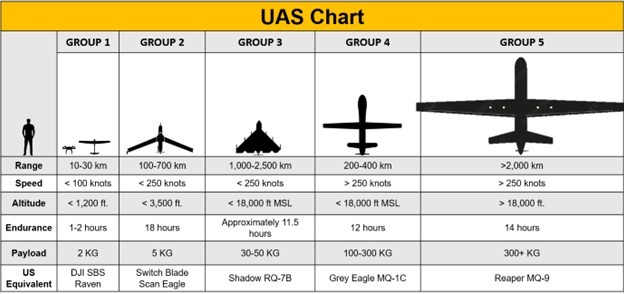
It's fairly important to distinguish what kind of drones are we talking about [1]. Iran's using Group 3 drones.
The GP is confusing Iran's neighbours not being ready to counter group 3 drones with the drones being inevitably effective. These drones are by necessity large and slow, because they need a lot of energy and aerodynamic efficiency to get their range. That means that they are vulnerable to cheap counters, which Ukraine is demonstrating very convincingly: even though Russia is now launching 800+-drone raids, the vast majority is shot down.
Even when those drones do get through, they are extremely inefficient. It's not just that they can't carry a heavy or sophisticated payload (more complex warheads are more effective, but way more expensive), the extremely high attrition ratio forces the enemy to try to target way too many drones per aimpoint. Instead of serving a few hundred aimpoints, the 800-strong raid is forced to concentrate on just a few, otherwise most aimpoints will get no hits whatsoever.
But also the only reason 800-strong raids can even be launched is Ukraine lacking the capability to interdict the launches. 800 group 3 drones have an enormous logistics and manufacturing tail, which a Western force would have no problem destroying way before the raid can be launched. For example, Iran in its current state can't launch such raids. So in practice Iran's neighbours would need to intercept only a handful of drones, which is hardly an insurmountable challenge.
GPS denial is a mixed bag. After about two years of efforts and counter-efforts, the Russians seemingly managed to build GPS receivers that are pretty resistant to jamming.
The vietcong had some incredible technology, courtesy of Russia. Their fighter planes were breaking the Air Force's back, thanks in large part to their far better doctrine. They had the fabled AK-47, the toy drone of its day.
> The Ukraine war is being fought with a bunch of cheap toy style drones dropping grenades everywhere
This hasn't been true for 3-4 years now, most of the combat drones being used now are purpose built kamikaze drones. Notably the Russians are using Iranian designed Shahed 136s, while the Ukranians have the similar Liutyi. Among many, many, many other models in various roles.
> And let's not forget. The US had napalm, helicopters, bombers, incredible logistics, cutting edge equipment of all sorts. Vietnam had a bunch of sticks in a hole covered in poop. Those sticks sent Americans crying home and we still get movies and games with them crying about how bad it was.
While the Americans absolutely lost in Vietnam really bad, the Vietnamese regular army (PAVN) was extremely well equipped with some of the latest Soviet and Chinese equipment. Hanoi was one of the most densely defended anti-air spaces in the world (because the Americans insisted on trying, again, to kill civiliasn to get them to surrender, which never works), with top notch systems. The PAVN had mechanised batallions with tanks, armoured personnel carriers, anti-tank missiles, even amphibious tanks. The air force also had pretty good quality fighters.
The VietCong on the other hand was a guerilla force equipped only with light and mobile equipment.
I'm just not sure what to even say when you're both so assertive and completely wrong. Please stop relying on twitter/reddit to inform your takes.
The war in Ukraine is being fought with all tiers of systems, ranging from Zircons and PAC-3 on the high end to booby traps on the low end. All of them are essential, and shortcomings on any of the tiers is ruthlessly exploited by the other side. Saying that it's only the small drones that matter betrays over-reliance on the gory FPV kill footage.
"QA, safety, blah blah blah" get implemented on every level as soon as it's feasible. You can just look at photos from Yelabuga and see how their assembly lines are not fundamentally different from Raytheon's. Ukraine is standardising their drone manufacturing. This is inevitable, because faulty munitions lead to
- killed friendly soldiers if the munitions explode pre-launch
- wasted logistic resources if they don't launch
- wasted time and targeting opportunity or friendly units not getting fire support when they fail after launch
The cost of faults is severe and much higher than just the cost of the munition itself.
It seems that you're misinformed about the real cost of modern FPVs used in Ukraine. Reports of sub-$1000 drones are years out of date and heavily relied on salvaged munitions, but there are only so many RPG warheads you can get for "free". Current FPVs are heavier, more capable, and cost a few thousand dollars. Further, it's reported that it takes dozens of FPVs to kill a single "hedgehog tank", which brings the total cost of one kill to a rough parity with "classic", "expensive" systems like the Javelin, except Javelins can be carried by a mobile squad, and launching FPVs requires a dedicated immobile unit with a long logistical tail.
Don't mistake forces not being ready to counter low-tier threats immediately with the threats being impossible to counter. Group 3 drones are very effectively countered in Ukraine, to the extent that it takes hundreds to deliver maybe a few TLAMs worth of payload to the target. There are mature systems being rolled out right now across western armies, from various gun-based solutions to APKWS. Group 2 drones are decimated with cheap anti-air drones. Group 1 drones are being handled with APSes, which work pretty well even in urban environments, as Israel has (very unfortunately) demonstrated lately.
> Further, it's reported that it takes dozens of FPVs to kill a single "hedgehog tank", which brings the total cost of one kill to a rough parity with "classic", "expensive" systems like the Javelin, except Javelins can be carried by a mobile squad, and launching FPVs requires a dedicated immobile unit with a long logistical tail.
You still need to get to the line of sight with your Javelin, which is unlikely in current meta.
So now they're standardizing it, cool. Would Ukraine still be around if they had not fought defended themselves initially with cheap toy drones and waited until they had 4 years of QA, non-combat testing, verifying shelf life, etc etc?
The history of war is a nonstop story of armies who consider themselves advanced over investing in old strategies and technology, then being wiped out by a ragtag group of rebels with cheap tools and new techniques beyond the imagination of the "better" military. The natural process is the new tech works, then improves.
A $100 rocket can easily turn the tide in war. Thinking that means that these $100 rockets will stay as they are and never change is absolutely not the point. Users will continue to refine them while keeping them affordable.
And if you're in a country that's being bombed nonstop, frankly, losing a few soldiers or having launch failures is meaningless. Having one successful missile out of 20 still has more benefit than 0 missile launch attempts and just waiting around for some "better" tech.
And while Japan ultimately lost, they effectively used kamikaze attacks where the pilot dies by design in order to terrorize and slow down an invasion. If they told every soldier to just stay on land and hold a gun, it a land invasion would've been more likely and more messy. And by consequence, since the Japanese were so willing to give their life to defend themselves and attempting so would just mean massive deaths on both sides, America avoided invading the mainland entirely and realized just firebombing every inch of the country would be a much cheaper technique that was impossible to defend from. And firebombing worked because it was dropping very cheap and ridiculously large numbers of bombs.


The Ukraine war is being fought with a bunch of cheap toy style drones dropping grenades everywhere. The US got their bases blown to pieces across the Middle East by cheap drones that gently float through the air like a paper airplane in comparison to absolutely any missile.
And let's not forget. The US had napalm, helicopters, bombers, incredible logistics, cutting edge equipment of all sorts. Vietnam had a bunch of sticks in a hole covered in poop. Those sticks sent Americans crying home and we still get movies and games with them crying about how bad it was.
In war between great powers, yeah, high tech works because it's scary and civilians don't want to have that kind of stuff coming home. In a war where civilians are being targeted by great powers who terrorize them by blowing up schools and hospitals, a lot of people are thinking about how many weapons they can make to defend their home and for cheap. If America thinks an invasion is a good idea, they're going to be bringing their 50 million dollar tanks face to face with a few $100 toy rockets. And those toy rockets will be picking off tanks like fish in a barrel while a drone streams it in 4K live to the internet. I really do not think American who support current happenings are ready for the absolute mental torment they're going to endure if this continues.