I'm old enough to remember the $2 trillion Pentagon accounting error announced by Rumsfeld the day before 9/11. Didn't hear much about that in the intervening years
Not very satisfying debunking, $2.3 trillion being untrackable implies many billions being stolen. Don't really think it had much to do with 9/11, just a huge fucking grift on the taxpayers
I too when presented with facts think to myself 'but who is the person who typed these all out'. Do you have anything specific about these facts that you disagree with, or are you just spreading FUD to spread FUD? Did you eat up all the Microsoft FUD around Linux in the past too?
I wonder if that's inflation adjusted or not, because I can easily imagine that after factoring in inflation the depreciated value of a 30 year old weapon system is about the same as the new price 30 years ago.
I'm not an accountant, and I don't know how the Pentagon approaches depreciation schedules, but most examples I've seen in general descriptions have annualized rates much higher than inflation. Also, some methods have a final period over which the the depreciation is 100% of the remaining value, which can't be offset by any amount of inflation.
Scrap has storage and disposal costs, especially for things that go boom. Giving old war machines and ordnance away is probably a huge expense reduction for all NATO donor countries.
Depreciation isn't based on realistic estimates. They're standards issued by a governing body to try and capture some expense of the reality of depreciation.
For example, there's not a Dodge minivan vs Honda minivan depreciation difference, even though, if you've had both, you know one depreciates much faster than the other.
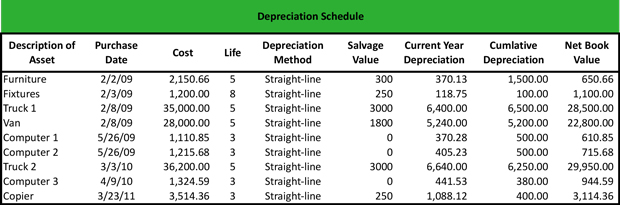
In the example below, it says 5 years for furniture. Is all furniture worthless after 5 years? Of course not. There's an entire industry of centuries old antiques.
"Depreciation is a non-cash business expense that is allocated and calculated over the period that an asset is useful to your business."
There are depreciation schedules in taxation that let you offset your tax. To this effect, 100% depreciation would expense the item (and thus reduce the taxable income). Because the tax doesn't represent 100% of the value you paid for the item, it doesn't mean that the item no longer with value.
I thought this was the idea all along... the announcements were all using as new sticker prices +r&d for the first manufacturing run on 20 year old hardware, it was a feature not a bug.
Cynically this "accounting error" is either an excuse to send more hardware to achive the same absolute $$ cost, or a method of communicating that the "cost" to the taxpayer was much (much much) lower than it really was.