This is exactly what the "deniers" have been saying - that the mathematical model is not fleshed out enough, and the data is not present in sufficiently accurate quantity, for the climate models to be accurate.
This research shows that the mechanism of action was misunderstood all this time. What else hasn't been researched enough and has simplistic assumptions baked into the climate models?
That shockingly simplistic models and the barest of data don't actually have predictive power wouldn't surprise people in any other scientific discipline, but it will certainly be cause enough for this subject, to have this comment voted into oblivion....
This sounds like a prelude to a simplistic "the models aren't accurate, so climate change probably isn't really a problem". However the problem with that is that the overwhelming majority of observations and models, many of which are far from simple and use large amounts of data, point to climate change being real, unusually rapid and anthropogenic. Using the argument that these models aren't accurate ignores the fact that even with a large margin of error, the lower bounds of climate change still result in significant negative effects for large numbers of people and ecosystems. Models have for a long time shown that the overall global temperature will rise and observations over the years have proved the models reflect reality. Are all models 100% correct with predictions? No, but the trend the models show is proven, even if there is a margin of error which is typically always acknowledged during modelling.
Questioning the accuracy as a form of dismissal raise the question of what level of accuracy you'd want before accepting the results, and what level of accuracy any countering research should have. Research like this paper also has margins of error, are often single studies or analysis and therefore aren't proven to be accurate themselves. Science evolves all the time, a large amount of the science we experience or rely on day to day cannot be fully modelled with high accuracy but we don't discount reality because the models don't match it.
I think the problem with the attitude of “so what if the models aren’t accurate, we should still undertake giant unpopular sacrifices because I, the expert, says so…”.is that it makes people more and more distrustful of future models that may be more accurate.
We just watched with front row seats what happens when once trusted scientific authorities rely on poor data, poor communications, and poor models. The general populace starts to distrust and reject them. This is the danger of every apocalyptic climate prediction that fails to come to pass. The desire to scare people into action only tends to push people into distrust and indifference.
Significant portion of population will always act against status quo even if the data is accurate to the T. Something about “don’t let perfect be enemy of the good” heavily applies to climate modeling, in my opinion. Worst case scenario, we convert to better sources of power through a ton of investment, and make general populace’s life “cleaner” anyways.
There’s always the Lizardman Constant[1], and on top of that there’s people demanding unreasonable perfection of data, sure. But I think the post you’re replying to has a good point: public opinion of “public health” has taken a significant hit in reaction to the handling of Covid, as more information came out that contradicted earlier messaging (vaccine confers immunity -> vaccine lessens symptoms, most notably). It seems prudent to acknowledge the same could happen with climate change!
The worse case scenario is investment in your your movement towards cleaner energy is constantly hampered by scientists and politicians making near term apocalyptic predictions based on conjecture.
> However the problem with that is that the overwhelming majority of observations and models, many of which are far from simple and use large amounts of data, point to climate change being real, unusually rapid and anthropogenic
I think climate change is a problem (not a crisis) but it's important to note that if a scientist questions climate science, he becomes a pariah. In such an environment, it's hard to know how much confidence we should have in consensus.
> Models have for a long time shown that the overall global temperature will rise and observations over the years have proved the models reflect reality. Are all models 100% correct with predictions? No, but the trend the models show is proven, even if there is a margin of error which is typically always acknowledged during modelling.
My understanding is that we observe some climate trend over N years and then select the best model proposed in the past. This is where the "oil companies knew about climate change!" accusation comes from. But it's much harder to select the model before taking the measurements and climate models have obviously performed much worse at that.
> if a scientist questions climate science, he becomes a pariah
As a climate scientist myself, I can tell you this is untrue and a harmful legend. As climate science is mostly atmospheric physics, biology and chemistry, it's pretty much very easy to disagree with anyone if you have a good argument supported by data. If you have strong scientific arguments, it does not matter even if the whole world is against you. On the contrary, this will likely make you famous and secure your career. Scientists (at least the curios ones) love to be proven wrong.
> If you have strong scientific arguments, it does not matter even if the whole world is against you.
That’s a nice idealistic thing to say.
Academia has shown this to be false again and again.
Most groundbreaking ideas or arguments which go against the current wisdom get buried in the best case, and the proponents scorned and driven out of research in the worst case.
It has been like this since the beginning of organized scientific communities, which is understandable. Scientists are humans with the usual shortcomings like ego and pride.
There's also a long list of people who were listed as IPCC reviewers, who claim they pointed out serious flaws in the research, were ignored, and whose names were then put on the final report anyway.
1. The article is simply a summary and repetition of Judith Curry's announcement, and Curry is/was an academic climatologist.
2. Given (1) I don't really care what reason.com is, but at any rate, I think right wing think tanks are far less biased and far more reliable than universities, government agencies and left wing think tanks, so that's not a useful or convincing response. Climatology is flooded with money due to their claims of doom, so they're as biased by money and profit as it is possible to be. My experience was that their opponents are barely funded at all and object due to a belief that things labelled as scientific should actually be so.
> I think climate change is a problem (not a crisis) but it's important to note that if a scientist questions climate science, he becomes a pariah.
People who have never done science really like this idea of the general scientific community being some sort of secret society that agrees to support eachothers ideas.
If you put 5 scientists in a room, you can't get them to agree on >anything<. The idea that disagreement is enough to get you outcast from "science" is complete nonsense.
I know scientists who are climate change skeptics. However, what gets published ("the consensus") isn't the same as "what scientists think".
This isn't only true in science, it's true in virtually all parts of human societies. It's hard to go against the grain and you're naive if you think doing so doesn't blight careers.
Well for one thing it's a waste of time to work on research that won't advance your career.
Also, I'm not saying "heterodox scientists have secret, bulletproof analyses to disprove climate change," I'm saying that there are significant incentives against publishing climate-crisis-skeptical research. I'm unsure how anyone can disagree with that. Acknowledging it doesn't mean denying climate change is real or accepting that its risks are exaggerated.
This is a pretty serious misunderstanding of the claim you're responding to. It's not that scientists in general agree about everything in general. It's that certain hot button issues become politicized in such a way that prevents real scientific skepticism / decent on those subjects in particular.
It's incredibly well funded, that's part of the problem. Every time they make extreme claims their funding levels go up, because rich people and governments conclude studying the climate is the most important thing that can be done with the money.
The reason your comment is bad isn't you pointing out some "truth".
The reason is your comment being misleading. You pretend, the accuracy of climate models was insufficient for any relevant conclusions to be made. That is just nonsense.
The interesting part is people clinging onto anything calling that impending climate catastrophe (or its human cause) into question.
Individual subjective short-term benefits outweighing rationally obvious mid- to long-term consequences is usually considered the domain of teenagers. Or of people living in very uncertain (life-threatening) circumstances, devaluing any future considerations.
Either way, those opinions can't carry weight in such a context, as their reasons share no common domain of validity with global long-term considerations.
You're talking about changing literally trillions of dollars worth of economic activity, per year, now and supposedly for the next 50 or 100 years, across the whole of Western civilization.
The requirement for the math being absolutely "spot-on" in this case is extremely high.
If the police isn't sure if someone is driving 190 or 220 miles per hour in a 45 zone, should we just not ticket the person?
Or perhaps a "scientist" has spotted a suspected cancer in your brain but they can't quite pinpoint whether it's a 20x increase from normal size or a 28x increase. Based on the 28 assumption, you'll be in a wheelchair within seven years, but it might also be ten years. It's entirely preventable by doing the surgery but that costs money today plus minor lifestyle changes. Before doing a costly operation and bothering with, say, a daily pill and no alcohol, one could choose to wait while they refine their equipment over the next decades and then measure again before taking serious action. Can't trust dem scientists anyway, maybe it wasn't a problem in the first place.
That's the logic I'm seeing here. A "times worse than CO2" value for one of the elements might have been off by 30% so we should just assume nothing is wrong in the first place and not change our society away from burning carbon. Maybe it's just a coincidence that ~five of the past ten summers are the hottest of all the summers whose temperature we've measured... yeah I agree: maybe. It's a possibility, no matter how remote. But I'd rather not wager with billions of lives impacted by the outcomes that are part obvious (sea level rise) and part the prediction from yet more models. We needed to act yesterday if the models are anywhere near the truth and it's going to get exponentially harder to fix the longer we wait (because reducing emissions year-on-year is a lot easier than cutting+capturing at a moment's notice). If it turns out to be a dud, we can continue to dig up the remaining oil and have a big feast, everyone happy. If not, it's a good thing we acted and we're probably still not going to be able to prevent some level of habitat damage for the species we call human, but at least it won't be as bad as when we wait for more precise information on a problem where the conclusion remains unchanged.
(That's besides the healthy years of life provided by having cleaner air; I don't know how that would compare against e.g. cobalt mining.)
No, the model doesn't need to be "absolutely spot on" for it to be correct about the correlation between industrial activity and sustained global temperature rises.
And that argument works better in reverse anyway: we're talking about a trend implying large parts of the planet becoming uninhabitable for present levels of human population within a relatively short time frame (which will also have an effect on economic activity!). If contrarians really have a good faith belief that this trend is caused by some other factor and will be self correcting, perhaps they could deign to specify their own testable assumptions and make their own model...
> literally trillions of dollars worth of economic activity, per year, now and supposedly for the next 50 or 100 years, across the whole of Western civilization
I'm not sure what sort of model you used to arrive at this vague estimate, but:
Even if you assume AGW science is completely wrong and the effect is zero, humans have to move from fossil fuels to renewables/nuclear in that timeframe anyway, because we have 47 years of oil left. Whether it's 20 years or 80 years, still needs to happen.
Well, Climategate happened. So there is legitimate reason to be skeptical of dire claims. And yes, I’m aware all of those involved in the scandal were cleared of wrongdoing. That’s like the FBI investigating itself and finding nothing wrong.
Anyways, the fundamental assumption of most models—-that humans are behind climate change—-has not been sufficiently evaluated or tested. I find starting with that assumption unscientific.
I don't know whether you're being genuine or just trolling/flame baiting. If you are serious, maybe start by reading what those emails you're referring to actually said.
Just for kicks, what do you think is the reason for that curve at the end of the hockey stick diagram? Because there's quite a bit of work that's been done there, I don't know what you need more!
From models, basic physics, and observed effects scientist make forecasts about climate change, and they adjust models based on observations.
If scientist make 100 forecasts based on current models they won't all be spot on. It might turn out that say 85 of them turn out to be pretty close, 5 of them turn out to be wrong in that things actually turned out worse than the models forecast, 5 of them turned out better than the models forecast, and 5 of them didn't happen at all.
The "deniers" look at those last 5 or 10 and dismiss the models and all conclusions from them as worthless, ignoring that the models got it mostly right and that the things they got wrong are nowhere near important enough to change the overall result. They at most just change the timeline a little.
Except climate change is happening, and there's no doubt about that because knowing it's happening isn't relying on models, it's relying on thermometers (and to a lesser extent ice cores to confirm that it's human-driven rather than a natural change).
How bad climate change will be, yeah I suppose there is a little fuzzyness there. But given how bad it COULD be (think: complete extinction of humanity, or an end of civilization) we can't really wait around not doing anything while we try to develop a perfect model.
The temperature has changed repeatedly without any evidence of human involvement over those longer time periods we can observe.
And the levels of CO2 etc. have changed as well, during time periods when it could not possibly have been blamed on humans.
I grew up in Canada, in an area with lots of farms... and I remember the high school trips to different geographical features such as moraines which are the residue of glaciers from long ago.
What caused those mile-thick glaciers to melt, given the low levels of human population and the low levels of human technology?
I don't think you understand what you are arguing.
Yes, the average temperature of earth has chaged vastly over its history, giving different levels of habitability.
At this time, we're in a really good spot for habitability, and we are seeing that we are slipping out of it.
There is evidence that some of the temperature change could very well be human made, and thus easy to stop (compared to, say, the emissions of volcanoes).
For some reason you argue that nothing should be done, because nothing was done in past massive climate changes, which resolved in mass extinctions.
Climate has changed in big ways without mass extinctions. The medieval warm period, the little ice age, mid-20th-century cooling. Just three examples. The idea the climate has been stable since the dinosaurs isn't supported by the evidence.
I mean have you looked at the charts showing the little ice age and the warm medieval period? The variation of temperature is orders of magnitude different to what we are experiencing now - I don't think that it's very relevant, is it?
While climate hasn't been "stable" as in "hasn't changed", it has remained in a very narrow band of t°, of which we are slipping out of it at a much faster rate than all your examples.
I'd argue it's quite clear we are on the way to an extinction class climate change, are you saying we are not? The hockey stick graph is pretty alarming to me.
Hockey stick graphs are indeed alarming, but also fraudulent, and the IPCC has even accepted that in the past! Look into the history of these graphs, the Mann lawsuit, the work McIntyre did on showing how these graphs were manufactured etc. After it was shown how Mann did it the NAS investigated and hockey sticks vanished from IPCC reports for around 15 years. Then one snuck back in to the latest report but only in the summary! The graph doesn't appear in the actual scientific review part at all! That's the state the IPCC has degraded to: the summaries for policymakers are completely different to the actual content for scientists and introduce new claims unsupported by the cited research. The graph is still wrong and the techniques that lead to them are blatantly fraudulent (lots of cherry picking, truncating, splicing, even tipping raw data upside down to make it go up instead of down, really horrific stuff).
For anyone having read this far:
- "the mann lawsuit" is climategate, where some people found a single sentence out of context that sounded off out of years of emails. Mann sued the people that accused him of skewing the facts, and won a defamation suit.
- while you write about things around the hockey stick graph, you dance around describing what they show. You can't "manufacture" a global rise in average t° of over 1°C.
- I'm not even certain you are a real human being! Why argue all this, when you can just look at the graph?
That's backwards! Michael Mann filed a defamation lawsuit against a skeptic and then lost it nine years later. The court awarded the defendant full costs:
Not only did the B.C. Supreme Court grant Ball’s application for dismissal of the nine-year, multi-million dollar lawsuit, it also took the additional step of awarding full legal costs to Ball.
The case was about whether Mann was engaged in knowing scientific fraud when he made his false hockey stick graph. Tim Ball said he did, and Mann sued, but in the end he preferred to lose the case rather than reveal his data and working, which says a lot:
In the pre-trial Discovery Process, the parties must give up key evidence in a reasonable fashion, that proves or disproves the Claim. Dr. Mann lost his case because he abused Discovery by refusing to honor the “concessions” he made to Ball in 2018 to finally show in open court his R2 regression numbers (Mann’s math ‘working out’) for his graph (see ‘update’ at foot of article).
Mann v competitive enterprise institute recognizes that a jury would find their comments as deragatory, false and damaging, and the suit was dropped because Mann delayed the proceedings as he was "busy with other things".
No where was his data found fraudulent - the court recognized that Mr.Ball's statements are derogatory. The delay is a technicality that has nothing to do with science.
The article you linked is very inflamatory and makes this seem much more of a big deal than it is - nowhere do they discuss the court decision itseld, but they bring up more than 3 scientists from the 90's shitting on climate change.
He didn't spend 9 years fighting a very expensive lawsuit and then, when he finally had a chance to prove that his work wasn't fraudulent in front of a judge, decide he was busy with other things lol! He refused to present the relevant evidence because his goal from the start was an ideologically motivated litigation war, in his own words:
thanks Phil. there is a possibility that I can ruin National Review over this. Going to talk w/ some big time libel lawyers to see if there is the potential for a major lawsuit here that will bring this filthy organization down for good.
But then National Review was removed from the case and so there was no chance for him to achieve his goal via abusive litigation anymore.
Mann is unquestionably a fraud even in the eyes of his colleagues. He deliberately deleted data that disproved his reconstruction because he knew that if he was honest "skeptics would have a field day":
As lead author, Mann decided to omit the Briffa data without the input of his other lead authors.. . . Mann’s own collaborators cautioned him against the deletion. IPCC TAR Coordinating Lead Author Chris Folland wrote to Mann that Briffa’s data “contradicts the multiproxy curve and dilutes the message rather significantly.”. . . Briffa himself urged Mann not to succumb to “pressure to present a nice tidy story” by “ignor[ing]” his post-1960 results. . . . Mann agreed with them on the merits but bemoaned the data’s political impact: “[I]f we show Keith’s series . . . skeptics [will] have a field day.”
"Technicalities" like Mann filing a lawsuit and then never actually doing anything to move it forward? The judge is extremely harsh towards Mann in the Mann v Ball case dismissal, stating in plain language that Mann has engaged in abusive behavior. He also clearly tried to BS the court about the reasons for delay.
That sort of behavior is consistent with abusing the legal system so he could say he was suing for defamation without ever having to actually win - for a decade! Dismissing such a case isn't a technicality. As the judge points out, Ball got witnesses lined up in his defense and Mann delayed so long that Ball's witnesses actually died of old age.
Honestly, I hadn't read the dismissals before. But it's laughable to call this dismissed on technicalities. Mann comes across as an abusive, manipulative and extraordinarily untrustworthy person in all of this. A clearer case of abusive litigation is hard to find.
But you agree that all the judgment also recognize that the jury would've edit: been able to recognize the comments as defamatory, and that, factually, in reality, the cases were - black on white - dissmissed on technicalities instead of from an actual judgment of anything scientific?
The whole point is that you bringing this up has nothing to do with the subject of this conversation.
And that you were blatantly wrong and misguiding in saying that he "lost the case" as the case was not argued
> But you agree that all the judgment also recognize that the jury would’ve recognized the comments as defamatory
The Mann v. Ball judgement [0] does no such thing (as is common for a procedural dismissal of this kind, it doesn’t address the merits at all.) I’m not going to track down the rest when the first one I check shows that you are wrong on the blanket claim, but if you’d like to point to any specific judgement that meets your description, feel free.
Edit: here it is
When looking at the bottom of the climate change litigation database on Mann v Competitive enterprise, if you go read the second to last summary, it states what I was meaning to say. I think I read it a bit quickly - it states that Mann met the burden of proving that a jury could find actual malice...etc. The to me is enough to indicate that the courts were supporting the suits as having some degree of validity. I think I was a little heavy worded in my prior comment.
What I meant to say was that all courts recognized some degree of validity to his claims of derogatory comments, by not dismissing his suits on those grounds, but on technicalities. So the whole thing is simply inconclusive, while the other commenter keeps arguing that it proves Mann is the antichrist.
So this whole tangent feels unnecessary and goal-post moving, as it has nothing to do with science.
> if you go read the second to last summary, it states what I was meaning to say. I think I read it a bit quickly - it states that Mann met the burden of proving that a jury could find actual malice…etc. The to me is enough to indicate that the courts were supporting the suits as having some degree of validity. I think I was a little heavy worded in my prior comment.
Assuming you mean the third to last document in the reverse chronological listing (the second to last is the plaintiff’s amended complaint, not a finding of the court), this is a ruling on a very early motion to dismiss, and what it actually found is that it was too early to determine whether or not there was, as a matter of law, sufficient evidence for a jury to find “actual malice” to the required standard of proof. [0] The first (most recent) document in that list (the one I linked upthread) is on a later motion for summary judgement, and, on the same issue, the court found explicitly against Mann on “actual malice” from CEI, finding that there was not evidence on which a reasonable jury could find that, which is why they dismissed his claim against CEI. That earlier ruling is not the court endorsing any degree of validity of any of Mann's claims, it is simply stating it is too early to address whether or not those claims were material disputes of fact for the jury, much less whether they had validity (which is mostly what the jury decides, though the court can resolve it when it reaches the level where there is no basis for a jury to find one way or the other.)
> What I meant to say was that all courts recognized some degree of validity to his claims of derogatory comments,
That’s simply false; some found that there would be triable issue of fact on falsity, but that’s not recognizing any merit of the claim, and others simply did not address the question at all.
> What I meant to say was that all courts recognized some degree of validity to his claims of derogatory comments, by not dismissing his suits on those grounds, but on technicalities.
Dismissing claims because of failure to provide sufficient evidence to meet required elements of the claim (like “actual malice” against CEI) is not a “technicality” (which is a bad name for procedural misconduct resulting in a dismissal with prejudice, anyway) but a ruling on the merits of the claim.
> So the whole thing is simply inconclusive, while the other commenter keeps arguing that it proves Mann is the antichrist.
I don’t see anyone claiming that Mann is the antichrist. He is a serial abuser of the legal systems of multiple jurisdictions, however, that is clear, and his claims on this issue have either been dismissed on the merits or because of his culpable failure to pursue them.
[0] “At this stage, the evidence before the Court does not amount to a showing of clear and convincing as to ‘actual malice,’ however there is sufficient evidence to find that further discovery may uncover evidence of ‘actual malice.’ It is therefore premature to make a determination as to whether the CEI Defendants did not act with ‘actual malice.’” http://climatecasechart.com/case/mann-v-competitive-enterpri...
Thanks for taking time to write this up, I was sloppy in my reading - as I said, I lost interest in these suits quite quickly. Sorry if I mislead anyone, not my intention.
On the topic of Mann's science itself, I don't find anything in these suits to affect our view of it. Do you?
No, the jury would not have found it defamatory if it were true, which it was.
The cases were dismissed without evaluating the science because of Mann's behavior. The people he sued wanted to just get on with it and debate the science, but Mann literally filed suit and then never turned up to his own legal proceedings. Hence the judge's displeasure.
Apparently Mann tried to make the same argument you made about not losing the case. He lost all the cases. If the judge dismisses your case that is losing. You don't get to file a lawsuit, never turn up and then when the judge tosses you out, claim you won.
> Mann v competitive enterprise institute recognizes that a jury would find their comments as deragatory, false and damaging
No, Mann v. Competitive Enterprise Institute had Mann’s claims against CEI dismissed at summary judgement because Mann’s evidence was insufficient for any reasonable jury to conclude that the required standard (“actual malice”) was met in CEI’s conduct, irrespectice of whether the charges were false or not. [0] (“actual malice” was held to be a triable issue of fact for the jury against an individual defendant in the same case, as was the actual falsity of the charges. I believe the case against the individual defendant was abandoned because CEI was the real target, or just because of Mann’s pattern of abandoning cases because he was “too busy” to prosecute them after filing.)
I wonder if in general you are making the mistake of assuming that motions to dismiss or for summary judgement in which the court is required to assume that the jury would find for Mann in any cases where there is a material issue of fact constitute “recognition” that the jury would find for Mann, which is decidedly not the case.
That paper comes from the same group as the original MM paper (one of the authors studied under Mann even), has some of the same problems and was itself rebutted:
WA reported that reconstructions without bristlecones (their Scenario 6) lack “skill” in reconstruction and “climatological meaning”, a finding with which we concur. The NAS Panel says that bristlecones should be avoided in temperature reconstructions. Thus, MBH-type reconstructions (with PC networks) with or without bristlecones are both eliminated. So much for the “refutation” of our criticisms.
Like all the variations you mentionned are less than 0.5° average, while we are already over 1° now. I think it's almost disengenuous to use them to say that the present warming is nothing to be worried of.
No, the changes were much larger than that, but recall from the climategate emails that they spent a lot of time trying to find ways to cover up the data around that. Look into the history of "hockey stick" graphs to see just how far they go. Historical evidence from outside their field shows there must have been changes of many degrees in the relatively recent past, e.g. bison fossils at altitudes indicating 5-6 degrees warmer than today with no runaway feedback loops and obviously, subsequent cooling.
How large were they? With a source please, you say a lot of garbage that I'd like not to have to sift through. Every source I see shows clearly that both your events were much less than 1°.
Bison fossils? What about ree rings and ice core samples? How are bones a possible indiction of anything?
Climate gate had a single sentence that seemed off to someone who has never done statistical analysis, if taken out of contexy.
ClimateGate had numerous emails that in context showed serious malfeasance. They were literally saying they were going to exclude any scientific work that disagreed with them "even if they had to redefine the peer reviewed literature to do so". It certainly wasn't a single sentence. Try reading them yourself and see!
But there are other lines of evidence that work in similar ways. They are based on the discovery and dating of fossils at altitudes where that form of life can't exist today because it's too cold, and then from that calculate how warm it must have been at the time (much warmer than today, even in the relatively recent past).
Re: tree rings/ice cores. These are called proxy reconstructions and they routinely conflict with each other, meaning they can't really be temperature proxies. Nonetheless, PCs are regularly discarded in a form of industrial scale cherry picking in order to create a hockey stick. An example of the problem is here, where proxies are randomly selected and plotted showing how almost none of them show any kind of hockey stick:
Easy to stop? Lol it's down right impossible and all this discussion is colossal waste of time. Humans are never going to coordinate globally to do this.
The deniers are mostly denying that the impact of human activities on climate is real. They are just attacking the models as a convenient scapegoat which is weird because everyone know the models can be criticised but there is undeniable evidence for human emitted CO2 having an impact so it’s mostly a waste of time.
If you really want to criticise the models, demographic hypotheses are far more questionable than anything having to do with methane by the way. Population growth was widely overestimated in the 90s for example and might still be. Plus the impact of an aging population and immigration becoming the main factor of population growth in the USA, Europe and China isn’t really well studied. This is partially voluntary by the way as it quickly leads to unsavoury questions.
If modellers were caught by surprise by this then they are clueless. But they weren't because population doesn't factor into models. They go straight from projections of CO2 levels, which have also grown at a constant rate:
> World population has grown at exactly the same rate for the last 70 years
Did you actually look at what you linked?
The main graph is only China and India and already shows a net inflection for China in the past few years. It will keep slowing. Read about population-lag effect.
The second graph nicely confirms that contrary to what you pretend population growth has started slowing globally.
There is no consensus about how much it will slow and when the peak will be reached. IPCCC had to adjust their hypotheses in the past because the lowest credible estimation where falling outside the lowest considered by the first climate model and some specialist argue we should look at even lower prediction. People in developing nations have stopped having large families faster than we thought.
> So it's not clear why you bring up population growth. It's not relevant.
If you don’t see how population size affects consumption, production and in fine pollution, I can’t do much for you.
> What is it and how is this impact measured in an undeniable way. It can't be temperatures because they don't track CO2 levels.
You are clearly arguing in bad faith or are clueless about the research surrounding climate change. In both case, I think it would be a waste of my time arguing further.
But as I said, they don't care about population, only CO2 levels, which also go up in a straight line.
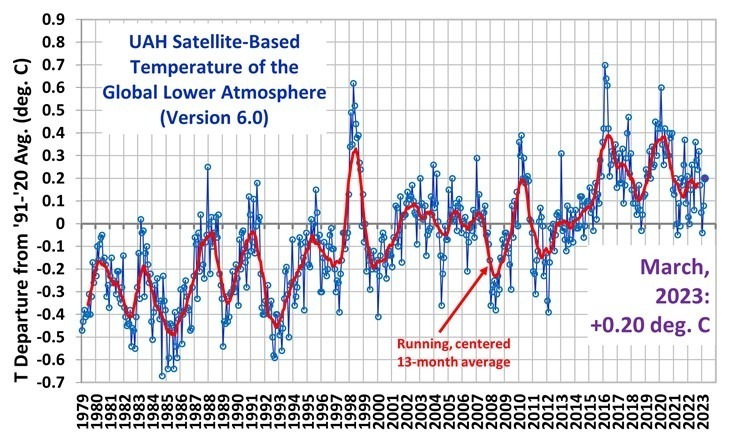
It would indeed be a waste of time for you to argue further, because you don't seem able to respond to the points being made. Here is a graph of temperature as measured by satellites. It consists of long flat periods, punctuated by sudden rises. This is not correlated with CO2, which grows smoothly.
I was serious when I said you should learn about the population-lag effect. The global population has been steadily declining since 1990 as even a cursory search would have shown you. So that eventual other readers haven’t entirely wasted their time, here is a link to the relevant UN source: https://population.un.org/wpp/Download/Standard/MostUsed/
I’m not going to bother answering the rest of your comment.
There is disagreement about when the peak will be reached. As your link shows, the UN puts it in 2086. The Global Burden of Disease Study published an article in the Lancet putting in 2064. The UN projection is solely based on current demographic trends and assumptions regarding life expectancy are quite optimistic. I have seen at least one study put the peak in the 40s while arguing that the rate of decrease in the total fertility rate is underestimated which while not likely is not impossible - historically predictions of variation in the TFR have not been very accurate.
Generally, the impact of potential feed back loops including climate change are understudied. There is a convincing argument to be made than worsening conditions could lead to the peak happening sooner.
At the end of the day, models remain models. They are not exact forecast. It's important to keep in mind when people argue we are doomed based on them.
(not a climate scientist)
Also, for the graph showing "peaks" - it seems to me that the "pattern of peaks" is constant through your graph, but the average temperature rises continually through the peaks.
If I were to guess, the peaks are things like volcanoes, currents and such, which are "constant" through time. The rise in CO2 is shown in the graph by the median not being a flat line.
If you have a step function and draw a trend line through it, the trend line will go up, but that doesn't imply a continuous process. CO2 forcing is (asserted to be) a continuous process. More co2 = higher temperature. The attempts to explain why that's observably not the case have become particularly wild in recent years, yet we are constantly told the science is settled and other untrue things.
Co2 is far from the only thing affecting temperature. The graph you're posting is clearly not a step function either. More like some kind of oscillation with an additional linear trend. Maybe the oscillation is el nino, it seems to be roughly periodic to 7 years or so, I don't know.
Edit: the bigger peaks are bang on el nino years, especially the '98 peak
Yep the step function is El Nino. There is also La Nina which can cool things, the AMO and other natural inputs that affect temperature. So it turns into a debate about how much each factors matters, which is the big set of unknowns that have no clear answer. Hence why the science isn't settled.
Modelling assumes it's carbon, that's taken as a premise. The models are built to calculate that the climate is stable if not for industrial activity. If the climate is simulated as non-stable even in pre-industrial times, that's assumed to represent a bug in the model.
Technically speaking, gradual increases and decreases over time don't have to be explained for CO2-doom to be wrong. Invalidating a theory doesn't require replacing it with a different one. But it could be AMO or sunspot activity or many other things that were once considered uncontroversially to have a big impact on the climate.
National Geographic, 1967:
Dr. Hurd C. Willett, Professor of Meteorology at Massachusetts Institute of Technology, suggests the answer. Dr. Willett, one of our staff affiliates this year, has shown us how cyclic changes in the climate closely parallel the cyclic changes in sunspot activity—the manifestations of powerful electrical energy discharges from the sun. We now feel confident that our investigations here back up the solar-climate theory of weather cycles.
If you want to talk about predictive power, let’s look at the first IPCC report from 1990. That had estimates which we now have data to judge them against, and have held up well:
Similarly, Dr. James Hansen (director of NASA's Goddard Institute) testified before Congress based on his 1988 study predicting global warming and his numbers were very close to what we saw over the subsequent 3 decades:
This research shows that one variable might be 30-40% smaller but the impact of that is clearly still within the margins on reports from 3 or 4 decades ago, so perhaps consider that the fossil fuel-funded sources telling you that the models are “shockingly simplistic” are not being entirely honest about their motives.
As the Ars article makes it clear, the predicted range of temperature change was extremely wide, 0.35 to 0.7 degrees by now even if you allow for the re-scaling to a shorter time period, yet actual change was at the very lowest point of that uncertainty interval.
That by itself doesn't tell us that they understand the climate though. Remember that previously they were extrapolating a cooling trend into an ice age. Anyone can extrapolate a linear trend forward on a graph into a disaster zone territory, but that doesn't imply real understanding.
It’s not news that scientific consensus becomes more precise over time. The point was simply that scientists have a good track record of making accurate predictions decades out, which is quite the contrast of how deniers have flitted from wrong prediction to wrong prediction. Don’t feel bad for them, however — they get paid a lot better than climate scientists do and are probably old enough to miss out on the worst of it.
It got less precise. Look at the range of ECS estimates. They are now wider than they ever were. It's quite the controversy. Even guys like Hausfather and Schmidt are sounding the red alert over it.
Do you have any examples you could point to? Most of their public comments on the topic of this thread look like this, noting the accuracy of predictions:
If so, the key point is that neither the IPCC nor NASA GISS reports are affected because they weight the models based on their accuracy predicting the past. This looks like the normal scientific process at work: ¼ of models are overly sensitive to CO2, careful validation caught it, and the major reports don’t have that problem because that review process worked. We also know that this is an increasing challenge human efforts do have a significant impact and if emissions go down that’ll be used by critics as proof that earlier predictions were wrong.
From a policy perspective, it’s also worth noting that there’s no credible reason to think warming will halt or reverse. At this point we have roughly half a century of models accurately predicting that we will have a big problem unless we stop polluting and we know the costs of the unavoidable warming are already measured in trillions. Trying to reduce error bars is always good but at this point it’s clear that acting seriously now will save many lives and enormous sums of money compared to letting the fossil fuel companies continue to encourage more rounds of “debate” on whether the problem is real.
>> the key point is that neither the IPCC nor NASA GISS reports are affected
You: scientific consensus got more precise over time.
Me: it got less precise over time and there's no consensus on the right answer for a core variable.
You: if you drop models you "know" are wrong then it's got more precise!
That isn't a rebuttal it's a confirmation. The models have been getting less precise about core variables over time and they don't know why. IPCC try to cover this up to some extent by downweighting models they "know" are wrong, but as the article you cite says, most climatologists don't do this and continue to act as if all models are equally correct even though they're diverging and so that can't be true. Result: not only is there no consensus on ECS but there's not even any consensus on what to do about its divergence. No precision, no consensus.
>> there’s no credible reason to think warming will halt or reverse
Temperature trends have halted or reversed even in just the last few decades so that can't be true, although climatologists like to go back and edit the record to try and remove these embarrassing episodes. See: global cooling becoming global warming, and "the pause" e.g.
"Issues related to the pause of global warming in the last decade are reviewed. It is indicated that: (1) The decade of 1999–2008 is still the warmest of the last 30 years, though the global temperature increment is near zero; "
From my perspective, trying multiple things, testing them, and picking the ones which had the best predictive values seems exactly like the scientific process working as intended. ¾ of the models did not have this problem, after all. Remember, science isn’t the process of assuming you’re right but rather testing your ideas harshly and learning from the faults you discover. Given half a century of reliable predictions, I again argue that they have sufficient predictive value even if it makes science deniers uncomfortable to acknowledge their personal contributions have only been towards making the world worst.
Global cooling was never a mainstream position and the people hyping it since the mid-1970s have intentionally been lying to you.
Similarly, there was not a reversal of warming. Weather data and sources are noisy, and changing sensor artifacts introduce sampling biases, but the trend is clear and numerous follow up papers found that claim to be wishful thinking:
After witnessing and taking part in many such debates also around COVID, it's become apparent that a lot of people don't really understand the scientific process. What you've given here is a good example. Recap: study, hypothesize, predict, observe, validate, announce. This is the process meant to be followed by a person or team as part of being a scientist. Ordering matters!
1. You aren't allowed to go around announcing you fully understand the mechanism at play until you have successfully validated your hypothesis via enough correct predictions being generated by it.
2. You aren't allowed to team up with others, make every possible prediction and then when one of them ends up right by chance, claim credit for the entire group. That's the same thing as if a single person made dozens of predictions and then cherry-picked one to claim understanding.
3. You aren't allowed to change the data to fit the theory. You have to derive the theory from the data.
Climatologists and really quite a few other fields don't work this way. Because they make predictions with a 20 year horizon but want fame, glory and funding before then, they make an endless series of predictions that can't be validated until the end of their career, and then immediately skip to the announce stage. They do it over and over. When after a decade or two it becomes clear their predictions were wrong, they point at predictions they made last year - not yet validated - announce them as correct and state that their earlier incorrectness was just science at work. Or they decide it must be evidence of an error with the data and go fishing for reasons to change/ignore it. There's endless examples of this, and Climategate revealed not only them doing it but literally stating to their colleagues they were going to do it because otherwise the skeptics would win, and far from scientists embracing skeptical review they actually turned out to hate it and call it things like "Lord Voldemort".
Re: global cooling. The Ars article wriggles around and omits a lot of relevant evidence, but I find actually the top comment to be the clearest example of how it all goes wrong. It's by a climatologist who worked on modelling during the 70s. He says things like:
- "I found him [Schneider] to be an excellent scientist, but also a political creature, and thus a funding magnet."
i.e. so-called "excellent scientists" were corrupted by a desire for political influence and money, exactly what skeptics argue today
- "various senators wanted to show off these models to prove they were worthy of the huge federal funds to build them."
i.e. the science became a circular process of justifying prior funding grants, exactly what skeptics argue today.
- "the early models were pioneering efforts on overburdened (slow) computers, so oceans were ignored"
i.e. the models were known to be inaccurate but presented to the public anyway, exactly what skeptics argue today.
- "The answer we got was predictable: Meh, can't tell. But the additional funding sure helped."
i.e. politicians weren't told the models were useless and so the money kept flowing, exactly what skeptics argue today.
- "For a while we didn't know for sure. We simply laughed at the simplistic articles that appeared in the press"
And finally, another lie. Why do climatologists lie so fucking much, all the time? This guy claims he worked directly with Stephen Schneider who, apparently, was one of those who "didn't know for sure" and they "simply laughed" at the "simplistic articles". So why did he write a whole book about global cooling?
If they were "simply laughing" at the press, why was he giving interviews to the New York Times to tell them all about the threat of global cooling? Why did he tell them that this was a consensus position and why, when apparently they didn't know and the models didn't really work, did none of these people who were being mischaracterized stop laughing for a second and object?
"they [climatologists] are predicting greater fluctuations, and a cooling trend for the northern hemisphere [...] the news for the future is not all good. The climate is going to get unreliable. It is going to get cold. Harvest failures and regional famines will be more frequent"
But it's a rhetorical question. We know why the press reported these views as the consensus of all climatologists, it's because none of them actually objected to it. They didn't object for the same reason they don't do that today: they love presenting a united front, and threatening that would have endangered their prestige and funding, which they care about much more than truth. Nothing has changed and nor will it until we stop listening to these people.
The fossil fuel industry has also grossly underestimated the amount of methane leaking from wells and fracking sites.
Researchers got some things right, other things wrong. What we have seen historically is that the pessimistic estimates of scientists have matched reality better than the optimistic estimates. Scientists have actually under estimated the effects of climate change.
> What we have seen historically is that the pessimistic estimates of scientists have matched reality better than the optimistic estimates.
I wasn't aware of this, but it also sounds hard to prove so I'd be very interested in such a study having been done. Or do you mean for climate change specifically? (That seems much more manageable to meta-analyse)
Climate simulations: recognize the ‘hot model’ problem
Users beware: a subset of the newest generation of models are ‘too hot’ and project climate warming in response to carbon dioxide emissions that might be larger than that supported by other evidence.
In recent studies, the “hot models” have even been shown to be ineffective at reproducing past temperatures, a common method used to test their reliability and accuracy. This has cast further doubt on the model democracy approach, whereby all models are given equal weighting when establishing future warming parameters.
The second link is not an unpaywalled copy, it's "climate change isn't real" content that you're portraying as having been posted to Nature. This is not a constructive way to talk about the topic at hand (methane being the equivalent of 20x CO2 instead of 28x, at least if the submission isn't in error).
Here's a public versions of their nature comment written by the same authors. I should have linked to that instead of the original paywalled version but all these versions are making the same argument, presumably with sightly different wording for copyright reasons:
If you're claiming this material is "climate change isn't real" then look into who the authors are.
The topic at hand is climatologists changing their minds about basic variables despite decades of making predictions with 100% confidence. The fact that their latest models are totally unrealistic, by their own assessment, is further evidence that the science here is seriously flawed and subject to major revision, still.
Alright so the ipcc makes multiple projections, with some being "hot", in the sense that they are worse than their other predictions. I think they made like 6 predictions last report.
This papers is just arguing that the "hot" predictions should be less intense, because they are not very good at reproducing some specific past dataset.
That has nothing to do with a problem with hot models - it's a slight modification to them.
You seem to be arguing in bad faith. Your article even seems to imply that the hot models are fine with predicting present data, just jot the data of the last ice age. Who cares? What has that got to do with anything? No one is only looking at the hot model!
The article says this: many of the models are getting hotter with time in ways that are clearly wrong, but climatologists routinely use them anyway out of some misguided belief in "model democracy" i.e. that all models are equally valuable and correct even when they disagree strongly with each other so should just be averaged together. It's pointed out that this undermines vast amounts of the supposedly settled science.
> That shockingly simplistic models and the barest of data don't actually have predictive power wouldn't surprise people in any other scientific discipline
This is dead wrong. It's a source of wonder in most scientific disciplines that heavily simplified models can have amazingly good predictive power.
> This is exactly what the "deniers" have been saying
Deniers gonna deny. They'll use whatever argument it as hand, including completely nonsensical and contradictory ones, to tarnish, downplay, distort, misrepresent, and fundamentally reject the underlying thing they want to deny.
> . What else hasn't been researched enough and has simplistic assumptions baked into the climate models?
Simplistic assumptions does not necessarily have favorable outcomes, on the contrary, it's more likely that climate change is worse than what we think it is because of our assumptions. Also climate models are insanely complex, usually contain thousands of equations that sum up the research efforts over the last hundred years, it's not some simple model that one guy can implement in an evening as you are basically trying to simulate the whole earth from the scale of plant stomata and molecular diffusion to the entire boundary layer plus the interactions and feedbacks between the different parts of the earth system.
Thanks for your rebuttal based on logic and rationality. Did you have anything to add in terms of, I don't know, something based on scientific or mathematical grounds?


This research shows that the mechanism of action was misunderstood all this time. What else hasn't been researched enough and has simplistic assumptions baked into the climate models?
That shockingly simplistic models and the barest of data don't actually have predictive power wouldn't surprise people in any other scientific discipline, but it will certainly be cause enough for this subject, to have this comment voted into oblivion....