I'm not sure that construction speed is the metric you want to optimize when it comes to skyscraper construction, although I suppose robustness is built-in to all the designs these days. A quick search for robust skyscraper design turns up this interesting effect-of-9/11 discussion:
Skyscrapers also have a footprint that might no be immediately obvious - it's their energy, water and food demand. Assuming they're inhabited by humans, what's the amount of agricultural land needed to provide for those humans? What's the energy demand, how many modular 100 MW nuclear power plants or hectares of solar PV panels (plus associated 24/7 storage/distribution centers) are needed to keep the elevator, lights, pumps, ventilation and heating/AC functioning? How much water do they consume daily?
That's the kind of 'skyscraper footprint analysis' that architects should be asked to submit for any building design.
> Skyscrapers also have a footprint that might no be immediately obvious - it's their energy, water and food demand. Assuming they're inhabited by humans, what's the amount of agricultural land needed to provide for those humans? What's the energy demand, how many modular 100 MW nuclear power plants or hectares of solar PV panels (plus associated 24/7 storage/distribution centers) are needed to keep the elevator, lights, pumps, ventilation and heating/AC functioning? How much water do they consume daily?
That's the kind of 'skyscraper footprint analysis' that architects should be asked to submit for any building design.
We should either require this for all buildings or for none. People are gonna have to live and work somewhere. Typically the foot print of lower-density solutions in all ways you describe will be even bigger.
If we think a sustainability assessment on all new construction will help, that can be a reasonable argument. I caution though that all the friction in getting new construction approved is a big factor in our growing housing cost. So let's make sure any regulation truly carries it's weight.
> We should either require this for all buildings or for none.
You do understand that "requiring this for all buildings" has a name: urban planning. This sort of analysis is basically what engineers do when assessing the environmental impact.
Pardon my general ignorance in this topic, but it’s those energy, water and food demand would still be applicable no matter where people live, no? The denser the population, easier to deliver said things (something alike economy of scale). Unless i’m missing something?
Yes, but is the power grid capable of such demand? Sewer and water pipes?
Thinking with the perspective of, how do we service this land for growth/people changes one's perspective.
People often think...look at all this empty land, it can hold so many people... but, where will they get their power (which can relatively easily be transmitted long distances). Water and sewage are another challenge. Water of a sufficient quality and quantity needs to come from somewhere and be treated, sewage needs to be conveyed to a treatment plant, treated, and discharged to, generally, a river or lake. So much infrastructure is needed for modern society, especially density, that is often not thought about by most.
For example, I was at a gas station on a highway where there are no cities nearby and another customer asked if there were any car washes. I thought about it for a minute and realized that there's no sewage treatment around so there's nowhere to send car wash water. They could store it and truck it but that would be quite expensive.
Thanks for coming to my shower thoughts TEDx talk.
> Water and sewage are another challenge. Water of a sufficient quality and quantity needs to come from somewhere and be treated, sewage needs to be conveyed to a treatment plant, treated, and discharged to, generally, a river or lake. So much infrastructure is needed for modern society, especially density, that is often not thought about by most.
All of these problems are easier with higher density, not harder. Would you rather run and maintain a few giant sewer lines for a million people, or thousands of small sewer lines over hundreds of miles? Sewage treatment plants benefit enormously from economies of scale. Economies of scale and lower transportation costs make higher-density living more economical in nearly every way.
>All of these problems are easier with higher density, not harder. Would you rather run and maintain a few giant sewer lines for a million people, or thousands of small sewer lines over hundreds of miles?
But that's not really the problem faced with construction, except when building on previously undeveloped land. Significant increase in density imposes commentate additional demand on existing infrastructure, which is much harder to expand than to operate and quite probably vastly harder to expand than it would've been to build initially to that expanded state before there was a dense city on top of it.
Well, the two extremes would be an even distribution of small homes over the entire agricultural footprint space for the human population, vs. all the humans living in a giant skyscraper surrounded by the agricultural (and energy, and water) production zone. Each setup has certain advantages and disadvantages (transport from field -> skyscraper has a cost, vs. local availability of basic resources, but on the other hand, if you have to run fiber optic to every household, that gets expensive). In terms of delivery, it depends on lot on the mass of what's being delivered.
If we want to go larger, then imagine multiple installations like this, perhaps specializing in different production capabilities, and trading among one another. Sort of a Factorio gameplay scenario.
Basically, would skyscrapers (or underground versions) be the best way to colonize Mars (you'd still need the large agricultural zones)? See also Mad Max: Fury Road for the dystopian version (BulletFarm, GasTown, and Hydroponics/Milk IIRC).
Back on Earth, the issue would be that if you doubled the population density of a city by building a lot of skyscrapers without also doubling the regional agricultural zone size, you'd end up dependent on import of foodstuffs from remote regions, which could become a problem.
I don't think we exist somewhere on the line directly between your two extremes; I think there are more dimensions than that. It's true that for most of human history, the local availability of basic resources meant not having to transport lots of goods around. But that's just not modern society: even in resource-rich rural areas, the vast majority of goods on store shelves are from far, far away. If you want local stores to stock oranges all year, and smartphones, and plastic toys, resources are going to be moving thousands of miles no matter where humans live. Density ultimately just means fewer destinations for those goods, which can allow for optimization. High-density living is just more optimal in almost every way.
> Skyscrapers also have a footprint that might no be immediately obvious - it's their energy, water and food demand
I am not sure I understand. Wouldn't all these statistics amount to roughly equal or lower consumption as compared to options that house a similar number of people ?
The domestic resource consumption is constant. The overhead is actually lower. Centralized heating is cheaper than individual heating. Lighting a bunch of corridors is cheaper than lighting an entire street of single family housing. Water consumption is also lower when the green spaces are communal (green rooftop) vs individual yards.
> Skyscrapers also have a footprint that might no be immediately obvious - it's their energy, water and food demand. Assuming they're inhabited by humans, what's the amount of agricultural land needed to provide for those humans? What's the energy demand, how many modular 100 MW nuclear power plants or hectares of solar PV panels (plus associated 24/7 storage/distribution centers) are needed to keep the elevator, lights, pumps, ventilation and heating/AC functioning? How much water do they consume daily?
Yes, that is a footprint, and it's almost universally much lower than any other form of housing. Modern construction is very efficient, and it's much more environmentally friendly to consolidate these concerns than to spread it out.
> That's the kind of 'skyscraper footprint analysis' that architects should be asked to submit for any building design.
What you're proposing is really just another way to block construction, NIMBY-style. Nobody asks for these proposals when building tract housing. Why should it be any different for shared housing? It's not like the amount of food and water people need varies based on where they live.
It's hardly NIMBY-ism, the idea is that you take all the factors involved into account. If you're doubling the population density in a given city by building a dozen skyscrapers, you should account for the resulting increase in demand for electricity, water and food (plus random other issues like public transit and private vehicle parking).
I'm certainly not saying skyscrapers are 'bad', but a lot of people don't seem to understand that one human needs about a hectare or four (depending on dietary choices) of productive agricultural land just to sustain basic life necessities (food, cotton, wool, wood, etc.).
It typically doesn’t happen this way, though. Typically, a city becomes very popular for some reason, gets into a housing crisis as it grows, then developers see an opportunity and build skyscrapers. Seattle is a good example — major growth due to tech, and huge housing affordability crises. But not caused because new high rises are going up everywhere, but because of an influx of high paying jobs in the tech sector, which causes high rises to be built to meet that existing need
I struggle to think of a scenario in which a developer would build a high rise in a city that didn’t already have the demand for that much new housing.
Beyond that, cities do already plan for infrastructure capacity. (As an example, certain new construction in Seattle has to pay a fee for some time to help cover the cost of capacity expansion.)
Of course what you’re saying is right in that a new skyscraper will increase load on existing infrastructure. But I struggle to think of cities that aren’t handling that already… and then building skyscrapers that start causing brownouts and water shortages. That just doesn’t typically happen. (In other words, why would we need an extra permitting/design step when it’s already being done to some extent.)
Beyond that, skyscrapers are built in places with existing population density, so it’s not like we’re doubling population density in the city.
Not to mention parking minimums, which are very common. And developers love to capitalize on parking. (Most new high rises in Seattle have several below-ground floors of private parking, and it ain’t cheap!)
> Nobody asks for these proposals when building tract housing.
Of course they do. In my area we require any proposed development to include a detailed independent analysis (not a few pages, it's an inch thick book) of all the infrastructure requirements to support that development as well as the predictable downstream effects, and so on.
Maybe that's not universal. Maybe it's why my suburban area hasn't experienced any of the infrastructure failure predicted by places like strong towns despite well over 100 years and counting. But I expect that it is more common than not.
If you're only talking about "how much food land somewhere in the world do we need to support X people here or somewhere else" then sure, I guess nobody probably does that. Regardless of housing style. It's not very useful, unless we're planning some dystopian population controls and are looking for justification.
> If you're only talking about "how much food land somewhere in the world do we need to support X people here or somewhere else" then sure, I guess nobody probably does that.
Yes, that's what I'm talking about.
Environmental analysis of the other form is commonplace, but varies by locality. In some places, the environmental review process is already weaponized in order to block construction with absurd claims, purely for self-serving purposes.
You mean the landed gentry don't want high-density low-income housing right next door, and so use environmental review to block such developments? This is probably true, although just buying the city politicians seems to do the job in most places.
To be honest, I was more thinking about how to build cities on Mars than that issue. High-density skyscrapers surrounded by dedicated agricultural production might be the best issue, although I suppose people will still fight each other over who gets to live on the top floor with the best views...
>Skyscrapers also have a footprint that might no be immediately obvious - it's their energy, water and food demand. Assuming they're inhabited by humans, what's the amount of agricultural land needed to provide for those humans? What's the energy demand, how many modular 100 MW nuclear power plants or hectares of solar PV panels (plus associated 24/7 storage/distribution centers) are needed to keep the elevator, lights, pumps, ventilation and heating/AC functioning? How much water do they consume daily?
All of that is much more efficient in high-rise buildings than anywhere else.
The same with cities vs. rural/suburban areas. The former is much more energy efficient and has a smaller carbon footprint.
If we have a thought experiment of a donut of mid rise 5 story apartments powered by its own footprint with a central park a couple km across and possibly commercial activity and outlying farms vs one colossal skyscraper in the middle.
The donut has less transmission infrastructure (most of the energy travels under 100m).
The food is less centralised, people could even go and get it from where it is packed on foot with no transport step if you wanted to go to the extreme.
Each floor of the apartments is holding up on average 2.5 floors above it so doesn't need to be as strong. It takes less material.
The center of the donut is free for other uses rather than needing to be entirely transport infrastructure to get people in and out.
The donut has a better exposed surface area to volume ratio (unless the majority in the skyscraper have no windows or is made from impossible materials and doesn't taper) so needs less heating/cooling. The donut has more thermal mass available for heating/cooling loops so doesn't need some higher tech thermal store.
Less energy is needed for water and sewerage per person.
Maybe 10 or 20 stories is optimal, maybe it's 3, but the peak isn't at the as big as possible skyscraper end.
Carbon footprint depends on energy sources, not population density. 100,000 humans supplied with coal-fired electricity have a radically different carbon footprint from the same populations supplied with solar PV and wind electricity, and it doesn't matter whether they live in isolated households or in one skyscraper.
Isolated spaced out households need more roads, more travel for goods, more pipes, more stormwater treatment, more services (as each needs a larger buffer to smooth spikes in demand), use an order of magnitude more energy to heat/cool, take more materials to build, require more vehicles.
You may only need to build up a little to fix most of it, but sprawl uses much much more of everything than building up.
> Carbon footprint [does not depend on] population density.
Patently false. Carbon footprint can depend on more than one variable, and indeed does. Transportation of goods and people is a huge source of carbon, all of which goes way down in cities.
> it doesn't matter whether they live in isolated households or in one skyscraper.
It's much easier to heat every room in a skyscraper than isolated households due to volume vs. surface-area scaling, even if you hold square footage equal. But square footage is not equal; people occupy less space in skyscrapers, because of redundancy in amenities (shared garages, laundry, recreational areas) and other reasons.
I think because you can easily photograph a meadow that's now a metropolis, but you cannot photograph an area that hundreds of square miles of meadows and forest and now covered in sprawl, humans instinctively think city = bad, sprawl with two trees = good.
It's hard to understand somehow that the trade-off is between ruin a giant area or totally ruin (even that's subjective) a much, much smaller area.
Agricultural production is pretty ruinous to the native biota, although this can be mitigated by introducing patchiness. Farms are kill zones, in other words - you have to kill the insects and rodents which would otherwise devour the crops intended for the humans in the skyscrapers. A lot of people (vegans ahem) seem to not understand this (although it is true that if you're eating the crops directly, and avoiding the losses involved in feeding the crops to animals and then eating the animals, you can subsist on a smaller agricultural footprint).
Short of suicide, is there a way to reduce the footprint caused by food consumption lower than from a vegan diet? It seems to me that eating meet always will consume more land and other resources, no?
Well, 'vegan' is a broad concept. Clearly there are certain plants which are hard to grow and which produce minimal foodstuffs per acre, strawberries and almonds probably fall into that category (comparable to dairy, certainly) and in grassland ecosystems, it might be less of a footprint to live off meat and milk from herded animals rather than trying to implement crop agriculture.
Reindeer herders in Siberia, for example, are probably more in tune with their environment than any vegan cultivator in that zone could be.
I'm not sure what to make of the grassland angle. It works well for the reindeer scenario, given the reindeer have always been with that ecosystem. However, how well does that scale to production levels we need to support 8 billion people? I also wonder how well that translates to other areas. I understand we've pretty much destroyed the American prairies. Not sure about the details of that though.
> Interestingly enough, the huge outlier in slow construction isn't the US, but Canada, with an average skyscraper construction speed of half that of the US’s.
A building materials professor I knew years ago talked often about how robust Canadian skyscrapers were, and how many pre-9/11 U.S. designs never would have been approved there. I suspect differences in local building robustness code play a role in how much square footage makes it into skyscrapers in a locality, and how quickly.
Hong Kong has very special circumstances which makes it quite different from other cities in this respect, including other asian cities. IIRC its building codes require skyscrapers to be about twice as dense and reinforced as other cities in order to easily withstand cyclones (hurricanes). Cyclones often tear through the Philippines, killing many, and then ram into HK, which barely notices. Furthermore, much of Hong Kong is mountainous, and so its skyscrapers are often built on unusual and very, very steep grades -- sometimes steeper than the steepest stuff in SF. OR they are built on reclaimed land with its own special issues. Last, Hong Kong proper is by many measures the densest city in the world, and that includes Manhattan. Building a skyscraper often involves destroying another one.
I had expected to see Dubai there, but apparently, they're too slow to make the charts.
Neom's The Line should easily top the charts if (BIG IF!) it gets realized in the next few decades. 170kmx200m area of skyscraper quickly adds up sq ft...
The Line is a scam. Not sure exactly who is being scammed vs. doing the scam but it’s delusional and will never amount to anything. It’s not an “if”, it’s just not real.
I've heard it generally suggested that it's the Crown Prince scamming himself. He wants the massive monument to himself and headlines about all its fantastic new ideas, he has the money to bankroll it, and consultants will happily take large multiples of their usual fee to agree with his ideas.
The numbers don't make sense to me. LA at the top at around 445,000 sqft per year is equivalent to a gross floor area given by a square of sides 667 feet, or ~66 meters. It's probably off by like three orders of magnitude
"Average construction speed of skyscrapers completed in 2000 and 2020, in square feet per year"
While a bit unclear I take that to mean it's presenting the construction speed of individual skyscrapers and giving the measurements in square feet per year then averaging those rates by presented location. In this measurement a 200x200 square foot floor building with 20 stories would be 800k square feet, if it took 4 years to complete that would factor in as 200k/square feet per year in the city average, not as +200k/square feet per year to the bar.
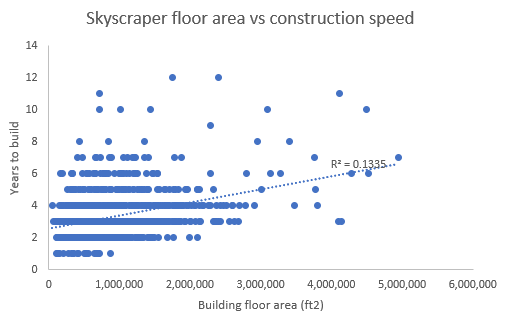
Looking at the graphs it seems a building with 4,000,000 square feet doesn't take much longer than a building with 400,000 square feet: https://substackcdn.com/image/fetch/f_auto,q_auto:good,fl_pr... and there are a lot more smaller ones to weigh down the speed.
lol do you actually live in LA to witness the towers going up everywhere over the last 10-15 years? also, 3 orders of magnitude is 100% -> 10% -> 1% -> .1% of reported numbers.
The other way around, to me this means that the total floor space is the size of a 66 meter square, which is ridiculously small. I think it must have been at least 1000X times that
He clarifies that it's probably due to a low sample size. But still... LA?
It seems like the "surprising" success of the US might be due to skyscrapers being largely built by the private sector, which is pretty good in the US, while American public sector construction is, unfortunately, something of a running joke.
Good on him for recognizing the mistake (autocorrelation) in a previous article.
I can't think of a large scale public construction project recently, in any domain. Everything's contracted out. In Seattle for example you see the exact same contractors building stuff for Google and Sound Transit.
Speaking of Seattle, the 99 tunnel was pretty large in scope with the world's largest tunnel boring machine. Construction started in 2013 and opened to traffic in 2019.
"Boring of the tunnel with the 57.5-foot (17.5 m) diameter "Bertha," at the time the world's largest-diameter tunnel-boring machine, began on July 30, 2013,[69][70] and at the time was expected to be completed in 14 months" [1]
We also have the lightrail projects with total funding of over $54 billion. Pretty large in scope with variability in success and budget[2]
> Pretty large in scope with variability in success and budget[2]
Sound Transit would have better luck if they weren't forced to work under so many constraints.
Because money trickles in slowly, and because funding has to come from different cities in a predetermined way, they are stuck with speculators buying up property before Sound Transit is allowed to, and then selling it to ST for inflated prices.
Cities that need mass transit right now are not allowed to pay for transit to be built faster in their area.
And of course everyone loves to sue them, costing even more $.
I still have not figured out why the holy hell there isn't commercial real estate built along with all sound transit stations. We have these large expensive stations that are devoid of any commercial activity, meanwhile Japan sticks Michelin Star restaurants in their transit stations.
The Roosevelt station is a notable example of this, huge station, takes up lots of the block, and it is tall, why aren't there at least 2 or even 3 levels of retail space in it?
>I still have not figured out why the holy hell there isn't commercial real estate built along with all sound transit stations. We have these large expensive stations that are devoid of any commercial activity, meanwhile Japan sticks Michelin Star restaurants in their transit stations.
In general, the opposite complaint has been raised: US station platforms are too large!
I don't know how they do it in Japan, but the train station in Rome has all of the services above ground in a normal building, away from the tracks, while when I've seen coffeeshops and the like at subways in the US, they're often on the platform or at least underground. DC has some truly cavernous stations full of a lot of signs and stale air (and not much else).
So it seems like part of the problem is that the subway authority is confined to an unreasonably tight definition of where they can operate, and then they try to cram a camel through the eye of the needle.
Public agencies don't have enough in-house expertise, so they spend more on contractors and consultants than in peer nations (particularly vs. non-Anglosphere).
So I'm sorry if it was confusing when I said "public sector", because the problem occurs with public infrastructure projects directed by the government, and the privatization downstream has minimal effect.
It's very difficult to put a direct comparison, because the government usually does not build skyscrapers, and the private sector almost never builds public transit. But you see dramatic shortfalls in US cost and rate on the construction of major transit infrastructure compared to peer nations:
As I detail in a cousin comment, privatizing the construction process itself does not help (and might make matters worse), but it surprised both the author (of TFA) and me to see that the US is competitive when the whole project is privatized — possibly implying that the government is making mistakes in administration particularly.
It's not impossible. But again, the contrast has four parts:
- Eurasian private sector, works
- Anglosphere private sector, works (except in Canada)
- Eurasian public sector, works
- Anglosphere public sector, confounded by cost overruns
If it's a simple result of scope, it remains to be explained why similar projects are harder in the English-speaking world than in Italy, China, Japan or Mexico (yes, even Mexico has substantially lower costs!). My other comments in this thread offer more details.
I guessed that Los Angeles would be high on the list, not necessarily first, the amount of construction in downtown has been crazy the last decades. The skyline is so different compared to the 90's.
Yes, I agree with this, if a public building probably takes 10x 20x slower. My city was rather fast too, but we still have one bridge Under Construction since 1986 :)
US tall buildings are not slower than the rest of the world. That's the biggest surprise in the data, and it persists under different analytical methodologies.
"Construction speed" really feels like the wrong phrase to use.
Maybe "pace of construction"? I'm not sure. The thing to understand is that in all the large cities all over the world, there are multiple construction crews working concurrently on individual projects. "Construction speed" feels like it would be describing a single crew working on a single project.
In addition, there are plenty of internet communities where people track construction projects, and if you read through those you'll see that there are a lot of variables that influence how quickly a skyscraper can be built. The soil plays a large role - how stable, what material, how close is bedrock, etc. The foundation of a skyscraper is extremely complicated and expensive, and the time it takes to construct is hyper-specific to the location. Just one example.
IMO, this article confuses building speed with production rate.
A city that takes a month to build a skyscraper will be ranked lower than one that takes three months to build one if the former has one build going up at any time, completing 12 in a year, and the latter always builds 4 in parallel, completing 16 in a year. A hypothetical city that builds a complete skyscraper in a day and doesn’t build any the remainder of the year would score way lower than either.
If we assume a global market for building crews (which, I think but correct me if I’m wrong, is somewhat true. Specialists are willing to move around to get to work on big projects) and little shortage in tooling or materials, those numbers reflect demand, not at which rate they can build.
I'd like someone with expertise to analyze this data. Often blunt data like what's in this article can mislead outsiders.
For example, how is the start defined? Maybe that's a technicality, depending on local permitting laws. Maybe post-construction legal or regulatory issues are involved. Maybe it's tied to weather or the ground. I'm just making up possilities - the point is, I have no idea myself.
Throughput per year is a valid definition of "speed" in certain contexts; e.g. "if you wanted to add X square footage of new skyscraping housing in a city, which city could get it done fastest."
The thing that it tries to capture vs "linear time to build a single building" is parallelization capacity. Having one expert contractor who built a tower fast, but no capability to build 20 towers at the same time, won't get it done.
The analysis should probably require more samples or data cleanup though. Just from quick inspection of the city at the top of the list: "The fastest city out of any examined is, somehow, Los Angeles, though random variation may be the cause (it only has five skyscrapers in the database)." - doesn't fit with the article's own criteria of "every skyscraper completed between 2000-2020 that was taller than 100 meters, had a start and completion date, and had a gross floor area" because https://en.wikipedia.org/wiki/List_of_tallest_buildings_in_L... this list shows many more than 5.
I suspect that, because so much of the time required is either political or organizational, the part that's left (which would be expected to go up with increasing size) is not actually enough to make a very big correlation between size of building and time to complete. Which means "builds skyscrapers the fastest" actually means something more like "builds the biggest skyscrapers".
Manchester, UK is likely missed on this list because it's not one of the "largest" cities in the world. But if we're just looking at skyscrapers added in the last 20 years, one thinks it should be included. The before and after of the skyline since 2000 is similar to those Asian cities (not quite the scale obviously, but similar in almost being unrecognizable).
I'm surprised Toronto was so low. I've read reports that for 3 years in a row the city has had the most active construction cranes of any north American city.
I guess it could be that alot of Toronto's buildings don't hit the sky scraper designation?
Wouldn't that statistic hold if Toronto were building the normal number of skyscrapers, but were particularly slow about it? If a city starts 1 building/year and buildings take 5 years to build, the steady-state average will be 5 simultaneous active construction sites. On the other hand, if it takes 10 years to build a building, there will be 10 simultaneous active sites.
The more likely explanation is that the author has excluded everything less than 100 meters in height. That's somewhere between 30 and 35 floors. You'll be using a "permanent" construction crane for anything greater than 10 or 12 floors - a lot of buildings that use a crane are simply not being counted.
FYI - in high-rise construction, the foundation is designed to have a space for the construction crane. It is anchored to the foundation at the beginning of the project and removed at the end. IE, for the duration of the project the crane is part of the building. Shorter buildings will have a "portable" crane, even if it is on-site for a long period of time.
I scrolled through and didn't see anywhere that they defined what "complete" meant. It could be as simple as Canada counts a skyscraper as completed when the first residents move in versus perhaps America counts it as completed when the roof is done. This may initially sound dumb... but it can mean a lot "legally speaking".
My understanding is Canada and America have very similar building codes and construction plans. Indeed, many of these construction companies are multinational.
Living in the middle of a dense city does improve quality of life for many people via access to amenities and jobs with a very short commute. A hypothetical 50 story skyscraper can provide these benefits to 50 times as many people as a single story building could.
You're right that light and sky visibility are finite resources that require more land. 100+ story buildings can feel oppressive to people. The question to ask then is why we allocate so little land to mid-rise development and force it all into Manhattan and small downtowns. That's the biggest reason we have such tall buildings there.
I wonder if there's a way to factor in planning time needed. My perception is that the US requires years of (e.g. environmental) reviews before construction can begin which countries like China do not have.
It'd also be really interesting to a similar view on cost per square foot. The US is probably expensive from high labour + land costs, but it might more even expensive than those would suggest.
I wonder which cities are building the most sustainable environments the fastest, which cities are more livable.
While certainly skyscrapers are an engineering feat, I don't want to live in a city dominated by skyscrapers. I want to live in a city built for humans.
Wow, the before-and-after pictures of some Asian cities (Shenzhen, Singapore, Hong Kong) are arresting. Hong Kong in 1967 looks so idyllic and clean! The pollution in the "now" photo is heartbreaking.


https://www.dezeen.com/2021/09/07/911-anniversary-skyscraper...
Skyscrapers also have a footprint that might no be immediately obvious - it's their energy, water and food demand. Assuming they're inhabited by humans, what's the amount of agricultural land needed to provide for those humans? What's the energy demand, how many modular 100 MW nuclear power plants or hectares of solar PV panels (plus associated 24/7 storage/distribution centers) are needed to keep the elevator, lights, pumps, ventilation and heating/AC functioning? How much water do they consume daily?
That's the kind of 'skyscraper footprint analysis' that architects should be asked to submit for any building design.