Did you tried to encode anything with av1? Even with a high end CPU it's just not feasible, I tried with ffmpeg and it was encoding a single digit fps per seconds.
A video of just 10min would take many hours, on the other end h265 encoding is slow but doable.
Edit: just retried on my laptop:
0.6fps with a 11th Gen Intel(R) Core(TM) i5-1135G7 @ 2.40GHz
Using the lastest version of ffmpeg with the sample from the wiki: ffmpeg -i input.mp4 -c:v libaom-av1 -crf 30 -b:v 0 av1_test.mkv
It's that slow that I don't even get the file size to change on disk, still 0 I guess the ffmpeg encoded buffer is still too small to be flushed out after a minute.
Try compiling ffmpeg with `--enable-librav1e` and use the `rav1e` encoder implementation. It's supposed to be the fastest software encoder, though of course it can still quite slow depending on the settings.
I don't think there are CPUs with integrated GPUs from Intel that do AV1 encoding yet. Raptor Lake launched on October 20, 2022, and while RL will decode AV1, it won't encode it.
The Intel Arc cards will encode AV1.
The next generation of Intel CPUs with integrated GPUs are supposed to have AV1 encode. Maybe a year or two away?
Intel CPUs don't have AV1 hardware encoding support quite yet. Their latest 13th gen CPUs have AV1 hardware decoding support though. The recent performance improvements[1][2] are for software encoding.
But does that get the same quality? All the codec performance comparisons I've seen have totally ignored the video quality, making the utterly meaningless.
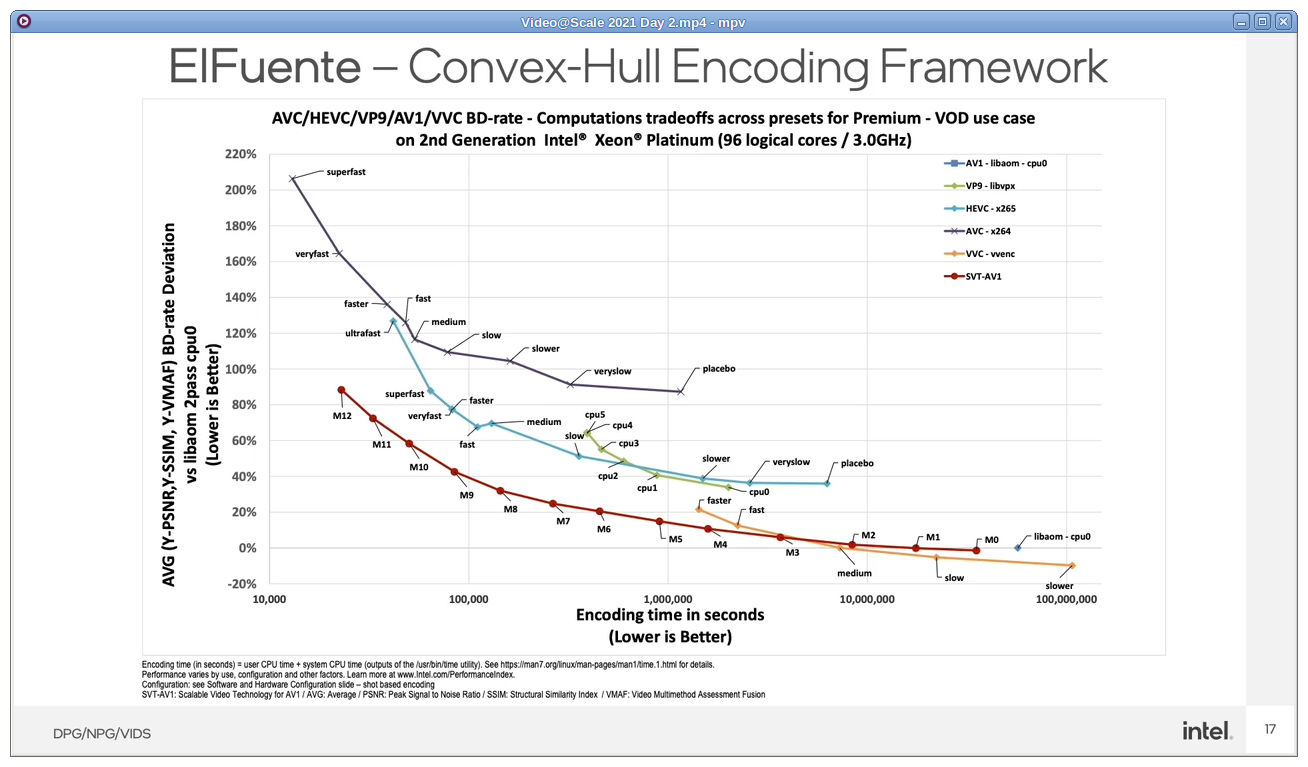
For what it's worth, Intel & Netflix's AV1 encoder SVT-AV1 is extremely fast -- it changed my mind about what encoder rates are possible with AV1, to the point that I'm very happy with realtime CPU encoding.
This was also true of H.265 in its early days before there was widespread support. I once had to wrangle a few workstations to act as a renderfarm overnight in order to transcode a couple hours of footage by the next morning having not been aware that we were dealing with H.265 until the day before it had to be done.
But also yes, as others are pointing out, this is a problem rapidly being addressed and is not atypical for new media formats.
I'm able to encode using av1an (which I believe still uses ffmpeg as its backend) at 3440x1440@30Hz with 10bit color using a mid/high-range AMD 3800X processor.
I'm not sure what might be wrong on your end, but it sounds like ffmpeg's default configs might not be well-optimized yet if you can't encode in real time.
With the correct encoder and settings, it can be faster to encode than x265, for any given "efficiency" that x265 can achieve. Of course, the efficiency can be pushed higher than that, too, still with a reasonable encoding time.
exactly. vp9 isn't actually that good. It's clearly worse than hevc. AV1 is better, but there's limited hardware encoding/decoding support. The result is exactly as expected.


A video of just 10min would take many hours, on the other end h265 encoding is slow but doable.
Edit: just retried on my laptop:
0.6fps with a 11th Gen Intel(R) Core(TM) i5-1135G7 @ 2.40GHz Using the lastest version of ffmpeg with the sample from the wiki: ffmpeg -i input.mp4 -c:v libaom-av1 -crf 30 -b:v 0 av1_test.mkv
It's that slow that I don't even get the file size to change on disk, still 0 I guess the ffmpeg encoded buffer is still too small to be flushed out after a minute.