If Powell pulls this off, as in we’re below 5% CPI YoY by Halloweeen, without jobless numbers spiking, I’d be inclined to believe we actually know something about monetary policy. (We’re currently seeing 2.5% over 5 [1] and 10 [2] years.)
Maybe, but I think some of it is just luck. Supply chain issues are starting to soften, finally. It all feels to me like we're still dealing with COVID bullwhip issues/echoes. The Fed has just been trying to manage the wave.
Alot of people have been predicting that this inflation was driven by supply chain problems and not by printing money.
I don't have enough information to give my opinion either way, but if indeed inflation is going back down, this wasn't luck, this was what they many were banking on.
It's clearly a combination of factors. War, post covid supply chain fractures and money printing all played a significant part it's just a question of how much.
When people said inflation was transitory, they didn't realize that the transitory period could mean a few years.
For "money printing" to have an effect on inflation, the money has to actually be circulating in the system. Most of the money printing people talk about, with the exception of the big fiscal policy responses(stimulus, ppp) is just number shuffling between balance sheets. It doesn't really mean much to the real world.
This is a tangent (not directly related to your comment) but I find it funny that whoever is in office, their political opponents will blame a poor economy on them (even if the issue is global), but if things do improve, whether the administration is responsible or not, those blaming the problems on them will suddenly have to change course and say it didn't have anything to do with the administration!
> Maybe, but I think some of it is just luck. Supply chain issues are starting to soften, finally. It all feels to me like we're still dealing with COVID bullwhip issues/echoes. The Fed has just been trying to manage the wave.
Weren't the high gas prices specifically fallout from the Ukraine-war? Is this an indication that the sanctions against Russia aren't working (e.g. they've had enough time to adjust to exporting to China/India, and their previous customers have had time to start importing more from the places China/India stopped importing from).
Yes, and - “managing the wave” that well is really hard. I didn’t think we’d be able to do it. If we do, it suggests we know something, at least, about monetary policy.
I think you are being very semiconductor focused if you describe it as "starting to soften". Lumber, copper, and meats are all at pre-pandemic prices and key drivers of inflation. Even some electronics categories (cameras) are dropping significantly which is why I think you said "starting". In my opinion, gas/oil/petroleum is the last thing keeping inflation up. If gas drops by 20-30%, things like plastics, cement, and anything that requires transport (food) will return to pre-pandemic levels as well. Some people will blame the war but the clear driver of all of this is Biden signalling to domestic producers that they will face hostility. The stopping of new oil production didn't move the needle itself but rather that CAPEX definitely was reduced which meant recovering production levels has taken longer than it should have.
Do you think oil magically starts flowing once a human signs a piece of paper? It takes time, the impacts of the last decision are being felt now 2 years after the fact and the impacts of this decision will take 2 years. We are reaping what was sown 2 years ago and it was entirely predictable and the whole point of the policy of banning new leases was to make oil more expensive to expedite green energy adoption as it becomes more economically viable. It is pretty clear Biden is still signalling that these concessions are temporary and that, if inflation is curbed, will go back to being hard on oil. Like I said, this signaling is more powerful than the actual policy because it prevents investment as the ROI is too risky.
Do you think there has been fewer permits issued under Biden? Because there haven't[0].
There were many thousands of existing leases not being developed[1], and now a record number of permits--both in percentage terms and as raw numbers--have been issued under Biden.
Turn off the political info and look at the reality: this is not, and has not been, a domestic leasing issue. The Russian invasion of Ukraine has really been as catastrophic for oil prices as people have been saying, which is why this is a worldwide problem, not just a US problem.
Biden banned new leases on Federal lands on the first day in office. Like I said, the policy did not prevent more oil production but investment in new production on existing leases were certainly tempered because companies did not want to spends $BIG_NUMBER to simply be told to shut off the pumps if the Democrats win the midterm elections.
Core PCE has been accelerating MoM the last few months. Wage inflation has been accelerating
There is no slowing of inflation in measured data, aside from leading indicators, like commodities, but speculation and US reserve releases have been a big driver in the downward move in oil prices. Structural oil price equilibrium is likely to be over $100/barrel once US reserve releases stop on November 1st
All market moves have just been anticipation at this point. Wage trends imply that core inflation is likely to average 4%+ as a steady state, even if headline CPI has peaked. If this bears out, the 10y treasury could easily run to 4-5%
There is almost certainly a coming whiplash effect from consumers reaching max tapping out of credit, that's the only thing that could realistically solve inflation at this point, aside from stronger Fed action.
Keep in mind markets greatly overestimated forward inflation through the 80s-90s, it's equally likely they may perpetually underestimate inflation in the 2020's. Market forward measures are not a strong source of accuracy if you reference history. Just look at what the market expectations of inflation were for most of 2021 (far below realized inflation in 2022)
You almost certainly know more than me on this topic. I am freely admitting ignorance, compared to you, before I comment.
That said, I cannot see any circumstance that exists that would result in bringing inflation to our target rates without a recession and much higher rates. From what I have read on fintwit, we have never brought inflation down without raising our interbank lending rate above the inflation rate.
What is worst is that wages are increasing too - "wage-price spiral". Except due to war, the only way we have broken a wage price spiral before is via a deep recession.
So in our future, we have either a large increase in the interbank lending that would result in zombie companies going out of business, and investment liquidity drying up leading to a recession - or we accept high inflation and the wage->price spiral which will naturally (at extremes) lead to a recession.
Look, I'm asking for your insight here - I can't see a soft landing because its historically not happened. I can't see a path without recession due to the choices we have to make. How is a soft landing here possible?
I'm also not an expert, but heck that's what the comments section is for.
Hitting the Fed's target would require deflation. We would need to average -0.5% month over month inflation for every month from now until the end of the year. (N.b., that's for the Fed's target, not the 5% mark in the comment you are responding to. 5% would be significantly easier, at the obvious cost of it being 5% YoY inflation.)
> What is worst is that wages are increasing too
My understanding from what I have read is that this is largely on the lower end. E.g., Amazon offering $15/h is driving those earning minimum wage up … but this is just pushing real minimum wage closer to its historic highs — which it is well beneath, so I don't think this should necessarily drive inflation. Price would go up not so much because labor costs, but because corporate greed wouldn't want labor capturing their fair share of the profit.
Tech in particular has been article after article about layoffs, or how the VC money is stopping. (And this matches my experience as an "normal" IC eng: I've lost >10% of my salary since the start of the pandemic.)
Even should inflation recover, then there is the problem of the higher interest rates for anyone in my age bracket who might like a mortgage some day. Housing market when.
You forgot to mention governments going out of business too. Half of US debt (15 trillion) needs to refinanced in less than two years, which is unaffordable if interest is above inflation.
That's affordable if they buy their own debt through "quantitative easing" - which means printing money - but then you're back to inflation getting worse.
From my perspective the root cause of inflation is a lack of housing (near where people need / really want it). Compared to my parents it is a herculean task for someone younger than 40-50 to get a starter house, near a stable job, that actually has a career path where settling down makes sense. Particularly where I grew up / currently live (near Seattle, WA).
Maybe houses are cheap in some places in the country, but those places are not where I am or need to be.
We need an overhaul on building policies. I'd like to see tougher building CODE (better built houses) and much simpler zoning with less red tape. Sustainable, tax base vs maintenance expenditure positive, already environmentally impact ready interface packages on the shelf for areas that can be built to provide the features an area needs. More like simulated city planner games.
As a deflationary measure, tax the rich for real. Instead of handing out more stimulus that will be priced into the inflation of goods; a hidden tax on the non land-owning middle class; increase buying power and quality of live for all by decreasing the wealthy's advantage and increasing the commons and public works.
Tougher building codes and lower prices are opposing demands. Tougher codes mean it’s more expensive to build or retrofit. Zoning is to land as codes are to structures - tougher zoning = higher prices.
Its possible that tougher buildings codes but with also much less restricted zoning could lead to lower prices. I'm not familiar enough with housing to know how much each affects the current market.
Building takes time, so this would be 2+ year market... but we've gotta start some time since for the last ~50 years 'enough' housing has not been built, there's a lot of unmet demand, which is why the market is so inelastic.
If you assume that productivity is fixed, and that relative shares of profits, wages, and taxes are fixed. Then the above is true. The reality is that the above have complex non-stationary relationships. Labor can get more expensive and more efficient. Speculative investment can be reduced, and capital/government can reduce/increase their share of the economy.
A soft-landing was possible post-WW2 US economy, where the US both inflated away large debts and maintained high GDP growth rates. We'll see how things shake out.
Most probably the employment figures only tell half of the story. As long as one has to get two jobs in order to have a decent living in many parts of the US then I don’t think said employment rate tells the whole story.
I think your point is "many poor people still need two jobs to make a living" and while that's probably true, we have many people who are now back to work, and many of them are not working two jobs. Is it because their second job went out of business? Unclear.
having two jobs doesn't affect the employment rate, you are still either employed or not. And if you work five minutes a month doing some dishes for your neighbor for pay, you are still technically employed, too.
it could affect the job hires rate, of course, but, the measure hasn't changed, people are just looking for reasons to nitpick it
> the employment rate, you are still either employed or not.
I know that, I didn't say otherwise, but having to have two jobs in order to make ends meet makes stats like the employment rate almost orthogonal to the economical and social "welfare" of the population.
Of course having no jobs at all it's worse, but hiding behind the mantra of "people are employed" without looking at how good or bad their socio-economic condition really is kind of misses the point.
Oil/gasoline is just commodities inflation, which is cyclical and probably bullwhip effects.
Core CPI is also running over 5% and wages are increasing at over 5%. The only way to really change the labor market is by destroying jobs and making people who lose their jobs desperate enough to take whatever they can find. That'll only happen through increasing unemployment via a recession.
The Fed is going to have its eyes focused on Core CPI which won't change until employment numbers change. We haven't seen wage inflation like this before, but this time there actually are some important differences. Boomers are retiring, immigration was reduced by Trump and those low levels maintained by Biden, COVID killed and disabled quite a lot of people, and a good chunk of people are just fed up with the way employees get treated and unionization is rising. That isn't gong to go away because oil prices drop.
And oil is dropping due to fears of a recession and demand destruction, so the markets are displaying "backwardation" where the further you go out the more the futures prices drop.
The 5-year and 10-year inflation expecations are likely pricing in a recession which will cause the demand destruction to cap inflation (and note that the effect of these policies to cap inflation also lower long term interest rates).
It is interesting how many Millennials are about to get an economics lesson. Surprisingly there's more to economics than just the "money printer go brrrr...." meme.
we are still negative GDP growth which is a disaster even if unemployment stays where it is, because it means our economy is becoming less productive and less efficient. Which isn't really that shocking when you consider money is being printed and handed out rather than allocated efficiently. Bunch of debt accumulated with not much to show for it
The US is becoming the equivalent of the startup meme of losing money on every sale and making it up with volume
How is falling productivity (and it has been tanking the last couple of quarters) caused by easy money policies? Seems like it's more related to the large number of folks who have gotten covid over the last six months or so. That and supply chain disruptions (at least partly due to China's 0-covid policies shutting down a lot of factories there - so that can be blamed on covid as well).
if you've been to a grocery store you don't need anybody trying to make things look bad, you can look at your receipt. Record levels of credit card debt and the rate of auto loan defaults tells you all you need to know
This has almost nothing to do with Powell. The demand spike began easing months ago as gasoline inventories began to go up.
The thing about the Fed and both parties is their only tool for tackling inflation is to suppress worker wages by spiking unemployment. That's what monetary policy is designed to do. But it's not the only way to tackle demand.
But you can do the same thing with taxation (eg Spain's windfall tax [1]). Why is it no one in US politics talking about that? The answer should be obvious: both parties exist to protect the capital-owning class and won't do anything that migh thurt profits.
> their only tool for tackling inflation is to suppress worker wages by spiking unemployment
This is nonsense. Unemployment is down.
Raising rates reduces aggregate demand in fairly direct ways, e.g. through home construction and renovation. To the degree workers are getting screwed it’s by real incomes being squeezed by inflation.
It's not nonsense. In the US, full-time jobs are down, people with multiple jobs are up. It's not reflected correctly in the Establishment jobs survey, which is the survey the media outlets all use when reporting jobs numbers.
Anyway, full time jobs are dropping out of the economy, but it's being offset by people taking more than one job to make ends meet. I don't know about you, but this hardly seems like a healthy situation.
> don't see why "Many-to-most people have to have two part-time jobs to make ends meet" precludes unemployment being at a 50-year low
Full-time employment is at a record high [1]. Multiple job holders are about 1mm over the pre-pandemic peak, but below trend and not cannibalising FTE [2].
> High inflation is causing the sharpest decline in real wages in decades. Even in a robust jobs market, the typical worker ends up financially worse off with every month that passes.
> The Fed has raised interest rates four times in its battle to curb the steepest inflation in four decades, and policymakers have signaled that more increases are in store. That strategy is likely to lead to a slowdown in hiring later in the year as companies cut payrolls to match expected lower demand.
> Already, surveys of restaurateurs, home builders and manufacturers have reflected concern that current spending will not continue. Initial claims for unemployment insurance have been creeping up, and job openings have fallen for three consecutive months.
> In that case, poorer families will almost certainly bear the brunt again, because low-wage workers are often the first to lose hours and jobs. The bifurcated economy, and the policy decisions that stem from it, could become a double whammy for them, inflicting higher costs today and unemployment tomorrow....
> America’s poor have spent part of the savings they amassed during coronavirus lockdowns, and their wages are increasingly struggling to keep up with — or falling behind — price increases. Because such a big chunk of their budgets is devoted to food and housing, lower-income families have less room to cut back before they have to stop buying necessities. Some are taking on credit card debt, cutting back on shopping and restaurant meals, putting off replacing their cars or even buying fewer groceries.
> So in principle, it seems as though, by moderating demand, we could see vacancies come down, and as a result—and they could come down fairly significantly and I think put supply and demand at least closer together than they are, and that that would give us a chance to have lower—to get inflation—to get wages down and then get inflation down without having to slow the economy and have a recession and have unemployment rise materially. So there’s a path to that.
Back to you:
> Raising rates reduces aggregate demand in fairly direct ways, e.g. through home construction and renovation
Because if there's one thing we need it's less home construction.
Higher capital yields mean a higher income share for capital. That means companies have less money to spend on wages and as far as I know, employers prefer firing entire humans over reducing pay or working hours over the entire staff, hence the unemployment problem and the need for inflation to quietly negotiate wages downward to avoid excessive unemployment that deflation would cause.
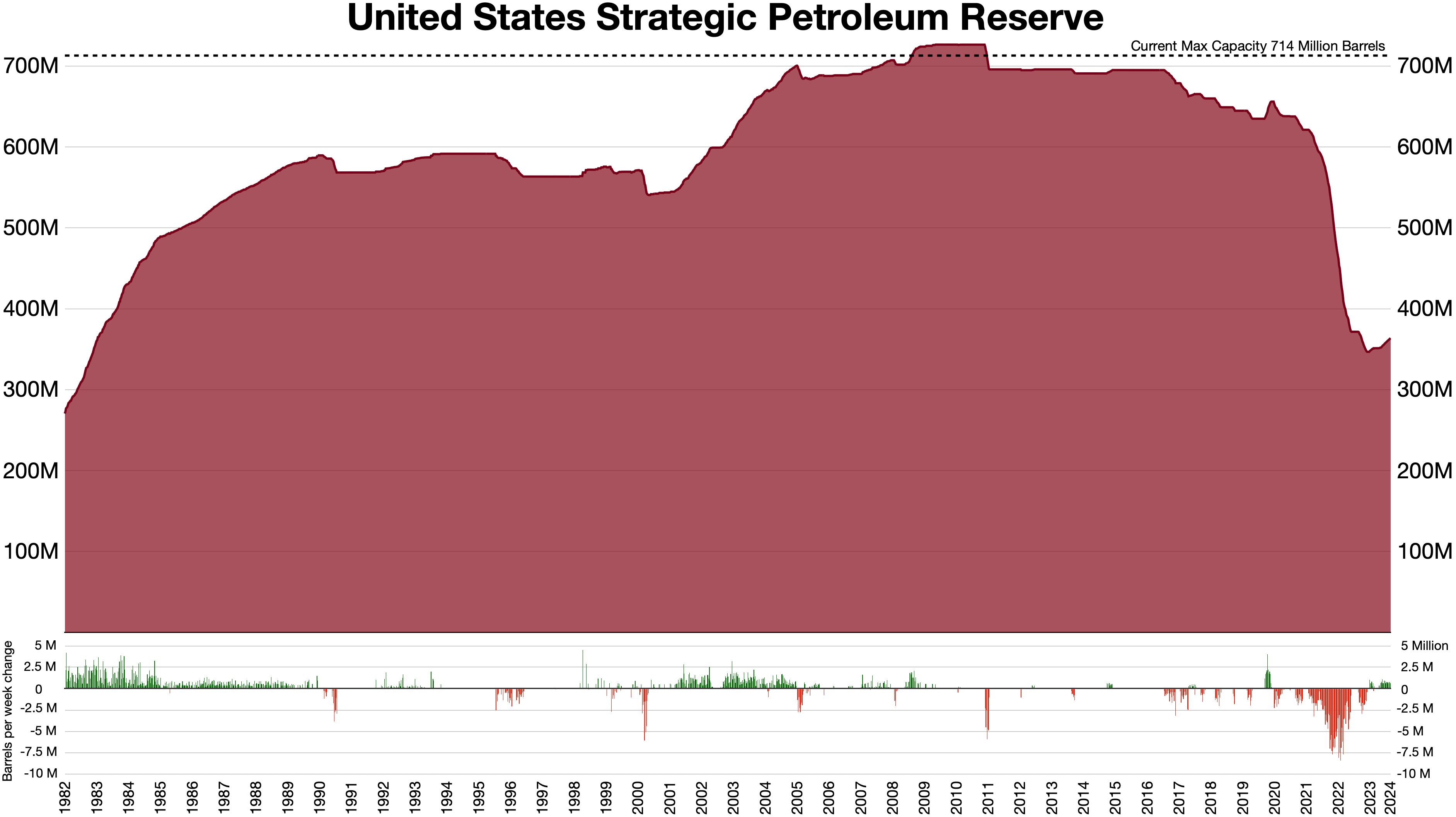
Enjoy it while it lasts, they're going to start refilling the strategic oil reserve in October IIRC and that's going to get interesting with prices again. If you didn't know, the US has been emptying its oil reserve at an enormous rate (I think fully 1/3 of it is gone now) to try to keep prices low.
Relative to daily US/global petroleum demand, the stategic oil reserve really isn't that big. I don't think it will cause a noticeable impact in prices.
With an inelastic good like oil, small changes in supply can cause big price swings. The reason is people don't curtail their use much as the price rises.
It's not the magnitude of demand that affects price - it's the price elasticity - the demand and supply curves matter. Demand for petroleum (e.g. gas, etc.) is very stiff - so small changes in supply can have large impacts on price.
Prices being sticky against increases to supply is to be expected. It's not like these are mechanical processes that happen automatically, people set those prices. Of course they won't price in information that makes the price drop.
Curious where this kind of federal oil and gas strategy is shared publicly? I'm just a tech bro, but it's always interesting to talk to my friends in private equity who work on energy (although supposedly this is a lackluster division of PE). It sounds like the current presidential admin has absolutely hammered the ability for oil extractors to finance exploration / development to extract new oil?
1. Most oil and gas production is on private land within the United States
2. Oil and Gas firms have leases to drill on public land that they are choosing not to produce. In short, they make more money with the price oil is high. Just look up their old profits and compare those to oil prices.
3. The Federal Government has many tax breaks and handouts for oil and gas firms. its in the billions per year : https://www.eesi.org/papers/view/fact-sheet-fossil-fuel-subs...
To be fair, if a president got elected that was vowing for the destruction of your industry, I doubt you'd spend a couple million investing in continuing that industry.
Might as well take your profits and run elsewhere since the prospects of long term oil usage is currently up in political turmoil. Political turmoil makes people think twice about investing in anything that could be taken away in a moments notice.
> Drillers, meanwhile, say they are balking at the government’s offer to take their oil because it is hard for them to move it from inland fields to the SPR delivery sites on the Gulf Coast, and because they worry placing it in the reserve could compromise the oil’s quality.
Oil transport barges were making bank around that time (I made a decent rip selling calls on co's in that industry) selling tank space on ships at a premium to handle the overflow.
When the US has to start buying millions and millions of barrels to refill the reserve (as obligated by congress/the law), then yes it will definitely affect everyone's oil price.
Yes that's exactly what it did, it kept us from seeing $10/gallon gas at the pump which would be immediately catastrophic to the entire American way of life. Even with $5/gallon gas like now and earlier in the summer we have seen pretty dramatic inflation in food and goods--diesel is enormously expensive and increased trucking costs just push up the prices of goods higher.
So now imagine what's going to happen when that is turned off, and even worse when the oil market sees pressure from the US buying millions and millions of barrels to take them off the market and throw them back into the reserve...
Additionally, the US did not stop the exports of oil though any federal trade policy when prices went from ~2 - $7 per gallon.
Exports continued at a in the ~3,500 barrels per day.
I understand they will stop depleting the strategic oil reserve this fall. Have they announced that they're going to start refilling it at that time, or will they do so strategically over some period of time?
We'll see what happens. The timing is terrible with Europe going into an enormous energy crunch as winter nears too. The fact that multiple countries (Germany, UK) are warning citizens and preparing them for loss of power and heating, steps to reduce power usage, etc. this winter is concerning.
Oil tends to be transported by tanker so it can be moved where needed. Europe's gas tends to come in via pipeline. Although it is now transported as LNG.
Here in the UK petrol prices are dropping while gas prices are still predicted to increase.
Also the govt here hasn't been warning about loss of power and heating. We were already importing gas via LNG. And are currently exporting that to the mainland via pipeline aswell as exporting electricity.
Short term contracts for gas are (were?) Incredibly cheap because we're receiving more LNG than we can actually pump to the rest of Europe. Unfortunately retail rates depend on longer term contracts.
so if a new ic car is built and sold the price wouldnt change? if a new ev is built and sold the price wouldnt change? if a new oil reserve is found the price wouldnt change? if a storm happens and knocks a refinery out of action the price wouldnt change?
Of course, it’s absurd. That’s what I was pointing out. Prices do change, so obviously markets are not perfectly efficient, and in fact can’t be including for the reasons you give.
That's a perfectly fine definition, but the post I was relying to was not taking that into account. It was suggesting that in a perfect market the possibility that maybe a certain course of action might be followed, that this must be priced in. If you follow that logic, then in perfect markets prices should never change. The problem is it's flawed logic because uncertainties cannot be priced in.
Because all future risks, including the ones under discussion, would already be priced in.
Obviously that can’t be true because not all risks can be anticipated accurately in advance, but that includes things like government strategic reserve changes that may or may not happen depending on all sorts of other factors.
The politics around this have been really interesting to watch as different people cherrypick (or just manufacture) evidence to push a particular agenda.
I stumbled across a creator on Tiktok who knows a lot about the oil and gas industry [1] who has been illuminating (to me at least) about what's been going on here.
Here's my summary: we haven't had a shortage of oil production although that was off its peak. The real problem was a lack of refining capacity that was caught off-guard by this year's massive increase in demand. There are a bunch of reasons for this. Some capacity was lost due to a hurricane. Other capacity was offline as certain plants were being transitioned to a renewables future when the demand was lower and it wasn't anticipated it would return so strongly and quickly.
Have Exxon, Chevron, etc made bank with the spike in prices? Absolutely. If you want to propose something like what Spain has done with a windfall tax to fight inflation (something no politician in the US talks about) then I'm on board.
But you can't just turn on an oil well or a refining plant. It takes time. Oil companies, for all the heinous crap they have done, antiticpated this demand spike was temporary better than any politican has.
On the political side you see Democrats desperate for prices to go down so they get slaughtered less in the midterms and Republicans desperate for this not to happen for the inverse reason (eg Republicans wanted to stop selling oil from the SPR).
But the warning signs of this price drop coming were evident months ago as inventory levels of gasoline started to go up.
> If you want to propose something like what Spain has done with a windfall tax to fight inflation (something no politician in the US talks about) then I'm on board.
> for all the heinous crap they have done, antiticpated this demand spike was temporary better than any politican has.
It's not that they necessarily anticipated the spike and subsequent fall; it's more to do with investor dynamics. Oil is a traditionally huge boom and bust field and is incredibly capital intensive. After the bust in the mid 2010s, coupled with huge investor outflows due to ESG reasons, the message that oil companies got from investors was to minimize capital spending (because they had little) and focus on profitability. So when this cycle came around, few were looking to do commit the capital to lift supply up. And now that demand is swinging back down, I suspect the bust cycle will look less dramatic then it has in the past.
> And now that demand is swinging back down, I suspect the bust cycle will look less dramatic then it has in the past.
I've seen people who seem to know a lot about this industry make this point. We probably won't see $1.50-2/g prices but next year we'll probably see ~$2.50/g and that's probably a good thing, better than a more extreme boom and bust cycle.
How on earth is a windfall tax supposed to reduce inflation? Adding taxes makes goods/services more expensive.
You would be removing the incentive to produce more oil. Why would an energy company invest enormous amounts of time and capital to increase production and refining capacity if the government seizes their profits?
Nobody enjoys producing oil. Profit is the only motivation to perform such a difficult/unpleasant task.
> How on earth is a windfall tax supposed to reduce inflation? Adding taxes makes goods/services more expensive.
Because a lot of price hikes haven't been because of inflation. They've exceeded inflation. Another word for that is "profiteering" (or "price gouging"). It's the reason why it's typically iellgal to profiteer off of a natural disaster, for example.
Put another way: Exxon, Chevron, etc are raising prices not because costs have increased but because they can. The record profits they've all recently announce bear that out.
So a windfall tax does a similar thing to increasing interest rates: it's a form of wealth redistribution. Raising interest rates diverts money to banks and investors. Taxation diverts money from corporate profits to the government who can then use that money for the people who are most vulnerable because of, say, the skyrocketing cost of gas and rent.
> Because a lot of price hikes haven't been because of inflation. They've exceeded inflation. Another word for that is "profiteering" (or "price gouging"). It's the reason why it's typically iellgal to profiteer off of a natural disaster, for example.
> Put another way: Exxon, Chevron, etc are raising prices not because costs have increased but because they can. The record profits they've all recently announce bear that out.
This doesn't make any sense. It's purely a supply/demand issue. Oil is potentially the most liquid commodity in the world. If someone wants to price gauge, your competitors will sell for less. We haven't built a new refinery in the US since ~1979. The oil producers are basically maxed out on refining capacity and trust me, those guys want to sell as much oil as possible. They made record profits because there's a shortage of a critical resource and tons of demand.
The way to fix this is by increasing production capacity. If you've made it more expensive to expand production, it should be obvious that you cannot expand.
> Taxation diverts money from corporate profits to the government who can then use that money for the people who are most vulnerable because of, say, the skyrocketing cost of gas and rent.
The ~30T deficit says otherwise. Our interest payments on that debt alone is ~$400B annually and will only grow. That's over HALF our military budget in interest payments. The government has done a terrible job of managing money.
Inflation comes from government spending. Look at the Fed's balance sheet! If you double the amount of dollars, but there's the same number of goods/services...you would think dollars would be worth less.
The UK bastardizes the metric system like the US does, but in different units too. So they measure car efficiency in miles per gallon but the number comes out different from American numbers because their mile is the same while their gallon is different.
I assume the UK is the same as the US though where all Imperial units are now just derived from metric equivalents anyway. It's all deranged, welcome to the world.
That's a separate, third kind of ton (hurray standards!).
The tonne is a metric measurement for 1000kg. American and UK tons are different amounts, but spelled the same way. They're known as short ton and long ton respectively. America also uses the long ton and the metric tonne for some applications without differentiating the names at all.
The UK price includes 57.95p per litre duty and then 20% VAT on the total.
In my opinion the UK is extremely well positioned geographically for renewables. The main problem right now isn't the technology or the theoretical capacity, it is government policy wherein the UK subsidies fossil fuels heavily, while actually slowing renewable projects and or electric transport[0].
What I find frustrating is that renewables are often only framed around climate change, whereas they are really a national security imperative (as is climate change too, by the way). The UK is too reliant on foreign countries for fossil fuels. The UK could very easily manufacturer wind turbines, but choose not to, then are surprised when international fuel instability and unstable demand wrecks havoc on the country.
You'd think they would have learned something from the current chaos, but the messaging coming out of Whitehall suggests that they're just waiting for the current storm to blow over while not looking over the horizon at how to stop the next time.
> You'd think they would have learned something from the current chaos, but the messaging coming out of Whitehall suggests that they're just waiting for the current storm to blow over while not looking over the horizon at how to stop the next time.
The civil service are utterly incapable of responding to any crisis. In fact, I’d argue that “Yes, Minister” was more documentary than satire.
Dominic Cummings’s breakdowns of COVID behind the scenes paint the picture of chaotic dysfunction back then. Hard to believe anything will have changed since.
Costco gas also the cheapest in its geographical area in the US. The only (first world) problem is that the queue time is usually 8 or 9 cars back (at least in California).
The Redwood City (CA) Costco is about the same price as the cheapest station on Woodside Road (2 miles away, and closer to many neighborhoods). I have a Costco card but never go there for gas anymore due to the wait.
First time since March, wow think of the poor drivers. Meanwhile second hottest July not since March, or since last year, or since last decade, but in recorded history—but that's not something you feel in the pocket just yet so too few people care to connect one topic with the other.
According to one analyst, the price of Brent Crude coming back to down to ~USD$60 per barrel would bankrupt russia and stop their illegal war in Ukraine.
IIRC there was quite a bit of piling up going on but eventually manufacturers have decided (as an example) “eh this car doesn’t really need that chip that controls cruise control, ship it” to some extent.
Cut production, it was just in the news that they cut another 100k-180k vehicles the other weem from their production schedules for the year for chip and other supply chain disruptions.
But let’s be clear, if gas prices have fallen, they are still much higher than what they were before, and the fallen gas prices had absolutely nothing to do with president, or congress, no matter how much credit they try to take for it.
I posted this to bring some since of balance to all the high gas price stories that were previously on Hacker News. Gas prices are still plenty higher than during the period when driving was down significantly, and there was no war involving a major oil supplier. Gas prices will soon not be significantly different than they were for, say, 2011-2014: https://fred.stlouisfed.org/series/GASREGW . You're right that, because petroleum is a global market, there's not a lot that the president or congress can do to do to bring prices down, but they also shouldn't be blamed for recent increases.
The kicker is that we're currently only paying the price of extraction, not the true price of the energy itself. Electrification only accounts for a very small part of the solution since fossil fuels are still immensely important for many other industrial processes that can't simply be electrified.
Interestingly, total net extraction of available oil peaked around 2019 - I'm not sure we'll ever see numbers like that again.
Highly recommend looking into the academic work / podcasts of Nate Hagens. His social theory is flawed in my opinion, but his reasoning on energy is impeccable.
I live in BC Canada. The province is at about 95% non-fossil fuels for electricity (a large part of that remaining 5% is remote communities where hooking into the grid is prohibitive.) We have also cut our CO2 per KWH by 65% since 2010.
Perhaps tis just coincidence that our carbon tax was introduced in 2008, and has increased yearly.
Buried hydrocarbons are mostly not dead trees. It's usually from long buried microscopic sea life (plankton, algae).
> Electricity is not an energy source, so you have to burn dead trees to get it.
Or from nuclear, renewables, etc. They definately can solve the problem when it comes to electricity. The problem is not everything is electrified. There's also a question of how long it would take at an investment rate we're willing to make.
How do you have burn dead trees with renewables or nuclear? I mean I agree that they probably won’t be enough without reducing our consumption but they are far from not solving anything
Wind, solar, nuclear and hydro can not be built with electricity at scale, you need coal, oil and gas to mine and melt steel (1500C) and burn lime stone (1500C for 3 hours) for concrete.
Also you cannot make food with electricity at scale; tractors, trucks and fertilizers (500C + 200 Bar) need hydrocarbons.
The US position back then was that that was too low, and used the threat of cutting off military aid to get the Saudis and OPEC to cut production for two years to raise prices.
GOOD Point by my wife. Has anyone considered building enormous oil reserves and using it to smooth out prices? It seems like the wild swings in prices bring costs of their own.
The US has already done this, and has been using it to combat oil price rises.
Look into the Strategic Petroleum Reserve.
It would seem that part of the problem is that we use such massive quantities of oil that it isn't easy enough to store enough to make much of a difference.
I feel you should have the option to buy gasoline futures at the gasoline station. Imagine buying X number of gallons at current prices and loading that onto a card. You can then pump those gallons from the same brand of gasoline at any time without worrying about the current price.
Some people don't live in the US or keep track of fuel prices: for them it's interesting to know that they are dropping again. It's also spun up a few interesting threads. I don't think it's entirely useless information.


[1] https://fred.stlouisfed.org/series/T5YIE
[2] https://fred.stlouisfed.org/series/T10YIE