France wanted revenge for Haiti's independence and to send a message to its other colonies. So, Haiti had to pay huge amounts of money to France until 1947. In order to fund this, they began harvesting wood at an unsustainable pace which led to deforestation. This in turn led to a decrease in agricultural output which started a cascade of other problems.
It has been essential for the development of almost every country in a similar situation, to initially rely heavily on agriculture. If you remove that, then that's a recipe for disaster.
There wasn't knowledge/investment in the country to jump to an industrial economy so they got stuck in their developmental phase, because of the massive deforestation.
> For decades to come, the United States was the dominant power in Haiti, dissolving parliament at gunpoint, killing thousands and shipping a big portion of Haiti’s earnings to bankers in New York while the farmers who helped generate the profits often lived near starvation.
You say it was a huge amount; the article says it was a small amount. Unfortunately neither of you states the amount, so it is hard for me to assess how big it was.
> After reviewing thousands of pages of archival documents, some centuries old, and consulting with 15 of the world’s leading economists, our correspondents calculated that the payments to France cost Haiti from $21 billion to $115 billion in lost economic growth over time. That is as much as eight times the size of Haiti’s entire economy in 2020.
That's not the actual size of Haiti's reparations to France though - it's completely imaginaary, hypothetical money that the New York Times is claiming Haiti would've made if not for the evil colonialists ruining their economy through reparations. The actual total reparations according to that article were $560 million in today's dollars, or between a fortieth to a two hundreth of how much the NYT is claiming it really cost Haiti. That claim should probably be taken with a massive pinch of salt given the quality of their reporting on race, slavery and colonialism of late.
Just the way they seem to be comparing the supposed cost of those reparations over all time to one year of GDP here seems pretty slimy. The part you quoted is clearly intended to make an inattentive reader think Haiti's GDP would've been eigth times larger if not for reparations, but not only is that not what it actually says, it's impossible to tell how big the supposed loss is compared to the size of their economy - the two are stated in incomparable ways.
> But the loss to Haiti cannot just be measured by adding up how much was paid to France and to outside lenders over the years.
> Every franc shipped across the Atlantic to an overseas bank vault was a franc not circulating among Haiti’s farmers, laborers and merchants, or not being invested in bridges, schools or factories — the sort of expenditures that help nations become nations, that enable them to prosper.
The cost of reparations versus the impact is different. The impact is a guesstimate, the cost isn’t.
The debt with France does not have any explanatory power as to why the DR's and Haiti's economic fates diverged though. Even if the debt held Haiti back from the glory it would have otherwise seen, or stagnated its economic development by many decades, we would still expect Haiti's economy to grow AFTER the debt was paid off to a much greater extent than it did.
There to me, is clearly more afoot here than the evils of France.
It’s not like the entire country worked weekends to pay this off.
The debt skimmed the cream from the country, and the political maneuvering by various parties introduced pliant, corrupt leadership. Haiti has been a failed state for a long time.
No we wouldn't, if the debt caused destruction of the local environment (which it did) there's no way how they could've started making money. Just importing food and other basic goods would starve their resources and give them no room for investment.
Looking into the stats, Haiti had 60% of forest cover in 1923 https://en.wikipedia.org/wiki/Deforestation_in_Haiti. If the debt made deforestation inevitable, why did Haiti have so many forests far into the servicing of the debt? I feel there MUST be something which happened in the 20th century which really accelerated deforestation aside from the debt.
I just don't buy the "debt destroyed all future economic/agricultural output" angle at all. If you just showed people a bunch of chart of different countries economic information and agricultural output devoid of broader context, nobody would probably EVER come to the conclusion that the debt led to the stagnation in agricultural output in Haiti from the numbers alone. If you compared the debt vs deforestation, again, nobody would conclude the debt caused the deforestation from the actual data. People would only ever conclude that if they're being shown unblinded data.
Let me stress here - I'm not even saying this must all be Haiti's fault, or that debt didn't have a profound impact which have shrunk Haiti's economy many times over. I'm saying the debt doesn't explain what happened. I feel like I'm getting a fraction of the picture here. All sorts of wild shit happened in Haiti in the 20th century, the United States occupied the country for instance and the deforestation correlates MUCH more strongly with this occupation than it does the debt.
I will post here the first paragraph of [1], as it directly provides this bit of information:
"The Haiti indemnity controversy involves an 1825 agreement between Haiti and France that included France demanding a 150 million franc indemnity to be paid by Haiti in claims over property – including Haitian slaves – that was lost through the Haitian Revolution in return for diplomatic recognition, with the debt costing Haiti $21 to 115 billion of economic growth over a period of two centuries and affecting the nation to this day. The payment was later reduced to 90 million francs in 1838, comparable to US$21 billion as of 2004, with Haiti paying about 112 million francs in total.[4] Over the 122 years between 1825 and 1947 the debt severely hampered Haitian economic development as payments of interest and downpayments totaled a significant share of Haitian GDP yearly, constraining the use of domestic financial funds for infrastructure, public services and ultimately making the nation ungovernable."
Singapore is a compact city-state, Malaysia has almost 500x the land area split across two major land masses to boot.
The classic divergence is North vs South Korea, which were practically identical until the Korean War. Historically the North was richer, now the South is orders of magnitude wealthier.
Obviously two Koreas had different priorities. What you said is true, but on the other hand, North Korea is an independent nuclear power, while South Korea is a kind of corrupt vassal state hosting foreign army on their soil.
South Korea, like Japan, is a "latent" nuclear power - meaning they have the ability to quickly (likely a matter of months) produce nuclear weapons given current resources and expertise.
Not shutting down their nuclear power plants is an easy first step. Building more nuclear, developing local fossil fuel sources, and building LNG offload terminals would all be good second steps, though of course also more expensive.
More nuclear - after Fukushima not a realistic option.
LNG - would be useleff today, since the Empire decided to limit LNG exports. And even if the Germany could claim complete LNG world export capacities all for itself, it would still not be enough.
local fossil fuel sources - there are none that are not already in use
Fukushima may have been bad (this is debatable, it was bad in public opinion more than anything else), but viewed in comparison to "not having enough power leading to industry shutting down (happening now) or people freezing to death (this winter)" or "not being able to oppose Russia" perhaps it's not quite so unrealistic.
As far as I know the USA has not restricted LNG exports. LNG is still very cheap in the USA in comparison to the rest of the world because our export terminals are operating at capacity. (To be fully effective, more global LNG export capacity may need to be developed - this is very possible as the US has excess capacity, but it is of course more expensive than just importing from Russia)
There are local fossil fuel sources! Lots of coal, for instance. Yes, this option sucks, and releases a ton of pollution! But you can still do it!
Isn’t this just path dependence in action (a least in part). If Haiti hadn’t paid reparations to France for a century plus, they would have had more resources to invest in building their own industries/capacity.
south korea also paid huge amounts of money to developed nations in exchange they applied policies that were favoring those countries. they are now one of the most developed countries on earth.
There are different levels in everything and you'd be hard-pressed to find worse than Haiti.
According to Wikipedia, the Dominican Republic has the fastest growing economy of the Americas while Haiti is the poorest country in the Americas (And neither has anything to do with France, and since the US meddled in both and even occupied both they probably have little to do with either as well)
The difference is not that Dominicans are smarter Hatians (which I think is what you are dancing around). The DR has enjoyed more political stability due to the amount of foreign investments in the country which would have never happened if the DR was stuck in a precarious developmental stage, as it was the case with Haiti.
>Haiti has, and has had, an utterly corrupt and incompetent government/state. That's why they are in the situation they are in.
Relevant Reddit post: TIL that Haiti has had 23 constitutions since 1801, with the most recent being enacted in 2012. At least two have declared the country to be an empire.
> deforestation ... in turn led to a decrease in agricultural output
Can you explain your theory here?
Deforestation happened all over the world and usually increased agricultural output (by creating more farmland). Why do you think deforestation led to a different outcome in Haiti?
This was excessive deforestation due to the pressures of the debt. Which led to desertification. This excessive deforestation didn't happen in the Dominican Republic, which explains the difference. If you visit Haiti and the Dominican Republic you would be able to tell the difference in climate and soil.
"To the west of the island of Hispaniola is Haiti, only 3% of which now has forest coverage. Although the
Dominican Republic that makes up the east of the island still has 23%. At least 90% of Haiti’s soils have been
severely degraded by deforestation and inappropriate cultivation as compared to 40% for the Dominican Republic." [1]
Not sure if desertification is the right word for "all the fertile topsoil washed off the hills in the rains, and without trees to moderate drainage, river flood more often, and those floods cover productive land downstream in infertile silt".
Those things aren't mutually exclusive. Did you take from what I said to mean that the entire country turned into a desert?
Haiti has become more desertic in some parts due to the deforestation and that causes a number of things to happen that affect soil quality including floods.
Might also be worth stating, that it was a restored French Monarchy, in conjunction with other European Monarchies that extorted this money with a threat of invasion.
Since they were basically doing the same all across Europe in the same period, putting down the first tentative steps into modern European democracy, we don't really need to frame it as Haitians Vs French, but (literally) right-wing vs democracy.
"Following the arrival of Europeans, La Hispaniola's indigenous Taino population suffered greatly to near extinction, in possibly the worst case of depopulation in the Americas."
I don't think that just because it's different people now on both sides makes it possible to use such actions to argue from a moral high ground, the power difference and who oppressed whom remained in place even though the peoples changed.
With Haiti, you don't have to go all the way back to the settling of the island for brutality. The closest analogue I've read to the behavior of the French who ruled Haiti was the treatment of camp inmates by the Nazis. Haiti was the worst colony in the Caribbean. It made the antebellum South look like a utopia in comparison. The life expectancy for slaves sent to Haiti was abysmal. Most of them died on the plantations within about 10 years of stepping on the island. So many died that in order to sustain the slave population, the French had to import tens of thousands every year. They wanted to create a native slave population, but it didn't work because they worked the slave women so hard that they made them infertile. They ruled by means of terror. The stories are sickening. They executed disobedient slaves by stuffing their rectums with gunpowder and blowing them up. They strapped them down and poured boiling cane sugar over their heads. They buried them up to their necks and smeared them with honey so that they'd be eaten by insects. For punishment, they cut off their slaves' limbs and poured hot wax on the stumps. This had gone on for a century prior to the revolution. By that time, there were about 500,000 slaves being ruled over by 30,000 whites (as well as, partially, 40,000 mixed-race Haitians).
It was not smart or good for Dessalines to massacre the 4000 or so whites that he did, but that act is so minor in comparison with the horror that the French visited on Haiti for 100 years that it's barely worth talking about.
You forgot to mention that it was due to diseases carried by europeans, it was not voluntary. The 5000 white killed the day of independence of Haiti was voluntary.
As a European whose country suffered and was enslaved for long periods of time, I take offence in the rhetoric of "Europeans" committing such crimes. Be specific, a subset of European nations, a subset of American nations, and a subset of Asian nations try to dominate others through violence.
So, name your country if you've done such deeds, but keep mine out of it.
Don't put every european nation on the same scale when it goes to mass killings.
Here the subject is Haiti, now please tell me how many voluntary mass killings happened.
Not quite sure about where we ended up here, but just to clarify, just in case.
I don't think it is whataboutism when it is relevant. I think it should have been considered in the initial argument, the one I replied to, to begin with.
The "genocide of its white population and confiscation of their property and land." - from the comment I replied to - was preceded by terrible atrocities by the people then in power against those who revolted (also see the comment from ambrozk). I think that is relevant to the discussion. Whataboutism brings in stuff that is not relevant and unrelated, to distract. I think I'm still right inside the same topic, one leading to the other.
It is not all or nothing. From today viewpoint, slave freedom and compensation from slaveowners is a legitimate goal, while confiscation of property (especially of non-slaveowners) and genocide is not defensible.
Not that rarely used, unfortunately. I've heard this argument delivered genuinely from kind old ladies who care a lot about ethics, history, anthropology etc.
It seems to be the "Godwin's Law" of political discussion. At some point it always goes back to might making right.
... Apologies if that was your [ought to be obvious but these days sure af isn't] point.
Note that the "property" that the Haitians had confiscated from the French included, in the opinion of the French government, the Haitians themselves. So the French, in effect, forced the Haitians to pay for the right not to be slaves.
Observe the colonial/imperial mindset - gun-trotting French sail to the Caribbean and steal land from Taino Indians, and kidnap and enslave Africans to do the work. Then back home, the king is guillotined and eventually even Danton is guillotined. The enslaved Africans eventually rebel against the slave masters, and they get into a sanctimonious huff about how "their land" was confiscated.
Ignoring the evidence that the enslaved Taino to some extent integrated with the imported slaves, the slaves made up 90% of the population and likely an even higher percentage of the workforce. That should give them the best claim to the land
I mean yeah? If your people spend a century integrating with the locals and working the land to the point where you make up the overwhelming majority of the population, it's pretty fair to say you have some right to it.
Stealing land from Taino people is as much unacceptable as confiscation of land of french citizens, and i am sure if there were some large Taino empire then it could protect property rights of Taino people against colonialists, but that is centuries before Haiti revolution, and since that property rights were clearly established.
If you look on individual level, then it is clear that person A cannot just stole property from person B and defend that by the fact that great-grandfather of person B stole it from person C.
It tells you in the article, the White Terror killed him, and then started calling what he did "The Terror" to discredit him, while they killed lots of their political enemies.
Don't mess with powerful people or they will kill you, and make you the villain of the story.
> The term "Terror" being used to describe the period was introduced by the Thermidorian Reaction who took power after the fall of Maximilien Robespierre in July 1794,[1][2] to discredit Robespierre and justify their actions.[3] Today there is consensus amongst historians that the exceptional revolutionary measures continued after the death of Robespierre, and this subsequent period is now called the "White Terror".
I'm struggling to follow your analogy. The Reign of Terror (slavery on Haiti?) fed into a reactionary White Terror (1804 massacre?), which in turn led to the rise of another brutal dictator and the return of all that was bad about the monarchy. Is that right?
The 1804 Hatian Massacre was a tragic event that killed about 5000 whites. For the century of slavery in Saint Dominique, around 10000 slaves a year died due to the oppression of slavery. So why did the French deserve revenge and not the Hatians?
> why did the French deserve revenge and not the Hatians?
Nobody deserves revenge. We deserve justice. But slavery and massacres are fundamentally unjust. Revenge perpetuates cycles of misery—that’s the story here.
Do the Tutsis "deserve revenge" against Hutus for the Rwandan Genocide, including women and children and Hutus who had nothing to do with the killing? According to your logic, yes. Fortunately for all involved, a counter-genocide in Rwanda was avoided. 30 years later Rwanda has comparitively low levels of corruption, high tourism, good international relations, and a rapidly developing economy. Compare that to Haiti in 1834, or Haiti today.
You're the one who seemed to be saying the French deserve revenge based on the 1804 massacre. I find the treatment of slaves in Haiti, the massacre, and the indemnity to all be abhorrent acts that should never have happened.
And I don't get your further point. The Hatians taking revenge is what caused their problems, despite the French also taking revenge without similar problems?
I think you’ve mistaken my point for something it’s not. The “revenge” demanded by the French was financial indemnity, hardly equivalent to genocide. As it happens, I also don’t think the Haitians should ever have agreed to pay it (not worth diplomatic recognition in my view), but I do understand why the French were upset after the bloody and unnecessary Massacre of 1804. That doesn't mean they deserved revenge, but it does explain their motivation. The desire for such a harsh indemnity cannot be understood without this context, which the article and OC left out. The massacre and its consequences had profound effects on Haiti’s early development and international relations.
Not really a genocide as such. The people were not being massacred because they were European, they were being massacred because they were slavers. That doesn't even strike me as particularly unjust, particularly for an era where serious crimes resulted in capital punishment. Slavery steals lives too and in a more horrific way than straight up murder.
There is a fascinating list of other examples like that, even within the same country or just a few decades apart.
Southern India vs. Northern India, Southern Italy vs. Northern Italy (in the other direction), Estonia or Poland in 1990 vs. Estonia or Poland in 2022 (the very same ethnicity in a single generation, so cannot be blamed on genetics), Rwanda vs. Congo, Lebanon pre-1973 vs. post-1973. Somaliland vs. Somalia.
Greece and Italy were countries with very low levels of governmental debt as late as 1975...
In cases of obviously broken countries, people tend to search for a guilty external party, most often the colonialists, but even though they may be sometimes right, this is a lazy pattern; plenty of colonies have grown obscenely rich (cough Hong Kong, cough Singapore) and plenty of colonial countries stayed relatively poor (Portugal, the Ottoman Empire, Russia).
Poland was particioned between Germany, Russia and Austria. Eastern part fell under Russia and it is visible many years later. Things were slowly changing, but now PIS party won.
Old imperial divisions are also very visible in Romania. The former Austro-Hungarian part is visibly more prosperous than the old Ottoman part, even though the capital Bucharest is located in the latter.
I would add Austria and Czechia since 1945. They had about the same GDP/capita after WW2, but after the end of communist rule in Czechoslovakia in 1989, It was about 2-3 times higher in Austria.
The NYT piece has a thesis which this author doesn't really engage with. To simplify, the Times says that Haiti agreed to pay a huge fee to France to indemnify it for having lost a profitable colony. The debt was then transferred to private markets: Haiti took out loans to pay France from French bankers who then conducted predatory repayment practices.
This article seems to try to hand wave the "double debt," as the NYT calls it, away but that seems irresponsible. The two reasons given don't make a lot of sense either:
(1) Debt payments were small. It seems likely that the government was negotiating the lenders into the smallest payments possible, so this isn't a surprise. This only meant that Haiti was in debt longer and paid out more. Besides, it seems like the relevant consideration should be the economic effect of the payment on government policy, rather than the size of the payment on a balance sheet. A poor country should be hurt more by having to pay out a small fraction of GDP than a rich one.
(2) Economic divergence with DR happened after debt was paid. So what? Economic impacts have many reasons to lag behind the factors which cause them, especially here where the argument seems to be that destruction of natural resources is an underlying cause.
"One popular theory is that Haiti’s poverty is a result of its indemnity to France. Although Haiti declared independence in 1804, France refused to formally recognise it. In 1825, Haiti and France struck a deal: France would recognise Haiti’s independence in exchange for an indemnity for the lost plantations and slaves. Haiti paid millions of dollars every year to France until the debt was finally paid off in 1947. Interest in this explanation has been reignited with recent attention from the New York Times. But the debt payments were a fraction of customs revenues, which were themselves a small fraction of the Haitian economy. Furthermore, the most significant divergence came long after the debt was paid off.
Indeed, Mats Lundahl, the leading economic historian of Haiti, does not even include the indemnity in his list of decisive events in Haiti’s economic history."
Can you explain how this is not addressing it, or "hand waving it away"? It addresses it explicitly and criticizes it. Seems like a reasonable criticism if in fact that NYT article ignored those two big problems with its thesis. Also, how did the NYT article address Lundahl's work which it disputes?
The same NYT reporting was also given a treatment in The Daily[0]. I did explain in numbered items above how I think the history is not adequately accounted for. My comment wasn't that they didn't address it, but that they didn't give it due weight. It's also worth mentioning that the absence of an event from a putatively authoritative history can say more about the historian than the event. For example, the bombing of Black Wall Street has not been taught in US history classes, but it is still quite important in explaining the modern order of American society. We don't teach it because we don't like what it says about us.
I don't think your (1) and (2) adequately dismiss these two major problems that the article apparently does not deal with. Nor did they address the literature or opinions of recognized expert in the field, apparently.
In any case, you might disagree but you're wrong that this article does not address it or fails to give it due attention.
The price was 150 millions francs, or one year of revenue. They took private loans to pay it. Later the debt was lowered to 90 millions and was paid in full in 1883. The private loans however were paid back in 1947.
What everyone here that focuses on the French debt is missing is the other part of the equation - what Haiti gained from the deal and why they signed it. France wanted compensation in exchange for recognition, and Haiti (correctly) presumed that others will follow in recognising Haiti's independence (nobody had recognised them years after independence). Basically, Haiti paid for recognition and normalisation of trade and diplomatic relations with most of the world. Did they overpay for that? Maybe, but i think the lost economic growth and opportunities from not being recognised and not being able to do normal trade would have been far higher than the payments to France. Should France have been nicer and recognised them for free? Of course, but it had every incentive not to.
The debt wasn't really for recognition, it was to even be able to participate in the world economy.
in the wikipedia page it seems like this was left as a small detail:
"The French managed to capture Louverture, transporting him to France for trial. He was imprisoned at Fort de Joux, where he died in 1803 of exposure and possibly tuberculosis.[63][79]"
But what actually happened is Louverture was captured under false pretenses of signing a peace treaty after the French were still actively attempting to stymie efforts from the Hatian government which essentially led to the Hatians paying the debt under unsavory terms:
"Leclerc's army had some initial success and Louverture was captured after signing a peace treaty with the French general, later dying in unclear circumstances in a French prison.[6]"
Unfortunately this a good example of the quote "When you strike at a king, you must kill him" by Ralph Waldo Emerson. Haiti was able to rise out of chattel slavery but still suffered under a form of financial slavery.
> The debt wasn't really for recognition, it was to even be able to participate in the world economy.
The two went hand in hand. Haiti wasn't recognised as independent but as a colony in rebellion, and thus embargoed by anyone of relevance (because they all had their own slaves and colonies and were afraid for their future). The French recognition paved the way for further worldwide recognition and thus normalisation of trade relations.
But yes, the French drastically misplayed their hand. Even Napoleon himself later admitted he should have used Toussaint Louverture and his troops against Jamaica and similar instead of wasting 60k soldiers to mosquitos trying to force the unenforceable.
To me, this article reads like one where there is an elephant in the room and it is not being identified. And I don't think the article can give enough of the rich detail of what is going on in Haiti to give us useful clues about what the elephant is.
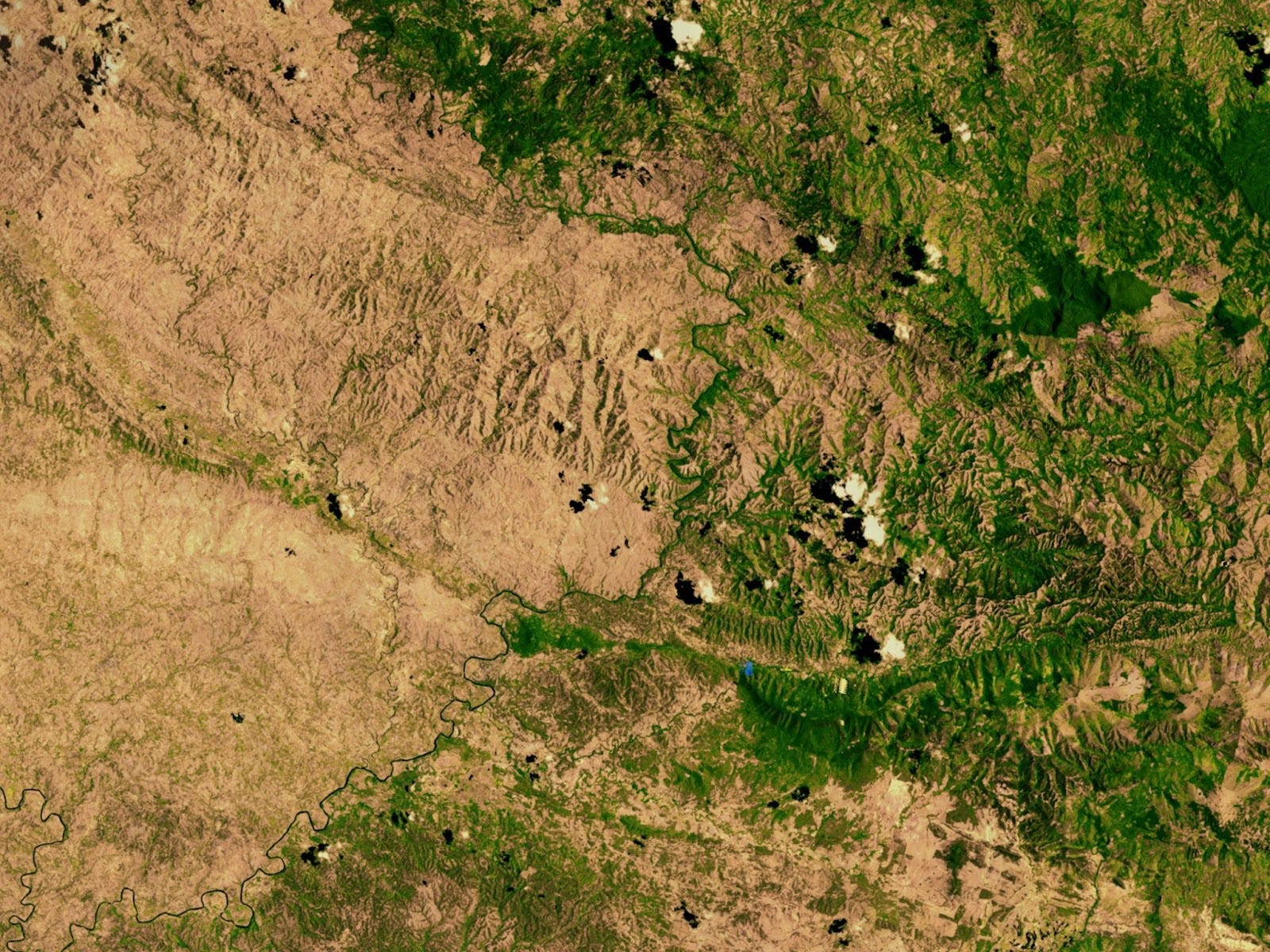
But those satellite photos look like the North-South Korea divide, and that is due mainly to unworkable political philosophies in the North. So I lean towards assuming ineffective leadership philosophies here too. There are some hints of that in the article, but not enough to draw conclusions.
To an extent, all historical/geopolitical/megapolitical/etc analysis suffers from this.
The process is (a) observe a bunch of facts about history, geography, economic policies, politics or whatnot (b) explain the present (or future) state as a consequence of these facts. If you're inclined to observe certain facts or emphasize certain fields (say history), then your conclusions reflect that.
The "method" of analysis is hopelessly prone to biases, from professional biases to ideological or chauvinistic. As the article shows, ideological (anti slavery) can affect the geographic (soil erosion/smallholdings) affecting and being affected by other things.
"Why is Haiti Poor?" isn't, perhaps, as important to answer as "How can Haiti become wealthy." You need a less comprehensive theory for that. If our theory-building practices are free-style and bias prone, IMO it's better to minimize theory zize.
> In contrast to South America, where agricultural land was divided into large-scale farms called ‘latifundios’, Haiti began independence with widespread land ownership where nearly every household claimed a few acres.
Isn't this just a complicated way of saying that the other countries still had slavery?
> Latifundios relied mainly on peonage, which is a form of unfree labour or wage labor in which a laborer (peon) has little control over employment conditions, with features of feudal serfdom.[2]
Fits with this theory mentioned later too:
> Lundahl thinks this failure is related to the land redistribution: since everyone had land, there were no landless laborers to exploit, so the elite’s only chance at rent extraction was through overthrowing the government. Given the dearth of business opportunities, one of the only ways to get rich in Haiti was to back a coup in exchange for special treatment from the new government.
It's not just that slavery continued on the Dominican side.
I think the key is that at independence Europeans in Haiti (and thus all land owners) pretty much disappeared, so there was redistribution among former slaves, although this wasn't fully carried out.
In 1970 my parents, sister and I went on a cruise which had a stop in Haiti; we rented a cab to drive through the town (I think Port-au-Prince) and I can admit I have never seen such poverty, as a child it was beyond shocking. There were also AK-47 toting men everywhere. My parents had no idea what they had gotten us into (no way to know much ahead of time back then). We eventually got outside town, and found a culture of mahogany carving and really amazing people. Sad to think that despite how depressing the town was (garbage dumped in streets for people to pick over, cardboard box houses) it's only gotten worse, and most of the trees are gone. The countryside was very beautiful but the poverty and terrible leadership and disasters eventually destroyed it all. As a child it made a powerful impression on me as to what people are capable of doing (or not doing) to each other.
Funny how everyone says Haiti is worse off because of colonialism, yet the Dominican Republic was also a colony of Spain, had civil wars for over 100 years after independence, then US occupation, then another civil war.
After the revolution (1791), Napoleon sent an Army of 60,000 Europeans (French and Polish) to reconquer Haiti, that Army was defeated. The shock of this loss and the shock of the subsequent defeat cannot be overstated,
France humiliated, and the United States panicked by this huge slave revolt-imposed trade blockades and sanction's on Haiti
Haiti (1825) was compelled to pay France reparations (equivalent of 32 billion in 2022) for the loss of the slaves... this was an extreme national debt.
Haiti of course had no immediate ability to pay the debt, after decades of isolation. The first payments required taking further loans from French banks and American banks causing the debt to only increase, these loans were backed by giving control over natural resources and monopolies to foreign entities.
(This is a pattern well known and understood today)
Haiti is simply the first country in the world to enter the debt-trap spiral, and of course the longest to be in a debt trap spiral. A wholesale transfer of wealth from Haiti to the USA/France.
The result of all of this is that Haiti entered the modern world with very small and weak governments, with very low infrastructure, and educational support, with most of what ever remained of an economy controlled by foreigners and foreign interests.
It is difficult to see how any nation in this situation, can turn it around.
Surely the historical context is important in understanding how things came to be? If an export-based economy is cut off from international trade because it isn't recognized as a nation, and also forced to pay off a massive debt, surely that influences the way it develops? Surely it discourages the evolution of sustainable systems and encourages unsustainable ones, similarly to how poverty creates those issues for individuals?
Note that I am not claiming to know anything about Haiti's history, I've listened to the Revolutions podcast series on it and read a bit but I know very little. I am just pointing out that the "this didn't happen until later" doesn't necessarily explain away the impact of the way foreign countries treated Haiti.
If you look at Noah Smith’s substack linked above in another comment he links to another post at the end contesting his somewhat and claiming if you look at the price data differently the divergence is quite manifest before.
Wikipedia is, at best, a starting point for further discovery. The tell is how definitively they summarize things in such a brief space. I'm sure the authors there think they are telling you what is important, but they end up leaving out other things.
If it's important for you to know, dig deeper.
For something more in-depth, but still very accessible, check out Mike Duncan's Revolutions podcast. He does a series on Haiti. He has his own obvious biases, but is much more in-depth than wikipedia, and gives a much better sense of things.
The economic divergence is shocking -- although not as shocking as that of South versus North Korea. The Dominican Republic's GDP (PPP) per capita is ~10x larger than Haiti's, whereas South Korea's is ~25x larger than North Korea's.
The author is right that soil erosion, caused by overuse of land without replenishment, is one of the most important factors. Consider: So much land in Haiti is in such poor shape that for decades the country has not been able to produce enough food, in sufficient variety, to feed its own population. The DR, in contrast, is a lush paradise full of greenery everywhere, capable of feeding itself well, whereas Haiti is full of deforested, eroded land, much of it unfit for agriculture. You can see the difference in satellite pictures from space.[a]
However, the author mentions only one of the root causes of soil erosion: ideological government efforts preventing the emergence of large-scale agriculture in Haiti. There are at least two other root causes contributing to the poor state of land, as Jared Diamond points out in his book Collapse[b]:
* The DR's soil is naturally more frequently replenished by storm systems continually coming from the Atlantic, bumping against the island's central mountain range, and causing nutrients and minerals to flow down large rivers to the DR's valleys at a much greater rate than in Haiti.
* From early on, the DR government has actively defended the country's natural greenery against deforestation -- with armed forces who would shoot and kill illegal tree loggers!
Surely there are many other factors at play (including the fact that many Western governments had a de-facto policy of ostracizing Haiti in international trade throughout the 19th century and for much of the 20th century), but Haiti's inability to feed itself well, decade after decade, due to overuse of land without replenishment, is possibly the most significant factor.
Just so you're aware: in that image, the border is not the prominent river. It's somewhat to the west of it.
Looking at the rough area on the satellite view in Google Maps [1] suggests that there's not all that much difference between Haiti and the Dominican Republic. Indeed, in your [a] link, you can see a decent swath of the Dominican Republic that looks as bad as the Haiti side in the picture... were you to continue a little southeast, the Dominican side would open up to an area just as large and just as deforested as that Haiti side. For most of the Haiti-Dominican border, it's actually challenging to distinguish the Haitian side from the Dominican side.
In these cases like Haiti, or (much of central America) I'm more interested in how to possibly fix things now. It just seems to get worse every year. How to build success and stabilty? USA has resources to fix things but rarely seems to be good at developing poorer countries. Europe has had more success but still has countries falling apart in North Africa.
> We found that Haitians paid about $560 million in today’s dollars. But that doesn’t nearly capture the true loss. If that money had simply stayed in the Haitian economy and grown at the nation’s actual pace over the last two centuries — rather than being shipped off to France, without any goods or services being provided in return — it would have added a staggering $21 billion to Haiti over time, even accounting for its notorious corruption and waste.
Strange that the hundred of millions of debt to France is considered by some as a reason of missed opportunities for the country, but no one take into account as "true loss" the money that was embezzled by the presidents and co not so long after:
It’s believed that Papa Doc pocketed $150 million during his presidency, which is a pittance compared to the $1.6 billion his son grabbed
That comes out to foreign debt consisting of something like 2-3% of GDP. In the US, in the present day, foreign debt is like 6% of GDP.
By contrast, for what it's worth, France's payment to Germany after the Franco-Prussian War was about 22% of GDP. Paid over 3 years, so the payments themselves would have constituted like 7% of GDP.
Germany imposed another massive financial penalty on France after defeat in June 1940, too. I don't have the exact figures on me, but it was a) stupendously large and b) accumulated daily and paid monthly.
Liberty that leads to decomplexification, leads to poor, aka less complex societies. All are farming, all are producing linearly for a exponential thirsty humanity.
The disaster is within liberty without bounds and mistaking societal complexity (division of labor) for enslavement. It has also repeated in other locations (ruanda, zimbabwe come to mind).
what this article is dancing around is that when Haiti gained its independence, it distributed its land amongst the freed slaves, and then, given the understandable lack of agricultural knowledge, over-farmed them to the point where today each plot of land produces about a quarter of the same plot in the DR
it does not. the article essentially says that the width of the distribution of land caused over-farming. too many people with little bits of land. it makes no direct mention of the brain drain that heavily enforced decolonisation will have brought about
For people who think the problem is not enough fertilizer I would think overuse of pesticides or poor drainage practices might be the culprit? I think there are some comments on Noah Smith’s substack to that effect.
The Haiti vs. Dominican Republic comparison is interesting, but I think the Cuba vs. Haiti comparison is equally valuable - although I imagine it gets neglected in the USA because it makes Cuban socialism/communism look a lot better than free-trade-philanthropic-democratic-capitalism system that was applied in Haiti. Of course, if you include the Dominican Republic, the situation gets more complex.
However, the article's central claim (small farms destroy arable land, so large foreign-owned plantations are more sustainable) is invalidated by comparison to Cuba:
> "The reason why this does not occur in all countries is that larger farms benefit from economies of scale. Haiti’s small farms were too small to justify investments in labour-saving technologies. They were also too small for basic investments in soil fertility, like leaving land fallow. It’s hard to leave land uncultivated when your family must eat from a small plot. Finally, small farms create erosion through a tragedy of the commons. Erosion does not just affect your farm, it affects neighbouring farms. Investing in erosion prevention for your own land has little effect if your neighbours do nothing. Farmers on small plots, therefore, have an incentive to ignore the erosion problem and overfarm their own land."
So, why has Cuba been successful when it broke up the plantations and distributed the land to small farmers?
The article implies that slaves in Haiti were "ripped from Benin" (known then as the Kingdom of Dahomey) by the French. In fact, chattel slavery was a long-established practice in Dahomey which made noble families there very rich. It was practiced in tandem with ritual torture and murder. These practices continued until around 1900 when the French, in response to slave raids conducted into French protectorates, finally fought and deposed the last King of Dahomey.
>The kings of Dahomey sold their war captives into transatlantic slavery. They had a practice of killing war captives in a ceremony known as the Annual Customs. By about 1750, the King of Dahomey was earning an estimated £250,000 per year by selling African captives to European slave-traders. The area was named the "Slave Coast" because of a flourishing slave trade. Court protocols which demanded that a portion of war captives from the kingdom's battles be decapitated, decreased the number of enslaved people exported from the area.
This history's still a very sensitive subject in Benin:
I don't see your point. The quote in question in no way implies slavery didn't exist in Africa at the time, and the fact that slavery did exist in Africa in no way alleviates the immorality of the transatlantic slave trade. (I guess you could make an argument that capturing slaves is morally different from transporting and owning them, but I don't think it is substantially.) The article also doesn't say who ripped them away from Benin. Certainly political systems in existence in Benin at the time were involved. But that doesn't mean the horror or impact to the slaves was lessened. So, overall, I don't see what the purpose of your comment is unless it's an attempt as European slave trade apologia.
> So, overall, I don't see what the purpose of your comment is unless it's an attempt as European slave trade apologia.
I am not OP but I take issue with this. I feel like this is the whole thing. Why did you feel the need to write “European”. That’s wrong and denigrates entire ethnic groups in a very ignorant way. The poles for example surely you would agree are european but did not participate in the slave trade. But, this is not my main point.
My main point is, the slave trade was a multicultural, multiethnic affair. In different periods of times, different peoples were enslaved by different other peoples.
Just so you don’t mistake my comment, this is not an apologia of slavery. It was a horrible institution worthy of condemnation and I am happy it was ended.
I just find it very annoying when I see this automatic assumption “europeans were slavers”. No, not all of them practiced slave trading, some of them were enslaved as well, the ones that did practice slavery collaborated with non europeans to create the supply chain and there were other non european peoples also actively engaged in the slave trade.
Slavery is not the sin of Europe, it’s the sin of all man kind.
Are you really going off just on the words "European slave trade?". How did the slaves get to Haiti? Who steered the boat? Who profited from their transportation? It's the European slave trade because it was Europeans who bought slaves in Africa and sold them in America. Yes, Africans participated in the slave trade. Yes, Africans did terrible things. No, not all Europeans participated in the slave trade directly. In fact the vast majority didn't. There were also (and terrifying still are) lots of other forms of slavery. I never said anything different from that, neither does the article. The evils of one group of people doesn't lessen the evils of another group of people. We aren't having an argument about morals here, we're having an argument about discourse. If every time you talked about slavery, you had to include all of the sins of all of the individuals involved in that trade, discourse would become so burdensome as to be impossible. The post I was replying was setting this as a standard that must be met without thought about the implications of such a requirement.
The only possible outcome of advocating such a position is that destruction of our ability to discuss the issue at all. The only type of person that would want that outcome is an apologist who simply wants the topic dropped, even when talked about tangentially, such as occurs in this article.
I don’t know if it’s worth replying because you appear to be an ideologue who doesn’t actually want to discuss the subject, you appear to only want to denigrate europeans.
Eh, I’ll give it a try on the off chance you are actually writing in good faith.
Assuming good faith on your part, I believe we have a different understanding of what the standard of discourse should be. While I understand the concern around scope creep, which is valid, I hope you can also see my concern about context.
When discussing a complex subject like slavery, I think it’s counter productive to focus on a niche. Let me give you an example. Would it make sense to talk about world war two focusing only on France for example? Could a meaningful discussion on world war two happen if the discussion was limited to France?
It feels to me the issue is like this. Continuing the analogy with world war two, I don’t think you need to mention absolutely all countries that participated in world war two in order to have a meaningful discussion on the subject. At the same time, I believe it is impossible to have a meaningful discussion on the subject by talking about literally one country.
You appear to be asking us to talk specifically about one country. This to me seems to be actively harmful. I cannot see what good ( unless you count painting european people in an unduly bad light to be good ) can come from ignoring critical context.
My purpose is not to stifle discussion by burdening it with unnecessary context, my purpose is to elevate the standard of discourse by including critical context.
Show me in my comments where I am an ideologue or encourage a specific ideology. Where do I denigrate Europeans? Give me the specific quote of what I wrote. Don't say " you appear to be," give me the actual text and tell me how that is either being an ideologue or denigrating to Europeans.
Btw, I have nothing against modern day Europeans. All of my ancestors came from Europe. I do think a lot ( not all ) of Europeans in the 18th century behaved immorally when it came to their colonies. If you don't think that, you need to study some actual history. (I also think that a lot of Africans, Asians, Native Americans, and Pacific Islanders behaved immorally too, but that doesn't seem to offend you for some reason)
The Nation of Islam published The Secret Relationship Between Blacks and Jews which describes this relationship. Naturally, this work is highly critiqued by Jews as being misinformation. So you will have to be the judge yourself as to whether or not it's actually an honest description of what happened.
Introduction:
An accurate accounting of the history of Blacks and Jews from the Columbian era to the Civil War, including the extensive record of Jewish slave trading in the western hemisphere.
This study is structured as a presentation of historical evidence regarding the relationship of one people with another. The facts, as established by highly respected scholars of the Jewish community, are here exposed and linked by as sparse a narrative as is journalistically permitted for review by those interested in the subject..
The subject at hand is a controversial one and should be approached with great sensitivity. Those who would use this material as a basis for the violation of the human rights of another are abusing the knowledge herein. The wise will benefit to see this as an opportunity to develop a more equitable relationship between the families of man.
If Spartacus wouldn't have been enslaved there is a good chance that he might have ended up with Slaves on his own at one point or another in his life.
The involvement of Africans in the slave trade is conspicuous in its absence from the article. Whenever that fact is obscured, we promote the false perception that slavery is the fault of one race in particular. This feeds into modern attitudes, especially in the US, of innate racial good or evil and inherited guilt or grievance based on skin color. Teaching the full history of slavery, i.e. it was practiced with all its cruelties by every race of people who ever lived, is a necessary building block to healthy race relations. I think it is important to share this knowledge wherever it is clearly absent.
Slavery is a not a major part of the discussion in the article, almost all of which is post-revolutionary times. The word slave only appears in a few paragraphs.
And they were ripped from their homes — referred to in passing without saying by whom.
I feel your comment tries to inject something not relevant to the article.
"The involvement of Africans in the slave trade is conspicuous in its absence from the article."
Because it is completely irrelevant to the article.
"Whenever that fact is obscured, we promote the false perception that slavery is the fault of one race in particular."
This is untrue, and it is ridiculous thing to say. You do yourself no credit, trying to drag racial politics into a situation where they do not add explanatory power.
Racial politics are central to the article because they are central to Haiti's history and development. Discussing racial politics in a wilfully blindered manner has serious harmful side-effects.
You are bringing up the racial in a way that is irrelevant to the political. The Kingdom of Dahomey did not profit from the Republic of Haiti via reparations post-independence. They do not have any relation to the continued immiseration of Haiti, unlike France did.
It sounds like you didn’t read the article. The discussion of slavery is just brief context for the majority of the article, which is about the post-slavery period.
It’s not really relevant. If you’re worried about attitudes and racial grievance, whitewashing the events that took place in Haiti with whataboutism probably isn’t the way to go. If anything saying “what about Africa” distracts from the fact that slaves were being slaughtered like abused donkeys faster than they could reproduce. That by itself speaks to the horrors of this period.
The reality is that Haiti demonstrated how racism drove policy and actions of the colonial power. French colonial society was different than the US and evolved differently. France was distracted by its own problems and wasn’t able to maintain the dehumanizing regime necessary to maintain the slave system.
The whole thing is gross and disgusting. It’s a scar on society, and was no better in antiquity.
I don’t see how it’s flame bait. I’m using “white supremacy” in the accepted academic sense. And the article is about how Haiti got to be the way it is. Pointing out that pop history is loathe to ascribe moral agency to non-whites seems directly on point.
No part of this article has anything to do with contemporaneous African culpability for slavery, obviously. Unlike the previous commenter, I generally assume you comment here in good faith. So I guess I'd ask: why did you bring this up? How was this a contribution to the discussion of the divergence between Haiti and the Dominican Republic?
It is sort-of like writing an article about the horrors of totalitarian concentration camps, spending a lot of time on Nazi Germany, meanwhile quickly mentioning the Soviet Union as a country next door, but studiously avoiding any mention of the gulags or the Molotov-Ribbentrop Pact.
In that situation, one does not have to be a Nazi whitewasher to be somewhat suspicious about the author's agenda. Not every story can cover every detail, but some omissions are glaring.
By this chain of logic, no article is complete unless it mentions all of the other related topics that it could have mentioned, if it didn't mind being infinitely long. When writing a book about the Holocaust, one could also mention genocide in the USSR, or in Turkey, against the Armenians, or the Italian brutality in Ethiopia, or the mistreatment of Africans under British rule, or the widespread massacres that occurred in the Philippines when it was initially conquered by the USA. One could go on and on, mentioning more and more genocides.
Or one could simply stick to the subject that one is writing about.
The unfortunate souls shipped to the New World as slaves were directly bought from Benin slavers, though, not taken in some kind of hostile pirate-like raid, which is the mental picture that the word "ripped" conjures to mind.
When writing, there is always a question of where the related references stop. There is no clear criterion. But the word "ripped" here indicates a certain unwillingness to address the fact that slavery was, until fairly recently, a rather widespread phenomenon in Africa.
Ignoring this fact does not make European slavery worse and acknowledging it does not make European slavery better. The only thing it would do would be a certain refinement of currently politically popular stereotypes.
History should be told as it was, not as we want it to look like. And slavery existed because it was immensely profitable to all sorts of people, from native kings in Africa to the white (and sometimes Native American) slavers in America.
Only by understanding this can you prevent reemergence of slavery in the future. Arguably, sexual slavery works on a similar background.
>The unfortunate souls shipped to the New World as slaves were directly bought from Benin slavers, though, not taken in some kind of hostile pirate-like raid, which is the mental picture that the word "ripped" conjures to mind.
Agreed.
I estimate that 90% of Americans/Europeans would, if asked "how slaves were caught", would describe some variant of "white people sail to Africa, catch unwary Africans in giant nets, and sail away when the ship is full".
I do not know a single person who thinks that, but I know a very large number of people who like emphasize that most slave catching was done by Africans. When I lived in North Carolina and Virginia this fact was offered by someone in the group every time the subject came up.
If you had a bit more self awareness you might realize how you look when invent imaginary statistics like “90% of Americans”.
Ironically, that would be fairly close to the reality of the North African Barbary Pirate raids on European shores as far as Iceland, which resulted in more than a million Europeans being enslaved. [1]
I am not exaggerating when I say that the average American SJW/Redditor sincerely believes that slavery has existed in only one country in the world's history: in the United States, involving Africans. The etymology of the word "slav"? Brazil? Haiti? Guadeloupe? North Africans (as you note) enslaving Europeans? Vikings taking thralls? Feudalism? Never heard of 'em.
I see the reasoning you have and I mostly agree. Actually, scratch that, let me say I agree entirely. You are right. If an author decides on a particular subject, he should guard against scope creep least he produces a rambling screed that tries to touch on everything but fails at being meaningful even for one idea.
But, to play a bit of devils advocate here. In the case of the USSR, it did paint it’s self as a liberator, claiming left right and centre how they’re freeing the prisoners. But, at the same time, they had their own camps where they were sending their own prisoners. I feel this by it’s self warrants some mention at least in a treatment of the holocaust. We’re not talking about a separate genocide in another time and place. We’re talking about a genocide perpetrated at the same time by a county that was beating it’s chest about stopping a genocide.
Just my two cents. But, yeah, I agree with you on the scope creep issue.
Would you then agree that such an article should include Churchill’s role in the Bengal famine of 1943, or the internment of Japanese-Americans, or the Italian Empire’s massacres in conquered Ethiopia, not to mention all of Japan’s policies in Asia at the time?
This article isn't about the horrors of slavery. It's about economic history. It makes reference to slavery in that context without discussing it in detail. A better analogy would be an article about why Israel is an economic success mentioning the concentration camps from Nazi Germany (without much detail) and then not mentioning the gulags of the Soviet Union.
Also not mentioned in this article:
- the genocide of the native Americans that allowed Haiti to be a thing in the first place
- the continuing oppression of women at the time
- the oppression of LGBT+ that was a constant reality of society in a Catholic country
And yet these comments seem to only care about calling out oppression that happened a continent away. Slavery isn't even really that big of an piece of the article. The majority of the article is about what happened after slavery ended in the 1790s.
If you’re looking at the evolution of concentration camps, you’d probably want to also include the evolution from the British camps during the Boer War to the Imperial Germans in Southwest Africa or the Ottoman Turks in Armenia.
The Nazis evolved the tactic into a mass killing factory. The Soviets were more about political oppression; they went about the business of mass murder in other ways.
The Soviets outsourced a lot of the killing to the Siberian nature. A gulag in the taiga didn't even have to have any walls. The snow and the frost in combination with semi-starvation were as reliable killers as a bullet to the head, and cheaper.
The exact quote from the article is "In fact, many Haitians are descendants of slaves ripped from Benin...". That statement makes me think they were citizens of Benin who were taken into slavery.
But they weren't. They were slaves owned by the Kingdom of Benin and sold to the French.
Is this why African countries were so prosperous before the scramble for Africa kicked off in the 1870s? And why today, the countries in Africa least touched by colonialism are the most well off?
Or are they, actually. The human development index [HDI,1] can serve as a proxy for "prosperity", but I'm having a hard time finding the "degree of colonization" each country suffered, to see if the two are anti-correlated. The closest I could find was that Ethiopia and Liberia are considered to never have been colonized [2], but both are near the bottom of the HDI list. Maybe duration or how recently colonization ended could be used instead.
[2] https://www.thoughtco.com/countries-in-africa-considered-nev... (I found it amusing how the article says Turkey was never colonized by the West. Yes. In fact, a large chunk of Europe was under Turkish colonial control [3]. One could argue a large chunk, Byzantium, still is, but is no longer considered Europe due to being conquered.)
Before the independence wars, all modern stuff reached our colonies before they were even an idea in Lisbon.
After the independence and continuous wars, mostly sponsored by western countries, they keep a shadow of their former selves.
I have been a couple of times in African countries and it is quite sad to see how hard it is to come out of this vicious circle.
I also find tragic that in some countries despite being independent, the colonization for all practical effects never left, because most companies that offer jobs worth having, are in the hands of European/US multinationals or expats.
There are a lot of places that have a really nice major city that gets foreign investment and stays under the watchful eye of the government. Other places, particularly rural, fall to the wayside. The US has a lot of interest in catering to rural/suburban voters, sometimes more so than they do cities.
> Is this why African countries were so prosperous before the scramble for Africa kicked off in the 1870s?
African countries were prosperous. In sub-Saharan Africa, hunter-gatherer bands often worked less than 40 hours a week (as observed by anthropologists even after the Scramble for Africa). This prosperity exceeded that of many programmers working in the San Francisco Bay area today.
Hunter-gatherer cultures were also only ever one bad season away from starvation/famine, highly dependent upon very specialized workers. Agriculture required more work in quantity of hours, but there are decided advantages to it - general prosperity being the primary one. Humanity has voted on this. By and large, cultures have moved in one direction on this question, consistently, for eons.
> Hunter-gatherer cultures were also only ever one bad season away from starvation/famine
Huh? Famines, disease outbreaks and such were much more common at the beginning of the agricultural revolution. Hunter-gatherer bands were much safer from famine than early agricultural workers. This was true from the beginning, to the Irish famine in the UK 170 years ago. And insofar as epidemics - we are in at least one right now, if the monkey pox one doesn't get set to make two.
Insofar as general prosperity - the inflation-adjusted hourly wage in the US is below what it was a half century ago. This also pre-dates the recent inflation and Covid. I don't see how wages falling over the past 50 years is some sort of general prosperity.
This is about the shaky existence one group of people will have living the H/G lifestyle. Animal populations fluctuate naturally, disease and accidents affect skilled workers, affect animals, plants. Droughts the same. H/G populations are highly vulnerable to these whims of nature in a way that agricultural societies are more insulated from. Sure bad things happen to agricultural societies too, but it is (evidently) more a more stable and prosperous existence in the main.
In terms of general prosperity, you're comparing some metrics today to 50 years ago, and I'm not sure I understand the relevance. We were no more a H/G society 50 years ago than we are today. Do you know of any H/G societies that exist today? How does their prosperity compare to the poorest of the developed world? Do you know any developed nations that are still hunter/gather societies? Do you think this is merely coincidence or perhaps a big conspiracy?
This thread now spans from the predictable 4channer talking about racial IQ all the way to this person talking about how sub-Saharan Africans were prosperous due to working less than 40 hours.
This conversation officially wins my "this oughta be good, just from the title" award. Reader, ye be warned, you'll find nothing of value here.
One of the points of the article was that the DR was also the subject of imperialism, but it’s doing much better, and the majority of the divergence between the two countries occurred after the indemnity to France was paid off. This seems to undercut imperialism as the primary explanation for Haiti’s current problems. What do you expect economics historians to do? Ignore this fact because someone on Twitter says it must be wrong?
It mentions coups repeatedly, and, discusses and refutes thr French payments issue, makes multiple comparisons (unfavorable) to the success of Jamaica, another former imperial nation that has done significantly better.
Seemed to be right after that Haiti began to rapidly fall behind the Dominican Republic in GDP per capita. Also from the article "But the debt payments were a fraction of customs revenues, which were themselves a small fraction of the Haitian economy. Furthermore, the most significant divergence came long after the debt was paid off."
I read the article. I just wanted to point out that statement was entirely incorrect.
As for the top comment the point they are making is that you can’t have a conversation about Haiti without including all the details. All history is complicated and leaving out or downplaying major pieces of the story is a bad idea. There is no one simple explanation that answers the article’s question.
The top comment missed this part of the article entirely where they actually did mention and consider some effects of colonialism, and dismissed it as a major factor (due to the reasons given in the part I quoted, and more, "Indeed, Mats Lundahl, the leading economic historian of Haiti, does not even include the indemnity in his list of decisive events in Haiti’s economic history.").
Whether that was wrong or too simplistic might be up for debate but the assertion that they didn't mention imperialism is just incorrect.
"I’m going crazy because even though I know the graph is wrong, I don’t have direct evidence to refute it."
Should have stopped reading there. Seems like an unhinged, expletive-heavy and evidence-light rant.
Most significant divergence means that before around that time the GDP per capita of the two countries were traking quite closely, and afterward, DR's GDP per capita started to grow while Haiti's remained flat, the difference today being over 5x.
Some countries have been completely dominated and leveled to the ground by foreign forces more recently than that but perform better economically. Some had straight up genocides.
Which has nothing to do with anything (payments were very small amounts for a country as mentioned in the article), especially the way Haiti has been run by its government, and taking into account that we are now in 2022.
France is used as a convenient scapegoat for Haiti's problems partly because of the nasty way independence occurred and partly because it's sometimes easier to blame others than to take responsibility.
Haiti had to be punished for its successful slave revolt and overthrow of its colonial master. Not just by that spurned overlord, but others who feared their own subjects looking at Haiti as a success and learning from it.
Yes, this is boiling down a lot of elements and caveats that can (and should!) Be made but at the core this is what happened.


It has been essential for the development of almost every country in a similar situation, to initially rely heavily on agriculture. If you remove that, then that's a recipe for disaster.
There wasn't knowledge/investment in the country to jump to an industrial economy so they got stuck in their developmental phase, because of the massive deforestation.