It’s been fascinating to see the shift in seasons resulting from it here in BC. I read this morning that snow pack on Vancouver island is currently 90% higher than usual. My wife and kids are going crazy waiting for mountain bike season to open up, haha.
My garden is doing great thanks to the cool, gentle spring (and some good fortune that the seeds I planted happen to prefer this weather). After last summer I’m actually enjoying this shift a lot.
yeah, last year few months were coldest in Czechia in decades, now I sent my kid to school trip wearing winter pants and winter jacket, because it's effin 2C there in morning, yesterday afternoon there were 8C, mind it's hilly over there but even in Prague yesterday afternoon it was only 16C, that's like end of winter or beginning of spring and not end of may, almost coming summer, insane cold temperatures, I wish we had global warming, because these last few years are coldest I remember in decades
Also April 2022 was in Prague 123rd warmest among last 248 years, in light of nonsense how hot are supposed to be recent years, this feels extremely cold to be getting median temperature from last qurater millennium. Btw. the hottest April was in 1800, coldest in 1839, so much for records.
I guess the snarkers will always regale us with their snide dismissal, but as someone who has lived in one place for going on a half-century, I witness the change: winters had feet of snow and now have inches. Temperatures drops are harder, temperature highs have gone from 40C to nearly 50, which is insane. Rainfall patterns have changed markedly, and they’re interfacing with snowmelt and now flood events happen like never before. Because of that, forest fires, too, have gone nuts, because the summers now dry out to an extreme.
In this area we have indigenous families that have histories that go back for many hundreds and even thousands of years. I live in an area that had been idyllic for as long as any family can remember, a claim backed by geo/biological evidence. There is no record of the area climate behaving like this. The change has been abrupt and extreme and, frankly, dangerous.
I move a lot to different cities, but was able to come to a similar conclusion in central FL in that every house older than 1980 or so had a wood burning fireplace. The thought was so gross to me even seeing them...it rarely got cold enough to even warrant heat. Of course, it was very rare in new builds, and even then usually just the decorative kind.
> t every house older than 1980 or so had a wood burning fireplace. The thought was so gross to me even seeing them
Wait, wood-burning fireplaces are gross? Do you mean aesthetically or conceptually?
I doubt too many in Florida depend on them for heat like they might have in past decades, but can't fireplaces still be enjoyed for what they are? Cozy to sit near, fun to watch/cook over, great for incinerating incriminating documents, etc. As long as the nights/winters get cool enough they're still nice for some things.
Ah sorry, I meant gross as is in it's usually 90 and humid and you're already sweating looking at houses, then the idea of more heat makes you ill(at the time).
In that area, it would very rarely drop below 60 in waking hours, even in the winter. I'm guessing it used to get a bit colder 40 years ago.
It also makes me wonder about climate zones, as you're not supposed to be able to grow coconut palms there, but there were a healthy amount thriving...
Pretty soon, ie now in Pakistan and India, the wet bulb temperature, a measure of realtime humidity and temperature, will regularly exceed 120 degrees, at which point it becomes too hot for the human body to physically cool itself with sweat. Our climate is changed and changing now. It was cooler in Florida 10-20 years ago, let alone centuries ago. It's hotter now. When hundreds of millions are starving, flooded, overheated, dried out, or otherwise displaced, how do you think life will be going for those without fucking air conditioning.
I grew up in Florida and the daytime temperatures were tolerable from early October to June. The data is readily available and it is hotter and more humid for far more of the year than when I was a kid.
Change that fast - regardless of cause - is alarming.
I've lived in the same city in the same neighborhood in Southern Ontario for my whole life.
We used to have a light dusting of snow on Halloween every year like clockwork. It sucked but it's long gone and now Halloween reminds me every year of how the world has changed.
The wind is new. The mornings where every lawn is covered in branches. That never happened when I was a kid. And the sudden torrential tropical-storm like downpours that vanish as quickly as they come. This has real impact on our electrical system -- the power's been out for over a week for folks in Ottawa.
Human memories suck. I have family who every time it snows say “i can’t remember the last time it snowed this much!”, then you look up weather records and it snowed more 3 years ago.
It's mainly a problem for industrialized westerners. Go ask a herdsmen that spends all year outside and they'll have a fairly good memory for extreme weather events in the same way that you and I remember what the social climate of 2008 was like.
Anthropologists and biologists commonly track changes in floral/faunal ranges and ecosystems by asking the people who observe them daily.
They aren't worthless though. The current over-reliance on super-human storage systems coupled with a nasty dopamine loop that doesn't reward good memories really distorted our perceptions of what people can and should remember. Entire oral histories have been passed down centuries because brains are pretty big.
> Traditional knowledge that relates to prehistoric eruptions is part of the oral history of many Native American tribes. This knowledge even extends back to volcanic activity that occurred thousands of years in the past.
> Oral traditions of the Klamath tribes and Umpqua people indicate that people witnessed the eruption of Mount Mazama 7,700 years ago. Artifacts have also been found underneath the Mazama ash layer.
Dude, the West Coast has been settled for some 30000 years. People have lived in this particular interior valley for at least 3000 years. You find it hard to believe that the Interior Salish peoples don’t have a history?
With no evidence, why do you assume their civilization was stable enough to carry a cohesive history? No writing system + inter-tribal conflicts makes it difficult for all but a few outlandish stories to make it more than a couple hundred years.
Just got back to town after 2 months primitive in a van in Kansas. It starts to wear on you the lack of facilities this country truly has. Housing crisis is a major issue. 7 million affordable homes short, combined with weather extremes.
Yeah, you misread. I am disabled, living with Lupus. Lost my housing during COVID because the owners found they could rent my place more on AirBnB to some desperate person who really needed the quiet to work from home. Bought a van in desperation since I had no money for first, last and deposit.
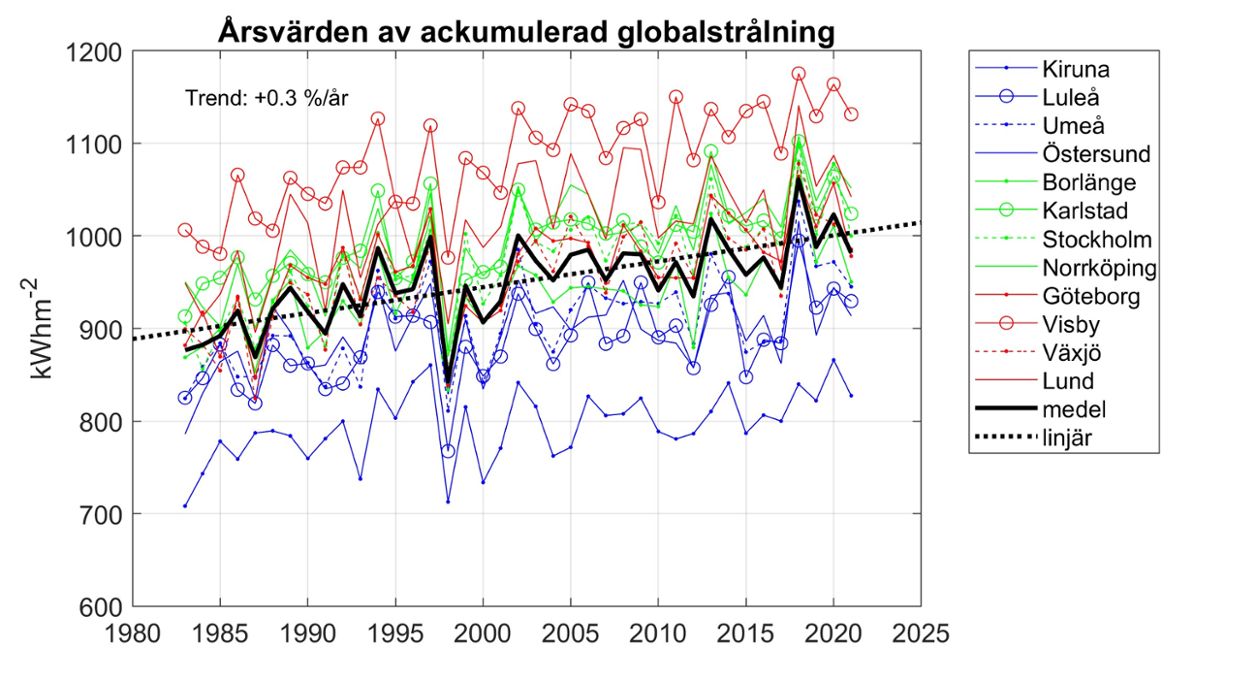
Notice the steady increase (called "global brightening"). This graph is produced and hosted by the Swedish Meteorological & Hydrological Institute (SMHI). They don't produce similar graphs for longer periods nor do they show the correspondence between average insolation and temperature. Fortunately the data is available for Stockholm (see e.g. page 184 of IPCC's AR5 - Observations: Atmosphere and Surface, [1]) which made it possible to create such a graph:
The correspondence between insolation and average temperature is very strong but it hardly ever gets mentioned in the public discourse around climate change. It is discussed on page 186 of AR5 chapter 2 [1] where the observation is made that there is a correspondence and there are numerous studies which come to the same conclusion but as so often is the case there is little to no relation between what the scientific literature says and how the media presents this.
And, once again, screaming "climate change" when there is a high begets "counter arguments" when it's cooler. Not every article with a hot point of data is proof and shouldn't be treated as such.
To be very clear before the knee jerk downvoting occurs, climate change is very real and needs to be addressed, scientifically. Don't bail on the mountains of science to make points in a small article about a regional high over a limited time.
Temperatures, particularly high temperatures, have a distribution. If enough contributing factors were independent, the high temp would follow a normal distribution, and new records would decrease in frequency over time. This isn't what we are seeing. Records are being broken faster than ever; outliers are increasing. So is the average.
Turns out, yeah, it is climate change. The whole distribution is shifting over.
So...when some place has a low, you're going to take that has proof against global warming? Of course not.
This article isn't about temperatures distributed over time or the globe. It's about one state over one month. That is cherry picking data and doesn't support global warming any more than one place is cold disproves it.
I'm saying to take global warming out of the popularity/anecdote contest, even when popularity and single points of data support it. But I see that people would rather play the popularity game by down voting me. They would also prefer to cherry pick data. Both of these backfire when someone else has enough votes or gets to pick the data.
Nothing I've written has been against climate change. It's merely against the, "See it's hot! Climate Change!" style argument which I believe does more harm than good.
> Nothing I've written has been against climate change. It's merely against the, "See it's hot! Climate Change!" style argument which I believe does more harm than good.
> They would also prefer to cherry pick data.
Stop crying "cherry picking". The 10 hottest years on record for the entire planet have all been in the 21st century. The avalanche of record-breaking heat incidents is overwhelming. If anything, the public needs to have its brains positively bashed in 24/7 with this before attitudes shift.
It's like, hey, on average, Dutch people are the tallest people in Europe. And then someone jumps in and says, "Yeah I knew a Dutch guy once, he was really tall!" and then you jump on them for cherry picking. Completely missed the point.
I don't know why you jumped in hot for an argument. Despite what you might think you are arguing, holding the line for truth or whatever, you're just creating doubt and muddying the waters, shifting the narrative away, propping up the holdouts, and sometimes, deniers. Regardless, there are several misconceptions in what you posted, thus my comment to straighten things out a little. I generally don't want to invest a huge amount of effort into long arguments on HN, so sometimes I downvote, too. Maybe your comment didn't really...sound right, and got downvoted? It happens to everyone.
> The 10 hottest years on record for the entire planet have all been in the 21st century.
The 10 hottest years in the last ~century that is. Also, see my post on temperature extremes just below this one for some anecdata on which period in time was good for the most records (1920-1940). Going by the data that period was far warmer - and in some places also quite a bit colder - than it is now.
Also have a look at the Atlantic period (6500 BC-4000 BC, also referred to as "the Holocene climatic optimum") when talking about "the hottest years on record". Notice that the sea rose up to to 3 m above the present level after which it started to go down due to water being locked into glaciers again. The end of the climatic optimum lies somewhere around 2800 BC going by temperature decline or 2300 BC to 1100 BC (depending on where you look) as evidenced by elm-decline, the latter of which being disputed as to whether it was (and is, we are again in a period of elm-decline) the result of temperature decline or human activity or a combination of these two factors.
> Stop crying "cherry picking". The 10 hottest years on record for the entire planet have all been in the 21st century. The avalanche of record-breaking heat incidents is overwhelming. If anything, the public needs to have its brains positively bashed in 24/7 with this before attitudes shift.
This article is about one month in one state.
Your metaphor is entirely wrong.
> Stop crying
> I don't know why you jumped in hot for an argument.
Don't tell me my state of mind.
> Despite what you might think you are arguing, holding the line for truth or whatever, you're just creating doubt and muddying the waters, shifting the narrative away, propping up the holdouts, and sometimes, deniers.
I'm not propping up the deniers. I'm denying them the argument of, "it's a cold month in Georgia, climate change is bogus." I have to deny that argument when it agrees with the theory of global warming. Ooh, I used the word "theory" -- it must mean it's not fact. I use the word theory as "theory of gravity" here.
I'm not shifting a narrative away unless you mean everyone should toe the line and accept global warming as dogma and recite it blindly. The argument for that is just as strong as denying that.
Going by this list the really worrisome period would be the 1920-1940 interval, going by newspaper archives this is corroborated - this is after all the time of the Dust Bowl.
Less spread but noticeably the very hot 1920-1940 interval also gave rise to a relatively high number of record cold temperatures. The 1980-2000 interval sticks out a bit in both record high as well as record low temperatures.
What, if any, conclusion can be drawn from these data? Just going by the numbers the 1920-1940 interval was the hottest on record thus far but in the same period a relatively high number of record cold temperatures were recorded. The same is true for the 1980-2000 interval. The conditions which give rise to record high temperatures also seem to be capable of producing record low temperatures. Elsewhere in this thread I posted an observation on the close relation between insolation and average temperature [1]. The difference in insolation is most likely related to the amount of aerosol pollution (of natural and human origin) in the atmosphere given that an increase in aerosol pollution leads to an increase in cloud cover due to those aerosols functioning as cloud condensation nuclei. It would be interesting to see the data on insolation/SSR (solar surface radiation) for these regions and compare it to those record periods. I would expect to find a correspondence there which would explain both the high as well as the low temperature records - clear skies make for hot summer days and cold winter nights.
The thing that's emblematic of climate change is not any one extreme — not that it's A's hottest X, B's coldest Y, C's wettest Z — but rather that it's all of these extremes simultaneously, and that they're all more extreme than they were in the past. At the same time that A is having its hottest X, B is having its coldest Y, and C is having its wettest Z, and it's a heat record for A, a cold record for B, and a wetness record for C. Simultaneously breaking weather records in multiple places, regardless of which exact records are being broken, is a prediction and sign of climate change.
I don't know why you are being downvoted when you are entirely correct. It is this type of use of stats that give cheap ammunition to skeptics. For the downvoters, I guess if May 1st is hotter than usual, you're happy to claim the entirety of May will be hotter than usual?
And it goes on to say
"Unfortunately, our lead will only increase with the third week of May likely to shatter numerous records across the state of Texas. "
Anyway, those 10 days were hotter than any other first 10 days of May:
It's meaningless to compare calendar months at all. They're entirely artificial. It would be more meaningful to compare something like rolling n-day average maximum temperates.
Well we have that already. Like since 2000's 19 years had been in the hottest years ever recorded. Thats 86% chance bet that next year will be in the hottest 20 list.
Since 70's average mean global temp went steadily by 1C in almost straight line.
Anything else is just click-bait articles that don't change underlying data.
- It's always being added to (parent comment)
- It's nothing but a fable agreed upon - Napoleon
- It repeats itself
- It's written by the victors - Churchill
- It's only remembered by the vanquished
- We are not makers of history, we are make of history - MLK Jr
And my personal favorite found when researching for this comment:
"The very ink with which history is written is merely fluid prejudice." - Mark Twain
The earth was once hot enough that nothing could live on its surface. The sun is just biding its time until it engulfs the planet in fiery destruction again. At a long enough timescale records for heat and (eventually) cold become meaningless, but the overall trends recently doesn't look great. I'd put money on this recent record being broken pretty quickly.
Seems to be 403 forbidden. Text from that article, from archive.org:
> Our hottest May in history gets much worse next week
> What we have seen so far in the month of May is nothing short of extraordinary. When you take the average temperature (morning lows & afternoon highs) in Austin through the first 11 days of the month, you get 82.2 degrees. That is 1.6 degrees higher than the next hottest May on the list, 2018. I know that doesn't sound like much, but that is a significant margin when looking at multi-day averages. Unfortunately, our lead will only increase with the third week of May likely to shatter numerous records across the state of Texas.
> May 2022 is our hottest May in history through the first 11 days.
> First, WHY have we been so hot so early in the year? It has been the perfect storm of ingredients including a La Nina phase of the El Nino Southern Oscillation, our worst drought in seven years, and finally a very early showing of a ridge of high pressure that has been stubborn over the southern U.S. High pressure consists of sinking air in the lower and middle levels of the atmosphere, and physics dictates that when air sinks, it compresses, and compressed air is hotter.
> Now, onto the forecast for the next 7 to 10 days in Texas. The ridge of high pressure is in the process of reorganizing and intensifying over Mexico, and it will return to Texas as early as this weekend. It won't be in a hurry to leave either with this sinking air situated over the state through all of next week.
> In Austin, that gets us to the upper 90s as early as Saturday and near/above 100 by Sunday and Monday. Hitting 100 this early in the year is highly unusual with this marking our third earliest trip to triple digits in Austin's recorded history. We could push even higher though through the second half of next week.
Everyone wherever I have lived thinks their weather is special. “If you don’t like the weather here one timeframe, just wait for the next”. Change is apparently the nature of weather.
I anticipated this sort of response seeing the title but didn’t anticipate it being (currently) at the top of the comments on HN. It’s a pretty myopic take.
I live in a place (Seattle) where the special thing about the weather is that it’s temperate and fairly predictable (our version of timeframe in your paraphrase is 5 minutes, otherwise it’s fluctuations within a stable range). Well, it used to be anyway.
Two data points doesn’t make a trend, three might suggest keeping an eye on it. Five years running with consistently uncommon heat and humidity and prolonged fire seasons isn’t a weather variable, it’s a change in climate.
Again, Seattle has been relatively stable. Relative to global temperatures, we’ve lagged behind the trend. World records have been concentrated in recent years in a way that’s only deniable if your probability models scale to centuries. Local records in other places make that completely untenable as a hypothesis, with some places breaking whatever pertinent record pretty much constantly for several years longer.
Weather does change, it’s the nature of living on a spheroid spinning around on a tilted axis with most of its energy coming from a nearby star. Many trips around that star showing similar persisting changes isn’t weather. It’s climate.
/me waves from the tropics, where there are effectively no seasons
Although after living here long enough, you start to recognize monsoonal microseasons. It's still ~30 deg C all year around, but the average is a couple of degrees cooler in 'winter', especially after a couple of days of solid rain, and a couple of degrees hotter in 'summer', especially after a dry spell.
And I just added to the carbon footprint burning electricity waiting for this. It did indeed take about two minutes to "process".
[Edit - continuing after it finished resulted in a blank page. Refreshing the page resulted in "403 Forbidden". Clearly they just do not want you to disable the optional cookies. It is Sinclair after all, so I'm surprised I didn't have to provide voter registration info to get in.]
"
We are processing the requested change to your cookie preferences.
This may take up to a few minutes to process.
Processing 67%
Some opt-outs may fail due to your browsers cookies settings. If you would like to set opt-out preferences using this tool you must allow third party cookies in your browser settings.