If you’ve been vaccinated are you going to be fine? Probably.
If you haven’t? Shrug. We’ll find out in the next couple of weeks I guess.
The government knows that they now need another round of lockdowns but don’t have enough support among the public to do it, hence the desperate push for this as the next best thing.
The queues to get jabs in my neck of the woods have been massive, so maybe that’s a good sign. Not that it was fun standing in a big queue with that many strangers for hours.
I’d prefer to have an actual Omicron vaccine but hopefully winging it with this one works.
Imagine the Facebook posts when people start dropping after a vaccine shot, because the government suspended the wait times. They need vaccinations to look as safe as possible - this will not end well.
> [..] it wouldn’t take much at this stage to cause the system to flood with cases.
I'm not entirely sure Omicron is a bad thing. It's over-mutated to the point where it's not nearly as deadly as Delta and out-competes Delta. The virology researchers even predicted that Delta was essentially as bad as it was going to get (hence the effort for a Delta specific booster).
> The government knows that they now need another round of lockdowns but don’t have enough support among the public to do it, hence the desperate push for this as the next best thing.
Not much of a surprise when you're out partying whilst the laws you helped pass are convicting others.
> The queues to get jabs in my neck of the woods have been massive, so maybe that’s a good sign.
As long as the majority of people who intend to get one can get one, I think that's a success. I don't want to see the stick being used in the UK, only the carrot.
> I’d prefer to have an actual Omicron vaccine but hopefully winging it with this one works.
Speaking to people on the inside, they were still desperately trying to get a delta specific version out the door in time for boosters - and the Delta variant has been around for quite a while. Don't hold your breath at all on Omicron. Unless there is magically some low hanging fruit (all signs say there is not), then at best you're talking about something for mid next year.
> I'm not entirely sure Omicron is a bad thing. It's over-mutated to the point where it's not nearly as deadly as Delta
This is untrue, and is based on misinterpretations of the South Africa data. There are lots of reasons why it looks less lethal in SA, but omicron in other countries is looking about as lethal as delta, with increased transmission. Vaccination and boosters look to be protective against serious harm. In England the vast majority of people in ICUs at the moment are unvaccinated.
> Early indications that the Omicron variant may be less mild will not stop a dangerous wave which could risk overwhelming hospitals, the chief medical officer has warned.
> Britain is now experiencing two separate Covid-19 epidemics with rates of the Delta variant high but stable while Omicron grows rapidly, according to Chris Whitty.
> This is untrue, and is based on misinterpretations of the South Africa data.
It's not untrue, from your iNews link:
> He said: “If the peak of this is twice as great, then halving of the size of the hospitalisation rate, you still end up in the same place. And this peak is going very fast.
So basically, he doesn't know. But he seems to agree that it is less deadly. The real question is whether it will play out as he says with hospitals becoming overwhelmed. I believe he is being overly cautious.
> Vaccination and boosters look to be protective against serious harm.
With >90% of the most at-risk category in the UK vaccinated, you would imagine harm would be minimized as well as it reasonably can be.
> In England the vast majority of people in ICUs at the moment are unvaccinated.
I am not sure there is yet evidence to back this up about the Omicron variant.
> There are lots of reasons why it looks less lethal in SA, but omicron in other countries is looking about as lethal as delta, with increased transmission.
Can you link me to a source proving that? The sources you linked to suggest it spreads more but is less lethal. My understanding was that the number of mutations the Omicron variant went under essentially made it way less deadly.
> There's also no evidence that Omicron is replacing Delta.
Eh, this is basic virology. We already saw the Alpha variant essentially die out because the Delta variant out-spread it. Survival of the fittest.
> Eh, this is basic virology. We already saw the Alpha variant essentially die out because the Delta variant out-spread it. Survival of the fittest.
To be fair, the consensus at this exact moment seems to be that it's not clear the extent to which it's replacing/outcompeting Delta or co-existing alongside it as an (effectively) separate virus in circulation.
Whitty actually addressed this from his podium the other night in saying that they're currently managing two pandemics - a Delta one that is holding steady in terms of numbers and an Omicron one that is rising exponentially by the day.
The concern (I would assume) is that Delta cases have not dropped markedly while Omicron ones are increasing, which suggests co-infection. Again, early data, so no-one should be surprised if we find out yet again that we've no idea what's actually going on.
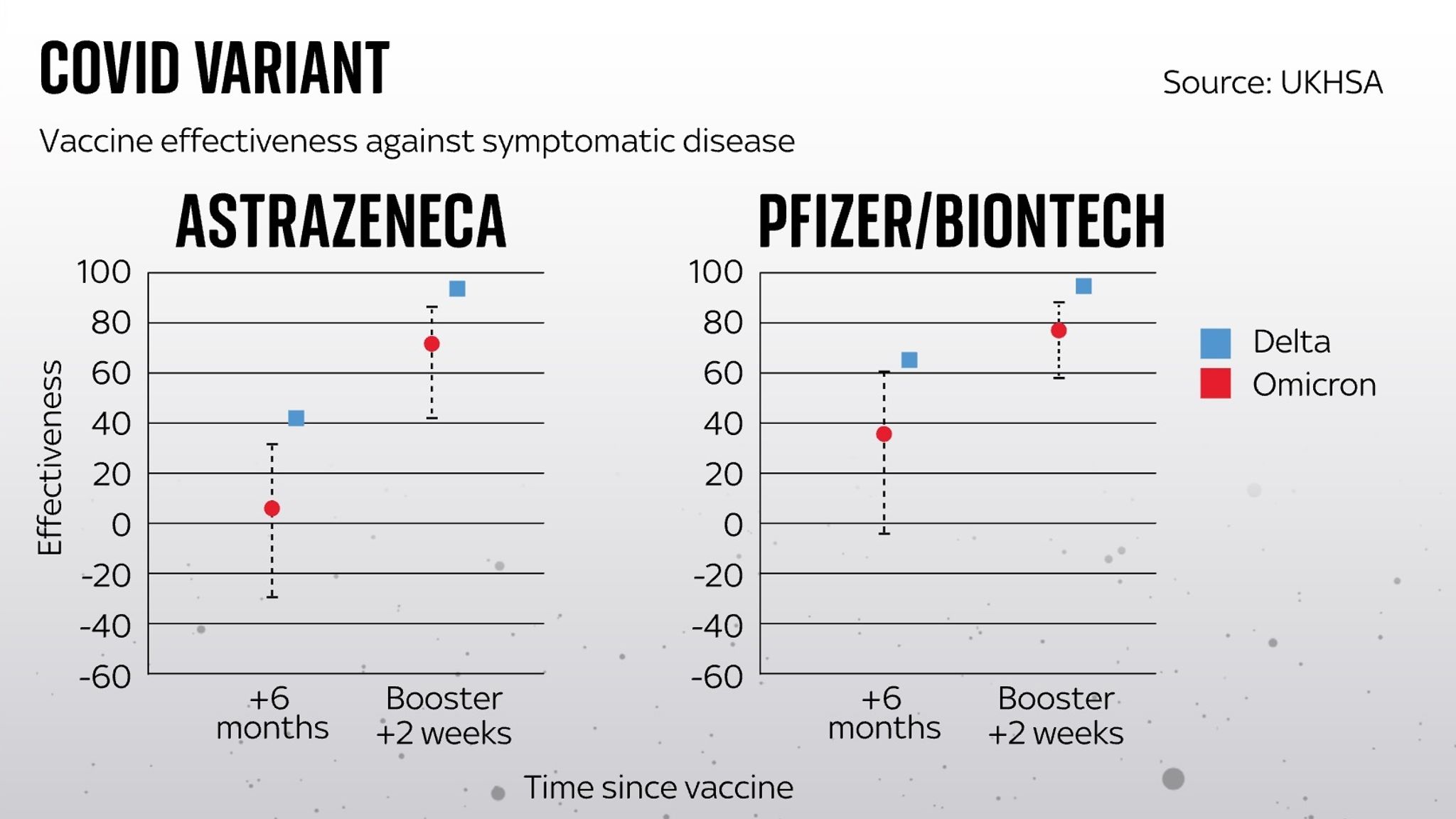
2 jabs is fine, its just you're about 20% more likely to get symptoms (assuming you are 18-50 and of good health). The issue is you're still going to have a week of feeling like shite. but you're much less likley to need hospital care
3 jabs gives you an 80-95% chance of not exhibiting symptoms. This is what most people expect of a vaccine. (frankly its what I had hoped that two jabs would provide. But I am naive )
There are many additional variables though. How much time since your last shot, which vaccine, how long between jabs, which variant of the virus you are exposed to, the state your immune system is in.
If you’ve had two jabs, spaced 3 weeks apart, last jab was 6 months ago, and you get exposed to omicron, it is a much worse scenario than “20% more likely to get symptoms”. So there is a rational push for boosters right now.
> So there is a rational push for boosters right now.
I very very much agree.
But what I am saying but failing to get across in a sensible way is this: A double jab will protect you from serious illness. so there really shouldn't be the narrative that double jabbed people have little to no protection.
> last jab was 6 months ago, and you get exposed to omicron, it is a much worse scenario
I do disagree slightly with this. Yes, old people (75+) who've had almost a year since the last jab will be more vulnerable. Boosters are very much needed to keep them out of hospital (just like the flu jab). But for the vast majority of the population, I am reasonably confident that 2 jabs will be enough to stop you having a really bad time. Sure you'll get symptoms, but it shouldn't be serious.
However I must stress that I have had the booster, and I would have rolled them out in july/august when they were approved for use. I would have not sat on the fence and waited, like the JVCI did.
In summary, I think we broadly agree, but down to my miss communication I have implied that boosters are not needed.
Yes, we mostly agree! I do diverge on the 6 months issue - there is a notable decline in efficacy. In the US, a majority of the people who were vaccinated got their second shot >6 months ago, and only ~16% have gotten a booster. Combine vaccine efficacy decline starting at ~5 months with omicron immune evasion, and that means a big winter wave. Even with protection from severe illness, if a lot of people are getting sick, it will mean a lot of severe illness (large denominator).
"it would just appear out of the blue and kill you"
I've had it and it didn't kill me. It also hasn't killed my wife, my kids, and the ~20 friends I know who have had it. If you want data rather than anecdotes... the current covid mortality rate (worldwide) is tiny.
Being killed by covid is NOT a typical outcome for the vast majority of those who get infected, and employing hyperbole like this is just ensuring that the world's overreaction continues. Let's make sure the language we use is proportionate.
In the long run you won't evade infection. All of us should expect to eventually get infected. Fortunately this disease has a <1% fatality rate. Vaccination and other treatments cut the risk even further.
All that happened was people loitering & browsing on their phones a bit before buggering off. Removing that isn't going to tangibly speed up the roll-out of vaccines.
The only NHS staff present last time in that area was someone handing out "I've been vaccinated" stickers
Where I went for my third, they'd taken over a small carpark and put up temporary canopies, so the "waiting area" is just a bunch of outside space, chairs, something to keep the rain off. People sit around on their phones, self-timing the wait. Throughput was their constraint, not capacity.
That setup was pretty low risk because it's naturally ventilated (even windy at times) and has lots of capacity because it's just a car park plus some canopies. But obviously in a city centre clinic it may be very hard to do this (my GP† is in the heart of the University where I work, set on the edge of a pleasant grassy leisure area with a stream, the car park is accessed from a service road behind) but I can imagine the city hospital couldn't do likewise, nor could GPs in other inner city areas of my own city.
† General Practitioner, ie the doctor who knows a little about almost everything that can go wrong with humans and works out in the community not at a hospital.
By Litte's Law, the arrival rate to the waiting room (l) is equal to the number of customers in the waiting room (L) divided by the amount of time a customer spends in the waiting room (W), ie., l = L/W. If the arrival rate to the post-injection waiting room is less than the throughput of the vaccination stations, then removing (or reducing) the waiting time after an injection is going to improve performance of the system.
I'm not sure what your maths is trying to but when I've been for jabs there have been queues for the injection but the waiting room has always had plenty of space. The waiting room was never a bottleneck so removing it would make no difference. I'm not sure where they got the 23% figure from.
Ah I just reread it:
> that under the conditions of a system working at full capacity (as is needed now) the 15-minute wait reduces throughput by 23%.
So they're saying if they add a load more vaccinators the waiting room may become a bottleneck. Fair enough.
My second dose was in Guy's, and the waiting area was at full capacity. (I would have quite happily gone to sit immediately outside the tent, but that was forbidden.) My third dose was in a community hall, with about the same number of vaccinators but 2x the available seating area, and throughput appeared massive by comparison. I think they must indeed have been limiting throughput at Guy's to avoid saturating the waiting area.
Currently there's an input limit because of this "buffer" (how full the waiting room is allowed to be), when I got my first dose 6 months ago there was a long line outside of the vaccination center (not in the UK), and people showing up at 5:20 for a 5:30 appointment was told to wait (the first limitation was probably only having x bookable appointments per time slot). The healthcare workers were going as fast as they can though, so I guess that's the real bottleneck.
I guess without the waiting area they can add more vaccination booths, but geez, that sounds stressful for the workers, imagine having a person every ~2 minutes for extended periods of time.
Which makes me think I should move my booster appointment to the morning...
>imagine having a person every ~2 minutes for extended periods of time.
For my 1s dose I was at a walk in that had announced a lower age range than rest of London and the entire twittersphere showed up as a result.
The docs must have been at <15 seconds each. Basically conveyor belt of people barely breaking their stride while walking past. They were still going at 19h00. Wild.
Though to be fair lots of volunteers on both before & after dealing with the logistics so that docs just did the needle part.
Definitely not sustainable pace especially if you expecting to do the same next day, but was impressive display of possible throughput
I had my booster this morning at a dedicated vax centre, there were two lines outside, one for pre-booked and a huge one for walkups. The whole thing was very slick, and extremely well marshalled by the volunteers, but you could definitely see a throughput issue with the waiting area - the movement of the queues wasn't constrained at all by the number of jabs they could give, but by the very large post-jab waiting area capacity. From entry to jabbed took maybe 3 minutes, but they couldn't move the queues any faster because of the backlog in the waiting area.
If you don't need to be observed, it would make it possible to be vaccinated in other settings than a big vaccine center. Like at your private MD, a mobile vaccine service, or something else.
> All that happened was people loitering & browsing on their phones a bit before buggering off. Removing that isn't going to tangibly speed up the roll-out of vaccines.
It's not generally a problem for mass vaccination centres, but it very much is for small GP practices and pharmacies.
Boris Johnson’s need to distract from his scandals led him to announce targets without discussing with the NHS and actual providers so now they need to make changes to accommodate his political requirements.
Not a fan of Borris Johnson but I will give credit where it’s due. UK government has done far better job than in delivering boosters and vaccines. No need to have derangement syndrome, I think more people we can get boosters the better off we are. His scandals and affairs are different issues.
There was a period towards the start of the vaccination programme where, yes, the UK Government took a number of chances that seemed to pay off regarding vaccine approval and purchasing. However is the Hurclean efforts of thousands of NHS staff and volunteers which should be the subject of most praise. It was and is an amazing an effort from a vast group of people who weren't in the VIP lane.
The UK has fallen well down the ranks regarding 1st, 2nd, and booster delivery compared to Europe.
As for the endless announcements of changes to government policy to the press before Parliament ... this Government has been on the receiving end of the sort of dressing down from the House Speaker that would have resulted resignations and party explutions in the past.
But it has had the desired effect of making people think the Government is doing well, so I'll give him that.
> The UK has fallen well down the ranks regarding 1st, 2nd, and booster delivery compared to Europe.
Why though? It's not because there's a shortage of vaccines, or logistics problems distributing them. It's because some sections of the community won't take them, for whatever reason. It's not the government's fault. We'd have the same stats if Labour were in power.
The Government know that that there are millions of people wandering around unvaxinated and additionally these are largely the group that have started voting "Conservative" since 2016 because Facebook and feelings equals facts etc. The Government know only a small fraction of these people will actually die because of COVID so they can still be relied upon at the next election.
The main collateral damage in all this is, of course, the NHS. If I have to point out the Governents actions (not their words) on the operation on the NHS in the last decade, then I'm not sure we are speaking the same language.
And if I hear "Labour would have been bad/worse" one more time ... I won't be surprised at this stage.
> these are largely the group that have started voting "Conservative"
That's not been my experience - it's the people who are distrustful of the government (any party) that aren't getting vaxxed.
I think people have a very short memory regarding the conservative vote in the last election: It was to unstick the whole Brexit issue and to stop a hard left party getting into power. Hardly anyone I know thought Boris would be a good PM, but at least those 2 mentioned things would happen.
No, it's because we didn't really push the equivalent of the European Green Pass. In some countries, you can be refused your salary if you don't get the pass, which in practice introduces de-facto compulsory vaccination.
That is squarely a governmental responsibility. You can argue that public opinion here is too individualist to ever agree (particularly now, so late), but that was definitely a political choice that is impacting vaccination rates.
There is one decision that made the vaccine programme possible, which is buying all of the vaccines early at a high(er) price. This was sensible and good. It took a lot of headbanging to get that through, I am grateful to whomever did it.
In terms of getting it into peoples arms, we've not been doing that well till the booster. Yes there was an early lead, but france now has more vaccinated people per capita than us, and they had a horrid start.
> Not a fan ... but I will give credit where it’s due
If you want to give credit, there are a number of actors, a number of facilitators, and a number of mostly spectators. You cannot immediately entail who did what, who is responsible, without knowing how the mechanism works (sometimes, without having information from the inside).
Some careers are based on taking credit irregardless; some other surely must be linked to real merit... Do not jump from "John was in charge" to "John did it" (to define the actual role and impact of John means considering a complex system).
About the specific context, I think there exist articles praising a number of key actors.
If the Fed bought toxic assets from the banks under TARP at face value, and supplied them with cash to buy distressed assets from entities without access to that window, how could you possibly claim that it was a win for the US taxpayer?
OK but what’s your point then? His government says 15min wait isn’t necessary- you say he is trying to deflect his own personal scandals. His government supposedly does a decent job - you say it’s not his credit. At some point these derangement has to stop. Like I said I don’t like him or condone his scandals. But this has nothing to do with the original post saying 15min wait isn’t necessary. This is what happens when you watch 24/7 opinion media outlets that want to tie seemingly different things to satisfy their narratives.
To be fair to Boris, he at least seems to have some sense of the limit of his own knowledge.
If Whitty and Valance tell him “this is what’s happening, and where we think it’s going” then it’s probably as much as you can expect to have him take the advice.
Obviously we’ve no insight into what if any advice he refuses to take behind closed doors, but at least he’s taking it seriously. We hope. Based on the limited amount of information we’re given.
Once a politician, always a politician. The good politicians stay on the front foot (as they say in English football). The bad ones are always on their heals.
You might believe these arw different issue. But if Boris is an on the front foot politician, rest assure he thinks (and acts) otherwise.
Are you forgetting his stunts and commentary to downplay the vacinations/covid resulting in people not taking it seriously, low vaccinations and no lockdowns?
They had highest deaths in EU as they failed to learn from Italy, who at the time was just recovering from first wave there.
This is akin seeing someone drive fast loose control and smash into a tree, followed by 'hold my beer, i can go faster'
2 things can be simultaneously true: Boris Johnson is a liar who is so completely untrustworthy that I'd check his assertion if he said the sky was blue, and in this particular case getting people boosted is a good idea.
In fact the thing he's doing to accommodate his political requirement here is softball the regulations in the hope that a panicky rush to give boosters will damp down a two-day doubling time. It won't, and he'll have to lock down yet again, far too late.
In Italy the 15 wait is done in an additional room where people are just "asked" to stay at the end of the process. Then they can go away before the wait, if the want. I can't see how a wait at the end of the process could reduce throughput by 23%. This looks like the next UK mismanagement of the pandemic.
Likely for two reasons. When planning vaccine clinics, you have to assume everyone will wait their 15 minutes and plan that into how many appointments you can book. If you only have a waiting room that can properly seat X amount of people for 15 minutes, then you can only book Y amount of appointments. (remember it's not fire capacity anymore since they should be 2 meters apart).
The other thing this allows is drive thru appointments in different areas. Drive thru vaccine clinics have existed before, but it's very difficult to find a place large enough to house a whole bunch of cars for 15 minutes. The same argument as above applies.
This also opens up things like vaccine clinics at train stations where you get the jab waiting for the train, then once your are done you can immediately jump on your train/bus etc.
In in Italy I received 3 shots in total, in three different vaccination units. We have among the highest vaccination rates in Europe so at some points a lot of people showed up. Well... the waiting room never where the problem because you need a room only as large as the peak vaccination rate you can have within 15 minutes. Now: because of anamnesis, check of the documents, and other stuff, it is very hard to vaccine a lot of people in 15 minutes: this means that you need a relatively small room. This is what makes me very skeptical about the NHS analysis.
EDIT: I just asked a friend of mine working at one of such vaccination areas and confirmed my impressions. They never had a problem with the waiting room, but instead a problem with the queue that forms at the initial stage, because the vaccination itself does not go very fast, due to the checks needed to make sure you can receive the shot, is the correct one, and so forth.
Well, given I share the same "race" of most UK people (I'm a while Italian), I guess it's not racism. Just the UK government didn't handle it very well in my opinion. For instance now they want a new lockdown after months where everything was possible without any care. And this is just the last data point. Removing the wait is another instance of a not very focused mindset in dealing with the pandemic. That the final stage of waiting slows down you 23% is very unlikely under a bit less rigid parameters. You can say: sit if there are sits, otherwise if you can wait staying on your feet, and as 3rd option wait in your car in the vicinity. To remove the wait looks like nonsense: an illusion of pragmatism. Now, since many other things the UK government did looked like nonsense, including the first idea of going for herd immunity, you have to admit that another nonsense is not completely improbable.
I'm not sure where you're getting your information about what and how the UK is dealing with the pandemic, but I suggest you change your sources. Especially as the UK has fewer deaths per 1000 than Italy, while having greater population density and being an international travel hub.
> For instance now they want a new lockdown
Do they? There's plenty of outside advisors suggesting a lockdown would bring down cases, it's the government themselves who are resisting this.
> including the first idea of going for herd immunity
Source? Stop reading nonsense. We had multiple lockdowns, and then we had extremely rapid vaccine rollout. None of that points to aiming for herd immunity through infections.
> That the final stage of waiting slows down you 23% is very unlikely under a bit less rigid parameters.
You should tell them this, I'm sure the NHS and UKHSA would love to see what data you have that they don't.
> 65 yo population in Italy is 22.8 vs UK 18.4. Most people dying are the old ones so you'll see more death in countries with older population, in general. Moreover the way we count covid victims in Italy is to count every death even when the covid was a minor co-factor. For instance an 80 yo with several chronic disease and cancer dies and is positive to covid as well? It is counted as covid death here, inflating the stats.
About the other statements, if you think UK did a good job with covid, well, I'm happy you trust your government actions. Live long and prosper btw.
If the additional room has N seats you can vaccinate at most N people per 15 minutes. Many vaccination venues are small and the size of these rooms could easily be the limiting factor compared to the throughput potentially achievable by a couple of staff giving the actual injections.
When I had mine there were maybe 8 seats, which were full, and they were calling the next patient as seats became free.
In Belgium, the first jab in June I was waiting in a tent in tent with others, tent was mostly opened. Second jab in July I was waiting in a closed store space, sitting on a chair, within 1.5 meters of each other.
I will most likely get the third jab in mid-january according to schedule so I am pretty sure I'll be standing outside for a bit (if I can) this time :).
In the UK, and my experience was similar. I did my 15 minute wait sitting in my car, and it was only recommended because I was driving. When my wife did hers, I drove her, so we didn't bother waiting around (and no one asked us to). I really don't know where this is coming from.
I think experience will differ a lot based on when you were vaccinated. Earlier on (Feb/March last year) it sounds like the waiting time wasn't being strictly enforced - you were advised to wait especially if you were driving but there wasn't really any administration of it. That was the experience my parents had and I heard similar from other people vaccinated at that time.
I got vaccinated in the summer at one of the larger vaccination centres and they were being more strict about it. After getting vaccinated they gave you a card with a time written on it which was when you were supposed to leave (although both times it was only 10 mins not 15). There was a dedicated 'room' with chairs in it and a clock and a nurse watching over things. After your time was up you left the card on the chair. Nobody was physically forcing you to stay but there was an obvious expectation that you would and I didn't see anybody walk straight out either time (out of a sample of 60+ people that I overlapped with).
My experience was as described in both May and July. If anything, I think they said less about it on the second dose. It might vary depending on location . . .
In Brazil we had a few tens of millions of people vaccinated with the Pfizer/Biontech vaccine, no 15 minute wait required. I haven't heard of any anaphylaxis case, which is anecdotal of course but I believe anti-vaxxers would have made a big deal out of it.
So all-in-all killing this 15 minute wait might not be very effective to quicken vaccination, but it should not be harmful at all either, so no biggie really.
I took both Pfizer shots already and I had to wait 15 minutes only after getting the second dose.
I really appreciate the hard work of our health professionals, but I think most people didn’t wait after the jab because we are not following the vaccination protocol as we should.
> I haven't heard of any anaphylaxis case, which is anecdotal of course but I believe anti-vaxxers would have made a big deal out of it.
People just don't talk about them. They happen, with a much lower (by orders of magnitude) rate than the ones caused by the disease, and AFAIK not distinguishable from the random average without a vaccine (what is very surprising, so I probably have bad data).
Anti-vaxxers do make a big deal about them. But people are very good on ignoring the fact that everybody has a small chance of just dropping dead at any time by random, so most people just don't listen.
It definitely will speed things along from personal experience, if only because the waiting area afterwards seemed to be the bottleneck slowing things down.
Anecdotal I know, but it really was a case of waiting around for people to leave before they could continue.
Comparing the USA rates of hospitalization by age group as reported by statista to the anaphylaxis rates in the link, the "best" vax outcomes are with very old and comorbidity people, so it would have been wiser to separate by age.
Or maybe rephrased the outcome for vax'd 85+ and generally speaking, old fat and sick, patients is so vastly better that anaphylaxis among that group would be a rounding error, being vax'd for those people is like 800+ times better than unvax'd. On the other hand, for thin healthy kids the hospitalization rate for covid for a couple months is about the same as the anaphylaxis rate in that age group, so vax'ing healthy young people won't reduce hospitalization rates overall, instead of having like 1 per 100K kids in the hospital for covid you'd have about 1 per 100K kids in the hospital for anaphylaxis, so for them the risk is vastly reduced from no improvement to some improvement if they watch them for 15 minutes.
Therefore the best policy would be some sort of age based triage. Not-old, thin, healthy are more likely to end up with anaphylaxis hospitalization than covid hospitalization, so put them in observation for 15 mins to minimize the damage from vaccination. As for the old, fat, and sick, the rate of anaphylaxis hospitalization can seems to be about one thousandth the rate of covid hospitalization so proportionately observing them for 15 minutes won't save as many as simply vax'ing more of them would save, so push them thru the assembly line and don't bother with the 15 minutes.
I don't know the ratio of old/fat/sick to healthy in the UK. Perhaps, similar to some areas of the USA, may as well simply make one policy assuming everyone is old/fat/sick or some combination. In that situation the UK plan might make sense. Like in the USA having a vax clinic at a nursing home or Walmart or similar, just assume everyone attending the vax clinic is old/fat/sick.
> On the other hand, for thin healthy kids the hospitalization rate for covid for a couple months is about the same as the anaphylaxis rate in that age group, so vax'ing healthy young people won't reduce hospitalization rates overall.
I don't think this follows. Part of the benefit of vaccination is that it prevents spread and so vaccinating young and healthy people helps insulate unwell, old and immunocompromised folks.
> Not-old, thin, healthy are more likely to end up with anaphylaxis hospitalization than covid hospitalization, so put them in observation for 15 mins to minimize the damage from vaccination.
The goal here is to speed up the rate of vaccination by eliminating the bottleneck of keeping folks around. Only 28% of folks in the UK are obese so, and taking into account other factors and comoribidities, let's say 50% of folks needed to wait and 50% were free to go.
Operationalizing a giant waiting line for thin people to hang out in as they wait on folks with a 15 minute timer, while fat people with comorbidies were free to duck in and out and get back to their lives feels pretty unworkable.
> I don't think this follows. Part of the benefit of vaccination is that it prevents spread and so vaccinating young and healthy people helps insulate unwell, old and immunocompromised folks.
Vaccinating young and healthy people will reduce the R value and that will result in some number of unwell, elderly, and immunocompromised people avoiding infection or taking longer to get infected. That's true.
However, the data on vaccinating kids seems to point to an increase in health problems for them - not of COVID but of myocarditis. So parents deciding whether to vaccinate their children need to consider the circumstances of their individual child.
> Part of the benefit of vaccination is that it prevents spread and so vaccinating young and healthy people helps insulate unwell, old and immunocompromised folks.
Does the evidence really support this though?
Kids are generally not hanging out around older people or groups of at risk individuals. Most infections (~99%) that result in mortality happen in hospitals, long term care facilities, and prisons.
Further, this doesn't align with my understanding of how the vaccine "slows the spread".
Spreading covid is like a game of catch. Someone has to throw the ball, and someone else has to catch it.
For ex. we know masks are a mechanism that reduces your ability to "throw the ball".
And we know the vaccine reduces your ability to "catch the ball", but once you've caught it you will spread the disease just like anyone else.
Therefore, slowing the spread means that everyone gets exposed to covid a little bit at a time, not all at once. Good for managing hospital capacity. But everyone gets exposed nonetheless.
So as far as targeting demographics goes, I'm not aware of any evidence that increased vaccination among young people corresponds to a reduced likelihood of the elderly getting exposed to the disease, though I'd love to see said evidence to the contrary.
> Kids are generally not hanging out around older people or groups of at risk individuals.
Do children live in feral gangs where you are, or are they co-habiting with adult carers or guardians? You know, parents. Teachers. That kind of thing.
The schoolchild-to-parent transmission path is very well established, in fact you can see it in the whole population data, e.g.
> The steep jump in Covid-19 infections among children has been followed by an uptick in cases affecting people aged 30 to 49 — their parents’ generation
So the idea that child to adult transmission has no plausible mechanism is wrong - it's called parents; and the idea that it's not actually happening now is wrong - look at the data.
I can't access your link it's pay-walled nor can I find a decent version on archive, but I'll take your word for it.
1. I should have clarified. By "old, unwell, infirm" I mean people over 50
Because of covids age skew in mortality and hospitalization, I'm not really worried about people under 50, nor is GP. The premise the GP is arguing is that "vaccinating young people is primarily good because it helps protect old people".
2. I'm not saying covid doesn't jump from young to old, I'm asking 2 questions:
a. is "unvaccinated young-to-old transmission" a major vector for infection among >50s.
b. by extension, does vaccinating young people correlate to a decrease in infections among >50s.
I suspect it doesn't for the reasons I described in my prior comment, but of course I would like to see data that supports it one way or the other.
If no one has done such an analysis yet, it begs the question why we're perpetuating such talking points and making policies without having the data first.
> 1. I should have clarified. By "old, unwell, infirm" I mean people over 50
Nice of you to move the goalposts after the fact, but are over 50s completely isolated from schoolchildren, or are they merely 2 hops away?
Are you saying that no-one over the age of 50 is a parent, carer or teacher for school age children?
The progress of outbreaks since mass vaccination began has had a general observable trend: it first flares up in the youngest age groups, and then sooner or later spreads to all age groups.
I didn't move the goalposts, I corrected your strawman. You said 30-49 and completely ignored anyone else. Nice of you to hold yourself accountable, but feel free to project more.
Again the questions is..
Does vaccinating young people correlate to a decrease in cases among >50s.
Since we agree that vaccinating young people is mainly about protecting everyone else, I'd like to see data that proves it actually helps.
As someone in a population that is 99%+ vaccinated and covid is spreading like wildfire, the vaccines are doing nothing to stop spread now. We are seeing the most dramatic rise in cases since Covid began. This is in a youthful population who are almost all vaccinated. We have so far avoided severe illness, so I would recommend the vaccines to any individuals, but I see nothing now to convince me that vaccinating children will stop or even reduce spread.
It's definitely not doing "nothing". The vaccines are reliably reducing the severity of infection as you pointed out, and also reducing the duration where someone infected will infect others, thus reducing R value, thus applying significant friction to the spread.
It's not the panacea we might have expected, but I think we all misunderstood vaccines from the get-go.
You mean like a flu shot? And Tdap? Oh no. Anyways.
This assessment is nether particularly interesting nor at all unprecedented. If it ends up being with us indefinitely, then a COVID booster will simply be incorporated into the annual flu shot.
You 100% can. It is continuing to spread, but more slowly, and less effectively thanks to vaccination. It's not binary. Vaccinations are 70-95% effective, which means that somewhere between 5 and 30 people in any group of 100 may still catch the disease. Those that do will be less sick.
We've had vaccines since 1798, this isn't rocket surgery.
No significant practical difference in the slope of the curve in areas with (supposedly?) 99% vax vs areas with 50% vax does have certain unavoidable mathematical implications. Either 99% isn't enough to be effective, in which case its practically useless as 99% is ridiculous high, or 50% is "high enough" that its doing all the good it can possibly do even at that low level, so no need for social pressure to push it. But you can't sell ads without sizzle content, and nothing sizzles quite like one group trying to forcible medical experiment on an unwilling other group, so we get infinite vax coverage in the media.
There's a similar trend in masking data seen on covid19.healthdata.org. The authoritarian authorities say masks work great with no real world evidence behind that aggressively enforced statement. The actual graphs of data show no correlation between mask wearing and rate of infection in the general public when comparing state experiences. Personally I believe that's similar to the old iphone antenna problem where it provably worked great in the lab, but the general public insisted on holding it wrong such that the antenna did not work in practice for the vast majority of the general public. I find no conflict in abstract theoretical scenario lab tests showing a piece of cloth works, while at the same time the general public completely fouls up the real world implementation such that there's no discernable change in infection rates. What I can't explain is why people have been spending thousands of dollars for decades on asbestos removal gear, exotic aircraft paint respirators, virology research lab glove boxes, and all along all we've needed to prevent a fatal pandemic is a mere single strip of cloth; someone should inform OSHA.
If you follow the money, interesting things are seen that explain a lot.
> No significant practical difference in the slope of the curve in areas with (supposedly?) 99% vax vs areas with 50% vax does have certain unavoidable mathematical implications. Either 99% isn't enough to be effective, in which case its practically useless as 99% is ridiculous high, or 50% is "high enough" that its doing all the good it can possibly do even at that low level, so no need for social pressure to push it.
Or, if we apply Occam's razor, a better explanation is adverse selection.
In areas with high vaccination rates and low vaccination rates, those prone to ignoring the problem (refusing to get vaccinated, refusing to get tested, and refusing to wear masks) are still going out and spreading the disease. In both high and low vaccination rate environments the careful are still not getting sick because they're being careful.
The statistics are crystal clear: of those in hospital, the unvaccinated are dramatically, dramatically overrepresented. 4X more likely to test positive, 4X more likely to be hospitalized, 10X more likely to die. [1] They're also dramatically overrepresented in the positive cases.
> There's a similar trend in masking data seen on covid19.healthdata.org.
[citation needed]
> The authoritarian authorities say masks work great with no real world evidence behind that aggressively enforced statement. The actual graphs of data show no correlation between mask wearing and rate of infection in the general public when comparing state experiences.
Except they do, see Figure 1. [2]
> What I can't explain is why people have been spending thousands of dollars for decades on asbestos removal gear, exotic aircraft paint respirators, virology research lab glove boxes, and all along all we've needed to prevent a fatal pandemic is a mere single strip of cloth; someone should inform OSHA.
This is also addressed in Figure 1. It clearly shows that while better gear is more protective, lower quality gear is still effective. Respirators for asbestos, paint and COVID are obviously different due to the nature of the material being blocked. COVID spreads by droplets - your goal is to catch them before they leave or enter your airway. Paints, your goal is to eliminate VOCs which are molecules - not virii. Asbestos your goal is to eliminate particulate. But of course, in paint shops and asbestos removal you're constantly exposed. This is not true of COVID masking.
> If you follow the money, interesting things are seen that explain a lot.
The total death count in my state for kids (under 20) is 4, which is simultaneously 4 too many, yet also any effort applied to vax kids is kind of a waste as long as old/sick/fat people are dropping like flies and filling the hospitals. Like the effort to save one of the four kids in my state by vax or whatever could, in theory, have saved about 2000 elderly people.
If you have a dual monitor system, its instructive to bring up a site like covid19.healthdata.org and put a state like Massachusetts on one monitor and perhaps Ohio on the other monitor.
In MA the vax rate is a 88% for one dose, and ICU beds needed has gone from 146 a month ago to 257 today a monthly growth rate of a a staggering 76%. If the number of ICU beds required in MA continues to double every month (very unlikely) then the entire population of MA will be in a ICU bed in merely 14 months.
In OH the vax rate is 61% for one dose, and ICU beds needed has gone from 716 a month ago to 891 today a monthly growth rate of 24%.
About a third of people in MA wear a mask as opposed to a quarter in OH, so we're told the growth rate is artificially smaller in MA than OH because they wear masks, so the situation is actually much worse.
As a simple linear regression, (76 - 24) / (88 - 66) shows a predictive model that for every one percent increase in vaccinations, there will be about 2.3 % GROWTH rate in ICU use. Not decline, but growth.
So as a predictive model, if 5% of the population of Ohio were convinced to get the vax, then the model predicts the ICU beds required in Ohio would be (2.3 * 5) which is an increase in the increase of ICU requirements of 11.5%.
For the second dose, as I walked out of the clinic an old-boy volunteer approached me: "Excuse me, which vaccine did you have?", "Astra-Zeneca" I replied. "Oh, OK then, we asking all of the people who have the other vaccines to wait in this tent for 15 minutes, there have been some cases of fainting ...", he leaned a bit closer, "... mostly women."
My brother did faint. Before he fainted I asked him are you ok? And he started replying incoherent words, that’s when I knew something was wrong. I was quick enough to go hold him as he was dropping towards the floor like a dead weight.
Also you have to understand I had no clue if the guy was fainting or dying on the spot
Ps: feel free to downvote cause this comment isn’t bringing any value, though it brings value to me as I’m venting off my heroic act..
You did great catching him. Always try to catch someone falling.
A friend became briefly unconscious once and fell while another friend didn't react fast enough to hold him. The result of hitting asphalt hard was bleeding in the brain the size of a fist and 5 days in hospital care with hearing troubles for weeks.
From now on, your brother should tell the doctor/nurse this whenever receiving a vaccination or other injection. They will ask him to lie down, and wait 15 minutes (regardless of this new rule).
I always had problem with injections. First time i almost fainted, asked them to lie down and wait. Next time i asked them to do the injection lying down
BTW this is not a side effect of the specific vaccine, lots of people have fear of needles like that (Though i must say these vaccines feel like a sizeable chunk).
I seem to have that issue with the dentist while they’re injecting into the gums or whatever. But shots in the arm don’t bother me at all.
Something about the inability to see whats going on, I just imagine the dentist panicking but trying not to let me know while the spit vacuum is draining my blood.
He probably was a bit sexist in the way that old people can be, not necessarily malicious about it. There wasn't really a point, I just found it funny.
Agreed. We waited the full 15 minutes on trust, but having driven there I would have preferred to sit in the car. If people are planning to drive it might be an idea to do that anyway - no delay to others, and avoiding getting into difficulty while driving?
It should be said that the minister clarified on the radio this morning that this is an optional measure for facilities where accounting for the 15min wait would slow down operations upstream. If there is no such restriction (because, say, the carpark is big or the waiting hall is large, etc), then they can keep people waiting.
I had my third shot in a parish centre, and the post-jab waiting room was a church hall. It was largely empty, there was plenty of space, I don't think they were even monitoring the numbers coming in; I wouldn't expect the likes of them to remove the wait.
Got the booster the other day and no 15 minute wait time. This is in the US. I did ask them to aspirate the shot before pushing it and they seemed surprised but did it without issue and were very nice about it. Have read a few articles questioning whether accidental intravenous injections are causing myopericarditis. Figured having them aspirate would just be a good thing.
To avoid a recurrence of last year where there was a massive spike of hospitalisations (due to Delta), the Irish health service is keen to get as many people their booster shot before Christmas. It looks like we’ll be doing the same in Ireland: https://www.rte.ie/news/coronavirus/2021/1215/1266843-covid-...
Last winter, the number of cases started growing from November onwards – even before newer variants such as Delta became a concern – but the government was under huge public and media pressure not to introduce further restrictions to control the spread. They went against the recommendations of the National Public Health Emergency Team (as they’re entitled to do so) and allowed Christmas and pre-Christmas to proceed without restrictions. Predictably, the case numbers grew exponentially and they had to bring in another lock-down a couple of days after Christmas. Unfortunately, it was too late and in the New Year, case numbers surged far higher and quicker than they had in 2020, ICU beds filled to capacity and it took many months of restrictions to restore Covid-19 incidence to a manageable level.
Almost everyone is hoping that the current set of approved vaccines will work effectively enough against Omicron that we’ll avoid a repeat of last year. While I haven’t (yet) “done my own research”, our National Immunisation Advisory Committee is fairly conservative so I’m not overly concerned if they recommend removing the 15-minute observation period to increase throughput and allow more citizens to get a booster shot sooner. As software developers might say, “the perfect is the enemy of the good”.
How on earth does this speed vaccination rates? The 15-minute wait is after the jab, and so presents zero bandwidth constraints on the actual vaccination process. It’s just a bunch of people sitting quietly in a room requiring almost no attention, then leaving.
I don’t have a huge objection to the decision itself; if folks have found that GBS is really low risk, sure, tell people they can stay or go at their leisure. But the justification here is so transparently ridiculous that it makes me wonder what the real reason is.
Globally, we have done a poor job preparing people for the shots. I only had symptoms after my first jab but I immediately ate lunch and started hydrating heavily. Nothing at all for my last two, maybe some very mild fatigue and injection site soreness. I talked to the RN who gave me my booster and her anecdote after doing this for months was that the only people who get woozy are those who hadn't eaten or drank that day yet.
Everyone should be told to eat 30 minutes before your shot and to hydrate excessively before and after your shot. Treat it like a cold and feed it. Your body will have an immune response after the shot, give it the fluids and immediate blood sugar to do so and get on with your day.
When Omicron reaches the majority of new cases the growth rate of the total number of new cases will accelerate. Until then, the doubling is masked by the large Delta background.
Lying is simple, and even then Government routinely fucks it up. I doubt they have the capacity to convincingly forge the data required to generate that website.
Not true. You can trust your own observations and thought process results and can make your own small statistics from anecdotes coming from your acquaintances.


Given the virus is by most recent evidence assumed to be airborne (https://www.gov.uk/government/publications/sage-98-minutes-c...) it wouldn’t take much at this stage to cause the system to flood with cases.
If you’ve been vaccinated are you going to be fine? Probably.
If you haven’t? Shrug. We’ll find out in the next couple of weeks I guess.
The government knows that they now need another round of lockdowns but don’t have enough support among the public to do it, hence the desperate push for this as the next best thing.
The queues to get jabs in my neck of the woods have been massive, so maybe that’s a good sign. Not that it was fun standing in a big queue with that many strangers for hours.
I’d prefer to have an actual Omicron vaccine but hopefully winging it with this one works.