Of course it will. Welcome to the new propaganda. Same as the old propaganda.
Free speech is the act of standing up for those who you disagree with simply because you believe they have the right to be heard. In today's world of "woke" content creators, everyone seems to miss this point. What started out as fairly clear cut issues such as racism and homophobia has now bled into grey areas around vaccines and gain of function research.
On the latter, should we not be concerned about this? We're in the middle of a global pandemic and we're not allowed to discuss whether GoF research is too risky? We're not allowed to discuss the nuances of what a "lab leak" may really entail? For example, I think the theory that a researcher collecting specimens from the wild accidentally infecting people in wuhan or themselves holds a lot of merit. Yet, it cannot be discussed.
We should be outraged. And, back on the topic of anti-vaxers. They kind of have a point. Why should they trust the government, the CDC, the WHO and the like? What have they done to prove they are trustworthy at this point? Shutting down open discussion around this topic will only make the situation worse, not better.
We detached this subthread from https://news.ycombinator.com/item?id=28693407, partly because it's swerving into generic ideological flamewar, and partly because I need to prune some large subthreads in order to ease the load on our poor server, which smoke is coming out of right now. The latter is our problem and we're working on fixing it, but the former is the community's problem and everyone needs to work on fixing that.
Censoring discussion in an environment of coercive mandates. Anyone working for Google - how do you justify this? You have great options out there you know?
The problem is that for any major issues you can get attention and money for publishing a contrarian view. Platforms like youtube then can be megaphones for monetizing conspiracy theories which do actual harm. There is some distance between good faith discussion and promoting the opposite of whatever view is popular.
Content distributors are then on a knife edge with moderation, and how to moderate fairly is incredibly difficult. Youtube doesn’t want to be the vaccine conspiracy clearing house so at some point they decided to just ban it all. Making money from peoples attention brings this problem and moralizing won’t make it go away.
All your points are true but they don't lead to the conclusion that censorship is the answer. The problem is the attention algorithms create an echo chamber with little room for distasteful alternatives. The quack content is on page 1 getting all the money from anyone on a particular rabbit hole. There shouldn't be this rabbit hole, the quack content should always be on page 12. And in the earlier days of Google before the heavy focus on personalisation, this is the way it worked.
The problem is that the content is engineered to take advantage of humans and google and becomes the thing on the first page. You might be yearning for the old days of less effective SEO. It's a hard problem how to moderate away though algorithm design or manual intervention things which pull on the strings of human weaknesses.
Is an algorithm designed to de-prioritize content you don't like any better than a human selecting content for removal?
Google isn't the one who wants to cut their ad revenue and get accused for being Big Brother. Social media censorship has always occured because people demanded it. This time, it's not just an angry Twitter mob either. Even the president are saying that they are not doing enough to combat misinformation.
There's still people dying in large numbers, unvaccinated? Eventually people notice the body count against a point of principle. That's how we got to this point.
If they are unvaccinated and they die, so what? They made their choice. The doctors ought to be saying "Well, well, well, if it isn't the consequences of your own actions" not trying to force people to do something in order to save them from themselves.
Then you always hear "well the real problem is that the unvaccinated are taking up ICU beds from non-covid patients that need them, etc."
Ok, how long have we known about this problem now? Why are ICU beds such a fixed resource? Why can't we make temporary wards for unvaccinated covid patients to alleviate ICU beds?
If this problem happened in the tech world it would be lambasted. "Please stop making requests to X website, it makes the server crash and then the people that really need to access it can't". Yeah DDoS attacks happen and are hard to prevent downtime, but if the server loading problem still persisted over a year and a half later people would be outraged that the company did nothing to try to meet the load. In the tech world when servers can't handle its load we start scaling (either automatically or manually) until the server can meet the load (or otherwise take some sort of mitigating action to alleviate the DoS). Hospitals need to innovate a way to do the same, "please don't get sick with covid because we have no way of scaling to meet load spikes" is such a crappy way of operating.
Every infected person is host to the evolution of the virus. It is likely to become vaccine resistant given enough reproduction cycles. And it could become more, or less, deadly. If it starts killing children quickly, like measles, and is vaccine resistant because we let it simmer in 35% of the population, we will be very sorry.
Our best defense against this is to vaccinate as quickly as possible. Measles now rarely kills our children, due to vaccination.
Measles is fundamentally different. Asymptomatic transmission and zootic reservoirs have no impact. It's not a leaky vaccine and we aren't in the midst of a measles pandemic. Long lasting sterile immunity is provided by the measles vaccine. It makes a lot of sense to mass vaccinate for measles.
True, that is one limitation, but there are tons of other things you could do. A little innovation is required here. I do not believe it is an impossible problem. I think what's happening is that hospitals don't really want to innovate and are hoping to just wait for covid to blow over so then can return to "normal" operation and business-as-usual.
But I say they need to innovate because this isn't the last pandemic that will ever happen, and hospitals need a way to deal with loading spikes and denial of service just like every other system susceptible to those things.
Some may argue the medical establishment has done this: they made a vaccine.
Everyone pays for maintained capacity. If you believe in a free market then your hypothetical plague-better is going to go bust well before they get to reap benefits from having 100k ventilators in storage.
Innovation involves working around limitations. I already conceded that medical staff was a limitation. So how do you work around it? Training covid-specialized temps, perhaps? I don't know the answer because I'm not an expert in that problem domain. But I've innovated around similar limitations in my current domain expertise so I believe it is possible.
You can’t. That’s the point. Nursing, even at the lowest level, is not a trivial skill. The only people you could scale up at short notice like that — if there wasn’t also a general all-sector labour shortage — is nursing assistants, who have to generally do their thing under supervision of a registered nurse, which is an Associate degree or a Batchelor degree.
(There is an intermediate level of Licensed Practical Nurse who can be unsupervised but can’t supervise others, which is “just” a one year vocational course).
> But I've innovated around similar limitations in my current domain expertise so I believe it is possible.
Unless you’ve innovated around a crippling multi-state demand spike, during a general labour marked supply shortage, in a sector where getting things wrong is literally lethal and where people sue for malpractice even for sub-lethal errors despite the government mandated minimum qualification levels, I think you are making an error in thinking your experience is transferable.
(If you do have that experience, please share, as that sounds like one heck of an anecdote!)
That said: One thing you could “innovate” that would technically work is making a roving vaccination drone that hunts down and forcibly vaccinates people that don’t want a vaccine. Even ignoring medical ethics, I don’t think that’s a great idea. But technically…
Hmm, funny. I'm pretty sure I could train a non-programmer to do a specialized type of programming task in a few months if it were a crisis even though that person doesn't have a computer science degree. I don't see why healthcare is so much more difficult to train temporary specialists. Didn't we do it during WW2 (rapidly train medical specialists in a matter of months, aka medics, without a 4 year degree)?
> Unless you’ve innovated around a crippling multi-state demand spike, during a general labour marked supply shortage, in a sector where getting things wrong is literally lethal and where people sue for malpractice even for sub-lethal errors despite the government mandated minimum qualification levels, I think you are making an error in thinking your experience is transferable.
Yeah that's the real problem. Any innovations that alleviate the problem are going to run afoul of some bureaucratic, regulatory, and legal red tape put in place over the last century. So let me rephrase - I could probably innovate and solve this problem if I were a medical professional. But not without running afoul of some red tape somewhere. But I say red tape is meant to be broken in times of crisis.
> I'm pretty sure I could train a non-programmer to do a specialized type of programming task in a few months if it were a crisis even though that person doesn't have a computer science degree.
Then you’re either underestimating the complexity of programming or overestimating general skill level:
"""One of the difficult tasks was to schedule a meeting room in a scheduling application, using information contained in several email messages."""
"""Level 3 = 5% of Adult Population
…
The meeting room task described above requires level-3 skills. Another example of level-3 task is “You want to know what percentage of the emails sent by John Smith last month were about sustainability.”"""
People here are unusually good with computers.
I have no reason to think intensive care of respiratory illnesses is easier than code.
I don’t know enough medicine to say what typical treatment is, but a quick search says the entire USA has 93k ICU beds, that the number occupied by COVID patients went from 3500 in June to 26,000 in September, that the total number of COVID patients (including non-ICU) peaked at 97800 in September (and 133,250 in Jan) and that there are oxygen shortages in various hospitals worldwide because too many patients need the same treatment at the same time.
Given how easy it is to make oxygen — and to make something that makes it — a shortage of it can only happen when there are enough other things that also need to be fixed that it isn’t the limiting factor.
As someone else said elsewhere on this thread, the actual innovation is the vaccine.
> Then you’re either underestimating the complexity of programming or overestimating general skill level
The more specialized a task is, the narrower the range of skills you need to do that task. I could certainly train someone on how to do a specialized programming task such as cleaning CSV files in python in a matter of months. They wouldn't be able to do much else, but they would be able to do that fairly well.
Being a general practitioner is hard because the knowledge and skill pool is huge. Being an ultra-specialist easy by comparison.
Very often patients of rare diseases (including cancer types) know much more about their specific type of disease, known treatment methods, etc. than a general practitioner. How is this possible? The scope of their study is very narrow, so they can quickly go much deeper than a general practitioner on that one topic.
So yes, I still think it would be possible to train ultra specialized covid caretakers in a matter of months given how much we know about how the disease progresses. They don't need to know anything outside of specifically covid and they can flag any cases falling outside of their training to a more qualified person.
Think of it this way: you basically just train people to learn flow charts. The flow charts cover 90%+ of what typically happens to an ICU patient with covid. If they encounter something not in flow chart, they stop and escalate to a real nurse or doctor. You're saying such a scheme wouldn't be effective at all? I think it would free up tons of medical personnel.
> I could certainly train someone on how to do a specialized programming task such as cleaning CSV files in python in a matter of months. They wouldn't be able to do much else, but they would be able to do that fairly well.
After a few months? Average user might still be copy-pasting the # symbol, and need help every time they tried to edit and run a script because they mixed tabs and spaces.
> Very often patients of rare diseases (including cancer types) know much more about their specific type of disease, known treatment methods, etc. than a general practitioner. How is this possible? The scope of their study is very narrow, so they can quickly go much deeper than a general practitioner on that one topic.
You also get people like my mother, who took Bach flower remedies to boost memory (she died of Alzheimer’s 15 years younger than her mother of the same); or my dad, who insisted he was drinking enough water even though at that exact moment he had a drip in one arm to rehydrate him and another drip in the other arm for kidney medicine because his kidneys had almost failed due to dehydration; or people that think they can cure cancer with quack medicine like Steve Jobs did; or breatharians; or people who violently assault healthcare workers and vaccination teams during a global pandemic as in some American hospitals; or countless other examples.
Don’t get me wrong: I value free speech as a way to reduce groupthink, and that can affect experts too, but the experts are still, on average, much less wrong than non-experts. (Also applies to experts being plain wrong without groupthink, as they are humans not angels: still less wrong in their domains than the rest of us).
If medical science is anything like physics — easy to misunderstand, lots of Dunning-Kruger effect — the only people who genuinely become experts in their own diseases are unusually gifted, or already doctors (MD or PhD) or have enough other knowledge to separate real science from half-baked stuff that fails (or never entered) peer review. The rest are lucky they found real science and got close enough to understanding it too make a difference, and lotteries are not sound investment strategies for national growth.
If it’s like computer science, how many battles does the tech sector have to have with the government about cryptography? Or, heck, I’ve had clients and bosses who wanted things which aren’t even coherent, like a view remaining the same size on different sized and different aspect-ratio screens without adding borders, moving widgets, or resizing anything.
If it’s like politics, how many people want tax cuts without cutting government services, completely convinced it’s just a question of improving efficiency?
Or denigrate Media Studies as a “Mickey mouse degree”?
Or think they can beat olympian athletes?
Those are most of the personalities that go to GPs saying they know better. Only a tiny fraction are correct.
> Think of it this way: you basically just train people to learn flow charts. The flow charts cover 90%+ of what typically happens to an ICU patient with covid. If they encounter something not in flow chart, they stop and escalate to a real nurse or doctor. You're saying such a scheme wouldn't be effective at all? I think it would free up tons of medical personnel.
What makes you confident they don’t already do that? Because I think they already do that, with a separate flow chart for every condition.
Thing is, almost everything in medicine has a side effect. I just went onto Google to construct an example with commonly used painkillers, and to my mild surprise, guess what? WHO says no paracetamol for the side effects of the COVID vaccines. I was looking for which ones can’t be taken with alcohol. Untrained people, even smart and eager ones, are likely to not even know how to recognise the right moment to call in outside help.
But even if they could — let’s say an AI tricorder-esq app that can run on their phones — which sector would you deprive of much-needed workers to supply these temps?
And then you need to manufacture a few tens of thousands of sets of specific intense care equipment…
There is merit in your points. How does the world discover these alternatives when everything outside the current treatment regime is heavily censored?
Because there are only a limited number of trained nurses and doctors available. "ICU beds" as a metric actually means the number of patients the staff is able to care for, not the literal number of physical beds.
Not to mention, even if you have some extra to handle variable demand, exceptional circumstances are by their nature exceptional. It's irresponsible to carry that much more capacity when you'll only need it once a century.
Take for example the recent Hurricane Ida. There's still trash and debris to pick up. There's still damage to be fixed, houses to be rebuilt, etc. Insurance claims to process and pay out. Why?
Because there's going to be over 2 million cubic feet of vegetation to dispose of. Just in my parish. That's not considering the other parishes. Or other types of debris. There are trucks from several states and they've been working most days. And we still need to get rid of downed trees.
Because every house is going to have a claim. Every house is going to need some form of repair. Thousands of houses. All at once.
We aren't prepared to handle that sort of scale. And having the resources to handle that sort of scale is just going to languish when its not needed. It'll be waste.
Same deal with COVID. COVID is filling ICUs at a scale that is wasteful to keep on hand during normal operations.
And I'm sorry, saying they "need to innovate" is just the laziest criticism one can make. It exposes the fact that you have not thought of the problem at all beyond noticing the obvious lack of resources. Congratulations for noticing the obvious. How are they supposed to innovate? How do you know they haven't created temporary wards (they have where they could)? What does it take to make a site appropriate for an ICU ward? Etc, etc. There are problems that you don't even know exist because you don't know the problem domain. And that's ok. You're not expected to. But don't armchair quarterback the domain experts who have been working on this problem for the past year. It's not as smart as you think it is.
Okay, then why are hospital resources more finite than non-hospital resources that can scale?
> It's irresponsible to carry that much more capacity when you'll only need it once a century
But you need it for at least 2-3% of the century it seems, so the current model of "please don't overload our beds for 2-3 years" doesn't seem very sustainable either. It's almost like you want Amazon-style "elastic" resources that only kick in when you need them.
> Same deal with COVID. COVID is filling ICUs at a scale that is wasteful to keep on hand during normal operations.
So don't keep them on hand. Figure out a way to mobilize the resources when you need them.
> What does it take to make a site appropriate for an ICU ward?
For one thing, maybe making "a site appropriate for an ICU ward" is too stringent a requirement in times of crisis and overloading?
My solution: Setup circus tents in the parking lot reserved for unvaccinated covid patients where they can sleep on army cots with fewer ICU resources and where they die at higher rates than the normal ICU.
Bam, problem solved. Now the normal ICU is at normal capacity again and unvaccinated covid patients can still receive some limited form of care. If they die at higher rates, oh well, that's a consequence of not getting vaccinated and the direct result of their own choices. And it's better than letting vaccinated heart attack patients die because their unvaccinated comrades took up all the beds and it's also better than taking away everyone's freedom and forcing the vaccination upon everyone. Because now everyone is happy. The unvaccinated still have their freedom, the vaccinated still have their ICU beds.
I'm sure people more familiar with the problem domain could come up with something much better than circus tents in a parking lot. My point was that everyone seems to have accepted that hospitals are inflexible and that the only way to solve the problem is to flatten the curve indefinitely and I don't accept that. Sure, flatten the curve initially, but only until you figure out a better long term solution to dealing with loading spikes.
I just gave you a recent real-life example where non-hospital resources were finite. Did you not read about the on-going problems due to the recent hurricane I mentioned?
Also your solution would pretty much kill all those people. People are in an ICU ward for a reason, moving them to a parking lot tent is not the same. Now, they're not just battling COVID, but also everything else that's out there.
By your logic, putting a bullet in their heads would also solve the problem.
But the problem isn't "getting rid of COVID patients", it's "making sick people well".
> It's almost like you want "elastic" resources that only kick in when you need them.
No. I'm saying that doesn't exist. That it's folly to think that.
> So don't keep them on hand. Figure out a way to mobilize the resources when you need them.
This is you literally suggesting the solution is ""elastic" resources that only kick in when you need them". The thing I said doesn't exist and is an impossibly difficult problem.
This ignores the aspect of personal responsibility. Nobody is forcing these people to refuse the free and widely-available vaccine - they do so by choice and an adult consciousness, and it follows that you bear the consequences for your personal decisions.
The recent vote against boosters by the expert CDC committee and the resulting overturn by the head of the CDC highlights the need for broader free and uncensored discussion.
I read a lot of studies and get help parsing them from YouTube occasionally. Watching videos of more competent people poking holes in videos of quacks talking about the same studies is quite useful and persuasive.
Content like what you're describing is expensive to make, usually very boring and gets no views. You have to pay experts, read studies, interview government officials, maybe even read some science papers. Later you have to dumb it down enough so the common man can understand it. Content like this makes me want to defer the matter immediately to actual experts so I can stop thinking about it.
Now contrast this to viral content claiming that Bill Gates is conspiring to implant 5G chips, vaccine induced magnetism, government hiding thousands of deaths from COVID vaccines and all other conspiracy theories that are easy to manufacture from the comfort of your home, require no expert opinion and get tons of views. Content like this is super addictive, exploits my fears, sows doubt and leaves me less informed. This content wins is the economy like this.
I had a reply about attention algos promoting content higher than it deserves being the root problem. In the old days content with more credible links to it made it to the top for all regardless of your preconceived notions. Now everything is gamed out to your existing profile with God like precision.
They aren't credible, but for other reasons. Remember when covid wasn't airborne and thus masks didn't do anything unless worn by professionals? And border closures wouldn't be necessary and only xenophobes would call for them? And then how they banned corona tests by anyone but the CDC? And the approval delays?
They're playing politics, worry about second-order effects before first-order ones and do 180° turns instead of focusing on the core mission of assessing whether something is a) safe b) likely effective. The same situation happened again with the booster approvals, they dragged their feet again and decided that only those above 65 should be allowed to get them when in practice some international travelers already are forced to get more than two shots due to inconsistent regulations.
More nuanced policy, communicating uncertainty and "currently not recommended but allowed" middle grounds would help their credibility.
Any statistics and numbers need to be scrutinized carefully given the past year of the media and our institutions showing a clear bias in trying to inflate numbers for mass hysteria and scaring people into taking the vaccine.
> We're in the middle of a global pandemic and we're not allowed to discuss whether GoF research is too risky? We're not allowed to discuss the nuances of what a "lab leak" may really entail?
When the polio vaccine first came out was the public (i.e. non medical personnel) allowed to discuss whether the use of inactivated virus was too risky?
> Why should they trust the government, the CDC, the WHO and the like? What have they done to prove they are trustworthy at this point?
To this point? Are you serious? Does someone seriously need to explain to you all of the viruses (far more deadly than COVID mind you) that have been eradicated by government organizations?
> Shutting down open discussion around this topics will only make the situation worse, not better.
You're missing the point. The people who are crying "why can't we discuss GoF research or the lab leak" are not engaging in the argument in good faith. I absolutely think we need to discuss this topics in a meaningful way, however when most of the actors who are bringing up these topics are trying to cry wolf then why should we take them seriously?
The CDC of the past is not the CDC of today. It never is the same, people come and go. The make up of the political structure has overwhelmed the program:
1. CDC director overrules recommendation of board (political reasoning alone).
2. Dr. Faucci admits he lied about the amount of people needed to be vaccinated.
3. Dr. Faucci admits they lied about the need for masks. Which if we look at the data it is messy and shows only a 20% efficacy. If we look at recommendations prior to this outbreak, the documents say not to bother with masks. Do not tell me it was for the greater good to lie, they lied. Which people were told to shut up and listen when we all questioned the lie.
4. The head of the CDC is having an emotional break down on TV when all metrics are trending good (1Q). Why was she having a break down when the public data shows something else. Could it be she had knowledge of something?
The point is, agencies change, they adapt to the political masters. We have these three examples plus my fourth curiosity that point to the government agencies no longer being trustworthy in their guidance.
> When the polio vaccine first came out was the public (i.e. non medical personnel) allowed to discuss whether the use of inactivated virus was too risky?
I would certainly have thought so. Are you referring to something specific or just sowing seeds of doubt?
> To this point? Are you serious? Does someone seriously need to explain to you all of the viruses (far more deadly than COVID mind you) that have been eradicated by government organizations?
To me? No. I can read the whitepapers myself and understand the risks I'm taking. I'm fully vaccinated btw.
Regardless, you're sort of missing the point here. Shutting down dissenting views is authoritarianism and categorically not free speech. And, to be clear, it's not just "misinformation" that's being banned. There are legitimate issues with vaccines people should be informed of such as early warning signs of myocarditis that are also not allowed on YT.
> The people who are crying "why can't we discuss GoF research or the lab leak" are not engaging in the argument in good faith.
"They" are? Who is "they?" Are you claiming there's no point in discussing this? We still haven't sorted out where the virus originated and simply showing it is likely zootonic in origin isn't enough. Wuhan was doing active research on zootonic coronaviruses.
> I would certainly have thought so. Are you referring to something specific or just sowing seeds of doubt?
No, I'm genuinely asking you. Do you know?
> I can read the whitepapers myself and understand the risks I'm taking.
Oh you can? Do you have a background in immunology?
> Shutting down dissenting views is authoritarianism and categorically not free speech.
> There are legitimate issues with vaccines people should be informed of such as early warning signs of myocarditis that are also not allowed on YT.
That people are freely allowed to discuss with their doctors. Why on earth anyone expects to get medical advice from a for profit entertainment website is beyond me.
> Are you claiming there's no point in discussing this?
I literally wrote:
> I absolutely think we need to discuss this topics in a meaningful way
You're asking me to research something there's no evidence of? No, I'm not aware nor have I ever heard of this being a thing until now.
> Oh you can? Do you have a background in immunology?
No, but I took more than one statistics class in undergrad which is enough for me to make decisions I'm comfortable with.
> That people are freely allowed to discuss with their doctors. Why on earth anyone expects to get medical advice from a for profit entertainment website is beyond me.
Using your own point, doctors do not have a background in immunology. So I'm not allowed to read and interpret medical papers, but the same logic doesn't apply to a medical practitioner who has nearly zero formal education in medical research. Which is it?
> I absolutely think we need to discuss this topics in a meaningful way
I apologize for misinterpreting your comment, but in my defense, it's fairly confusing as to what point you're trying to make. On the one hand you say that you support "discussion of these topics in a meaningful way." On the other hand, you criticize me for desiring to read medical papers in an attempt to make informed decisions. You even go so far as to suggest I should blindly listen to my community college grad MP when it comes to medical advice. Which by the way, this is the same person that got me hooked on PPIs when I had GERD which is now causing joint issues and then tried to feed me opiates when I started experiencing said joint issues.
> On the one hand you say that you support "discussion of these topics in a meaningful way."
> On the other hand, you criticize me for desiring to read medical papers in an attempt to make informed decisions.
The two aren't mutually exclusive. I'm trying to say we ought to have a meaningful discussion about these topics and bad actors are making it worse to do so. People who simply take those talking points ("makes you think huh?") and regurgitate them and THEN say "why can't we discuss this" don't faithfully want discussions, they want EYEBALLS (read -> $$). I can't tell if this you're viewpoint, but you sure are sharing a lot of the same characteristics of these people ("I can research everything myself damnit!")
You absolutely should have the right to read white papers AND also trust that the government entity that interprets such articles has your best interest in mind. But you're insinuating that we should simply just have research/white papers and leave it to the general populace to interpret whatever they want. That is, IMHO, more dangerous than the alternative, especially when it comes to vaccinations where there is a near binary effect in place (you either get herd immunity or you don't, everything in between is potentially worse).
>When the polio vaccine first came out was the public (i.e. non medical personnel) allowed to discuss whether the use of inactivated virus was too risky?
They weren't?
>You're missing the point. The people who are crying "why can't we discuss GoF research or the lab leak" are not engaging in the argument in good faith. I absolutely think we need to discuss this topics in a meaningful way, however when most of the actors who are bringing up these topics are trying to cry wolf then why should we take them seriously?
Why would the good faith actors get punished for the actions of bad faith actors?
Happy for you to provide evidence that shows otherwise.
> Why would the good faith actors get punished for the actions of bad faith actors?
Would or should? They shouldn't get punished, but this precisely the point. Bad faith actors get far more attention than good ones. So this is already happening regardless of whether you want it to.
> Happy for you to provide evidence that shows otherwise.
Wait, you can't just posit something, argue as if it's fact, and then ask someone who challenges it to do the legwork of disproving it. If my argument proposed that fifteenth century blacksmiths weren't allowed to discuss unsafe anvil practices, it seems a little disingenuous to then say "happy for you to provide evidence that shows otherwise"; I'm the one that asserted that.
> They shouldn't get punished, but this precisely the point.
There's a difference between losing eyeballs to bad faith actors because they steal some of your market, and having your market banned because there are also bad faith actors in it.
I could argue that Wal-Mart should stop selling Xinjiang cotton due to forced labor, but wouldn't say that the solution to that is too ban all cotton products, even those responsibly produced.
Perhaps a more relevant analogy: Amazon might decide to ban Mein Kampf, but I'd hope they wouldn't ban books discussing why Hitler's platform and rhetoric were appealing to the Germans of the time. Frankly speaking, I wouldn't want even Mein Kampf to be banned: silencing bad or evil ideas makes them enticing (note the popularity of "check out/buy a banned book" events throughout libraries and bookstores).
Good faith actors being harmed by bad faith actors is always going to be a thing. Good faith actors being punished by other good faith actors seems like something we shouldn't be okay with, though.
> If my argument proposed that fifteenth century blacksmiths weren't allowed to discuss unsafe anvil practices, it seems a little disingenuous
If the you argument proposed (blacksmiths weren't allowed to discuss unsafe anvil practices) was factual and I'm asking you to provide evidence of such how is that disingenuous?
> I could argue that Wal-Mart should stop selling Xinjiang cotton
> Amazon might decide to ban Mein Kampf,
These are bad examples because you are explicitly paying for these items as opposed to clickbait / attention grabbing content which gets more viewership the more controversial it is (which has been proven by various studies).
> Good faith actors being punished by other good faith actors
Agreed, but who's the other good faith actor you're referring to here? YouTube?
> These are bad examples because you are explicitly paying for these items as opposed to clickbait / attention grabbing content which gets more viewership the more controversial it is (which has been proven by various studies).
This seems the same to me.
A book with a flashy cover or title is more likely to be purchased because it's attention grabbing. Action movies have trailers with explosions and one-liner quips because they're attention grabbing. Cereal boxes say "new and improved!" because it's attention grabbing. Magazines and cable news ask "Does Jell-o cause cancer?" because it's attention grabbing.
Controversial content gets more clicks because it's attention grabbing, so I would absolutely expect that to be more enticing than the same information packaged less flamboyantly (just like I'd expect more attention-grabbing books, movies, cereal, and magazines to perform better as well.)
>Happy for you to provide evidence that shows otherwise.
Just to confirm, are you claiming that the US government actively suppressed anti-vaccine views when the polio vaccine came out?
>Would or should?
sorry, should.
>They shouldn't get punished, but this precisely the point. Bad faith actors get far more attention than good ones. So this is already happening regardless of whether you want it to.
And what do you think about that? Specifically, good faith actors getting swept up by bad faith actors? Is that fine? Should we do something about it?
Sounds like a misunderstanding then. Your initial comment was
> > We're in the middle of a global pandemic and we're not allowed to discuss whether GoF research is too risky? We're not allowed to discuss the nuances of what a "lab leak" may really entail?
>When the polio vaccine first came out was the public (i.e. non medical personnel) allowed to discuss whether the use of inactivated virus was too risky?
The quoted poster seemed to be anti-censorship, so when you replied in opposition to that, it gave the impression that you thought there was actually censorship going on for polio vaccines.
>but isn't that precisely what YT is doing..? They're banning bad faith actors here, no?
They're banning everyone, bad/good faith actors alike. That's bad and should be stopped.
> They're banning everyone, bad/good faith actors alike. That's bad and should be stopped.
Are you sure? From the article: (emphasis mine)
> YouTube is taking down several video channels associated with high-profile anti-vaccine activists including Joseph Mercola and Robert F. Kennedy Jr., who experts say are partially responsible for helping seed the skepticism that’s contributed to slowing vaccination rates across the country.
> As part of a new set of policies aimed at cutting down on anti-vaccine content on the Google-owned site, YouTube will ban any videos that claim that commonly used vaccines approved by health authorities are ineffective or dangerous. The company previously blocked videos that made those claims about coronavirus vaccines, but not ones for other vaccines like those for measles or chickenpox.
That sounds like to me they are discretionarily deciding who gets banned, no?
In terms of human viruses, governments have only eradicated smallpox and almost polio. We will not be able to eradicate SARS-CoV-2 the same way. Unlike smallpox and polio there are animal hosts (most other mammal species can carry and transmit the virus) and the vaccines don't reliably prevent infection. So I encourage everyone to get vaccinated to protect themselves, but we need to face reality that the virus will never be eradicated.
While I agree that free speech is important, misinformation is nonetheless an important topic to discuss.
Public policy debates are important because it leads to a more accurate state and more informed decision, but not when anti-vaccine opponents continue to undermine accurate information at every turn.
The lab leak theory was "misinformation" until it wasn't. They say "listen to the experts" and then censor actual doctors and scientists who say the wrong things. An "expert" is apparently someone who has a degree and holds the approved views, everyone else is spouting "misinformation."
Careful not to throw the baby out with the bathwater. An expert being wrong once doesn't mean all experts everywhere are always wrong.
Experts are a real thing. People who spend a lifetime learning about something will, on average, make better decisions about that thing then you or I. Pretending that this is not true is not only silly, it's often dangerous.
I don't think he's disputing that experts are real. He's saying that we need to be able to question the experts (ie the lab lead being refuted by scientists with massive conflicts of interest). Experts are also not a monolith, there were experts saying the lab leak theory was credible but they were shut down during the early stages.
> People who spend a lifetime learning about something will, on average, make better decisions about that thing then you or I.
I'm not convinced this is true. If you spend a lifetime doing something then I'd agree you'd be better than average at it. In such cases experts do not face much scrutiny, there's little doubt on a pilot's skill at flying a plane and no sane person thinks they are better at chess than Magnus Carlsen.
What is happening now is that we are taking people who have merely studied something extensively and asserting that knowledge gives them superior insight into decisions about the future. These "experts" might even be directionally right more often than an average person but that isn't enough. If expertise through a lifetime of learning leads to your confidence in your own abilities outpacing your actual abilities than they are going to make worse decisions than a lay person who is cautious in the face of uncertainty. Examples of this effect are abundant, the greatest team of financial experts ever assembled (LTCM) managed to lose every penny and then some while my parents 401k remained solvent.
There's good reason to believe a life insulated from the ups and downs of normal life leads to suboptimal risk judgement compared to a less educated person. There's a clear assymetry between overskepticism and overconfidence, the latter hurts you far more than the former. To suggest that skepticism is the more dangerous of the two denies the reality of most of the largest disasters of the last century.
Absolutely. But there are very few (no?) "experts on expertise". Which is what you need to be in order to make decisions about _which_ experts to trust in a field where there is plurality / majority consensus on some issue among those who are experts in the field.
> People who spend a lifetime learning about something will, on average, make better decisions about that thing then you or I
...at the expense of things they are not experts in. Ask an expert in virology how to prevent spread of the virus and they will give you a good answer. But that doesn't mean turning their advice into a mandated policy will work out well. Game theory comes into play there and an expert in virology is likely not an expert in game theory, politics, economics, or anything else involving policies affecting 350M+ people.
This. I'm a scientist working on identifying therapeutics for COVID-19. The number of relevant kinds of expertise is very large. There is no COVID-19 expert whose background covers everything, thus everyone has blind spots. It doesn't mean we should throw up our hands, but it does mean a bit of humility is in order from everyone involved. Unfortunately, that level of nuance and honesty does not seem possible in public debate. I really hate seeing science in public because it is quite different from what I experience in person.
In the lab leak case it appears that all the "experts" everywhere were wrong (or afraid to speak up, which is functionally equivalent).
One problem here is the conflation of government officials and academia with expertise. It's quite plainly possible to spend your life in academia yet end up with no actual expertise in the topic you're studying, as evidenced by the large number of papers out there presenting unvalidated predictions which end up being wildly false, over and over again. Fundamentally, in academia and government being wrong doesn't cause you to lose your job. Your job depends instead on your reputation and alliances. A large amount of groupthink and incorrect beliefs is a natural outcome.
I think it does happen by itself. After all, normally focusing your mind on a task full time does lead to superior knowledge and capability, and academics/government officials are able to spend all day on whatever their given topic is.
The problem is it's not sufficient to have time and money. You also need to be in an environment where you're expected to deliver genuine truth, and there are rewards for doing so and penalties for not doing so. And in the public/academic sector these things are lacking, which is sufficient to overpower the specialising effect of full time employment.
The problem is it is not just one mistake. Just look at the experts saying you don't need masks at the beginning of all of this. They didn't just get it wrong, they outright lied and admitted as much. Fool me once, shame on you. Fool me twice, shame on me.
Every profession has a certain percentage of unqualified morons working in it.
In most cases, it just means work doesn't get done and/or you have an unsatisfied customer. But in the case of medicine, it kills people.
Then you have the corrupt that will do anything to try to get rich and famous. This is where you'll have a doctor claiming they found a new treatment for a disease or some other discovery by manipulating data and not seeking peer review. Examples of this include the Andrew Wakefield who started the "vaccines cause autism" movement, and whatever doctor started claiming Ivermectin treats COVID.
I feel like 'malinformation' describes this kind of thing more accurately, as it is a style of misinformation that has directly harmful effects that can be fatal.
It's another level, compared to misinforming people about other things.
You can't argue with a cult. My entire wife's family are rabid GOPers and I have had multiple discussions where I have absolutely crushed them with facts and the outcome, nothing. They will simply deny anything that doesn't agree with their world view as "fake news" while believing anything Trump says without question.
How do you have a rational discussion like that? If folks can find absolutely zero common ground to agree on, there is no basis for any type of meaningful discourse.
I too have to deal with hard right wing Christians... I used to be one. The idea that they are too stupid or deluded to be talked to about anything just isn't true. Talking to people about emotionally charged issues is hard, and if your attitude is that they're all idiots you're not gonna do it productively. "Crushing" someone with facts will never, ever change their mind.
I've been able to have a lot of discussions with these types of people (albeit not everyone) because I understand them.
Right and Trump got boo'ed for saying people should get vaccinated because he's reaping the consequences of speaking without thought. I didn't say they're stupid, I said they're fools for believing what is obvious a bunch of politically motivated lies, science is no place for emotion.
What these people do lack is the ability to think critically about the subject, examine their biases, and challenge their assumptions. If we can't change people's mind with the truth, what possibly could make them realize they have been duped?
> Right and Trump got boo'ed for saying people should get vaccinated because he's reaping the consequences of speaking without thought.
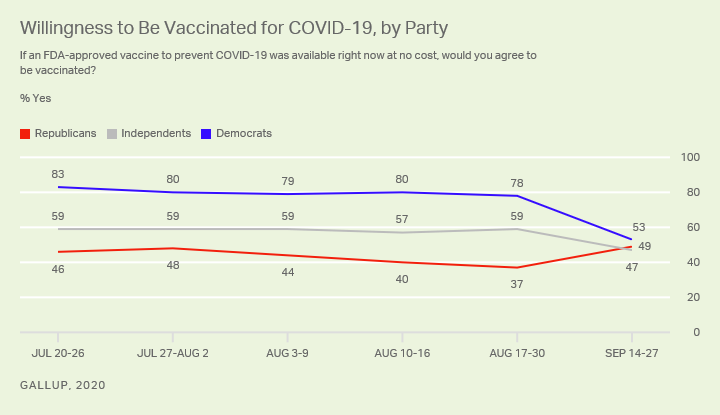
Trump saying that massively reduced Democrats opinion on vaccines and massively increased Republicans opinion on vaccines though. People shift their opinions really easy over tiny things, every little bit that makes one side more convincing helps pushing people to the correct realization and vice versa. So it is very possible to convince a lot of people, thinking otherwise just ensure those people wont get convinced. It is a spectrum, every tiny step helps a lot, there is never a point where being more convincing no longer helps.
I hate to be pedantic but the poll you reference was in 2020 and Trump said that in May of 2021. I don't think it had a measurable effect on either party.
You are right, this was due to another statement by Trump. But Trump saying something about a vaccine had that big of an effect. As soon as Trump started talking about getting a vaccine out to the people Democrats started to think that an FDA approved vaccine would be a bad thing while Republicans started thinking it was a good thing. As you see in the graph after that statement both groups were almost equally willing to get vaccinated.
> Democrats' reduced confidence follows President Donald Trump's Labor Day announcement that a coronavirus vaccine could be ready in October, as well as subsequent news reports stating that Trump is eager to see a vaccine delivered before the election. Trump's accelerated timeline does not align with that of many government health experts, and this disagreement has raised concerns as to whether a vaccine distributed that soon would be effective and safe.
I would treat Democrats that refused a vaccination because it was Trump's FDA with the same disdain. The fact that this issue is divisive along political lines is what is so damn infuriating. This is science people, one of the few things left on the planet that can conceivably be free of emotional discourse and we're actively killing it for financial gain.
I'm not a Republican or a Democrat, I'm a scientist.
Most people aren't able to dispassionately pursue the truth. You need to remove emotional barriers first before the facts can be heard by finding ideological and emotional common ground somewhere and then using that camaraderie as an attack vector to convince them that something else that they believe is wrong. I have done that somewhat successfully with a fairly far-right person, managing to bring them back on some of their more extreme views.
It's possible you weren't the right person for this specific job. I believe that some alignment on at least some views is necessary for this process, otherwise the barriers just immediately go up.
Having said that, it's true that for some people no amount of reasoning or persuasion will work. The amount of cognitive dissonance and the extent to which the belief is tied into their self-worth and identity precludes anything but a years-long process of deradicalization. People aren't designed to be rational.
I didn't say they're stupid, I said their fools for believing what is obvious a bunch of politically motivated lies, science is no place for emotion.
No, you said "while believing anything Trump says without question."
If we can't change people's mind with the truth, what possibly could make them realize they have been duped?
Packaging matters. People are emotional and make rarely make factual determinations in a vacuum. Your attitude in our conversation so far tells me that you have a near-zero opinion of their intellect and have no idea why they believe what they believe (ie you say that they believe 100% of what Trump says, but 10 seconds later acknowledge they'll boo him at his own rally). You most likely come across as smug and superior in these conversations so while you may just be explaining that mRNA therapies have been in development for decades they will see it as an attack on them... Logical? No, but it's how humans operate. Maybe you're perfectly logical but I kinda doubt it.
Lets use creationism as an example because it's what I have the most experience with. You can argue until you're blue in the face with facts and won't get anywhere most of the time -- there were certainly people who had that experience with me 15-20 years ago. Looking back I wasn't interested in the facts. The Adam and Eve story had to be literal to explain original sin, which had to be a thing to explain Jesus' sacrifice which was one of the most central things I believed in. So when you'd crush me with facts demonstrating that the earth cannot be 6,000 years old you'd actually be tugging at the single most central thing I believed. Good luck.
I was reasoned out of young earth creationism, but I had to be in a place where Jesus was also on the table to be discussed. It took about a year from "oh shit, that's how radiometric dating works" to "uh yeah, none of this makes sense." Open discourse was the only way that was possible -- the talk.origins archive, books like Why Evolution is True by Coyne, lectures by friendly scientists, ect.
That's a lot of assumptions about me and my behavior. You're right on one thing, I don't understand how pride and selfishness can be such a driving force behind people's views. I don't think your analogy with creationism holds water though, it doesn't cause a public health hazard. While I don't personally endorse creationism, I could care less what you believe and only have an opinion if you are trying to force me into the same mindset and while science has undeniably proven creationism false, there is no real detectable detriment to folks believing it.
COVID on the other hand is a massive public health problem and I view this unfounded resistance in the same vein as drunk driving and yelling fire in a crowded theatre. Your freedom ends when it begins to endanger other people. If there were any even remotely reasonable arguments, I could engender some empathy for these folks, however there is not, it is complete lies, fabrication, and fear mongering. 2000 year old ghosts, while useful for creating a system of morality to keep people in line, is not a basis for scientific discourse.
In some ways, the political/medical alignment problem turns Cialdini on his head in that once one sees other people as "rabid GOPers" then an appeal using Cialdini's "Social Proof" would turn the target of persuasion against one's subject of persuasion.
If I, an unexpert, were to work on the problem, I would use the ambiguity of risk to hold the vax door open (if the target did other vaccines, did not hold strong religious whatevers against vax, etc). With the door open I might take advantage of information asymmetries and use Cialdini's "scarcity," letting them know that I know a particular place has vaccine X today which is better than vaccine Y because of some reasons, and that vaccine X is in short supply so if they were going to do it, this is a great opportunity.
Are they conspiracies when they start becoming true though? I remember when the vaccine mandates and passports were a "conspiracy" at the begging of the COVID lockdowns. Now, here we are...
Not unlike the censoring any discussion of the lab leak hypothesis they (the censors) better be perfectly accurate every single time.
The moment they get it wrong and censor something that turns out to be the truth they lose 100% of their credibility and become a part of the conspiracy themselves.
I remember having to provide vaccine proof to get my kids into public school, when enrolling them into college. How is this a new thing? Why is it such a big deal now? Why are these people kicking up such a fuss now?
The reason: GOP makes money and gains power by proving people will believe anything they say. This is a blind power grab and the only reason it is an issue is because it is a great talking point. Tucker Carlson and the like are only doing this to get money, why no one sees that is beyond me.
I agree, however how do you deal with folks knowingly spreading misinformation for financial gain? Most of the "sources" have an active interest in having people listen to them and will say anything that will get more people to tune in, no matter the content.
Do we just let them continue in an age where there are morons out there that will believe anything that is written in a coherent sentence or posted to Youtube with cool background music? At some point we have to hold people accountable, as this is straight up murder in some cases. Remember that girl that convinced her boyfriend to kill himself?
Why is that? The central point of my argument is that the death rate in the US is the highest it's been since the middle of WWII. Everyone keeps saying it's not a deadly disease, not many people are actually dying, that it is being inflated because it's being listed as the cause of death. The vaccines don't work, yet you're 11 times more likely to die if you have not been vaccinated. The fact of the matter is, this data is undeniable, there is no question on the number of dead people (not from COVID, just dead).
> death rate in the US is the highest it's been since the middle of WWII
Age standardized mortality rate (that is, accounts for an increasingly old population) is at 2008 levels in the UK. This doesn't account the total lack of treatment early on, patients were denied anti-inflammatory medicine and put on ventilators instead of normal oxygen.
> saying it's not a deadly disease, not many people are actually dying
Not many people are dying of COVID-19, they're dying with COVID-19. Most have serious underlying conditions.
> The vaccines don't work, yet you're 11 times more likely to die if you have not been vaccinated.
This is patently untrue. 87% of deaths and hospitalizations since July are vaccinated [1]. Now, this site might seem sketch, but you can download the reports from the Scottish government yourself and verify the math. I did, it's accurate. Tellingly, the latest report is missing the death count table.
If the vaccines have any affect at all, it's marginal, and only in the elderly. Of course, they don't work, that's why they're rolling out 'boosters' because the vaccines keep failing.
> Age standardized mortality rate (that is, accounts for an increasingly old population) is at 2008 levels in the UK. This doesn't account the total lack of treatment early on, patients were denied anti-inflammatory medicine and put on ventilators instead of normal oxygen.
Thank you for confirming my argument, vaccination rates in the UK are well over 80%.
> Not many people are dying of COVID-19, they're dying with COVID-19. Most have serious underlying conditions.
Actually, deaths from underlying health conditions are all up in addition to COVID deaths, try again.
> This is patently untrue. 87% of deaths and hospitalizations since July are vaccinated [1]. Now, this site might seem sketch, but you can download the reports from the Scottish government yourself and verify the math. I did, it's accurate. Tellingly, the latest report is missing the death count table.
That is not an honest statement, granted I should have qualified my statement with "in the US". Comparing a country with a much higher vaccination rate seems to be apples to oranges. Very interesting stat though, need to read more on that.
> If the vaccines have any affect at all, it's marginal, and only in the elderly. Of course, they don't work, that's why they're rolling out 'boosters' because the vaccines keep failing.
This is 100% supposition, what data would you cite, if any, to back this up?
EDIT: Did some more reading, apparently Moderna, Pfizer, and J&J only account for less than 34% of the vaccines administered in the UK, they are primarily utilizing other vaccines.
> Actually, deaths from underlying health conditions are all up in addition to COVID deaths, try again.
What does say about your WW2 mortality claim then?
Okay, so looking at the first study linked in the post article [1]:
Scroll down to the first table.
Not Fully Vaccinated: 569,142 cases, 6,132 deaths. Mortality in this group: 0.010774113
Fully Vaccinated: 46,312 cases, 616 deaths. Mortality in this group: 0.013301088
Look at those mortality rates closely, the Fully Vaccinated group is actually higher.
The next section has a different total number of cases, unexplained in the table itself, but let's take a look at the most vulnerable population in that table, 65 and over.
Now, that's a difference of 0.023472434 in mortality. I don't know what kind of math it takes to make 2.3% look like 11x better outcome, but I'm sure it's not math based in reality. That's about a 30% relative reduction in rate, and that's using highly specious numbers IMO, especially considering the CDC put out guidance to NOT TRACK 'breakthrough' cases unless the patient is hospitalized. Since this table includes a 'hospitalizations' column, one has to wonder how these vaccinated cases even got tracked in the first place.
Mind you, this is if you believe the CDC and their data in the first place, which I don't.
> What does say about your WW2 mortality claim then?
That statement doesn't even make sense. I'm refuting you statement that folks are not dying of COVID, their dying with COVID. It's just not true, if that were the case, we would see a corresponding drop in other causes of death. We didn't they actually went up, pretty close to how much they go up every year. But COVID deaths on top have gotten us to the point of WWII death rates in 1943. So in short, it completely proves my point.
> Look at those mortality rates closely, the Fully Vaccinated group is actually higher.
I think failure to interpret the study correctly does not actually make it incorrect. Try reading the whole thing instead of cherry picking numbers to try to prove your point.
> Mind you, this is if you believe the CDC and their data in the first place, which I don't.
What's there to "believe"? Deny what doesn't fit your world view is not a good playbook. Did you "believe" the CDC when Trump was in charge? Was it different then? Sometimes things we don't like still happen, even though we really don't want them to. Denying reality doesn't make it true.
> But COVID deaths on top have gotten us to the point of WWII death rates in 1943
Except, they didn't, as we discussed already.
> think failure to interpret the study correctly does not actually make it incorrect. Try reading the whole thing instead of cherry picking numbers to try to prove your point.
I don't need someone to interpret numbers for me, that's the difference. The rest of the 'study' is drivel. Not to mention, the data's already cherry picked.
> What's there to "believe"?
For starters, we have to take their numbers at face value. We know they're not aggressively collecting adverse reaction data, we know they're not doing much investigating vaccine caused death and illness, we know their numbers are most likely skewed to show the vaccines are beneficial. Despite this, the best they can come up with is a report that shows the mortality among vaccinated is higher than the unvaccinated.
Rape is horrible, but you're using as an example a country which has arguably the worst rape statistics in the world, where rape is used as a regular war tactic.
Even for racism and homophobia has now merged through grey areas. Someone who disagrees with mass immigration is a racist and someone who is pro the sanctity of marriage between man and woman (not that you can't get legal rights as a same sex couple) is now homophobia. There's so much nuance in under these big umbrellas that no one care to have a dialogue about, they just want clear cut right or wrong with the world is filled in fuzzy lines.
Ir hardly "cannot be discussed". I've participated in several online discussions about it, and cited several major news outlets covering the story. The White House is openly investigating the topic. Defending free speech is very important, but crying wolf about censorship is counterproductive to the cause.
It's difficult to claim that it's crying wolf in the comment section of an article by a reputable mainstream source telling us what's happening. Honestly it is a little surprising that the mainstream is even admitting the censorship is happening and not helping hide it "for the good of the people," but I guess if this article didn't appear they'd lose what was left of their credibility.
The current approach is to ban dissent for sanctioned topics (lab leak, hunter's laptop, vaccinations, etc.) and I agree that it's not working, because you get an echo chamber and force critics into the darkness whether they are right or wrong.
The right approach is always more information. People can think for themselves, $5000 of Russian ads didn't do anything more or have any more lies a D or R campaign ad did, so stop pretending it did.
If you want to ban foreign actors, that's fine. Targeting citizens with legit concerns and ideas is wrong and violates their rights, even if you launder your tyranny through private companies.
"There's no time to be debating the scientific consensus right now. We are in a crisis. Lives are at stake. Debating and questioning the consensus (even if it changes) will cause misinformation to propagate and lives to be lost. The only way to optimize for lives saved is to temporarily take away some fundamental freedoms like speech so that the smart people in charge can resolve the crisis with minimal loss of life."
Sorry, we had emergency legislation because of terrorism since 2 decades now. A bit desensitized by now. Perhaps I should look for something that induces fear?
i regret that i have but one upvote to give. I'm a little tired of the constant state of emergency and pearl clutching since about this time of year 2001.
This sounds like the rationale government leaders often employ to institute a dictatorship: "temporarily remove freedoms and grant the president emergency executive powers".
But somehow "temporarily" becomes "permanently" because no one in power wants to voluntarily give up that power.
"Why should they trust the government, the CDC, the WHO and the like?"
For similar reasons they should be trusting people creating content on private media platforms.
People need information and seek for sources, whatever they are. I don't think the lack of content on YouTube will make change most of people beliefs, if something will reinforce them to think this is imposed.
You can always go to other sources to look for what you want to see.
I know HN is always on a hair trigger to call out free speech issues, but "youtube does a poor job of curating covid information" is the expected outcome. You don't need to postulate a conspiracy or malicious actor to explain the expected outcome.
So it's kind of hard to take stuff like this seriously:
> ...we're not allowed to discuss whether GoF research is too risky?"
Of course you are. Youtube middle-management aren't the arbiters of what is and is not acceptable scientific or medical information. If they ever were, that would be a crisis worthy of outrage.
Don't forget, the term "anti-vaxers" has become a catch-all term for shutting down the slightest criticism about the virus, whether fact or opinion. I have seen this term slung at people simply questioning vaccine mandates and passports in casual conversations both online and offline. Very few people are anti-vax but they powers that be would like most people to think there are only 2 sides. We live in dangerous times.
Exactly: that term seems to be used as a strawman to attack the worse positions avoiding the reasonable ones.
Dismissal has been a constant presence. Somebody got damaged after infection? Some will come and dismiss with "anectodal". Somebody got damaged after vaccination? Others will come and dismiss with "anectodal". One tries to tell someone that he lost very real family members and friends to covid: "they must have been already sick". One tries to tell someone that he has known of a surprising number of people with adverse events: "they must have been already sick". And with that the issue has not progressed a bit.
We should have supported openly racist and homophobic speech. So that we'd be able to continue openly talking about other things, like science. But we all think we can control the beast.
> "Why should they trust the government, the CDC, the WHO and the like? What have they done to prove they are trustworthy at this point?"
This is the crux of the issue IMO. As someone pointed out in another comment, the CDC of the past is not the same as the CDC of today.
I am vaccinated as are my wife and kids (young adults). However, it was not a slam-dunk decision to get it.
Why the hesitancy?
- Trump pushed to get the vaccine in record time (maybe to score some political points?)
- When outbreak first hit the US, Trump tried to halt international travel to a large extent. He was berated for this, while it seemed to me to be a prudent action given the situation. Other countries put the clamps on international travel and I didn't see any criticism of them.
- While Trump was still in office, Harris and others were publicly quoted as saying that if Trump says they should get the vaccine that they would be hesitant (don't recall the exact quote). (Did they say this as a legitimate concern or as a way of scoring political points?)
- Biden administration, supporters, and MSM rush to label anyone who questioned whether the virus originated from Wuhan lab as "conspiracy theorists", "kooks", "crackpots", "nutjobs", etc. Then later on, well-respected scientists openly suggest that Wuhan lab could be the origin. (Who is trying to manipulate our perceptions and WHY?)
- Mask mandates openly ignored by the same people who advocated for strict adherence (Gov. Whitmer, Pres. Biden, former Pres. Obama's big birthday party, etc.) If wearing a mask is so important for public health, why are they NOT doing it at times?
- Sufficient public testimony from NIH scientists in Congressional hearings to conclude that NIH funding of Wuhan lab through 3rd party DID fit the definition of gain-of-function research (suggesting that Fauci is lying to the public. Why?)
- Earlier in outbreak, Biden administration stated that they don't foresee mask mandates. Later, mask mandates.
- There is ample anecdotal evidence to suggest that many hospitals were quick to report fatalities as being Covid when there was no Covid connection. Why? Were the hospitals coached to act this way? Was it about federal government payments? Make the numbers look a certain way?
- From the very earliest days of Biden administration, up to today, there has been record immigration on the southern border. Putting aside your position about how immigration should or should not be handled IN THE ABSENCE OF a worldwide pandemic, WHY are record number of immigrants being encouraged, supported, and processed at our southern border? Are they being tested for Covid? Mayorkas just made a statement a day or 2 ago that he was SURPRISED by the jump in delta variant numbers at the immigrant processing and staging locations!! Really??? WTF are these people thinking?
I could continue on, but by now you either see the pattern or you refuse to acknowledge that it's even conceivable that there could be a pattern of deception.
If I look back over the history of vaccinations, they have been an absolute blessing to all of humanity. There's no doubt about their effectiveness in wiping out terrible things such as Polio (as just 1 example).
However, today there is so much evidence that federal government, UN, WHO, state governments, local governments, MSM, Facebook, Youtube, Twitter, etc. are now operating under a perpetual mode of MANIPULATION to coerce the public to their DESIRED end goals, irrespective of truth and scientific fact. Both Democrat and Republican parties are guilty.
Are you really surprised that there are people who question the truth and sincerity of the powers that be?
I mean you are anti-woke and supposedly much more informed than so called "woke" people and yet all your information seems to be coming from a single source.
Greenwald is a pretty solid source compared to a large amount of journalists though, even if he probably doesn't have a neutral opinion by now. But he tries and that is the difference.
First, it's a misdirection. It's a bargain with the social far-left in an attempt to reduce the power of the economic far-left given that those two groups overlap so much. We will go along with your culture war because it's the cheapest alternative available to us.
Second, it's the first-mover problem and a coordination problem. Nobody's brand wants to be singled out by a social media mob. Being around the 5th percentile makes you a target. So everyone tries to be around the median. The median keeps shifting up and up, as the people in the 5th percentile keep re-upping the ante as they chase the ever-increasing median. It's just a consequence of social media mobs targeting the bottom percentiles for brand damage. Their only other option is to regime shift into full blown anti-woke, which simply isn't viable for many companies. If all companies simultaneously shifted downwards (by becoming not-woke), there wouldn't be a problem, but that coordination can't happen with heterogeneous entities.
___________ is a blunt instrument of the elites to shut down any discussion that threatens their narrative.
It's a propaganda technique. If the opposite of wokeism etc. were popular and accepted by a large number of people, propagandists would use that. They would, for example, brand any dissent as "not white" or "gay" or "miscegenated" or "degenerate" etc. They did in fact do this generations ago.
If we lived in a super-religious society any dissent would be satanic. This version is still leveraged within the evangelical community.
All narratives will be weaponized by propagandists regardless of whether the narrative itself has objective merit when considered in good faith.
This is a tactic and works largely the same regardless of what narrative is being weaponized.
Indeed, just look at how "carbon footprint" came from the oil industry. I left behind a conservative religious upbringing, but never found an escape from tribalism and guilt tripping, whether for conservative or liberal causes. Manipulating our need for agency (by touting personal responsibility) and belonging (by guilt tripping and shunning) is an astonishingly good way to divide and conquer a society that really has a lot in common.
Exactly. And this has been going on for a looong time. In fact, as long as I can remember watching news. It's all a religion, be it christianity, nationalism, communism, ecology, global warming, "woke"ism, anti-racism. The tenets are always the same: YOU are guilty just for being born, or existing, or wanting to live a normal life. YOU need to do something to correct this. YOU must be with us, if you're barely neutral you're the enemy. YOU will never fully achieve full pardon for your original sin, but you have to keep trying with all your strength, otherwise you're a heretic that deserves to be cancelled.


Free speech is the act of standing up for those who you disagree with simply because you believe they have the right to be heard. In today's world of "woke" content creators, everyone seems to miss this point. What started out as fairly clear cut issues such as racism and homophobia has now bled into grey areas around vaccines and gain of function research.
On the latter, should we not be concerned about this? We're in the middle of a global pandemic and we're not allowed to discuss whether GoF research is too risky? We're not allowed to discuss the nuances of what a "lab leak" may really entail? For example, I think the theory that a researcher collecting specimens from the wild accidentally infecting people in wuhan or themselves holds a lot of merit. Yet, it cannot be discussed.
We should be outraged. And, back on the topic of anti-vaxers. They kind of have a point. Why should they trust the government, the CDC, the WHO and the like? What have they done to prove they are trustworthy at this point? Shutting down open discussion around this topic will only make the situation worse, not better.