A friend of mine living in an apartment complex with parking facilities at basement level recently told me that firefighters having inspected the area had come to the conclusion that they will make no attempts to go down and put out a fire if there are EVs parked. There will be fire until there is nothing more to burn, house still standing or not.
Seeing a car battery burn kind of makes me understand why.
> That's just a bad fire department. There are procedures to put out lithium-ion fires that aren't just "let it burn".
That's what they're supposed to do, though, according to Tesla[1]. The firefighters are there to pour water on the fire to cool it down and wait for the battery to burn and release its energy. This is what Tesla's manuals[1] say:
> If the high voltage battery becomes involved in fire or is bent, twisted, damaged, or breached in any way, or if you suspect that the battery is heating, use large amounts of water to cool the battery. DO NOT extinguish fire with a small amount of water. Always establish or request an additional water supply.
> Battery fires can take up to 24 hours to fully extinguish. Consider allowing the vehicle to burn while protecting exposures.
EV battery fires and their risk to firefighers are a national problem[2].
Also, you're expecting a lot from what are often volunteers who have little to no funding. I lived in a place where over $20 million was spent on police salaries each year, but firefighters and EMTs were all volunteers.
I'm one of those volunteer firefighters (Vacaville district). There's no way we would just walk away from a vehicle fire. If it means spraying water on it for hours, fine, then that's what we'll do. If there's no hydrant we'll have 2000-gallon water tenders lined up. On a big wildland fire it's not unusual for the pumpers to be working for hours.
You really underestimate how much firefighters love to use the equipment "for realz". I don't know anyone who doesn't dream of running into a (concrete) parking garage to put out a vehicle fire, EV or not.
Also, nobody (at least in my district) is allowed anywhere near a vehicle accident without bunker gear. If we had to rotate new pairs of firefighters in every 30m when the SCBAs run out, so be it. The department has a lot of tanks. We also have ventilation equipment on all the engines and squad units.
Also also: We're the rural team. The city departments (with their million dollar fire trucks) are even more hard core. "Make no attempt to put out EV fire" is just nonsense.
It can also be extremely dangerous to stay in a closed space i.e. underground parking if you don't have a way to turn off the fire. Most people don't die of fire in fires, they die of less than a minute of breathing in toxic fumes. To tell a volunteer to risk his life to watch a fire burn he can't turn off is a very privileged position to be in.
Firefighters tend to have respirators when they fight fires. It's not like things other than EVs don't release copious amounts of toxic fumes when they burn. ICEs are really not much better in that regard.
The difference is not the toxicity of the fumes, it’s the duration of the fire. A respirator will not fully protect you from a seven hour underground fire.
In an EV fire, you have an initial fire that burns hot and releases lots of fumes (a large part from all the other crap in the car combusting), and then you have a very long period where you have to dump water on the battery to keep the internal oxidation under control by cooling it. The later part is much less dangerous for the fire fighters.
This actually reinforces my point. The first part releases “lots of fumes” into a poorly ventilated underground space, which then requires firefighters to remain for “a very long period.” Your claim that the later part is less dangerous assumes that fumes have dissipated.
> That's what they're supposed to do, though, according to Tesla[1]. The firefighters are there to pour water on the fire to cool it down and wait for the battery to burn and release its energy. This is what Tesla's manuals[1] say:
No that's not what they say. They say to keep it cool to prevent it from burning. You're misinterpreting those instructions.
> besides keep water flowing over the outside of the battery pack while the inside self-oxidizes
But that is doing something other than just letting it burn. That's containing the damage, rather than letting the fire spread to everything around it.
They are different situations, but I'd argue they're different in the opposite way. For a car by itself outside, letting it burn would be fine. But in an enclosed parking garage, it's rather important to keep the fire from spreading to the rest of the garage.
Yes, but the problem with Li-Ion fire in a confined environment is that it generates a lot of toxic gas (doable but you need equipment for that), a lot of hydrogen which will react with everything near by, and the risk of explosion (in the sense of rapid fire expansion with a thermal run-away of most cells) is higher.
My guess is that the floor was poorly ventilated with complex access, rendering the access to the fire unnecessarily hazardous.
I'm not sure if that would do anything much to help; it might just trap the heat in. I think the standard recommendation for Teslas is to just dump water on it so that the extra heat energy can be conducted away and redirected in a relatively harmless way into conversion of water into steam.
>There are procedures to put out lithium-ion fires that aren't just "let it burn".
Can you provide more info on this? I'm very casual on the topic from what I've read is kind of impossible to put them out. Sometimes they have to throw the EV on a water tank and let it sit there for days.
The original poster is incorrect. The correct way to handle lithium ion battery fires is to put tons of water on them to keep them cool. Most of what's burning in lithium ion battery fires is the electrolyte being heated up by shorting batteries. You want to keep them cool so the electrolyte can't burn.
I would say that using lot of liquid CO2 must cool down a lithium fire while also denying it oxygen to continue. That's what a CO2 fire extinguisher does; it's often used to put out small fires in powered electrical installations.
At a car battery scale, especially in a garage, that would require the use of oxygen masks, and evacuating anyone around, because there won't be much to breathe. Also, of course, the fire truck must carry a large amount of liquid or solid CO2 ("dry ice").
Using liquid nitrogen would be even more efficient, but even harder to provide at scale. Liquid nitrogen is cheap, but cryogenic facilities are not.
Lithium by weight is very little of what's in the batteries. It's not Lithium that's burning. Primarily what's burning in lithium ion battery fires is the volatile electrolyte.
Sorry, that's just dumb. A lithium fire is hard to "put out", it's objectively safer than pretty much everything else that burns. It flames and sputters for a few hours, then it's done. Standard procedure for these things is to do nothing but keep it cool and wait. If your fire department can't handle that then I fear deeply for what happens in the next house fire they face.
This is just ludditism. New technology brings out a combination of people afraid of The New and people trying to look smart by pontificating about new New and Scary failure modes.
You really can't fathom why fire departments dislike stuff that can't just be put out, but needs to be kept cool for hours and hours with lot of water?
Cities have fire safety regulations for parking lots and if the parking lot violates it then it can be sealed off until fixed. It doesn't matter what's inside the parking lot unless its legal and say not a nuclear reactor.
ICE vehicles too catch fire all the time, It just seems your firefighting agency is not doing its duty.
I've been thinking that if I have a "power wall" I will want it outside a good distance from the house and in its own cinderblock bunker.
I wonder if it would make sense to install these larger batteries over concrete "basements" or pits and have mechanisms to "drop" them — maybe flood the pit with water.
You will want to do the same for synthetic clothing, cooking oil, and your cooking range & oven.
We already have houses burning down because people left the bacon unattended for a few seconds too long.
House batteries already have thermal management and fire suppression built in. Mount the battery on a brick or metal wall of your house as per the instructions and forget about the doomsday scenarios.
There's an interesting trade-off for people who go the DIY route: LFP batteries are pretty ideal for power storage, for a lot of reasons (safety, durability), but they don't deal well with cold and can't generally be charged if the temperature is below freezing. So, you can have them in the house (in the garage, perhaps) where they'll stay warm enough, or you can have them away from the house where they'll do less damage if something goes horribly wrong, but then you have to figure out how to keep them warm in the winter if freezing temperatures are a thing in your climate.
Yes it's a single battery pack burning and you need to keep it cool with larges amount of water for a long period to let it cool off so it doesn't restart.
A second pack or a separate cell inside the same pack? These things are highly modular and even within a large pack there's multiple smaller packs that are also fire insulated against each other.
Seems pretty clear from this photo[0] it spread to a second pack that was in close proximity. A quote from the media release is "They found a 13-tonne lithium battery inside a shipping container was fully involved" which would exclude the possibility that it was a single pack within the container. This is also shown in the photos.
Maybe those battery packs need to be spread out more. Oil tank farms are usually spread out some, with dirt berms around each tank. That helps to contain leaks and fires.
If they only lose one container-sized pack, that's not too bad. If they lose two, that's not so good. If they lose the whole installation, this needs a rethink.
Tesla builds its industrial battery packs so they don't spread fire to nearby packs and are insulated such that nearby fires can't cause them to go off. It's not exactly clear in the article, but the fire didn't spread, it's contained to a single module inside the battery "field".
The root cause will be great of great interest; I hope we get to find out publicly. These battery systems are still new, but even so they have many layers of safety systems designed to prevent thermal runaway.
Well, maybe. But this application isn't safety-critical. Power infrastructure is fenced off, remote, and generally operated without personnel. Certainly you don't want to deploy stuff that's going to spontaneously combust for reliability and economic reasons. But it's not a car.
I hear people talking about replacing peaker plants with batteries. Peaker plants are usually not at all remote, and could pose a threat to nearby buildings.
I’m not a grid expert so I could be wrong, but don’t they place the peaker plants in urban areas to avoid “congestion” on long distance transmission lines during peak demand?
Peaker plants are burning possibly explosive chemicals. If you can build a peaker plant safely in a certain location, you can put a battery there as well. It'll be safer than a gas or diesel fired peaker plant.
When this battery caught fire they told area residents to stay indoors, close all windows, and turn off their HVAC to avoid breathing the fumes. We don't get told to shelter in place when a diesel vehicle drives by and we cook with natural gas in our homes -- are you sure the safety is the same?
Actually my area had a transformer fire at a residential substation (not a peaker plant, but same infrastructure) about three years ago. And... the instructions were exactly the same! Apparently it smelled bad within a quarter mile, put a ton of soot in the air (apparently from the cooling oil burning), and was on the nightly news. And until this thread I hadn't bothered to remember it. I doubt many do.
Come on. Stuff breaks, things burn. We don't want it to burn. We should take reasonable action to make sure it's engineered not to burn. But if it happens to burn? Meh. Let's not lose our shit about it and start banning critically important technology, OK?
Are these actually lithium ion batteries? I kind of assume so given the fire. Why not use something like LFP instead, for a grid-scale installation where weight doesn't matter so much? Along the same lines, is the Tesla Powerwall a lithium ion battery? Most DIY equivalents are LFP, that I'm familiar with. This seems like a sensible choice.
Because Tesla doesn't have LiFePO4 (which, technically, is a category of lithium-ion, just a less exciting variant) production, and isn't using them in their cars, so they don't have a bunch around. They're using a low-cobalt variant of NMC, last I checked, though that may have changed to NCA at some point. They're not nearly as exciting as LCO (lithium cobalt oxide, high energy density and really, really happy to come apart at the seams), but still can runaway pretty happily if they get hot enough.
You can get LFP to runaway as well, it's just a lot harder, requires far higher temperatures, and doesn't release nearly as much energy.
LFP is good for grid storage, though depending on what you're doing, if you don't mind a bit of watering (or catalytic recombiners), flooded lead acid is pretty darn boring. Not the most efficient (though if you run it from 30% to 80% SoC like lithium, it's quite efficient, and the newer lead-carbon combinations resist hard sulfation pretty well), but it lacks the exciting failure modes of lithium.
Especially if you have flooded lead acid, the battery just doesn't have the energy to boil all the water out. The only real risk is hydrogen buildup, and that's easy enough to mitigate by giving it "Up and to the outside" path - it goes up really, really well and a bit of fresh air plus a path up mitigates just about all hydrogen buildup issues.
There's no particularly good reason to use a high energy density lithium cell for grid storage unless that's just what you have laying around, which was obviously the case for Tesla.
And, apparently, their cooling system can't handle a runaway as well as they thought.
That's a good question. I suspect in this case it's a matter of Tesla having a large supply of a certain kind of cell at low cost, so that's what they used in Powerwalls. If someone else can make a product that is cheaper, safer, and lasts much longer by using LFP cells, then there won't be any reason to buy Tesla's product. In the long run I expect LFP (or whatever supersedes LFP) to win in the end.
I don't know if there are any LFP-based Powerwall-equivalent products, but I assume they must exist at this point and are probably being deployed in utility power storage projects. I just don't see why you wouldn't use LFP unless you either can't get them for a reasonable cost, or these things are being deployed in unheated facilities that experience below-freezing temperatures (LFP generally can't be charged in sub-freezing temperatures).
Although, some would like to use this case as something to ban battery storage all together, new much safer battery technologies[1], Current magapack has been deployed using old battery technology and built 4 years ago. Batteries will just get better check this one:
That page is way out of date and in general not accurate (thus all the warnings on the table). If you have the space, it's cheapest to do gravity storage with water reservoirs, however you need specific geography for that to happen. If you need to build such a reservoir without assisting geography it would be prohibitively expensive. The only other real option is batteries.
If anyone tries using this as a reason to ban batteries just ask what happened at Calide (turbine exploded, lodging 200kg debris in the roof of its building)
Do you know why gravity isn’t used more as a storage mechanism? It seems like you could use batteries as big capacitors for pumps and have the “real” energy stored in water towers.
Writing "X (Y)" means that Y is the same as X. They were clearly under the impression that 300 MW is the same as 450 MWh. Like 30C (86F) or £1 ($1.39).
It should have been "300 MW, 450 MWh" or "300 MW / 450 MWh" or something like that.
This isn’t a consumer product. It’s not as simple as blaming whichever company manufactured the individual parts. It could be Tesla’s fault. Or it could be caused by some dingus damaging it during transport or offloading. We don’t know. You need to resist the urge to make assumptions in order to satisfy your preferred narrative.
That’s the all clear after an alert for the local area asking people to stay indoors to avoid toxic smoke, so presumably things where worse and have now improved.
Concentration makes the poison and the threshold for noticing smoke is very low. Assuming significant distance from a one off event this could be noticeable but effectively harmless right now.
There’s almost no population within a kilometre of the site - it’s on the absolute rural edge of a city the size of Reno or Aachen, in a switchyard on the main power transmission lines. There’s maybe a handful of people and a kangaroo that’d be in harm’s way, and it’s been a cold and windy week - they’d probably not mind having the windows closed.
The 450 MWh plant is composed out of 210 battery units [1], so a little over 2 MWh just went up in smoke. Sources say that commercial chemistries emit between 20 and 200mg of hydrogen fluoride gas per watt hour. [2] At 100mg/Wh, the pack would have released a fifth of a metric ton of hydrogen fluoride gas onto the neighboring roadway over the course of the fire. You be the judge whether or not that warrants precautions.
Edit: a second pack is on fire, so we're approaching half a metric ton of HF gas now
Not would have, could have released up to 200mg/Wh depending on chemistry, but nothing says 100% of the battery burned.
Anyway, hydrogen fluoride is nasty but well studied. The 5 minute LC 50 for rats was 5120mg/m3 and at 6 hours of exposure 156mg/m3 is lethal for rats. It demonstrates a rapid fall off in toxicity rather than direct bioaccumulation because the damage is from acidification of water in the lungs. https://inis.iaea.org/collection/NCLCollectionStore/_Public/...
Humans exposed to 23mg/m3 notice lung irritation, but short term exposure is considered low risk. By comparison even a short distance from a 2 day fire in 5km/h winds your quickly talking sub 0.1mg/m3. It’s still toxic just not acutely dangerous from lung acidification.
.. assuming that the laptop batteries tested in the paper are a suitable comparison. Tesla’s cells are at least similar LFP chemistry these days, and the documentation [0] lists the same gases in the case of a fire.
But this is not an enclosed space - it’s a fenced-off high voltage switchyard in a paddock more than a kilometre from the nearest dwelling, and this battery hasn’t instantaneously emitted all its contents all at once. It’s also quite a windy and rainy week, which affects how serious a practical hazard this is. The emergency services have notified [1] people within 10km to keep the windows closed nevertheless.
Many more of good people of Geelong have a gigantic oil refinery on their doorstep[2], which is a far greater concern if you want to get exercised about HF-related accidents[3].
In 2014 the Hazelwood Coal Mine in Victoria caught fire and burned for 45 days, creating toxic fallout that is still affecting people today - I don't think it's entirely fair to make comments like that when our previous energy generation technology has been orders of magnitude worse than batteries.
(https://www.abc.net.au/news/2020-08-24/hazelwood-coal-mine-f...)
Well, I get the point many things we own in the household are already fire hazards. But at least those are either small enough that we can wait for them to burn out on their own (phone batteries) or we can reasonably put out with a fire extinguisher or hose.
What exactly are we supposed to do with a large li-on battery burning in the garage? Give up and call insurance?
What do you do if your car catches on fire in your garage? You call your insurance.
How often does that happen? I would say not very, even though gasoline is highly volatile. The onus is on designers and manufacturers to make Li-Ion fires so rare that consumers effectively ignore the risk.
For conventional cars you might still have a chance to put out the fire using fire extinguishers as the highly combustive materials, mainly fuels, are actually contained and they will not be a problem until vital structures compromised and such deterioration can be avoided by routine services. But there is not much you can do for Li-Ion batteries. Lithium spikes grow each time you charge the battery and eventually those spikes will penetrate membrane between electrodes, beyond which point the explosion will be inevitable: the process needs no air and will not stop until energy stored in the cell fully discharged. For small batteries we can prevent situation from deteriorating by putting them in water. But there is not much can be done for the size in a Tesla. I've seen video footages of two accidently involving those, one was a couple of years ago in the car park of a Shanghai apartment. Started with just a little bit smoke, but in just around 10 seconds, the Tesla was beyond redemption. Luckily there was no casualties. The other one was a tragedy. A guy brought a e-bike in to a lift and just when the lift door was about to close the battery started to burn. Unfortunately they missed the vital second that could stopped the lift door from closing. It turned several people severely burnt, including a baby.
Fire departments trained and equipped for such fires is the most likely answer though it's possible we'll end up with outbuildings that house the batteries much like garages and stables were detached from homes until automobile were considered safe enough to be parked in a home attached structure.
None of these things are ticking time bombs, they are things with (other than your electricity inside your house) fairly fantastic failure modes.
A Lithium Ion battery pack will experience cascade failure in it's lifetime. A tank full of gasoline will not, neither will the circuit panel in your home.
Will that battery pack catch fire when it inevitably fails? Who knows, but that's exactly the problem.
Ah yeah, and what happens when you increase that number 100x? Adding a powerwall to your house will increase the battery count in your home by 1,000 or more.
What's your point? That out of the tens of millions of homes, residential, and commercial buildings that receive natural gas just in the U.S. alone, there were only 11 explosions over the course of 2 years?
There are significantly fewer home-scale or business-scale battery installations. The fact that there have already been so many issues with them is concerning, since they're much harder to put out than other fires.
Yes, there will be new safety procedures developed to account for these new risks. But they aren't in place yet and they won't be if Tesla fans ignore reality and pretend like nothing's wrong.
You are comparing an industrial site fire to residential fires. They are not comparable. Best wait for the incident investigation before declaring batteries dangerous and demanding they be banned.
Best wait for the incident investigation before declaring batteries dangerous and demanding they be banned.
I did not suggest that lithium batteries be banned (that was all you), I suggested that additional safety mechanisms would be needed to control the risk of spontaneous, uncontrollable combustion, which especially seems to be a risk with Tesla battery installations, seeing as how it has happened at every one of Tesla's Australian battery installations to date.
This is a very large facility, and the expected number of fires is proportional to the number of batteries.
It would be good to know with what probability a powerwall will burn your house down, and what the probability is of anything else burning the house down.
Nonsense, it is not like gasoline powered automobiles never catch fire, it is just that we are used to it, and practices, car designs, and building codes are specifically designed to account for the hazard, e.g., attached garage floors must be below the adjacent floor level, have a certain slope away from the house, and have firewall and fire-rated door.
If hysterical reactions like that were prevalent, we'd still be on foot. Every power technology has issues, and with consistent intelligent development, they are mitigated, or something better is developed. You think burning fossil fuels or containing hydrogen at 3000bar are better ideas?
No it's not. A single rare fire is not a rebuke, nor are they time bombs. You're completely over exaggerating. Fires in electrical grid equipment happen all the time.
It's not a rebuke of grid-scale batteries, it's a rebuke of Tesla's implementation of it, or perhaps the design of the site if it wasn't planned out by Tesla engineers. One would expect that the batteries should be better isolated from each other to some degree so you don't get a chain reaction, and there to be automatic fire suppression (plain water, probably) on site and ready to go.
It's not clear from the article what exactly went wrong, but it looks like they probably lost at least one shipping-container-sized battery pack.
Should you have a Powerwall in your house? Maybe, maybe not. I would feel safer with a design based on less volatile cells, like LFP. No reason to use technology that's unnecessarily dangerous when there are reasonable alternatives.
The worst part about it is that that instability is on public display every time we get another battery fire. It shakes American confidence in EVs when it's the country that most desperately needs to adapt non-fossil fuel cars at a higher rate. I wish we knew more about the implementation process...
The EV fires look worse from a public perception perspective. I am sure there are plenty more fossil fuel car fires, but seeing a full EV car engulfed in flames multiple times is not a great look. I'm just saying they need to do better if we want people to go more green
Give fuel fires the same coverage as EV fires. Every gas station catching on fire or exploding. Every car spontaneously catching fire. Every home burned down because a fuel burning vehicle caught fire in the garage.
Just give proportional air time to incidents based on fires per vehicle.
This one BEV got half an hour of air time during the week? Why aren’t there a hundred hours of fuel burning vehicles catching fire?
This one BEV came off the road at high speed, hit a tree and all the occupants died? Why aren’t there an equal number of minutes for the non-BEV fatal single vehicle accidents?


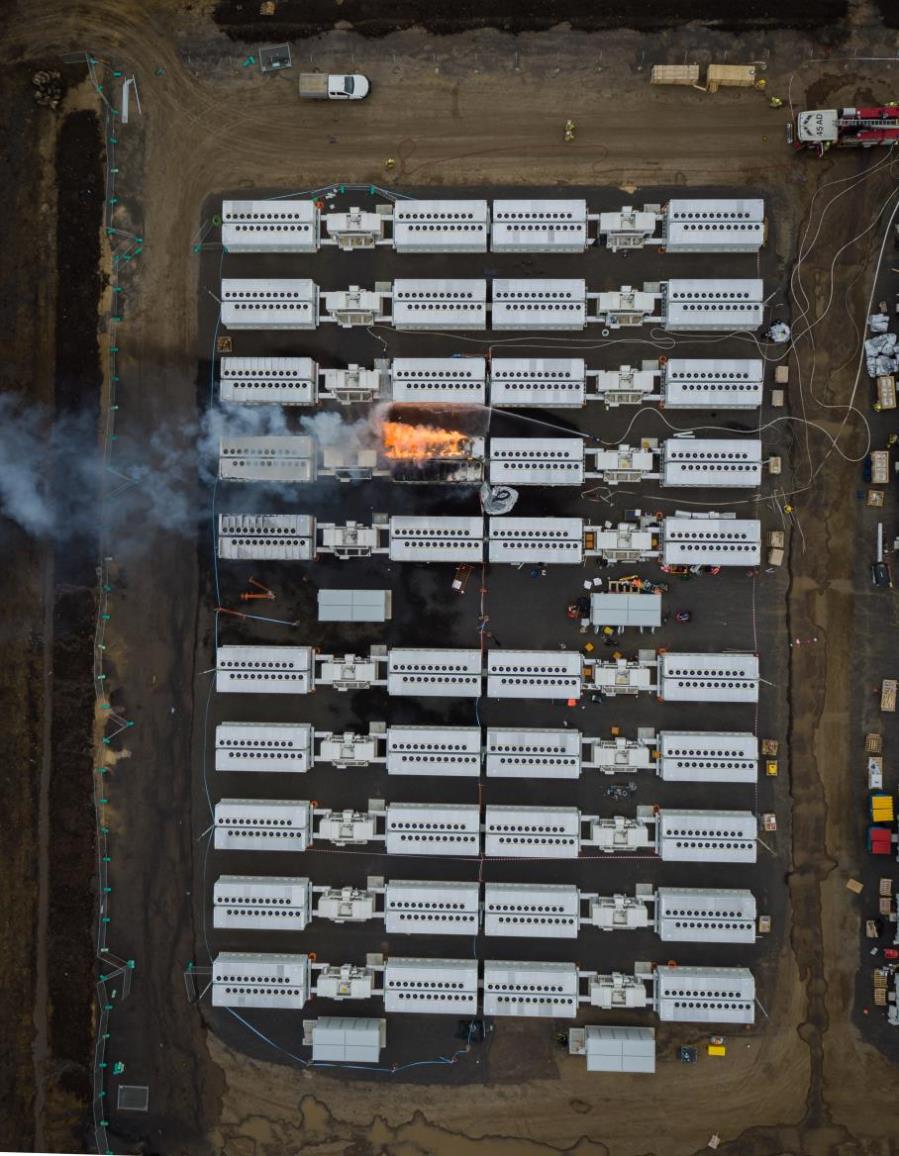
Seeing a car battery burn kind of makes me understand why.