When I was a child and teen I was a hyperactive, unstimulated, bored, D- student. Ritalin drastically changed that and I was getting A's and teachers described me as a whole different person. I would too: it made me antisocial and jittery and basically robbed me of my humanity. Since then I've found drug-free strategies to manage my intellectual/social Jekyll and Hyde.
The idea of performance enhancing drugs making their way into the workplace arena scares me a lot.
> The idea of performance enhancing drugs making their way into the workplace arena scares me a lot.
You say that as if it hasn't already happened, Adderall has been ubiquitous for years.
At my last office job we had an intern from out of state miss work abruptly because she couldn't get her Adderall prescription filled, and, I shit you not, skipped work to fly to Nevada to fill her out of state 'script because CA pharmacies wouldn't. She claimed she couldn't get any work done without it, from what I saw she couldn't get any work done either way, but the Adderall sure helped her focus on her phone for hours on end.
I've been on adderall since I was 17. I'm 32 now. Almost more of my life has been spent on it than off it.
I've been productive in a variety of ways. Some examples are listed on my patreon: https://www.patreon.com/shawwn but I feel silly bragging about comparatively minor accomplishments in ML.
But I know for a fact that without adderall, I wouldn't have done a damn thing. I've tried for a few months. Shrugged and went back.
Her flying to Nevada is completely understandable. CA pharmacies are some of the worst in terms of this medicine. I've experienced it firsthand.
Is it so hard to believe that I'd probably be a potsmoker working at a grocery store if I hadn't had adderall? Not that there's anything wrong with potsmoking nor working at a grocery store, but it's not ML.
I advise empathy. Try. And I wish I could put it more eloquently why it's worthwhile. Her missing work for a few ays is equal to a coworker getting sick for a few days. Your reaction is why so many keep their lives private.
I myself have gone from Missouri to IL to fill a script. A few hours' drive is nothing. Fun road trip.
Most recently, a person (who wasn't me) found themselves in CA unable to fill their script because their doctor wasn't licensed in CA. They literally just tell you "Sorry, can't do it." What are you supposed to do?
It's easy to say "Well, just deal with it." And we do. Let me cast a sleeping spell on you and see how well you do. You're getting verryyy sleeeppyy... you'll have a rough week.
I started amphetamine at age 20 and I'm, coincidentally enough, also 32.
I happened to have a good friend on Adderall in university, and he let me try a pill one day.
In one day I went from thinking that I was just a lazy, low-achieving individual that would always zombie through life, that—like my dad said—just didn't have a fire lit under my ass, and I went to realizing I was just a low dose pill away from achieving all I wanted. (I would eventually tell my dad that I did feel like I had a fire lit under my ass before I found amphetamine, I just had felt like it was engulfing me and I couldn't muster to move.)
I live abroad in South America right now and I fly back every three months to refill my script, that's how much it has improved my life. Though I just took a year-long break from the drug.
Btw, I switched from Adderall XR to Vyvanse about half way through my amphetamine career. Definitely was an upgrade: a more gradual curve and ~no come-down.
Anyways, the talk of amphetamine and ADHD (whatever that loosely understood umbrella word includes) is a lot like the talk of opioid painkillers: yes, there's abuse, but the conversation can't just stop there.
This sums up perfectly the issue with mental health problems. Burn-out. Depression. ADHD. Being 'old'.
You cut slack for someone with a broken leg or a blind cane. But unless you've been there yourself, you don't understand what's going on in the head of someone else. So the natural thing to do is to decide "they're slacking".
Exactly. I think one of the problems is that "invisible" handicaps do not invoke an emotional response.
In fact it is even worse because e.g. irrational behaviour of a mentally ill person often invokes a negative response. This results in stigmatisation, which is inherently counter productive.
A general mindset change is needed to address this on a larger scale. Specifically, in education there should be much more of a focus on ethics than there is now. This is hard because it can be in contrast to "profit-focused" education where e.g. the main goal of studying a field is to get a well paying job at a big company. But of course there are many factors there such as how a university is funded and can keep running.
Sadly, it doesn't look like the general population is ready for these discussions because as a human race, we cannot even get over more known/discussed problems such as racism.
But I know for a fact that without adderall, I wouldn't have done a damn thing. I've tried for a few months. Shrugged and went back.
There's an underlying assumption here: that the medication either makes things better, or makes things worse. It may have different effects on different axes, but it has those effects while it is active, and they go away once the drug is metabolized.
This way of looking at things makes the logic of using many psychoactive medications inescapable from a school and career perspective (Maybe less so from a social point of view). But it's not the only way to look at things.
What if, for the sake of argument, we posited that that the drug has not one, but two kinds of effects:
1. Constant effects, like we are assuming right now, and
2. Derivative effects. Effects that change not how good you are at work today, but how good you are tomorrow. This could be either an adaptation to the medication, or a suppressive effect the medication has on learning.
If that is so, then we would expect type 2 effects to dominate in the long run, but type 1 effects to dominate in the short run. At any given two week window taking the medication is a huge win (because of type 1 effects), but on a longer time horizon of perhaps two or three years the prognosis could be better off the medication (because of type 2 effects).
The devil is in the details, ofc: do type 2 effects exist? How large are they? Is there a crossover point? Is it two years, twenty years, or two hundred years?
My personal experience with stimulant medications is that type 2 effects do exist, and that the crossover is something like two years. That means that getting off them requires one to put up with two years of being worse off than one was on the medication.
> type 2 effects do exist, and that the crossover is something like two years. That means that getting off them requires one to put up with two years of being worse off than one was on the medication.
Very nice, nuanced analysis and sadly one I can relate to almost 100%. It was really hard to let go of it but I had to for the sake of my sanity. The side effects were getting too dramatic and long-term to ignore.
I reached a level where i wanted to learn, prepared everything, my desk, materials, made a plan and i knew why i had to learn and honestly i like to learn new things.
When you sit in front of your clean and prepared desk with over 20 and you sit there and hold a pen and you look at the book and nothing happens and you just can't and give up after 15 or 20 minutes starring at it, i realized thats how it is.
I don't know where this blockage comes from, i know it took me quite a while to see this barrier so clearly but i know now this was always here.
Ritalin just solved this problem. I had a small wall to break through with Ritalin, easy and then i just did it.
This is one thing that terrifies me about moving away from my Dr. if I were to move across the country and suddenly couldn't get my medicine I know I would quickly become a wreck for a week or so well I dealt with all of the comedowns.
I felt this during the big injectable estrogen shortage of 2019. Ended up begging an ex for some of their vial because I couldn't get my Rx filled anywhere.
I had the timeline wrong, it was 2016-17 apparently (years have been a blur for me.)
There was (is?) a duopoly of manufacturers for estradiol valerate: Par and Perrigo. [0] Perrigo stopped manufacturing, only disclosing issues with "shortages of an inactive component" to the FDA and refusing further comment. Par said their supplier for the API pulled out, and had to rework their supply chain.
I eventually managed to track down a trans-run compounding pharmacy that had apparently stockpiled the stuff (so grateful to my community!) but it was a rough time and I'm glad my ex came through for me. Detransitioning is harrowing, I speak from experience.
> I realize in some cases it isn't possible, but those cases are few and far between.
Really? Do you have any basis for saying this? For many people, going without meds is like going without glasses--you may be able to walk around without your glasses, but you're not functioning the way you want to.
Be careful about providing pharmaceutical advice over the internet. There may be some prescribed medications that people can safely self-ween from, but stopping psychiatric drugs should only be done with close medical guidance. There have been many documented cases of people stopping too quickly with dire results.
I was diagnosed with inattentive-type ADHD, and while I definitely felt the “high” from Adderall (and was convinced I was more productive) it was hard to say I actually was. I did find it easier to stay up later than I should; but that loan always comes with interest, the drugs just give you a bigger line of credit. Ditto other stimulants.
The only stimulant I still use is caffeine, and I would like to use that one less. For non-chemical coping, I find day-before and morning-of planning to help immensely with my ADHD symptoms. I do wish I had gotten non-medication help sooner in life, but even in my late twenties, still better late than never.
I use stimulants to cope with my ADHD. The problem is that without it my mind - a bright one - goes absolutely blank. It actively refuses to cooperate unless what I want to do is extremely interesting. Without the stimulants I feel like
a train cart being taken to a different direction by the rail tracks, pushed or pulled against its will by the train. I was unable to go clean my teeth, eat, or clean my flat; and I didn't do anything fun too (except for porn and weed). I was a mindless drone for most of my life. Stimulants have put myself in the foreground, and made me actually me.
Yeah, at the core we're still just animals. Our consciousness just runs inside the brain and tries its best to control the hardware/wetware. Some are more successful at it than others. Personally, I want a refund heh
The refund is a hard one for me. I hate what I and my family had to go through, but I like the person I became because of it, I like the knowledge I got because of mindless hyperfocus on things I shouldn't have cared about, and the stimulants make me able to do whatever I want. It helps that I found out about it before my mid 20s.
I am an addict, without the stimulants I become a complete mess - I'm absolutely dependent. It's not withdrawal though, I've been absolute mess ever since I can remember, even before school began, and only the stimulants made me less of a mess. I had entire years I spent laying down, decaying - against my will.
A long time ago while high on weed I noticed that my mind is actually two very disparate parts: My "autopilot" and myself. I can control the autopilot, but it can also control me, especially by promoting desires for porn, weed, sugar, videogames etc; this quickly becomes impossible to ignore, and then the autopilot takes over completely. Since then I noticed that this wasn't a creation of the drug, it's there all the time, I just never thought about it, and thought it's always just myself (mostly because I really did hate school, that wasn't just an urge). My whole life was a fight between myself who wanted to make cool software, do my school work and be physically active, and the urges of my autopilot - and the autopilot mostly won, except for a few extremely stimulating cases. Now I can control myself, and the person other people see and interact with is me, not my autopilot; and it's me enabling the autopilot when I need it, not the autopilot enabling intelligence when it needs it.
Smoked pot for a while in my twenties and it was crazy how I immediately became aware how much of my daily life was just stuff I was doing on autopilot.
When I haven't smoked pot in a while I sort of lose that awareness of it, and the autopilot just blends into the noise of everyday life.
It's a little scary when you think about how unaware we normally are of it.
I've come to realize that "I" am just a small part of the brain. A virtual machine running on top of the primitive host.
Every single second is a struggle over the who gets control of the hardware, and most of the time the host wins.
What "I" want and what the primitive host brain/OS wants are 2 completely different things. Food, shelter, reproduction. That's all it needs. Needless to say, "I" want so much more.
Of course, what everyone else sees as "me" is the body/machine. We are one in the eyes of other people, but that couldn't be further from the truth.
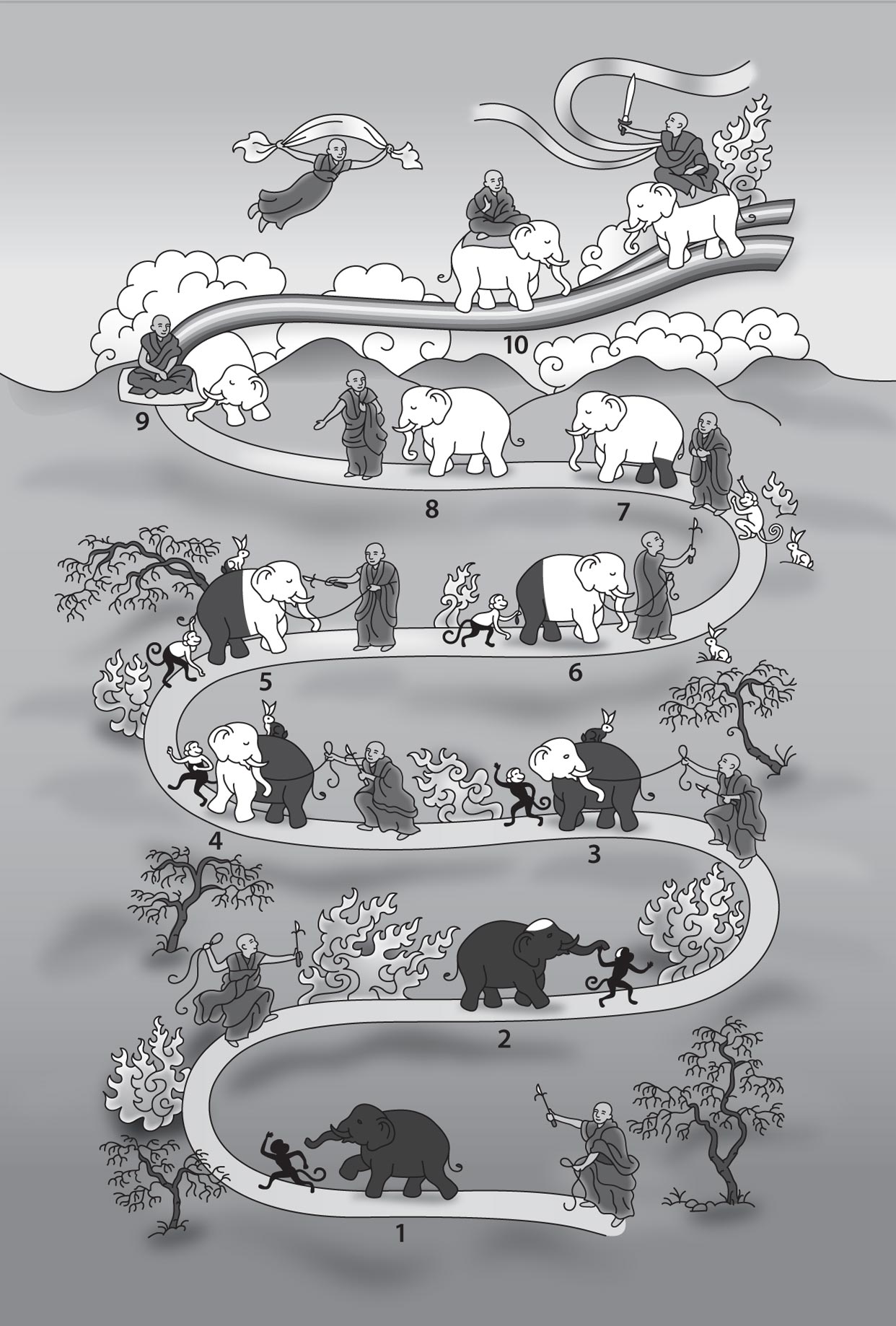
One commenter on HN once wrote, that meditation helps him more than the stimulants. The ten stages of meditation (https://www.consciouslifestylemag.com/wp-content/uploads/201...) depicts the mind as an elephant too. It gets distracted by the ape mind (look! shiny!) in the beginning. If you want to start meditation, get the book that has been recommended here before: Mind Illuminated by John Yates
I would like to heartily second the recommendation of Mind Illuminated. John Yates aka "Culadasa" is a neuroscientist turned buddhist monk who was able to distill those cultural teachings into a context backed by modern science. I must confess I had read only the first chapter thus far but it is what enabled me to follow through with a daily meditation practice for 3 weeks, my longest streak as of yet. I saw great benefit from it (however as is discussed in the book - it may be better if the expectation of results is not the primary driver of one's will to meditate) and I intend to get back to the continued aid of this well written book.
I'm sure that you have had moments of clarity where you are in the flow, present and aware, unhindered by distractions, and knowing that you can achieve whatever you set your mind to.
If you're lucky that's a common state of mind. But for people like me who have severe cases of inattentive ADHD, it's a once-in-a-blue-moon state of flow. Off medication my life is a perpetual hot mess, in large part because my self-image of who I am is not reflected in how I act, moment to distracted moment.
Adderall (or Vyvanse in my case) gets me a 0.95 batting average. Every moment of every day I'm on-task, energized, and achieving what I want to achieve. It makes the person I am, moment to moment, reflect the person I want to be.
Most people get prescribed Adderall because of failings at work or school. People come to think of ADHD as an unable-to-work-hard personality failure. But really it's a my-life-is-a-hot-mess-and-I'm-struggling-to-stay-afloat condition that you just can't escape. Adderall is a magical drug that makes this failing go away, leaving us on top of things and feeling normal.
I have never had ADHD, but I used to have a lot of problems to concentrate on class and while studying. My (perhaps naive) idea about my problem these days is that we just train our brain to be distracted. I have tried to fix it by applying deep work techniques (get rid of distractions, plan what I'm going to do, plan the breaks, make sure to eat/drink, etc). Basically I try to train myself (in a very Pavlovnian way) to enjoy concentration and hate mind wandering.
I've tried pretty much everything aside from prescription stimulants (can't get them)... The only things that work is some stuff I can get without prescription (tolerance is a bitch, though) and exercise.
Even after exercising, I feel good but I still can barely concentrate on anything, I have to always bring my attention back "manually", for lack of a better word.
I split my work into different 'tasks.' It's like a to-do list. One task might be to write an email, another task is to read a paper, another is to write some code, etc.
I put the tasks into a text file.
I run a python script that keeps track of which task I should be working on, displays it to me, and shifts from one task to the next every two minutes with audio cues for 30-minute sprints.
So, I work on the email for 2 minutes, then I hear 'SWITCH TASKS' in my headphones and I read like two paragraphs of the paper and I hear 'SWITCH TASKS' and I spend two minutes on the code, then I hear 'SWITCH TASKS' and it's back to the email. It cycles through the task list in 2-minute bursts.
I know it sounds insane and incredibly inefficient, but it's the only way I can keep my brain on track. I have to keep it moving at a million miles per second. When my brain is racing as fast as it can to keep up it seems to be happy and my aggregate productivity goes up (even with the inefficiencies at a micro-scale).
Sometimes I'm lucky and I get through a few 30-minute sprints my brain will fixate on one of the tasks and I can do just that for the next two hours uninterrupted, but that's not something I expect every day. It's nice when it happens.
My brain wants to be doing ten things, so I just feed it ten things and keep cycling though them in 2-minute intervals so it doesn't have a chance to get bored with any one thing.
Sometimes I don’t: I feel overwhelmed, I start to despair and I become very sensitive. Coming back from those times is hard, and sometimes I get into cycles of bad habits that persist for days (or, at the worst of times, weeks).
When I do manage, it’s a mix of things going on.
It helps to follow genetic advice like exercising, staying hydrated, sleeping enough, and not drinking too much. It’s generic advice because it’s pretty universally applicable.
Separating tasks into “must do” vs “want to do” helps keep things from falling through the cracks and makes it easier to prioritize.
I try to be mindful of when I am giving myself leisure time vs demanding performance, and reminding myself (preferably aloud) which mode I am in if I find myself distracted. Speaking of speaking aloud, vocalizing my internal monologue (aka “talking to myself”) helps me debug it, sort of like rubber ducking. I like to declare my goals for the day out loud to myself in my room, and it’s easier to get through hard times and make tough decisions when I talk to myself. I also feel like it improves my memory, though I haven’t measured to confirm.
It helps to work on my relationships with success and failure, and with meaningness. Some days will be failures. Most successes will be modest. Evaluating your self-worth on a day-to-day basis is like day-trading on the stock market, very risky and not the best growth strategy for most people. Warren Buffet’s investing advice is remarkably applicable to life in general.
Being in nature is incredibly healing. I love camping with friends/family, but any outdoor activity is good.
I’m incredibly optimistic about the potential of therapy involving psychedelics and I am a monthly donor to MAPS. Some people may benefit from pursuing similar treatment modalities on their own, though there are inherent risks and of course there is no silver bullet for mental health treatment.
As a counter point I was a hyperactive unstimulated student that went onto Concerta and haven't looked back. When I'm off my meds I'm angry and mean and constantly frustrated by how slowly everything moves. I enjoy being able to relax and take things easier due to this stimulant. But I think that's a big problem with over prescription of stimulants, a lot of folks that get put on them don't need them and don't respond to them in the intended manner - but healthcare is such that no one ever takes them off of them and tries other approaches.
I wouldn't call Ritalin given to a hyperactive a "performance enhancing drug". It is a treatment for a disease. It would be like calling Tylenol a performance enhancing drug, of course you will perform better without a headache, but Tylenol won't do anything if you don't have headache.
That ADHD drugs are also performance enhancing drugs in healthy individuals is just a coincidence.
As for performance enhancing dugs in the workspace, they have already made their way. The big one is of course, caffeine. Nicotine would be in second place.
And BTW, nice job managing your hyperactivity without drugs.
When you got off Ritalin, did you find yourself more emotional and “feeling” more pain? I think the fear of this keeps most people on Ritalin/Adderall/Concerta/Vyvanse, etc.
I can't comment on the OPs experience but I was on adderall for a few years of my childhood until my parents took me off of it because I was too angry and violent as they said.
I got back on it a few years back after realizing that normal people didn't seem to struggle with problems I just took to be my own lack of willpower.
I occasionally take breaks, sometimes weekends or weeks. I've noticed when I get off of it, it is basically the same as when I had depressive episodes. I start to feel completely lethargic, don't care about anything, I want to sleep and I consume all food within a 10 mile radius. I've notice the same thought patterns coming off of adderall as I do when I am depressed. I don't care about anything, I don't want to exercise because who cares, eat a box of donuts, sure it feels good now, and who cares about later.
When on adderall I can be shorter with people and get angrier quicker; however I am also less likely to act out because I have better control of my angry impulses and am able to recognize it for what it is. I also don't deal well with distraction on adderall because I want to just go go go and focus on one thing. Take that for what it is worth.
Thanks. Very much appreciate it. I’m 34. Was diagnosed with ADHD in 1st grade. Have been on it since and have done very well in life. Much of it, I give credit to medication. Though it hasn’t been the cure-all. I’ve had many peaks and valleys in life. Medication doesn’t prevent that. I’d attribute my positive results due to inner work, personal-development (hundreds of books), countless podcasts (Tim Ferriss, Naval Ravikant, Farnam St), and Mindfulness/meditation, and intense periods of obsessive hard work, and deep work processing and learning from missteps. Medication has been a helping hand in this. Yet, I come across those who espouse getting off everything. I’ve found myself curious to stop for a week as an experiment, but haven’t mustered up the courage because of the comedown fears. That said, the only right answer is to run an experiment. But stopping momentum, I’ve found, is a challenging and courageous hurdle. Plan on doing it soon.
> I’d attribute my positive results due to inner work, personal-development (hundreds of books), countless podcasts (Tim Ferriss, Naval Ravikant, Farnam St), and Mindfulness/meditation, and intense periods of obsessive hard work, and deep work processing and learning from missteps.
Any chance you could expand on some of this self-work? I'm a big fan of self improvement books, and I certainly struggle with attentiveness. Any insight would be much appreciated.
This might be the third or fourth time I've been asked so I'm going to write about it on my website tomorrow and share it here once I'm done. Apologies.
I'm interested too; feeling described to a T by your post. I struggled heavily with focus issues as a child / teen but it was never diagnosed far enough to try and medicate me out of it. As an adult with improved awareness of my attention issues, the prospect of pursuing a prescriptive fix that might just make me feel worse is intimidating.
I got diagnosed with ADHD at 31 and got a prescription for methylphenidate (Ritalin is the most known brand name for this)
I think medicine should be used as a last resort and it is not a "fix" or "solution". Dealing with my ADHD is still a daily struggle and I didn't transform into a better person by taking the medicine
What it did was to turn my experience of my life from a large overwhelming interconnected problem into small doable issues. It made me able to pick up each of the many broken aspects of my life, fix it, and move on to the next
I'm afraid of the notion, I often hear, where medicine "fixes" something. My ADHD didn't go away with the medicine, but it did make me able to take responsibility for my own life and feel confident enough in myself, that I don't want to apologize for needing a different environment to be productive
The good thing about methylphenidate is that it works quickly (20 minutes or so after taking it), so you know pretty quickly if it's a good fit. It wears off after 4-8 hours depending on the formulation, so if you feel worse it'll only be for a short period
For me, my add has been made much better with aggressive weight training. I started doing "Starting Strength" and transitioned into the Texas method but three pretty heavy workouts a week really helps.
Normally I feel like I see the world through the narrow end of a funnel. When I get done with a big workout, somehow for the next day or so my brain is chilled out and I can concentrate again. After two days or so I start to regress a bit but another bout of lifting resets me.
I only really need medicine during periods of bad health or incredible personal stress now.
Interesting, I've recently started committing to a hard 10-minute workout each day of the week, and it's been helping me focus through my ADD a lot better too. I feel so much more alive.
I've also picked up meditating 10 minutes a day and that's been helping as well, but I don't think as much.
I've got a theory about why it works. Basically you're tiring out parts of your brain when you exercise and activating others. Somehow that regulates the neurotransmitters at the heart of add for a while. If I only lightly exercise, I don't get the same effects. The workout has to be strenuous and I need to feel like I worked both body and mind (finishing that last rep under heavy load takes willpower and concentration).
I bet that HIIT could be as effective as weights for me because the curative part seems to come from exhaustion and exercise of will.
Meditation may or may not be as mentally strenuous, I am not really familiar with it.
Good for you getting Ritalin in a time where it counted.
I was avg in school while being smarter than what i was able to bring to the paper and it frustrated me like hell.
With something like >20 i got myself Ritalin. Now i was able to get the next degree and actually start studying as well.
Whilei never took it every single day, i do took learned behaviour, like a certain 'i'm cleaning now everything' with me and other work/learning behaviours.
I prefer my current live and while i have full appreciation for everyone doing jobs which require less smarts, i would have been very depressed and unhappy if i would be stuck in another type of job without the need of my smarts.
Remember wfh for a week to finish a project well behind schedule due in part to depression. 20 hour work days on Adderall while watching breaking bad from start to finish. The only food I ate was cereal and the occasional McDonald's. Good times
I had the same issue due to excessive coffee drinking. Stopping cold for 2-3 weeks helps to bring back some of the effectiveness later. But any regular dose even after this is rapidly tolerance-building.
Caffeine has a serious effect on me - it makes me jittery and screws up my sleep. I gave up caffeine in the late 80s - to my happiness, actually. I consider it a competitive advantage.
Pretty much the same here.. I drink a lot of coffee just to have a hot drink, but I can drink coffee at night and it doesn't seem to do anything. Maybe a little, but I hardly notice.
Same here, I imagine this might be due to me drinking coke zero in huge quantities, and that somehow making me indifferent to caffeine even when i am not drinking coke.
The only time I’ve felt effects of caffeine is horrible jet lag combined with 900mL of cold brew (about 1400mcg of caffeine). I was lifted from the dead and felt the highest relative improvement in mood and wellbeing in my life.
I once tried to improve my math exam scores by drinking 4 espressos but didn’t feel a thing. I can easily fall asleep after 2 cups of coffee.
Hmm, I've kept a pretty steady dose of coffee across years without needing such an increase over time. A day with zero coffee is, indeed, not fun. But we live in the future and coffee is really available everywhere always. And even if the supply chains crash, it'll be a bad week and then I'll be fine...
Huh. I like a cup of coffee in the morning but I’ve never experienced the “I need a cup of coffee or it’s gonna be a long day” feeling people talk about. (Well now that I think of it I may have thought that a few times (in ~20years) but it was usually after a short night of sleep or something like that.)
I drink one cup in the morning, occasionally a second after lunch.
Increasing doses only works up to a point, your brain has only so much capacity to support caffeine; anything beyond that just affects the rest of your body but does nothing to the brain.
Much like nicotine, the addiction seems to be highly dependent on the person.
I can drink coffee for weeks and weeks, and the stop abruptly and suffer no ill effects. Same thing with oral nicotine pouches. I can use them for weeks and weeks, and then stop cold turkey and have zero craving or desire.
I know people who do the same and the withdrawal absolutely wrecks them.
I've never seen any requirement, or even social pressure, to use caffeine at work. Plenty of people in all offices I've worked at didn't take coffee, or only very ocasionally. It was widespread, but no expected of you.
I wouldn't mind some coleagues taking some drugs, as long as they didn't make them very antisocial or generally bad to be around. But I would very much mind an employer expecting me to take something.
Its a question of where the line is drawn. Some, or many perhaps, would prefer a world where they aren't forced to alter their brain chemistry to the degree that a powerful pharmaceutical does. Caffeine, while substantial, does not have this same degree of power, whether positive or negative. There are reasons why one is a controlled substance and the other freely available OTC.
True, I drink a beer a day so why not snort a line of coke instead, they're both drugs, right ? Or heroin for that matter, they're all the same thing obviously
There's a web comic about something like this: https://www.powernapcomic.com/. The story is set in a world where the majority of people take a drug that eliminates the need for sleep, but the main character is allergic? to it so suffers a "handicap" for being what we would call normal.
If there’s emerging research, which there is with micro dosing, that shows a potential tactical advantage for a particular substance certain groups within DoD will probably lean into it and try to get an exception. For things like marijuana or cocaine, not gonna happen, it’ll still get treated like alcohol influence even if it is removed from Federal scheduling. That said there’s been plenty of confusion in the past with workout supplements causing positive drug test results for Amphetamines. It’s an administrative problem without an easy solution that I can think of.
Love it - only half-joking. Take advantage of a large population of healthy young men under close medical supervision and government access to good LSD in order to run a good experiment to see if micro dosing has positive cognitive effects.
Man, the mental health crisis is just bad for certain people. I basically got thrown away by the professional mental system because I'm classically "untreatable" and got left to fend for my own. :(
I mean, I'm pretty sure the tendency for LSD users to ethically object to war or other offensive violence is exactly why the US decided it should be treated as more dangerous than crystal meth (or perfectly legal drugs like alcohol and tobacco and caffeine) despite there being precisely zero evidence of such danger.
While LSD use was associated with anti-war activism during the Vietnam war, and probably did have something to do with it being made illegal, that doesn't mean there was actually a causal relationship between LSD use and anti-war or anti-violence views.
There were, to my knowledge, no scientific studies of this relationship, and anyway it was confounded by the US being in a hugely unpopular war, with the Civil Rights movement making non-violence a popular position among its supporters, and by the fact that there was a draft. Now there's no draft, no war, an all-volunteer military.
Also, back then LSD tended to be used in way higher doses. So even if there was a relationship between large-dose LSD use and anti-violence or anti-war views, that doesn't mean that there'd be a similar connection when microdosing LSD.
Something else to consider is that while in the popular consciousness, LSD is associated with hippies and peacenicks, and psychedelics are also associated with peaceful indigenous peoples around the world, there have been some societies (like the Jivaro) which both used psychedelics and were extremely warlike and violent.
So the connection between psychedelics and anti-violent/anti-war views is far from established. That's why it'd make for a very interesting study.
How much has this tendency been researched, though? Could there be a confounder where Americans who are more likely to take LSD are more likely to be anti-war for reasons unrelated to the LSD itself?
I agree it's absurd that it's illegal (or that any drug is illegal, but it's especially absurd that LSD is considered more dangerous than amphetamine, as you say), but I'm skeptical both of the motive you state (that the US government banned it because they feared it'd make more people opposed to the war) and that it necessarily correlates much with generating anti-war sentiment in people who otherwise didn't have any.
I think the effects are highly dependent on the environment, the intentions, and existing predisposition of the user and the people around them. For example, it's been reported that viking berserkers used to take psychedelic mushrooms before entering battle, because the mushrooms would help induce the berserk state.
The history of psychedelics include a ton of irresponsible use in the 60s which lead to reactionary banning before there was clear medical uses. Research was happening but nothing conclusive. Meth has established medical uses. There's no conspiracy to prevent people from questioning wars, we do that without drugs anyway.
I've read that before it was made illegal LSD was the most studied pharmaceutical compound in the world, with literally thousands of papers written on it.
There were clearly medical uses, and it was being used medically. Whether the research was "conclusive" is a matter of opinion.
Pretty much all of the psychedelic researchers I've read or heard interviews with (which is a lot) were completely convinced of its effectiveness.
But that didn't matter to the administrators and lawmakers, who were much more interested in the headlines than the science.
I just went to double check my self quickly. It never was an official medicine, therapy with it was still experimental for alcoholism. It was having success but turned into a recreational drug that scared people so it all got banned. The same thing happened with mdma and crack later on. The penalties were excessive and reactionary to recreational use.
This was the end of 50s early 60s, seems we still did stuff like lobotomies. Idk if I can blame law makers for not taking psychiatry seriously at the time.
"This was the end of 50s early 60s, seems we still did stuff like lobotomies. Idk if I can blame law makers for not taking psychiatry seriously at the time."
LSD was made illegal in 1968, so actually it was the late 60's (right at the peak of social unrest and reactionary backlash in the US), and they took psychiatry very seriously then, but they didn't ban lobotomies, just LSD.
It was pretty clearly a moral panic. Had absolutely nothing to do with science.
> I'm pretty sure the tendency for LSD users to ethically object to war or other offensive violence is exactly why the US decided it should be treated as more dangerous than crystal meth
The point I was trying to make
> It was pretty clearly a moral panic. Had absolutely nothing to do with science.
It has nothing to with being anti war, lawmakers panicked when it became a recreational drug and didn't know what to do.
Also california and nevada made lsd illegal in 1966
So still the late 60's, not "the end of 50s early 60s".
"It has nothing to with being anti war, lawmakers panicked when it became a recreational drug and didn't know what to do"
It was a recreational drug long before it was made illegal, and the illegality had nothing to do with it being a recreational drug, but rather had to do with panic over sensationalized media stories about LSD's involvement in things like the Manson murders, and Art Linkletter's daughter committing suicide.
LSD's role is Linkletter's daughter's suicide is highly questionable, as are all the urban legends at the time of people frying their eyes out by staring at the sun under the influence of LSD, or their chromosomes breaking because of LSD, etc. Yet sensational media coverage like this, along with a panic over "look what all these crazy kids are doing! They're having orgies and frying their brains on LSD!!!", combined with LSD's association with the anti-war movement and the counterculture (including Leary very publicly telling kids to "drop out", LSD being associated with "free love", etc), which shocked and outraged the very conservative powers that be is absolutely what led to it being banned.
LSD use was basically seen as a threat to established social order.
You're definitely right, and I'm not trying to make a statement about your personality or anything (I'm almost 100% sure you didn't intend it this way), but the phrase "please don't spread misinformation" comes across as so smug and pompous.
Every time I see someone post it I immediately want to read them the long list of all the dumb shit they've ever said in their life (we all got a really, really long list).
analyte123 also corrected the guy, but I read it and instead thought, 'huh, learned something new today.'
This is not true. US law only bans “current users” of drugs from possessing firearms. On top of this, the statute requires you to be “actively engaged” in the use to be counted which means the prosecutor has to piece together a paper trail of arrests, transactions, or testimony to prove this.
Threads like this always make think that I think most of human society has the wrong frame of mind about performance enhancement. I think the "stock" performance of the human brain / body should not be blindly accepted. I want to outgrow my biological limitations and be a more effective version of myself.
The chart on page 3 suggests cannabis has roughly the same harm to others as tabacco? And steroids present harm to other individuals? I'd love to hear these arguments.
That's a citation from a different study. The original study was "Drug harms in the UK: a multicriteria decision analysis" is based on a survey of experts, if I recall correctly, and the breakdown of the reasoning is in that study.
The major contributing factors for "harm to others" for cannabis, over tobacco, are:
- "Loss of relationships: Extent of loss of relationship with family and friends"
- "Crime: Extent to which the use of a drug involves or leads to an increase in volume of acquisitive crime (beyond the use-of-drug act) directly or indirectly (at the population level, not the individual level)"
- "Family adversities: Extent to which the use of a drug causes family adversities—eg, family breakdown, economic wellbeing, emotional wellbeing, future prospects of children, child neglect"
It's an open secret in the military that psychedelic use is fairly widespread. Unlike cocaine and weed, you can't really test for it. Kind of sad to see something like this published by the Marines though; basically content free "muh microdosing." I mean, does this even mean anything?
"Microdoses cause cortical functions
to be more fluid, leading researchers
to believe that psychedelics may help
certain brain areas work in increas-
ingly flexible and expansive ways."
If ever there was a meme elixir designed to punch holes in your pre-frontal cortex, microdosing is it. There's basically zero evidence such substances enhance anything. In my experience, and in my observations of others, it makes you feel like you're enhancing your noggin, but real world performance definitely, sometimes dramatically suffers.
Modafinil and amphetamines probably enhance performance on grinding tasks. Nature, concentration and lack of sleep definitely enhance performance on creative tasks. Caffeine works too, and nicotine and the racetams for keeping the cobwebs out and the acetylcholine high. Microdoses, yeah, nerd "muh microdoses" articles ain't gonna cut it for me: I've seen the effects and will stick with coffee and snus. Hell, simply looking at scientific or technological output pre and post civilizational psychedelic use: you can see it hasn't had any obvious benefit. People did more amazing things back when day drinking was common.


The idea of performance enhancing drugs making their way into the workplace arena scares me a lot.