The fundamental issue with this article is that the inflation number is a lie. Housing costs are the key cost for every consumer but are excluded from CPI.
Western countries have been running fiscal deficits consistently for decades, QE and low interest rates for 10 years. Yet for academics and central bankers the only answer to growth is more debt.
Low interest rates benefit only the asset rich. They deprive everyone else of investment income. They also prevent essential restructuring as zombie companies stay alive instead of going bust.
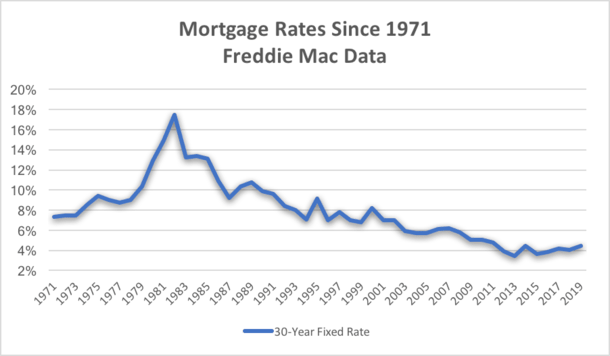
High housing costs, caused by low interest rates, are causing a demographic crisis in the west. People literally can’t afford to start a family.
Our economies and culture have a skills crisis not a growth crisis.
---
Edit: To provide some clarity on the comments below highlighting that housing costs are included in CPI. Each country calculates inflation statistics to various methodologies. CPI in the US includes a rent equivalent value which is independent of the actual cost of purchasing a home.
The weighting allocated to housing is also unrepresentative as those entering the job market in cities now are facing housing costs representing 50% of income when most inflation metrics have it at 50%.
It definitely seems like BS to me. At 3% it's 258% over 32 years (1.03^32). Most people are barely getting 1% annual raises which means income increases by 138% over the same period. From 1984 to 2016 housing prices in the Greater Vancouver area have gone up 800% [1].
Assuming I got the math right, it doesn't take much to see current young people are getting screwed. In the last 4 decades wages have barely increased, but major assets like cars and houses are 8-10x what they used to be.
Add in the cost of schooling for 2 people, which in my mind roughly translates to the cost of 2 brand new cars for my parent's generation, and it's easy to see why young people can't afford anything.
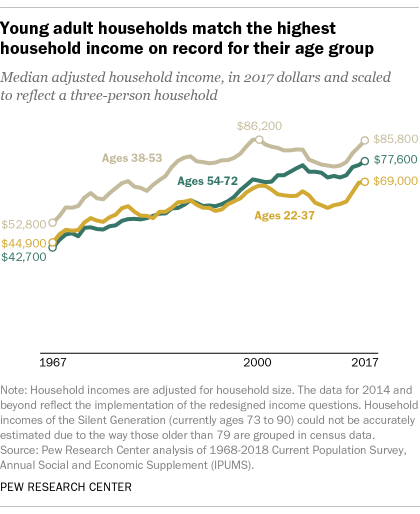
Then consider that "household" income is coming from 2 income earners now vs 1 income earner 40 years ago and you really start to get a picture of how tough it is.
How is anyone supposed to start a family when they can't afford to start thinking about buying a house until they're 35. Frugal people from my parent's generation could have their house paid off by the time they were 35.
You're perspective is skewed by living in one of the craziest housing markets in the world. Here in exurban Maryland (not to mention say Kansas City or Iowa) young people are buying homes and having kids.
Also, two-earner households were already the majority since the late 1960s: https://files.taxfoundation.org/legacy/docs/22.jpg. The percentage of households where only the husband works dropped a bit from 1980-1990, but has been basically unchanged in the last 3 decades.
The thing you're overlooking is that the median young person lives in Kansas City (or whatever the equivalent is for Canada), not Vancouver. Those young people living in Vancouver are getting screwed for sure. They should vote out the liberal governments causing housing prices to skyrocket through overregulation, causing credential inflation by throwing money at universities, etc. Or they can move to Kansas!
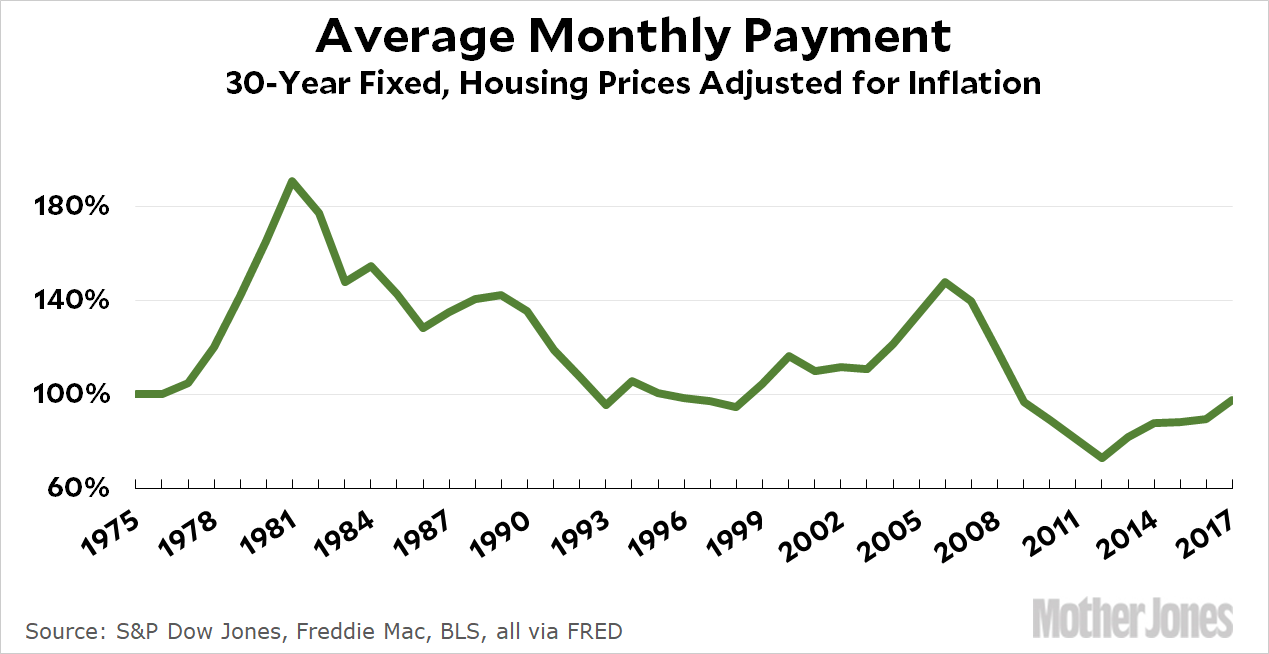
>>> They pay less on a monthly mortgage payment than their parents did
The reference you gave for "They pay less on a monthly mortgage payment" is itself adjusted for inflation as noted on the chart. So using the questionable inflation figure itself to refute inflation isn't persuasive.
Intuitively also, I'm not sure I buy the argument that the median young person lives in Kansas City. I grew up with dozens of family members who actually did live in middle america (most of them as engineers at car plants.) Many of those jobs are not as cushy as they once were. Some are gone. From my own experience as an engineer, the weighted centroids of the job market are in SF or NY or DC, not in Ohio.
Of course, that is an engineering viewpoint, what about overall across professions? I dont quite understand this and i'd love to be educated. From everything I read, the traditional jobs in middle america have left and these towns struggle. My own experience is only anecdotal (e.g., upstate NY, western pennsylvania)
> The reference you gave for "They pay less on a monthly mortgage payment" is itself adjusted for inflation as noted on the chart. So using the questionable inflation figure itself to refute inflation isn't persuasive.
Yes, it's adjusted for inflation. But if housing costs were growing faster than inflation, the monthly mortgage payment adjusted for inflation would still be going up.
> My own experience is only anecdotal (e.g., upstate NY, western pennsylvania)
Head down to Kansas City, or east Texas, or pretty much anywhere in the sunbelt. These places are booming. They're full of young people, families, and tons of kids.
> Most people are barely getting 1% annual raises which means income increases by 138% over the same period.
Where is that 1% coming from? It seems to me US salaries growth pretty much followed 3/5% average for the last 50 years, with some obvious drawdowns during crises.
> In the last 4 decades wages have barely increased, but major assets like cars and houses are 8-10x what they used to be.
That doesn't make any sense. The price of a good should roughly follow an optimum of supply and demand. There is of course a spectrum in which it can oscillate, but your "barely increased" versus "8-10x" comparison is ridiculous.
Things are evolving inside a pretty much closed system. Of course that's not exactly true, especially with capital movements, and mondialisation, but the ballpark should be there. You cannot take conclusions if you don't study the full picture.
Take housing prices for instance. The main driver for real estate is not some conspiracy of evil super wealthy people. It's just the interest rates. If interest rates lower, then borrowing money is cheaper, people get bigger mortgages, which in turn inflates real estate prices.
> From 1984 to 2016 housing prices in the Greater Vancouver area have gone up 800% [1].
Real estate cannot be studied in geographical isolation. There are way too much factors that can cause local inflation. In the case of Vancouver's real estate, it is notoriously the flow target of a lot of Asian capital. I don't think that should be taken as an example.
That is almost exactly an increase of 8X, compared to roughly 1.5X for personal income. Do you think an increase of 1.5X over forty years or so counts as "barely increased"?
Of course household income is higher because most households have two wage earners instead of one. But that's still around 3X to around 8X.
And the standard deviation for property prices has increased hugely.
This has nothing to do with supply and demand and everything to do with the difference between an unproductive rent seeking economy which sweats static assets - including the workforce - and a productive creative economy driven by innovation and invention.
For all the rhetoric, the current economy has a lot more of the former than the latter. And this is only good for a small number of incredibly rich individuals - at the expense (literally) of almost everyone else.
I think these graphs mistakenly compare inflation adjusted wages to unadjusted house price. It also fails to account for increases in house size.
Inflation adjusted cost per square foot is $126 in 1978 and $146 in 2020, about a 16% increase. Inflation adjusted wages over the same years went from 24.5K in '78 to 36K in '19, for about a 46% increase.
According to these stats, housing is actually more affordable for the same home size.
I wonder to what extent homes have increased in size to compensate for the higher price of the land they are built on.
In my neighbourhood over the last ten years small-ish 1-floor homes built in the 70s and 80s have been consistently replaced with 3-story McMansion atrocities.
You can't buy a smaller, cheaper, house because they are not being built, and I suspect the reason I'd that their price per square foot would be sky high due to the cost of the land.
What I am saying is that the price of a good (say, a car) is not decided in a vacuum. It is merely an indirect side effect of the supply and demand optimum.
What that means is that if the price of cars increases, it is a consequence of either consumers being willing/able to pay more for a car (demand driven) or cars being more expensive to build (supply driven). As I mentioned, this is not an absolute truth, since the term structure of the supply demand _could_ change due to external factors. I still mention that in the case of these goods, this is very unlikely.
For housing, the main factors are 1) what the investment will yield (rent expectation) 2) what the investment costs (interest rates).
If any of these factors (rent, IR) changes, it will impact the price.
> Here's a graph of median personal income:
> And here's a graph of median house prices:
You are comparing CPI adjusted versus point in time dollars here...
Is the source taking the average or median for wage growth? I'd expect that the average has gone up because of the insane growth in executive pay. But I'd be interested in seeing the change in the median, which I'm sure is much less than the average.
It is not that simple. I crashed out of my first career (with student loans in a STEM field), then learned to program at age 27. I’ve been tremendously lucky and successful in the decade since then, lived in a tiny place in SF for years (with a growing family) while working big tech, and I’m only just now at a point I can get my family into a house.
I’m one of the lucky ones. Learning the skills is not enough, you have to get a very good job and work your ass off for a decade for it to amount to enough to comfortably afford the housing, education, and healthcare for a family.
A generation ago getting that kind of quality job was much easier and just having the job put you in the family-supporting income range.
No. The original scalable solution to low growth is government R&D seed funding spreading out into innovation in the consumer economy.
You're not going to get much growth if all you do is educate people. You also need to give them something to do, and that requires a national investment strategy.
This is exactly the difference between the insanely productive post-war economy, which developed and then commoditised electronics and computing, and the modern lazy bullshit job economy which is built on financialised gambling-at-scale and ad tech rather than game-changing creative invention.
It is also a lie to say there is a single inflation number.
There are CPIs calculated including regional food, energy and real estate prices [1]. For policy makers, varying interest rates according to Syrian politics and Midwestern crop yields is too fine-grained. But to suggest the data are hidden is false.
What none of the inflation statistics capture is volatility, or the feeling of volatility. Wages can go up 5% per year, but if you think you have a decent chance of losing your income and not being able to get it back in your working years, you will need to act more conservatively.
Americans especially should be worried about their income security at 45+ years of age, when health insurance premiums become $12k to $14k per year per person plus $15k oop max, in today’s money (who knows what it will be 20 years in the future).
If you lose your source of income that comes with employer subsidized health insurance in that 45 to 65 year range before you get to Medicare, and you have a medical problem, all of your assets might be in play since the sky is the limit when it comes to healthcare costs. Not to mention you will have lost ability to learn income if you are having to take care of yourself or your spouse.
I agree, I’m trying to explain why people don’t feel like inflation statistics are legitimate.
For example, I don’t care about housing in 90% of the country if I think only 10% is going to provide economic growth and opportunities sufficient to make me feel secure.
Or if you think you need more retirement savings than generations before because you think money will be worth less or returns will be lower, perhaps due to lower population growth, environmental concerns, etc.
You’re not missing anything. Housing is included in CPI as rent. Housing purchase prices aren’t included because they represent both current and future housing consumption (people don’t consume a house within a year).
Nope. They can go inverse when, say, an economy collapses and everyone is forced out of their homes as they go underwater on their mortgages and but they still need somewhere to live. Kind of like 2008/09
> an economy collapses and everyone is forced out of their homes as they go underwater on their mortgages
People are not forced out of their homes when their mortgages go underwater, they're forced out when they can't afford to pay the mortgage (underwater or not).
Problem is that outsourcing and automation has collapsed the cost of most non-essential manufactured goods. These artificially depress the CPI and hide the crazy inflation that is occurring in essential areas like housing, health care, and education... basically in anything that can’t be outsourced or automated.
Massively aggregated statistics like the CPI border on bullshit. They have too many hidden variables and gloss over far too much detail.
Housing is included in CPI. Housing is included as rent, and owner-adjusted rent (what rent would be if a house was rented).
Housing purchase prices aren’t included because a house isn’t consumed within a year. The price of a house represents both current and future housing consumption. It’s not some conspiracy to hide inflation.
Sure, it is included, but underrepresented. When people with six figure salaries are paying 30-50% of their income on rent, the rent figure should be the primary driver of the CPI.
The San Francisco, Los Angeles, Seattle, Washington DC-Baltimore, New York and Boston markets are not the only places in the United States.
There are lots of places in this country where you can get a 1 bedroom apartment for $500/month, or a 2,000 square foot house for $100k.
Meanwhile, wage growth in these high-cost coastal markets has kept pace with the housing cost increases, which is part and parcel with housing cost growths in these regions.
There's no doubt that there's been significant housing inflation in this country, but someone in Chicago making six figures is not paying 50% of their income on rent.
Another thing that bugs me: many countries are taking "tech improvements" in inflation.
For example: suppose a TV costs 2x now than what it did 10 years ago, but it is also twice the size, for many countries this means 0% of inflation.
Problem is, you can't buy the old stuff.
For example, are cars now much faster, safer, etc... than cars of 1950?
Yes.
But, if you are buying your first car, you can't buy one from 1950, you either buy a car, or you don't, you either spend the 2020 price for the car, or you don't, thus this "correction" for technology development is bogus.
Or a personal anecdote:
My phone broke.
A phone now is ludicrously more expensive than it was years ago, but doesn't count in inflation because it also became a computer, that can do a ton of things.
Problem is, I don't need a computer, I need a phone, I want to do phone calls! But nobody sells those here, they only sell computers that happen to make calls, for the price of a computer.
Does the fact you can typically find 5 year old technical gadgets (phones/computers) or 10/15 year old cars for cheaper than new via marketplaces impact the assertion here? There's tons of old tech, much of it going to landfills. If everyone wanted old tech, they could have it -- there is so much of it.
Hmm... The situation is quite the opposite I think. You can buy a car now for, inflation adjusted, 50ies car prices, that will be vastly superior to the 50ies car, especially if you buy used.
Ditto for phones. Call-only phones (I have one for travel) are dirt cheap, they cost less than a decent steak.
Housing prices are long term "bound" by CPI, not the other way around. More specifically they have always mean reverted to CPI if you look few hundred years back. Robert Shiller wrote a lot on this topic.
Also, the current level of divergence between housing prices and CPI is nothing out of the ordinary. It will correct itself over time (either houses will become cheap or CPI will catch up).
If you want a simple explanation as to why it is that CPI bounds houses and not the other way around - just look at the recent post-covid deurbanization trend (and the carnage that's going on in San Francisco or New York real estate markets). There's so much land that can be utilised once you understand that you really don't have to be in downtown New York. Then, homebuilding costs are basically CPI.
The direction of causality matters though. "Houses will become cheap" and "CPI will catch up" mean very different things for the average new family trying to afford a house. The first is cause for celebration; the second just means that instead of struggling to afford a home, they'll struggle to afford anything.
It wouldn't surprise me if the second is closer to the truth. Homebuying is close to where money is injected into the economy: when the Fed drops interest rates, mortgage rates drop, the home price you can afford for a given income goes up, and housing prices go up to compensate (particularly in land-constrained areas like Vancouver or the SF Bay). Other industries like food don't go up until that money has had a chance to circulate through the economy and make it to the average food buyer. I'd expect to see large increases in the CPI over the next decade, with housing last decade being a harbinger.
by saying this, you’re implying that there is some underlying “truth” to cpi and housing prices, but it misses the underlying critique that these measures are not representing the truth on the ground at all, as experienced by americans.
cpi and housing prices may be correlated, but that says nothing about whether they each measure anything of societal relevance (similar to the critique of IQ, for example). we should expect housing prices to correlate to some combination of gdp (or some near equivalent, since that’s also a measure that’s gamed politically) attenuated by population and wages, as those would be underlying ingredients in the supply and demand functions. then when the correlation falters, we could potentially diagnose how the economy might be failing a core function of providing shelter to the populace.
Health-"care" costs are rising even faster - premiums are rising 13-15% EVERY year.
And the only way you see it in full is when you are self-employed. If you have employer-sponsored health insurance, some part of the increase is covered by the company - at the expense of your salary increase or bonus, of course.
That's because health insurance premiums are actually a tax. You're not paying for your healthcare, you're paying for your healthcare plus the healthcare of someone who can't afford it, such as poorer people or older people.
The ACA limited how health insurance companies could determine premiums by restricting it to just someone's age, which means they can't take into account pre existing conditions or whether or not they're about to have a baby. ACA also forced insurers to not charge older, unhealthy people more than 3x what they charge 21 year olds who aren't expected to use any healthcare.
This means the premiums for younger, healthier people are going towards paying for older, unhealthier people. AKA a tax. Additionally, the nation is getting older and there are fewer and fewer younger people to divvy up these healthcare costs.
See this pdf from NJ showing how the age rating factors work:
The ACA requirement for an out of pocket maximum for in network health care also made it so insurance companies have no ceiling per person healthcare spending, so if someone needs $5M of healthcare in a year, then that insurance company is going to have to pay for it, and it's going to have to come from everyone's premiums.
Bottom line is the amount and quality of healthcare people expect to receive is very costly. So if people want health insurance premiums to not go up so fast or go down, they need to consume less healthcare, lower quality healthcare, or they need to increase the amount of healthcare available so prices of the healthcare go down.
I don't have a problem chipping in to cover those who can't afford it.
I DO have a problem with paying at least 50% more than the next highest spending countries like Switzerland or Norway - all with excellent healthcare systems - probably better than the US (except for the very high-end)
Bringing the price of healthcare down simply has to do with increasing the supply of healthcare providers and medicine. Technically, I guess the nation could also work on reducing the demand side of healthcare by promoting better diets and exercise, but I won't hold my breath on that one.
The prior is already happening with the introduction of PA and NPs taking over roles that MD/DOs used to do (for better or for worse, I've seen many discussions on how PA/NP education is very lacking and the bar to qualify is too low, which I agree with).
I don't know much about increasing supply of medicine, but that probably has to do with patent reform and/or FDA approvals for slightly modified medications.
There's also probably something about liability and litigiousness that is a factor of higher prices in the US.
There needs to be outrage at the Physician cartel, the hospital cartel, the pharmacist cartel, the pharmacy cartel, the pharma manufacturer cartel, and insurance cartel.
These government granted monopolies make unnaturally high incomes due to regulatory capture.
My best solution is to legalize a science based healthcare. Although the cartels would never allow it, they have spent billions establishing Authority based healthcare.
> They deprive everyone else of investment income.
Who that “everyone else” might be and what percentage of the population does “everyone else” represent in this context?
Keep in mind that there are other reasons they economy works the way it does. The end goal of a central bank or a government is not (contrary to popular belief) make investors rich, the end goal is stability and possibly prosperity for the society at large.
That may be the stated goal, but the metrics relied upon to measure economic health do a good job measuring top line wealth and a poor job capturing the true quality of life for ordinary people.
> Edit: To provide some clarity on the comments below highlighting that housing costs are included in CPI. Each country calculates inflation statistics to various methodologies. CPI in the US includes a rent equivalent value which is independent of the actual cost of purchasing a home.
Real monthly mortgage payments can be very misleading. It's quite different if one pays 15 year mortgage VS 30 year mortgage. Of course, for 30 yr monthly rate is lower but total costs are way higher.
The chart is assuming a 30-year fixed mortgage on whatever happened to be a median-priced house in a particular year with prevailing mortgage interest rates.
This is true. Low interest only helps if someone is buying up assets using cheaper credit or if companies are accessing cheaper credit for expansion, production etc. It does not help the people who are saving up in the bank.
The common person is forced to move their money to riskier and riskier financial instruments putting more and more money into the equity market - which again benefits companies and puts more money into the pockets of the rich.
If not equity, the ordinary person could try and buy assets such as houses which will become marginally cheaper - but risk going into even greater debt.
"Low interest rates benefit only the asset rich" it is too complex to fully unpack why, but what you said there is not correct. Low interests actually allow the asset "poor" to acquire assets by borrowing at low rates that allow them to afford assets.
But you are very much correct about the ""skills crisis", and unfortunately, the short term solution that has been used by politicians and corporations to evade responsibility, accountability, and having to reveal their failure … immigration … the syphoning off of skills from other societies; has only fueled the deepening of the damaging crisis.
I like foreign cultures and people off all of the world very much, but there has been a vast con job pulled on people for many years now … far longer than any of us are old … that simply replaced spending and having to solve difficult questions by simply extracting talent from foreign societies and cultures and countries.
The impact has been vast on both the origin and destination side. It has both immensely sabotaged the growth and potential of other countries that were deprived of the skilled talent, and it has also allowed corrupt politicians and corrupt corporate institutions to obscure their utter failure and incompetence and mask the immoral and evil damage they have done to people. It may not be a popular opinion here, but at the core of it, immigration is an evil concept that only serves the billionaire strata. You've never asked yourself why the millionaires and billionaires love nothing more than immigration, i.e., cheap labor that allows them to profit more?
Immigration is a sabotage of the origin countries too that are drained of their human energy and potential.
> Low interests actually allow the asset "poor" to acquire assets by borrowing at low rates
It's counterintuitive, but this is not true. Low interest rates actually inflate the prices of risk assets (stocks, bonds, real estate), greatly benefitting those who already own them.
New entrants have to buy houses at higher prices, which net net washes away the gains made from lower interest. Early movers during the transition may get lucky, but in aggregate, this is true. Think of how a bond works. Interest rates and bond prices are inversely correlated. Lower interest rates = higher bond prices = lower future returns. Its the same for Real Estate.
Also Re: your points about immigration--again, its counterintuitive, but you are also mistaken here. The market for talent is not a zero sum game.
Immigration allows for increased productivity in the global economy because talent is able to go where it can be best utilized.
That talented engineer would be wasted in Albania, because Albania lacks the capital, talent, and opportunities to best utilize the engineer’s knowledge. Albania loses nothing, but benefits greatly when that engineer moves abroad and contributes to making wireless networking accessible for all.
The global economy is not a zero sum game where somebody wins and somebody loses. This is often the hardest thing for people to understand about how the economy works.
And even if that weren't true, yearly immigration as a percentage of population growth/decline in most countries is extremely low. To attribute any of the social ills of a given country to it is foolish.
The world could become more productive and efficient if immigration happened more not less. Everybody wins when talent goes where it can best be utilized.
The issue is, housing is not just houses. Maybe it was 100 years ago when it made no difference whether you live near a plain or a river (just easier access to water?). The problem is, housing become linked to economic opportunity in a particular region. For example, people who might have lived in Long Island might not have a much different life/income than those who lived in ElPaso. It was just different weather.
But the mighty Manhattan changed this. The people who were born to Long Island's households now have access to this city. This is an economic opportunity that is not available to anybody else's in the entire world. Would it be fair to incorporate this economic opportunity in the value of this home? I think so. The market thinks so.
This is a result of the winner take all economies will live in. Whether you are a person, a city or a country. The same logic still applies.
Interest rates cost has been going down. And the monthly amount paid into mortgages is capped by lending ratios. This leads to more debt but not higher rents.
The main deflationary pressure is that more than 50% of the workforce has seen declining income since the 70s (men).
There are many causes, outsourcing, different groups joining the workforce, shrinking unions, more income for capitalists and less for workers. In my mind the biggest killer has been the decline in productivity growth.
If you want to get more speed out of an engine, you need both more gasoline and also more oxygen. If you change the amount of gasoline, without changing the amount of oxygen, you'll end up running too lean or too rich, and both conditions have negative consequences.
To boost economic growth it would be great to have both an increase in final consumption by the government, combined with moderation of interest rates. A combination of financial policy with monetary policy. But in the USA the Republicans have been sabotaging this simple process for decades. Final consumption by the government has stagnated, which has put the USA into a situation where it has had to lean much too much on monetary policy (low interest rates) to try pump the economy. This inevitably leads to distortions. The obvious way to fix the problem is to have the government increase the amount of final consumption that it is engaged in. Tax cuts do not help, what would help is an increase in final consumption, to directly drive economic growth and directly create jobs.
“ In other words, while it’s possible for an individual bank to boost its reserves by selling assets to raise capital, it’s mechanically impossible for the entire banking industry to collectively raise its reserves industry-wide.”
Why not? I have confidence people would rally together to buy distressed bank assets at rock bottom prices.
It means that all banks will be distressed, thus destabilizing the whole system. Regulatory change plays here a role of an artificial shock (since banks have to increase their reserves), which gets smoothed by the QE. I guess an alternative could've been a gradual raise of the legal requirements, but probably such measure was too slow for the crisis conditions.
I agree. Here is the critical damage to American workers from money printing:
* Hourly pay rates are locked in when people are hired. Workers completely lose their negotiating power after being hired. "Sticky prices" in economic terms applies to workers salaries also.
* In an ideal world, workers would job hop aggressively to move up their hourly pay rate. They don't for good reasons (for their company, for the economy, for other non-tangible reasons).
* Having the M0 and M1 never grow is the ONE critical factor that MUST be there for workers to get their fair share of GDP growth. The economy growing and having a fixed M0 and M1 means workers get more buying power. Their negotiated locked in hourly rate when starting at the company can give them more buying power. In capitalism today, this is the ONLY way workers get their share of GDP growth.
* When M0 and M1 grow, then workers (except the top 20% in demand) are robbed of getting their share part of GDP growth.
* Workers are on a hamster wheel. Central Banks think they need to speed up/slow down inflation (compared to a frozen M0 and M1) causes the hamster wheel to speed up for workers to work harder for less and less.
* 1801 to 1899. There was zero to -6% inflation across those ~99 years. Salaries doubled. This is how the working class gets their fair share of GDP growth. Today they are robbed by central banks.
* Workers are robbed when banks get to "recapitalize" banks paid for by robbing workers (the bottom 80% of workers have nearly zero ability to demand their salary go up)
to pick a nit, inflation between 1800 and 1899 varied from as high as +25% (around 1865) to as low as -14% (about 1805). The 1800's were a time of extreme economic volatility in the USA: a few dozen financial panics; crazy economic bubbles; waves of bank failures every few years; astounding opportunities for enrichment, etc. It was the best of times and the worst of times.
It also depends a lot on where you live. Inflation in housing is far higher in “hot” markets.
IMHO it makes no rational economic sense to live in a place like SF or NYC unless you are doing it for a while for experience or can land a very high salary job. For SF I would say bail if you are not making $300k by age 30. The only exception is those with no interest in starting a family and don’t mind living in a very small place forever. If you need space and don’t make bank, you will never build equity or significant savings. Real estate will eat everything.
It's easy to develop conspiracy theories around why this madness continues. I think the real truth is ignorance and an element of cognitive dissonance from policymakers.
Manipulating the cost of debt is the only instrument debt they really have so they just keep pushing that button. Asset bubbles are now so inflated that they can't really unwind the monster they have created. I would observe central banks are now guided more by capital markets fluctuations that economic fundamentals.
Something I never see mentioned is the rise of China. I think Western countries would have the confidence to accept a reduction in growth (higher/normal interest rates) if the US and European economies were still preeminent. A major recession in the US would require reductions in military expenditure which would change power dynamics in Asia and the pacific.
Spot on. The inflation number is based on a basket of goods and apparently they count an iPad as a necessary good. Then there are things like packaging staying the same size and less food in each package. If the old counting methodology was used inflation would be 10%.
Its more important how the numbers are generated than numbers itself.
Housing prices are going up regardless of land availability. In a smaller Midwestern city I visited this summer, there is essentially unlimited land in all directions from the city center - it is just farm fields. Regardless, the new construction they build is still priced 50% more than the exact same homes would have cost just 8 years ago, or about triple what they would cost in late 90's. You can verify this on sites like Zillow.
$8 / hour was the 'retail' wage back in the 90's in this area, and now maybe it has gone up to $14. I would imagine the professional salary has gone up even less - it has certainly not tripled from 1998.
Housing has far surpassed the rate of wage increases even in areas where land is not constrained. It has far more to do with interest rates and the monthly payment.
> (Growth does not have to mean resource intensity.)
That would be wonderful, alas the data we have suggest otherwise. But if you have ideas of how that decoupling between ressource extraction and growth could work I would glad to hear/read them (for real, I would like to be more positive on those matters).
> if you have ideas of how that decoupling between ressource extraction and growth could work
The universe of digital goods and services, for one. A few grams of metal and silicon producing as much value today as a car’s worth of steel did a century ago.
"3. Rest of the World. This group is the only group showing a favorable trend in energy growth relative to GDP growth, even in the last decade, although the pace of improvement has slowed. Two reasons for this favorable trend seem to be (a) continued growth of services, such as financial service, healthcare, and education, which use relatively little energy and (b) outsourcing of a major portion of heavy industry to Southeast Asia."
iPhones are produced in China. But the profits appear at Apple Inc.
You are right, I had misunderstood you. We can be more efficient with our ressources, what I had in mind was the total ressource consumption/extraction. Any efficiency we gain is largely offset by the rebound effect in our current system of production, i.e the GDP grows faster than the ressource intensity can catch up with.
And of course, the data has to be world-wide since the economy is globalized [1].
> The universe of digital goods and services, for one.
Digital goods consume energy, more and more of it. For now gain in efficiency almost (not quite though) offset the growth [2], and that is discarding all the energy and ressources needed to build the servers and chips in the first place.
> efficiency we gain is largely offset by the rebound effect in our current system of production, i.e the GDP grows faster than the ressource intensity can catch up with
We agree on this. But nothing requires the base resource load to increase. That's my point.
Blaming capitalism for our ecological problem is a cop out. It makes it sound like we have to re-engineer our civilization to escape resource over-use. We don't. The changes are simpler. But making it look like our entire financial system has to be rebooted to effect real change helps punt the issue.
> But nothing requires the base resource load to increase. That's my point.
And again the data we have shows that GPD is positively correlated with energy consumption. I take your point that it does not have to be this way though, let's just say I am not convinced.
>Blaming capitalism for our ecological problem is a cop out.
Ok I deserved that, it is true that blaming capitalism is a bit of my go to card. But to be fair lets not act like our system of production has no impact on how we consume ressources. You have a point though: ressource over-use is not strictly a problem of capitalism, a thing to keep in mind for the proponent of the fully automated luxury communism utopia.
"The planet has a fever, and the cure is more capitalism, a prominent researcher argues"
"This “decoupling” of growth from environmental degradation is showing up in other major economies as well, and even in some developing ones, MIT scientist Andrew McAfee argues in what’s bound to be a controversial new book. He asserts that the phenomenon represents a critical turning point in economic history—and an essential one if we hope to sustain a growing global population without decimating the planet."
I emailed him that his data is correct but how does his conclusion fit with the fact that the west just outsources energy heavy industries to China and pointed to some statistics supporting my question. He never replied. I think he may have fucked the chicken (as my professor always said, if you did a major f. up in science).
You could have a market of simple exchange without profit-seeking behavior. A market is just a collection of social relations wherein people exchange things.
Because for everything else someone somewhere will need very tangible resources e.g. raw materials to build that phone you are using do X or Y.
The price of a CPU is unrelated to the price of sand. CPUs are 10000x faster over the last couple of decades. So there’s little or no correlation required between raw materials consumption and growth.
A CPU is one of the few dozens of components that you need to get a tangible result out of a CPU. You need hard disks, screens, antennas, batteries and so on and so forth. So you need, copper, lithium and God knows what else. All these materials get transformed and many of them in the process get transformed to toxic material for humans.
Do you really believe that computing comes cheap and is unrelated to climate change? I find that line of thinking extremely naive.
Do you really believe that computing comes cheap and is unrelated to climate change? I find that line of thinking extremely naive.
No I believe something more subtle than that: that the same raw materials that make a computer of speed X can be used to make a computer of speed 1000X with the input of better design. So we have economic growth there purely through intellect with no correlation to raw materials consumed.
You mistake a market economy for capitalism. We had a market economy for a very long time, even in the middle ages. Actually Ludwig von Mises describes this barter based market economies perfect (but fails to understand capitalism).
Capitalism, that we have have since more or less 150 years requires the pre financing on a huge scale of industrial production. This requires debt that can only be, due to interest, paid back with growth.
There can't be a capitalist economy without growth by definition. From the link given by me:
"One big issue with even trying to stair-step fossil fuel use is the fact that our financial system needs growth to keep from collapsing. In order to pay back debt with interest, it is necessary to have economic growth, and financial growth and growth in fossil fuel use are very closely tied. Economic growth can be 2% or 3% above fossil fuel use growth because of efficiency gains, and economic growth in a particular country can be higher than that of world economic growth because of greater outsourcing of manufacturing to other countries. There was even a gain in the late 70s and early 80s, as we picked the low-hanging efficiency fruit and switched to using nuclear. But overall, there is no evidence that fossil fuel use, or even oil use, can be divorced from economic growth. If there is a big decline in fossil fuel use, it will translate to a decline in economic growth.
The need for economic growth in order to pay back debt even applies to our money supply itself. Money is loaned into existence. This happens when a commercial bank makes a loan and deposit at the same time. The problem is that when the money is created, not enough money is loaned into existence to pay back the interest as well. So economic growth is needed to create the additional money so that the debt can be paid back with interest.
Because of this issue, a Steady State Economy (economy without growth) requires a financial system with virtually no debt. It might be possible to have a little debt, but its use would be primarily to facilitate short-term transactions. Debt jubilees at regular intervals might be needed, to keep people from building up much debt."
> to pay back debt with interest, it is necessary to have economic growth, and financial growth
This toy model ignores defaults and fiscal spending.
Defaults destroy debt in the absence of growth (in the process transferring wealth from creditors to debtors). Fiscal spending crates money with no debt (in the process transferring wealth from savers to borrowers). These counter-currents let the system stay stable while credit flows from savers (via equity) and creditors (via debt) to investments and borrowers.
Leveraged systems have a multitude of steady states in a zero-sum environment. Even more when tastes and preferences change as human tastes and preferences do.
> growth in fossil fuel use are very closely tied
I have debunked this in another comment [1]. Energy intensity of GDP has been falling for decades. The carbon intensity of our economy is falling faster.
>> growth in fossil fuel use are very closely tied
>I have debunked this in another comment [1]. Energy intensity of GDP has been falling for decades. The carbon intensity of our economy is falling faster.
Both can be true, energy intensity of GDP has been falling even worldwide. But GDP and energy consumption is still correlated, i.e. you can plot a nice regression line in this plot:
"Energy intensity of GDP has been falling for decades."
No, it has not. While this is true for the US, she just outsources manufacturing to China. Hence the energy intensive steps are done outside the US. So your comment is true for the US but not for the world economy as a whole.
The first graph there seems to show a decreasing energy intensity since 2011. Is there something I'm not seeing here?
For instance, one source says that energy production in 2019 was 14,715 MToe (million tonnes oil equivalent) or 14.7 E12 koe (kilograms). The graph said energy intensity was 0.110 koe per $2015. That implies a world GDP of over 130 trillion in 2015$. But I thought GDP was around $80 trillion (maybe a bit higher using purchasing power parity).
I'm confused. Is energy intensity decreasing because somebody's using an inflated denominator (PPP dollars)? What's really happening?





Western countries have been running fiscal deficits consistently for decades, QE and low interest rates for 10 years. Yet for academics and central bankers the only answer to growth is more debt.
Low interest rates benefit only the asset rich. They deprive everyone else of investment income. They also prevent essential restructuring as zombie companies stay alive instead of going bust.
High housing costs, caused by low interest rates, are causing a demographic crisis in the west. People literally can’t afford to start a family.
Our economies and culture have a skills crisis not a growth crisis.
---
Edit: To provide some clarity on the comments below highlighting that housing costs are included in CPI. Each country calculates inflation statistics to various methodologies. CPI in the US includes a rent equivalent value which is independent of the actual cost of purchasing a home.
The weighting allocated to housing is also unrepresentative as those entering the job market in cities now are facing housing costs representing 50% of income when most inflation metrics have it at 50%.