The reason RSS failed to reach mainstream adoption by users is because it is not user friendly at all. While I love RSS myself, no amount of tech nerd nostalgia is going to make it popular enough that your mom starts using it.
Most sites still have implemented RSS in a terrible way. For example, many blogs I follow only show excerpts in their feeds. So the feed is worthless to me. Others put every podcast episode they do every day in between their posts. Annoying and worthless.
Then, if you want to follow a site that publishes a lot of content, often you have to subscribe to everything or nothing. Sorry all mainstream tech news sites. I don’t want to read 1,000 low quality articles every day.
Then comes the UX nightmare of actually finding the feed on each website you visit. If the site even has one.
> The reason RSS failed to reach mainstream adoption by users is because it is not user friendly at all. While I love RSS myself, no amount of tech nerd nostalgia is going to make it popular enough that your mom starts using it.
I think it is a false premise that something is only valid if "mom starts using it". That is the profit-driven mentality. eg. "how can we market this? How can we expand RSS market share into valuable demographics?" etc
Also, I actually did teach my Mom to use RSS a decade ago and she still uses it today.
These concepts are really not that hard. I told my mom it was like she was getting a newsletter from her blogs delivered to a special dedicated inbox, but without cluttering up her email. She was delighted.
I think if someone knows how to use email, and knows how to browse the web, and knows how to sign up for email newsletters, they can handle RSS. I would argue that it is in many ways more useful for less computer literate people.
> Then comes the UX nightmare of actually finding the feed on each website you visit. If the site even has one.
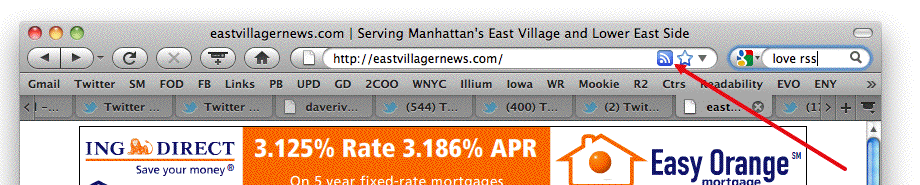
This UX nightmare was solved 15 years ago. Browsers displayed a little icon in the corner when RSS is detected.[1], Firefox later displayed an RSS icon prominently in the address bar[2].
The UX nightmare was then re-introduced as the RSS icon was de-emphasized[3][4] and eventually dropped completely, with a dubious justification.[5]
Most things are not that hard. The problem isn't the difficulty level. It's friction.
I mean, cooking healthy food for yourself and vacuuming your floors are both cognitively easy things to do. But most people don't have enough motivation to do these things all the time. It's why meal kits and the roomba exist.
The minute you introduce the slightest bit of friction, you lose people. RSS contains enough friction to remove a 95%+ of potential users before they even get started.
The reason why people prefer social media newsfeeds is because they have zero friction.
I'm not arguing that the problem with RSS is that it should be driven by a profit mentality. I'm arguing the problem is 95%+ of people will never benefit from what it can potentially offer the world: a better way to consume the internet.
I personally love RSS. Alongside email, it's my preferred method for reading the internet. However, I think the world would benefit more if the RSS ecosystem could be made viable for the average person. Whether that's a better protocol or a better client, I don't know.
High-volume sites are not a good use case for RSS. We already have various social ways to filter. Like the site you're on. I think RSS should be for high-quality niche sites where you care about every single post.
Oh, I have to disagree, I think high volume sites are a great thing for RSS. In fact, I tend to think the more items in a feed, the better. No, I usually don't go through all of them at once, I'll go through several hundred at a time.
Not all sites that offer feeds actually put the appropriate link tag (things that come to mind: youtube channels, reddit, a lot of wordpress blogs, ...), which is extra annoying. It actually takes a lot of heuristics to be able to say with some sort of certainty whether a site offers a feed or not.
Other than the issue of posting abridged content, it seem like all the other issues can be handled with a capable client. It's better to post more (inlc. the podcasts, etc.) and then filter as you desire, no?
Whenever you put the burden on the end user to endlessly customize everything you’ve just lost 95% of the mainstream public and [insert thing] remains a niche tool used by people on HackerNews.
...and then mom still ends up getting her news from Facebook.
5% of users is fine -- nobody is saying that RSS should be the only interface to the internet-at-large.
We just want to enable the 5% (or less) of users that are invested enough in the process that it's worth it for them to get their specialized content efficiently, but not lose out on valuable content.


Most sites still have implemented RSS in a terrible way. For example, many blogs I follow only show excerpts in their feeds. So the feed is worthless to me. Others put every podcast episode they do every day in between their posts. Annoying and worthless.
Then, if you want to follow a site that publishes a lot of content, often you have to subscribe to everything or nothing. Sorry all mainstream tech news sites. I don’t want to read 1,000 low quality articles every day.
Then comes the UX nightmare of actually finding the feed on each website you visit. If the site even has one.