This intrigued me, so I went looking. Apparently this effort was launched earlier this year [1], with Monty authoring the initial spec basing it off of the Opus-in-MP4 spec, and developed quite rapidly. Meanwhile Mozilla immediately incorporated these features into Firefox and their Rust mp4 parser [2].
If all these fail, I usually try to get a used CD from Amazon or Discogs, wait a week for the packet and rip the music to my collection. Sometimes digital downloads can be almost double the price what you need to pay for a CD, but maybe that's what you pay for not needing to wait.
If a government holds a figurative gun to a company's head and tells it that it's legally obligated to be racist, is it the company who is racist?
Personally, I feel no enmity toward what small-time IP-distribution companies are forced to do at the behest of IP law. Blame the people/governments that accept such laws, the lobbyists that propose them, the media cartels they represent—but why blame the companies who are also being denied the ability to sell you something they really would rather sell you?
Collaborating with xenophobes because of "law" is a poor excuse. Besides, most such media companies do it voluntarily, and even write this kind law themselves.
www.7digital.com can also be good and if you happen to be looking for obscure japanese music ototoy.jp is a good resource as long as you dont mind using google translate. but i also often seem to resort to an ebay or amazon cd buy to get my music in lossless.
That said dont rule out just getting in touch with the producers or the label, several years ago i got into some dutch instrumental hip hop, i bought several albums off the site on CD as they didnt offer flac, so one day i just sent an email asking if they would ever consider offering flac as an option.
to cut a long story short i ended up talking to both the guy who runs the label and the artist who now happily send me the original 24bit wav masters whenever he does a new album. (massive respect to both Ryan Goeller of BeatsBroke and Inf (aka Bas Te Braak))
What really kills me though is when youre left tracking down a compilation CD to get a track that was only released on that album (damn you TM Juke! why is Marbles and Drains nowhere else!)
It's not mandatory there as far as I know, so a lot of times it's not available. Besides, why can't they offer FLAC as well? Typical Apple NIH if you ask me.
You're right, the iTunes Store does not sell in ALAC format. They sell a "Mastered for iTunes" format though, which is encoding the 256Kbps AAC file from a high quality source.
- http://prostudiomasters.com - This one in particular seems to be the only one with many of the more "mainstream" albums. It seems to be the only place that has the soundtracks for most of the recently released movies for example.
I think it might be because in Japan at least, there's a very different approach to music consumption. In the west we basically moved from CDs to iTunes to Spotify but in Japan, online streaming and digital purchase never really took off. CDs are still, even today, the biggest music medium in Japan, accounting for 85% of all music sales in 2014 [1].
I think the Japanese tendency to own physical media, the lack of a good way to stream physical media you own and the insane prices of storage for mobile phones may have led to Japan sticking to MP3 players rather than moving to their phones like we have.
So after they stuck to MP3 players and competing in that market became important, I think to differentiate their product, Sony started pushing higher quality audio. I'm not sure how true this is but it feels to me like Sony is the Apple of Japan in that Japanese will typically eat up whatever Sony sells them. Sony sells higher quality audio, Japanese buy higher quality audio. People want higher quality audio, labels start to publish it.
It could also be that since CD purchase is so entrenched, online stores needed something to make their product more desirable than a physical disk and the way they found to do that was higher quality audio (note that I'm referring to the "Hi-Res" audio, which is typically 96kHz + 24-bit).
Not sure why in the the mind of some people streaming started being equal to loss of backup, or in other words to renting. Renting indeed doesn't need to provide the lossless original. Why not view streaming as convenience, and still be interested in backing up what you pay for? That's functionality of original CD (but in digital form) + streaming benefits, instead of replacing original CD with not really equivalent to it streaming.
In this context I agree, that increase in DRM, causes decrease in availability of lossless audio. But why wouldn't same users want DRM-free as well (in which case, lossless is a logical addition)? Stores like Bandcamp cater to these users.
> Why not view streaming as convenience, and still be interested in backing up what you pay for?
To put this into context in Japan, there is, even now, not even one streaming music service that can satisfy most people's musical needs.
It's not just that Japanese people aren't willing to stream their media, it's that it's not possible. Compare the Oricon charts [1] to the catalog of LINE [2] and you'll notice very popular labels missing in their entirety. It's very different to the west where you can get most western artists minus a few (single digits?) popular artists on your choice of service.
> Not sure why in the the mind of some people streaming started being equal to loss of backup, or in other words to renting.
I'm not entirely sure where this is coming from but that's exactly what it is. When you own the music you listen to, you know it'll always be available. When you stream the music you listen to, there's a chance it'll be removed from the service at some point in the future.
> Why not view streaming as convenience, and still be interested in backing up what you pay for?
For me and most of Japan, the issue is that streaming is a very very minor convenience. Since most of the music we'd like to listen to is missing from streaming catalogs, the convenience is nullified.
If, theoretically, a streaming service existed that actually had all the music I was interested in, this might change.
> In this context I agree, that increase in DRM, causes decrease in availability of lossless audio. But why wouldn't same users want DRM-free as well (in which case, lossless is a logical addition)? Stores like Bandcamp cater to these users.
I suspect that perhaps it's because streaming services have devalued music to the point where owning music appears to be expensive. An average CD costs ~1.5x 1 month of streaming, where you can listen to countless albums.
Not even close. Of course it depends on what kind of music you're listening to, but as someone who still maintains nad grows a collection of bought lossless, digital music I'd guess that about 20% to 30% of my library isn't available via streaming. I understand that my collection may be way more obscure and niche than most, but my point is that there is a lot of music you're missing if you only use streaming. Furthermore, whatever is available now might not be tomorrow - licensing deals end and music disappears on Spotify and Co.
I'm in the same boat as a very small portion of the music I listen to is western made and hence available on western services.
But I think your average non-HN-reader is usually going to have fairly conventional tastes and if you look at the most popular music in Western countries going by the Billboard charts, pretty much all of it is streamable.
I understand - however the gaps in the streaming catalog will be different for everyone, depending on taste, which in total results in a vast selection of music not available via streaming, even in western music.
No doubt, however, that most people will be fine with that. For me it isn't - I really care about my music and missing certain releases or the risk of losing it at some point isn't an option for me.
I'd ask the opposite - why not provide such features if it's trivial (i.e. producing a DRM-free digital copy costs practically nothing). Artificially crippling the product to make "minimally viable" is dumb.
Furthermore it is my understanding that Japan has a very active community of music enthusiasts, audiophiles, crate diggers, etc. Of course this only applies to a minority but it seems many japanese value music as more than background noise, which may also explain the audiophile clubs and bars in Japan - an interesting read: https://www.residentadvisor.net/features/2724
Have you seen murfie.com? They have reasonable prices and will "sell" you a physical CD but just digitally deliver you the FLAC. Of course the fact that they even have to do it this way is so anachronistic. Audiophile quality digital audio is one of the places where piracy - specifically a few invite-only music torrent sites - have completely surpassed (and arguably innovated beyond) anything legal.
Even it's a duplicate CD in their catalog they still have to rip it. I'm not sure if they're allowed to store the digital copy with deduplication, but if someone sends in 50 of the same CD they have to pay someone to rip each one.
What bit-depth, frequency, etc. is considered to meet the highest standards. Years ago I read 24 or 32 bits and ~96 KHz, but maybe those aren't even the specifications that matter any more.
These are useful to record and produce, they're of no use whatsoever to listeners[0]. 16/48 is the highest standard. 24b (let alone 32) is completely pointless and just wasteful, and 192kHz can actually be detrimental due to ultrasonics.
"Sampled signals are often depicted as a rough stairstep (red) that seems a poor approximation of the original signal. However, the representation is mathematically exact and the signal recovers the exact smooth shape of the original (blue) when converted back to analog."
The image attached to this looks basically like a sine wave and it's clear that if you do some basic interpolation on the sampled signal you'll get something that looks the same as the original.
But what happens when the signal you're sampling isn't as simple? What happens when you've got numerous tones overlapping each other out of phase, making the wave uneven and jagged? Will the signal still be accurately reproduced? Can humans distinguish the difference?
It will, and this is indeed what Nyquist tells us. Think about the engineering challenges involved in producing an exact staircase output! A stepped signal isn't nearly as beautiful. Most DACs today are also of the delta-sigma variety which produce something much more sinister. But that's all fine, as long as we describe the output signal. There can be overtones high up in the ultrasound for example.
The output filters are then what produces the nice signal you listen to. Bad output filters can produce artifacts that sometimes hearable, especially in DACs from the 80s, but if you to stick to the suggested implementation of commercially available DACs today then you should be fine.
Quantization errors is more problematic since they can appear anywhere in the post production chain. When you're in the digital domain you can get all sorts of aliasing artifacts just as you get for images. I think this is a common source of when people can hear differences between 44 and 96 kHz signals, where they just downsampled with a linear filter and they hear artifacts of this resampling. A little quantization noise will take care of that, and competent software such as sox and audacity will do this for you.
Yes, the original signal will be accurately reproduced, provided it did not contain any frequencies at or above 1/2 the sampling rate (Nyquist). If you're looking for some intuition, the restriction on input frequencies guarantees that the signal doesn't "change too fast" between samples. You don't lose any information simply because you make sure there's nothing in the signal you can't capture.
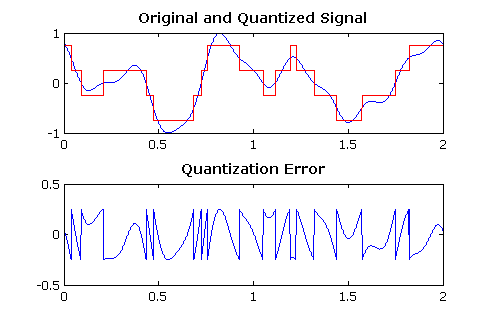
All this assumes infinite measuring precision, which is of course incorrect - in reality, the limited number of discrete levels a signal can take in a digital system introduces noise, or more accurately distortion since the noise is correlated with the signal. We fix this with dither, and it's absolutely essential for a digital audio system - by adding a small amount of random noise, you decorrelate the noise from the signal (you can do even better with "noise shaping"). Here's an illustration from wiki showing how nasty quantization error is [1].
To understand dither, it's interesting to think of the limit case of infinite sampling rate but only two levels, low and high. You could actually still reproduce sound perfectly with this setup, albeit still with a frequency limit. What you do is add "high frequency" (higher than the signal) random noise before you measure "low" or "high". This makes the probability of measuring "low" or "high" depend on the exact signal level, rather than whether it's above or below 50%. With enough samples you get a "pulse density modulated" signal, which lingers on low for low values and vice versa [2]. This is equivalent to a continuous signal summed with some nasty, but high-frequency noise. Filter the high-frequency noise you added back out and voila (your ear will do the filtering in a pinch, which is how you can get analog sound out of digital stuff, like hard drives and GPIO pins).
Basically: finite sampling rate, infinite precision - fine, we can squeeze the information into the precision. Infinite sampling rate, finite precision - still fine, we can squeeze the information into the time domain. Finite sampling rate and finite precision, i.e. the real world - there will be some error.
The "Loudness Wars" means that we don't actually get the full 16 bits, in which case I would argue that anything up to the 24/96 standard may well be an improvement.
> The "Loudness Wars" means that we don't actually get the full 16 bits, in which case I would argue that anything up to the 24/96 standard may well be an improvement.
You'll get the exact same loudness issue at thrice the storage requirements. Fight for better mastering (and ubiquitous requirement of loudness checker or across-the-board audio normalisation as iTunes Radio does), not for worthless and detrimental gimmicks.
As a music collector, the loudness wars is one of the biggest reasons to not use the streaming services. For some old albums, services like Spotify have only the remastered versions, if available. Especially in the early 2000s remasters were very loud in expense of the dynamics.
Luckily it's usually quite cheap to find the original CD versions, and the loudness wars database [0] is very helpful when hunting these.
Also for some new recordings the vinyl version has much better mastering because of the physical limitations of vinyl. Good examples are Radiohead or Björk, where the vinyl versions sound absolutely amazing compared to the overly compressed digital versions.
Of course there are always nice surprised, like the new Kate Bush live album, which is almost exactly 89 dB and has amazing dynamics.
Extra bit depth is useful only if you want to remaster the audio (apply whatever effects and etc.). Otherwise 16 is just fine. Lossless source though is needed if you want to encode in any lossy codec.
Yep. Here's an example I clicked on from the store page: http://tidal.com/us/store/album/67237700. You can choose MP3 or FLAC and then hit the DOWNLOAD button to take you to a checkout page.
I think that when a band uploads content in mp3 (on bandcamp), the flac download is still mp3 quality (in a flac format) (maximum quality) if you know what i mean(am i right?). I always wanted to analyze soundfiles to better see quality of file.
You can not upload MP3 to Bandcamp, they only take lossless formats. I mean, you could take an MP3 and convert that to WAV or FLAC, and then upload, but I hope not many musicians do stuff like that, and Bandcamp is pretty clear about it in their documentation.
I'm really hoping more updates come, particularly at the bitstream level. Michael Niedermayer (from FFmpeg fame) has said he would like to work on improving FLAC's compression rate[1]. Unfortunately that work wouldn't make it into CELLAR (but that's probably a good thing; broadening CELLAR's charter would probably just delay things). I'm hoping Michael gets time/encouragement to follow through with his interest (heck, even if it's a whole new codec it'd be really neat to see what improvements he could make!).



This intrigued me, so I went looking. Apparently this effort was launched earlier this year [1], with Monty authoring the initial spec basing it off of the Opus-in-MP4 spec, and developed quite rapidly. Meanwhile Mozilla immediately incorporated these features into Firefox and their Rust mp4 parser [2].
[1] https://bugzilla.mozilla.org/show_bug.cgi?id=1286097 [2] https://bugzilla.mozilla.org/show_bug.cgi?id=1303888