There is no limit to how low someone will stoop to get even a tiny token for free. I remember a local community fun event from a couple of years ago, which was set up by the library to encourage kids to read. They would count up these reading tokens at the end of it and give some tiny $2 teddy bear to the winners, and of course a bunch of adults swooped in, gamed the system, and all the toys went to them. People are totally shameless assholes when even an insignificant free prize is on the line.
That's a weird comparison because it's a mechanical and deterministic task. Bad autocomplete is just a bad algorithm. As far as I know, (word) artists are usually following the grammatical (or orthographic) rules of their target language by default, and if they want to do something else they would disable that. But it's not really a question of style if you misspell certain words. Your example would be like letting a Thesaurus suggest different words in every sentence.
> But it's not really a question of style if you misspell certain words.
Sure it is. Flagging vernacular, phonetic spelling for accents, punning, signalling a character's use of a word they are unfamiliar with, and so on and so forth. Intentionally misspelling words can definitely be a stylistic choice.
Maybe a linter is a more accurate allegory. I think there are parts of art that could sometimes be suggested in terms of anatomy, symmetry, shading, color theory, etc. You'd configure your art linter to your preferences/style (or target style) and it would point out the things you're doing wrong and offer suggested fixes.
Hi, it looks like you are drawing a human. Humans do not have eyes of this size. Also the nose can't just be an upside down v. Why are you even drawing Manga, freak? Don't forget to color this panel.
It doesn't though. NAT edits your outbound connections to appear to come from the router's IP; it doesn't do anything to make inbound connections harder.
If you don't initiate a corresponding outbound connection first then any attempt at an inbound connection will be dropped (unless you have a DMZ configured ofc). The router literally can't forward the traffic because it doesn't know where it should go.
No, the router doesn't forward it because it doesn't get there in the first place. Your 192.168.1.0/24 private network is not going to be routed across the internet.
Sure, but the Internet will not route packets going to RFC1918 addresses. So, if you're using an RFC1918 address on the LAN side of the router like every sane admin, packets that actually arrive to the router from the Internet with an IP address other than the router's own IP address will get dropped. And those that arrive at the router with the router's own IP address and a port that doesn't correspond to either an open connection or an explicit port forwarding rule will also get refused.
This is all behavior that happens even with no firewall whatsoever.
Because this is exactly what the GP was claiming, and you denied: even without a firewall, packets that don't correspond to an open connection will get dropped by a NAT, even without a firewall. Sure, maybe "dropped" is wrong, as the NAT box will probably instead send a RST packet, but this is almost entirely irrelevant.
Right, we were talking about NAT. So how is any of that non-NAT-related stuff relevant?
> Sure, but the Internet will not route packets going to RFC1918 addresses
This is about RFC1918, not NAT.
> So, if you're using an RFC1918 address on the LAN side of the router like every sane admin, packets that actually arrive to the router from the Internet with an IP address other than the router's own IP address will get dropped.
This is about reverse path filtering, not NAT.
> And those that arrive at the router with the router's own IP address and a port that doesn't correspond to either an open connection or an explicit port forwarding rule will also get refused.
And this is... actually not true. If there's a server listening on the relevant port, the connection is accepted.
> And this is... actually not true. If there's a server listening on the relevant port, the connection is accepted.
Fine. Packets that arrive at the router with the router's own IP address and a port that doesn't correspond to either an open connection, an explicit port forwarding rule, OR the port of a service on the router itself listening on the WAN IP will also get refused.
The point is that any LAN box sitting behind the NAT will not get that packet, same as if the router had a stateful firewall running.
And sure, this is not purely a property of the NAT itself, it's a combination of the Internet not routing private IP addresses, reverse path filtering, and NAT. That still doesn't need any firewall to achieve this.
Well no, it's purely a property of the fact that the packet is addressed to the router.
If the packet is addressed to a machine on the LAN, neither RPF or NAT will protect you from it. "The Internet won't route to private IPs" only protects you if you have private IPs on the LAN, and even then it only protects you from people who can't get access to the network on your WAN interface.
Any way you dice it, NAT isn't providing any protection.
The first time that happened to me I went on a small rant about some minor health issues and the state of the world in general and that settled the conversation with an overseas colleague.
It was later that I found out that "how are you" is a perfectly valid answer to "how are you" and it still boggles my mind 20 years later.
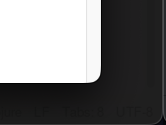
I had not noticed the rounded corner in the edge of my screen until now because I use a dark background and usually have some window maximized. This is a screenshot without this tool:
This screenshot shows the bottom right corner of my left monitor and a small slice of my right monitor. The light thing is the rounded corner of my browser window.
Anecdata: I've never experienced any noticeable annoyance with my T470p (i7-6820HQ) but with my new (old) NUC with an i3-3217U every time you go compile some Rust or C++ it's already a bit annoying (I'm running xfce and Firefox on it, it's perfectly usable - but I wouldn't want to compile all day on it).
> no cheats, no shortcuts, straight to the metal (from C-ish perspective)
Not the person you replied to but even when I stumbled over this (the network, not the game) for the first time, I was left wondering where the line is drawn.
> You can learn how computers actually work, so you can unleash the full potential of modern systems. You can dig deep into the tech stack and learn what others take for granted.
Just.. no libraries? Are modern languages with batteries included ok? What makes a library for C worse than using Python? Is using Python too bloated already? Why is C ok and I don't have to bootstrap a compiler first? (E.g. building with Rust is a terrible experience from a performance perspective, the resulting software can be really nice and small)
I'm not even trying to be antagonistic, I simply don't understand. I'm just not willing to accept "you'll notice when you see it" as an example.
So you're simply not interested in reading any random website by random people who don't see a benefit of establishing any form of trust, especially if should not be connected to their official government IDs?
Or to put it differently: Where should this come from, and which issuer would you trust? And why should anyone else agree with you that this is good?
When I browse to random site, I can see in my browser that A's first level contact trusts this site.
Now I can make a decision based on the amount of trust I have on A. Maybe after exploring the site I can mark specific pages or the whole domain as trusted, so people in my network can see the same.
On a larger level I might trust the Country of Finland, who will only mark their official sites as Trusted. This way I instantly know if I'm on an official site or something pretending to be one.
Trust is subjective! Let's establish trust in each other rather than rely on one-size-fits-all solutions.
Personally, I trust my friends, family, and some public figures and institutions to varying degrees. I want to see social experiences that reflect that.
> Do you think a mature company just migrates to a different database
You are right if you look at the current state of how MariaDB and MySQL diverged. But if you migrated right at the time of the split or close to, they were not different in a meaningful way.
> unless it is absolutely necessary
Staying free of Oracle is often deemed absolutely necessary.


I find Scala very esoteric, jftr :)
> You can even see Typescript or Python as backend languages, mainly in the startup area.
"even" "mainly" - I wonder if the author has ever worked anywhere else than... a bank or similar cliche work places.
> In 2023, 52.3% of the respondents wanted to use Scala.
What.. are these numbers? Sure that's not "52.3% of Scala developers"?
reply