I think there's a a bit of a paradox here: cardiovascular disease is solved biomedically, yet still remains the #1 cause of death worldwide.
From a biomedical standpoint, we have highly accurate biomarkers (e.g., ApoB, Lp(a), hs-CRP), long-term risk prediction models, knowledge of nutritional biochemstry, and next generation drugs like PCSK9 inhibitors and lepodisiran that can lower ApoB and Lp(a) by 90%. So there's no fundamental reason why cardiovascular disease has to be in even the top 10 causes of death.
Practically speaking, providing guideline-recommended preventive care would require ~27 hours per doctor per day. And the incentives are misaligned: health systems profit when hospital beds are full, so they lack the business model to actually invest in prevention.
So it's a clear illustration of a systematic gap between research and care delivery.
I also think that many people don’t know - I would wager for men that a significant percentage of them do not go to see a doctor preventively unless injured or sick and not that may know their blood pressure or cholesterol trends
Thanks for sharing this and empowering others to improve their heart health outcomes.
I’m not in love with the idea of sharing my biomarkers with multiple health-tech companies and really want a self-hosted solution to import biomarkers from multiple sources such as Apple Health, arbitrary csv and jsons while avoiding duplication.
Claude Code is something that will make this dream a reality for me pretty soon.
Do you have any tips on biomarker data design or import gotchas?
The thing that took the most time was normalizing biomarker names and units across labs. Even for the same lab chain (say, Quest), you'll get the same biomarker with slightly different names (e.g., Lp(a) vs Lipoprotein(a) vs Lipoprotein a) or units (e.g., cells/uL vs 10^9/L).
Well, and everyone knows they should exercise, and many know they should avoid dietary saturated fats, but most people neither exercise nor avoid highly fatty foods.
the mainline guideline is more exercise and better diet which is the treatment to much more than just heart disease. that's not something 27 hours of doctors a day can provide unless you give them guns
the treatments reduce risk, but they don't change the fact the human body is very reliant on the heart and increasingly vulnerable to cardiac death with age, even with perfect biomarkers
given the entrenched attitudes and the time it takes to actually get people to do the thing as evidenced by all the contrarians in the thread...
it would take a lot more than that. Ain't no doc got all that time to go through all this with every person who should take cholesterol lowering medicine but wants to argue their internet sourced bs
“Solved problem” is too strong of language, but the cardiologists I follow are generally open about the idea that we have enough tools and knowledges to reasonably prevent and manage it the average person.
Even without medications, we’ve had enough knowledge about diet and lifestyle factors that the average person (excluding generic abnormalities that lead to abnormally high risk) could reasonably avoid heart disease through lifestyle and diet alone. That’s easier said than done for a lot of people in the modern world, so it’s good that we have a few different medications on top of that knowledge.
Same with medications? It’s well known that medications don’t eliminate risk.
For the average person without genetic outlier risk, perfect diet and exercise would definitely make heart disease a non-issue in their lifetime.
The risk your cardiologist is talking about is probably the risk that you have one of those genetic outlier conditions that require medication regardless of diet.
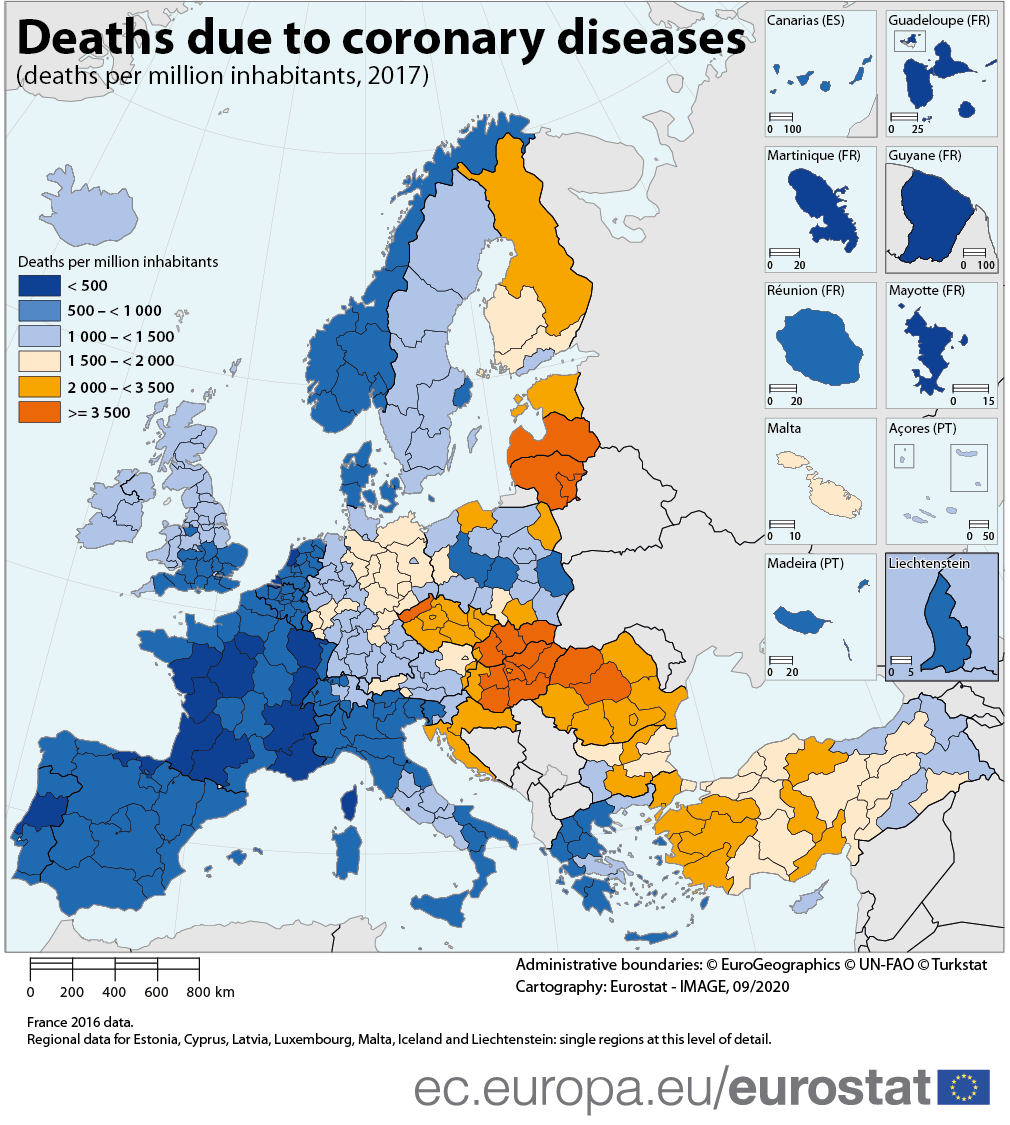
It's almost entirely a lifestyle problem. Shit diet, lack of exercise, obesity, &c. Overlap maps of obesity and cardiovascular deaths, they're virtually the same
Ages ago, I used to do the typesetting for the _Cardiosource Review Journal_ (lived my life around the publishing schedule because no one else was able to run a WordBASIC macro to do initial formatting, import that into a page layout program, process all the graphics and place them, and generate page proofs early enough that it could be proofed and corrected with a 24hr. turn-around until a postal rate increase killed it) --- cardiologists seem very big on data/analysis, moreso than most other medical fields.
That's not how I understood it. Full clones are big but simple — the server just sends all the packfiles. A first shallow clone needs some server work, but that's cachable, OK.
But then on subsequent interactions between a git client that made a shallow clone various time ago and the git server, it's AFAIU actually expensive for the git server to compute the portion this particular client doesn't yet have.
Intuitively, and very hand-wavingly, I suspect things could be improved by:
(1) clients relaxing "exact depth" requests to "give me approximately N days of stuff, over-sending being OK", and server relaxing "minimal traffic" to roughly map time ranges to whole packfiles — CPU/traffic tradeoff.
(2) allowing servers to under-send too (makes (1) tradeoffs easier), by client asking for missing parts right away and/or later — needs on-demand fetch ability to be transparent to user. With "promisor" mechanism in "partial clones" this sounds more realistic?
(3) storing history/trees/blobs in entirely separate packfiles(?) I suspect recent years work on bitmaps & MIDX move in this direction, only less naively?
I'm not saying Git can scale as well as a DB, but I do feel we sat on an effectively frozen Git format & protocol for a ~decade, and are now exploring more of the design space so hope future will be less clear-cut...
And specifically, partial clones remove the hard "fully offline vs. centralized" dichotomy we long clinged to. Assuming you stay online (necessary anyway if you consider HTTP/DB), things that used to be up-front UX decisions can now be matters of perf tuning!
* The most dramatic win is if you had to fetch info from every package's separate repo, like Go did. Then, a central DB/caching proxy can build global indexes, unlocking huge wins, no question. It's like "1+N" issues. However, most examples other than Go in the article talk of a single Git repo already storing a global view (still leaving opportunity for custom indexing and querying).



reply