It tends to be a spectrum, but the various, sometimes very different licenses adopted by the OSI still have something in common - the open source values laid out in the Open Source Definition. [1]
SSPL did not comply with this requirement, as it discriminate against specific users or use cases. I think it is in the interest of everyone to draw the line somewhere.
Open source licenses might be a spectrum but it's likely that the legal reality isn't. Like the famous double split experiment there's probably no spectrum and only a couple of buckets of legal validity.
Kubernetes for sure. When anyone asks for a good place to get started with understanding k8s - I tell them the docs should be all you need, then go get hands on.
Love to see the competition between the projects trying to get linux running on the m1. Though I think they will hit a wall trying to enable GPU support.
I think opening up just enough to enable this effort also serves as some good nerd marketing for Apple. This race keeps the m1 in the news regularly, giving hope to those who want a low-power and performant ARM machine that wouldn't otherwise consider an apple machine.
Does it actually require any serious development or it is just mostly tweaking and changing things here and there? I am sorry if that sounds ignorant, but I thought these are just low hanging fruits to harvest. Also why Apple wouldn't do that themselves? To me it is an opposite to "nerd marketing", a big middle finger to Linux users - essentially "you are on your own".
A middle finger from Apple would be locking the bootloader–keeping it open, plus providing minimal tooling and telling people to figure it out, is about as close to "we'd love to see what you'll do with it" as Apple could possibly give.
(Dealing with the GPU is going to be the majority of the work, I'd think.)
When Broadcom act like this they're considered villains and we're recommended to stay away from their hardware. But when Apple do it, they're being benevolent?
And that's ignoring the fact that I could actually get Broadcom documentation in exchange for dollars and NDA.
Maybe. Certainly people within Apple would have thought about Linux for this. But Apple would need to provide some form of mechanism for unlocked bootloaders anyway to facilitate kernel/driver developers and security researchers, so I'm pretty sure other OSes is not the main reason they do this.
It does work out for Apple in the end. Their current standard 10 years' support will look quite short now Moore's law is dead and their hardware has barely any moving parts. But they'll shush some complaints if up to date third party OSes are available in 2030.
While Correlium is a bit of a minefield for obvious reasons, I don't understand why Apple hasn't blessed Marcan's work. I wouldn't expect them to commit any development resources of their own, but I'd think it would be in their interest to (A) provide Marcan with some documentation and (B) make an engineer available to answer occasional questions.
Apple makes money selling hardware, and Linux support will sell more hardware. Perhaps not much more, but for a commensurately low amount of effort. What does Apple gain by forcing Marcan to reverse engineer everything?
I can't see why they would? Marcan is capable to be sure, but he's also a random guy with a Patreon. Why would Apple ever officially bless his work? I'd sooner seem them collaborating with Corellium, because that at least gives them a corporate entity to interact with. Plus, like, releasing documentation without giving away the stuff they want to keep to themselves, and without promising too much and having it break later, is work in and of itself that Apple is really not getting anything from. I mean, this is the company that still FairPlays apps, so…
Hypothetical question: If Microsoft wanted to port Windows to the M1 (as Phil Schiller said was their choice), would you expect Microsoft to have to reverse engineer everything? Or would Apple share documentation and expertise, under the logic that Windows support will increase Mac hardware sales, if only a small amount?
I realize that Marcan isn't Microsoft—but he's not quite "a random guy with a Patreon" either. He's a professional freelancer, and I'm sure he has an LLC† and a set of professional references he can point to.
Put another way—on a scale between "Marcan" and "Microsoft", where is the threshold in which Apple would be helpful? I don't personally see a huge difference between a one-person LLC and a 100,000-person company in this regard. If anything, the 100,000 person company offers more opportunities for things to get leaked.
It always comes down to "it doesn't benefit them" eh…
There are some interesting situations though. Like in the big GPU world it's very common to document the ISA. Even nvidia does. I suppose that's because it benefits the vendor when games and GPGPU compute programs optimize for their GPUs, down to the assembly level. It's sad that Apple's approach is "just use Metal" rather than fully enabling developers to get to the actual… well, "metal"
That would definitely be crossing the line. But I wonder if this behaviour of Apple is another avenue of stifling competition - that is how many smart people this will get involved that otherwise could have worked on a competing product? Then you can see how much resources any company dealing with Apple has to commit just to make sure their software keep up with Apple updates - that inhibits their growth and thus keeps Apple on top.
To be honest I’m amazed Apple even cares enough one way or another that they mentioned Linux virtualization in the M1 announcement. But it’s not a middle finger, this was more or less exactly how they handled multiboot on Intel: let the community figure out a solution, see if it gets uptake, support it with a first party solution if it does. That’s how we got Boot Camp, as there was a lot of interest in booting Windows at the time.
It’s a good sign that the latest betas (11.2 IIRC) officially support multiboot in the UI. That’s a good indication Apple sees the level of interest in Linux on M1 that they intend to at least let it happen.
I’d say it’s still up in the air whether they’ll go for full first party support with drivers or an open spec, but it’s definitely not out of the question. And they may even have direct interest in it, as I’m sure they’d like to get the benefits of their hardware in their data centers.
So essentially Apple is exploiting its consumers and get free research and development without having to pay salaries and tax? Probably that's why they are worth so much. I am only amazed that there is so many people willing to do this job for Apple for free - it would be a different ball game is macOS was open source, but sacrificing your own time and resources to enhance a commercial product... people are weird.
That’s... an incredibly bold take, especially on a forum operated by VCs, who certainly are familiar with the concept of finding product-market fit. Apple is observing the interests of people who use their products to help prioritize product development decisions.
Maybe the people doing this for free are just interested in benefitting from the result? As many people who work for free on open source do.
As far as I’m aware, there is no free (as in beer) hardware that runs Linux. Someone has put the effort into running Linux on every single for-profit/for-pay platform it runs on.
Are you under the mistaken impression I was suggesting that Apple waits for a community solution to be developed then packages that as a product? As far as I’m aware they didn’t do that with Boot Camp, but instead offered in-house drivers and blessed boot loaders and proprietary UI/UX for accessing both.
Well, that's why all the big companies open source stuff.
They're hoping to get increased for themselves, increased adoption of their internal tools outside of the company (easier recruiting plus purely internal tools are notorious for rotting quickly) and... free labor.
Just from a skim it seems like there is a new interrupt controller driver. The copyright header credits Linus Torvalds so they probably got started based on copying an existing one, but that sounds like substantial work and ongoing maintenance.
The interesting thing here is that now, when they own the CPU and GPU, and when MacOS is free, they probably might be more open to letting anyone install any OS on it. You want a Linux/BSD/Windows on M1, and you're not hurting any of their possible revenue streams, so why the hell not let you buy their hardware and throw whatever OS on it.
Somebody wants to copy the hardware over and sell it for half price? Yeah, good luck reproducing the M1.
Opening the boot loader to allow for Linux is quite an opposite of a middle finger, tbh. I don't know if they will divert some guys from working on MacOS towards Linux support, but this is already looking much better than before.
Oh, like the old ndiswrapper approach for various windows XP NIC drivers. Which worked reasonably well...I remember using it for some laptop with a Realtek chip. https://en.m.wikipedia.org/wiki/NDISwrapper
What will be interesting though is to measure the raw performance of this initial CPU only rendering. For now on it's a still image we don't know if it's sluggish as hell or actually pretty decent even without a GPU.
If the latest is true that could prove to be another prestige point for the M1.
A good number of comments here mention dealing with the GPU is going to be a major hurdle. What makes porting GPU drivers significantly more challenging than everything else?
They're very complex, very stateful devices which also run their own compiled shader code. Not to mention auxiliary DSPs like video decoders (not sure if M1 has it as part of GPU or a separate block), power gating control and many many more.
They may have in order of 100 registers to talk to them and they're horribly proprietary with pretty much no standardisation.
Reverse engineering that is hellish at best - you can see projects like nouveau which barely manages to get nVidia cores up and working without help from the manufacturer. And that's after years and years of development.
The hurdle Noveau is facing is that some things, like reclocking, need firmware loaded onto the card. The firmware is not in non-volatile memory on the hardware, but a file shipped with drivers, the one shipped with proprietary drivers is not redistributable and if you wanted to make your own, it needs to be signed by Nvidia anyway.
That's pretty much game over for Noveau, and it is not due to difficulties in figuring out registers and NV ISA.
> What makes porting GPU drivers significantly more challenging than everything else?
Multiple reasons:
1) GPU manufacturers are notorious for not publishing documentation out of IP/patent concerns. Worst offender is NVIDIA here.
2) For embedded GPUs there isn't much interest in open source drivers... the big customers (think Samsung and the likes) have direct support from the chip design vendor and get drop-in drivers as part of the board support package (BSP, basically a conglomerate of bootloader, kernel+modules+initrd, firmware blobs for components such as wifi) so they don't need OSS drivers
3) The mobile GPU space is... splintered. With desktops you got the three major players AMD/ATI, NVIDIA and Intel's built-in Iris, in the GPU space there are more.
> GPU manufacturers are notorious for not publishing documentation out of IP/patent concerns. Worst offender is NVIDIA here.
I think easily Apple takes the cake from nVidia - they don't even provide drivers for anything but their platforms (that is for their proprietary GPU core). The GPU core that's actually in the M1.
A lot of this comment I don't understand how it applies to the Apple M1. I'm not saying it doesn't. I'm completely ignorant of these things. Am I just missing it?
Apple's M1 chip has a custom GPU built into it. There is no documentation on how that GPU works and Apple hasn't released any.
Making any modern GPU work is a lot of work because of how complicated they are. That's even with the full documentation.
In the Apple M1 case, the GPU will have to be reverse engineered to understand how it works, then a driver will need to be written for Linux that supports it.
So pardons are for sale to the wealthy or well-connected. Maybe this has always been the case, but to see it so blatant...
The power of pardon simply further reduces the trust and legitimacy of the executive branch. At least for humans it should be revoked, I think we can still trust the presidency with the power to pardon turkeys.
My understanding is that there was a criminal investigation of Clinton's Marc Rich pardon that concluded without finding any evidence of criminality. I'm not raising this as a defense of his making that pardon, but rather, to point out that a President selling pardons is and has long been considered a serious crime. The Clinton precedent is a clear illustration. Saying "hey, some book alleges Clinton got paid for a pardon, therefore it's common practice" sounds nice, but ignores the fact that suspicion around Clinton's Marc Rich pardon triggered an extensive criminal investigation that concluded he did not, in fact, get paid for it.
> My understanding is that there was a criminal investigation of Clinton's Marc Rich pardon that concluded without finding any evidence of criminality.
I don't know anything about the investigation, but no finding does not mean no criminality. Ignoring all the politics involved, there are plenty of more mundane examples. Someone attacks you. You call the police. It's your word against theirs and so the investigation is closed because they cannot show that a crime was committed, but you know it was.
The wiki article cited on HW suggests that bribes may have been constructed as either loans (that were not repaid) or as payment to Hugh Rodham for "representing their cases". Neither is criminal, but it's a simple and classic way of taking a bride and turning it legal by putting another sticker on it. Example:
---
Almon Glenn Braswell was pardoned of his 1983 mail fraud and perjury convictions.[19] In 1998 he was under federal investigation for money laundering and tax evasion charges.[20] Braswell and Carlos Vignali each paid approximately $200,000 to Hillary Clinton's brother, Hugh Rodham, to represent their respective cases for clemency. Hugh Rodham returned the payments after they were disclosed to the public.[21][22] Braswell would later invoke the Fifth Amendment at a Senate Committee hearing in 2001, when questioned about allegations of his having systematically defrauded senior citizens of millions of dollars.[23]
If you're going to make the claim that payment for pardons (as opposed to lobbying) is common and accepted, you should back it up with facts. The actual facts in this case indicate that it wasn't common or accepted (as indicated by the fact that a major investigation was triggered and carried out), and in fact there's no evidence that it occurred in this case. You're now withdrawing to "well, we can't prove that criminal behavior didn't happen". That's true; we also can't prove that the Clintons aren't aliens. It doesn't make your claims any less unsupported.
ETA: The relevance to today is that the same standards will likely apply to any pardons made by Trump this morning. If people paid other parties to lobby for a Trump pardon then it may not be illegal (as much as it's terrible policy.) If direct payments to Trump or his businesses were made then it could be criminal behavior. There's also precedent for appointing a special prosecutor to investigate it.
"The brisk market for pardons reflects the access peddling that has defined Mr. Trump’s presidency as well as his unorthodox approach to exercising unchecked presidential clemency powers. Pardons and commutations are intended to show mercy to deserving recipients, but Mr. Trump has used many of them to reward personal or political allies."
Person gives person B money.
Person B gives person A a pardon.
We can say that A paid for access, made a voluntary contribution, lightened their walled, lent out money that didn't have to be repaid, etc. In practice, these are just ways of phrasing "bribe" differently.
That's not what the NYT is reporting, the NYT is reporting that Person A gives person B money, person B provides access for Person A to talk to Person C about giving Person A a pardon.
The pardoner, Person C, does not get any money. That is an important distinction.
I'm not saying Trump isn't accepting payments for pardons, I'm saying the NYT article linked above isn't reporting that. They're reporting on lobbying efforts, which don't appear to be illegal.
People pay for the President's time quite frequently. What's interesting about this story is that the folks with access are trying directly to solicit from convicts. I think that's fairly new or at least newsworthy.
My example is purposely simplified. It's only intended to illustrate how the same situation can be described in different ways. In reality, it makes a lot of sense to add all sorts of layers.
A gives B money, C offers A a parson, B does C a favor.
Etc etc etc.
This construction may obscure what's happening and may even make conviction impossible, which we may take to mean that it's no longer illegal. But legal or illegal, it is effectively paying for freedom.
---
This has nothing to do with lobbying. Freedom is what people pay for.
If B does C a favor, then it's lobbying. The lobbying laws are there precisely to regulate this kind of thing. You can't completely isolate lawmakers, and wouldn't want to. But you do want to know who they're talking to, and how much they're being paid to. That's why they have to register as lobbyists, and be audited for that. They're not allowed to funnel money or favors, and the FEC is watching.
It's far from perfect, but it's not as nefarious as it sounds. It's a compromise.
Ah, so this is a, "I don't like lobbying" complaint?
Fair enough, lobbying has gotten weird and pay-to-play, though if you don't like what's happening here, I recommend you don't look at what folks are doing about every other major policy initiative throughout Congress.
Do you have a source on Reagan and Carter pardoning people who gave them money?
The issue isn't Trump issuing a lot of pardons. It's the corrupt (though legal) influence market that is essentially rewarding him financially for doing it.
It's really frustrating that criminal consequences are moot if you find a way to get this president's attention or loyalty.
Just browsing the names and convictions it looks like a pretty decent mix of people genuinely deserving and people who have very powerful people advocating for them. Looks like most of the crimes in the list are drug or fraud related.
I haven't gone down the whole thing but the guy who got LWOP for weed (presumably huge quantities of it) caught my eye.
The reason why it exists is important for a democracy. It protects the outgoing administration from political persecution after they leave, promoting peaceful transitions of power and is a safety valve for when the state becomes powerful and goes after people that it shouldn't, which happens all the time.
Unfortunately it is also used by all presidents to pardon their buddies.
> Unfortunately it is also used by all presidents to pardon their buddies.
I may have missed it: did the Obama Administration pardon a single friend or relative of the Obamas'? Or a single person connected to the administration?
I believe that Obama tried to ensure that the pardon process was beyond reproach. (Some people may disagree with who was pardoned, but the process did not appear to be corrupt in any way.)
I read an article yesterday and it suggested that was because George W Bush impressed upon him the importance of having a plan and sticking to it after Bush was surprised at the end of his term with all the people coming out of the woodwork to ask for pardons, so it was on his mind when they met before inauguration. It was an ok article, CNN: https://www.cnn.com/2021/01/18/politics/donald-trump-elevent...
I don't know but he pardoned something like a few hundred people I think? That said, Obama was a class act so I'd absolutely believe he was (is) honest.
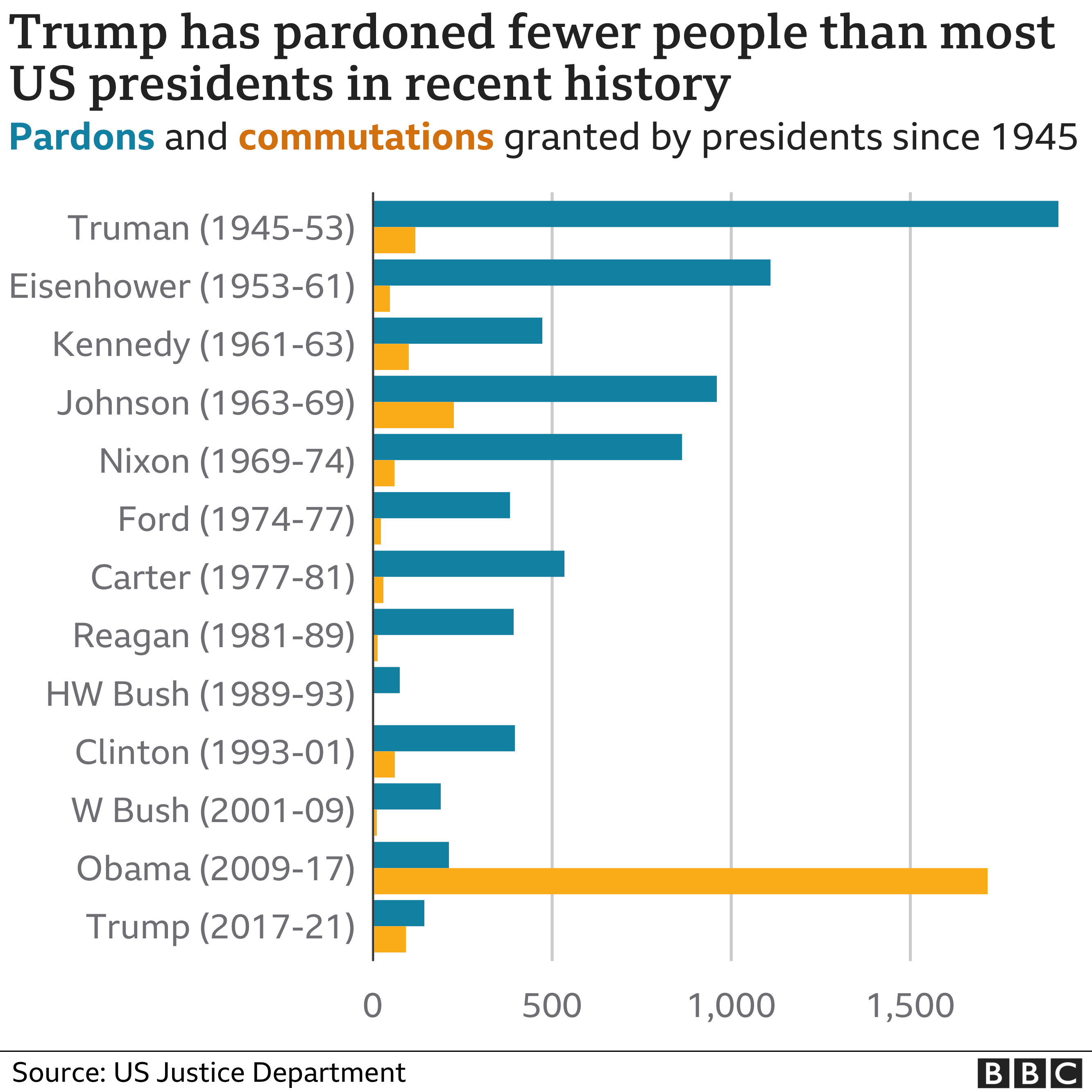
Sure, most president pardon a few hundred people. (Ford: 382, Carter: 534 , Regan: 393, Clinton: 396, Bush: 189, Obama: 212)
Obama ensured that there was a process set up that filtered the pardon requests, so that no hint of political- or personal-favors could intrude, no possible quid-pro-quo, etc.
Yes, Clinton's pardoning of his brother-in-law was pretty bad. Trump's pardoning of his entire slate of co-conspirators and personal associates looks worse, to me personally.
> It protects the outgoing administration from political persecution
Aren’t pardons generally given post-conviction? How can it be a tool to protect against an incoming administration if the victim has been convicted under the current one?
Unless you mean that in the future, when the outgoing’s party is back in power they can issue pardons. That doesn’t seem to be consistent with the trend that many pardons are issued on a President’s last day in office (and not his first).
> an argument for corruption/immunity for the sake of comity
It's not an endorsement of corruption, rather an acknowledgement that the price of comity includes some corruption. This seems like an anti-fragile mechanism to me: in exchange for the inevitable but relatively minor injustice of corrupt pardons, we can pre-empt behavior that could lead to all-out political war that destroys the entire system.
> Unfortunately it is also used by all presidents to pardon their buddies.
I agree, but that's the boolean. There's probably a reasonable float or int description that allows a more nuanced comparison of exactly how much any president did this.
Presidential pardon also weakens Judicial branch and seems to promote lawlessness. I read that some of the recent 'insurrectionists' actions were encouraged by the thought that President could pardon their illegal activity.
> The reason why it exists is important for a democracy. It protects the outgoing administration from political persecution after they leave, promoting peaceful transitions of power and is a safety valve for when the state becomes powerful and goes after people that it shouldn't, which happens all the time.
That's not why it exists. Pardon power exists so the President has a way to declare peace on behalf of the government with an individual. It has nothing to do with transfer of power. It's to ensure that the President has an out to call off the wolves of the rest of the government and put a matter behind us.
> Unfortunately it is also used by all presidents to pardon their buddies.
I'm not really sure I'd describe that one as "corrupt", which I feel implies a nastier motive than trying to deal with embarrassing family members. A bit questionable and self serving, yes, definitely, but corrupt? Not sure it goes that far tbh.
(An amusing detail from the newspaper reports was that Bill Clinton had authorised the sting operation that resulted in his brother's arrest during his tenure as Govenor of Arkansas).
(Ref: https://www.nytimes.com/2001/02/23/us/clinton-pardons-brothe... )
He's been the stingiest in terms of giving them out for people who deserve them on account of being ill-served by the criminal justice system, but he's been the most liberal in terms of bailing out his co-conspirators and politically connected elite.
Do we have a list of the “quality” of all presidential pardons?
It may be that proportionally some presidents show certain “favoritism” while others less. But given some pardon in the thousands it’s hard to say without further study that in absolute numbers one self serves more than another except by using biased heuristics.
Trump was never Assange's friend, and Assange was foolish to assume the enemy of his enemy would be his friend.
Given the way Trump operates in general, there's nothing in the long term that benefits him about having a whistleblower running around free, even if that whistleblower did significant political damage to his opponent one time.
Look at his pardon list from last night. It includes a large number of oversentenced drug offenders including a number of people serving life sentences for marijuana trafficking.
Corvain Cooper – President Trump commuted the sentence of Mr. Corvain Cooper. Mr. Cooper is a 41 year-old father of two girls who has served more than 7 years of a life sentence for his non-violent participation in a conspiracy to distribute marijuana.
You said he had pardoned fewer people than previous presidents. I said that the number of pardons had no bearing (on whether or not it's abused), and illustrated that point with a hypothetical.
At no point have I made up an argument as yours to attack.
It is not the number of pardons that is unusual (and it’s unsurprising that this administration has done less work than previous ones), but the sense that these pardons are so clearly in service of Trump’s personal agenda rather than true acts of clemency.
Can you find examples of bad pardons from other Presidents? No doubt. But not on this scale.
That's it. It's also the one where having the record of the prior crime expunged made a huge difference in the potential sentence for the DUI he was being prosecuted for at the time.
I'm not sure if it's better or worse to pardon someone above the table like that or for a president to throw their political weight around behind closed doors to get favorable treatment but it's slimy no matter how you cut it.
The drunk driving incident and the following DUI charge came several months after the pardon.
(Correction: it was the dropping of the case was months after the pardon. The drunk driving incident and subsequent prosecution was one month after the pardon)
And the prosecution started before the pardon. He got pardoned because it looked like he wouldn't be able to dodge the charge and was gonna get whacked with the kind of sentence that people with prior felonies get.
> Which of these is worse than pardoning your own drug trafficking, drunk driving brother?
The pardon of Roger Clinton is bad, but a number of Trump's pardons are worse. The critical difference is that Trump was pardoning people who betrayed the public trust. For example, he pardoned Duke Cunningham [1], a former Congressman who very explicitly sold his votes in Congress. And he pardoned Kwame Kilpatrick [2], the former mayor of Detroit who was elected on a promise to clean up Detroit's city government, but instead installed more than two dozen of his friends and family members in city government (they weren't competent, but they got high salaries), and who was convicted of extortion and racketeering.
It seems to me that a pardon that merely expunges a conviction for which the sentence was already served (as in the case of Roger Clinton) is quite different from a pardon that shortens or entirely preempts a prison sentence, or in some cases even preempts a prosecution (as in many of the pardons granted by Trump).
Another moral category is that, to my knowledge, Bill Clinton was not an accessory to Roger Clinton's crimes (in fact, as governor, he apparently even approved of his brother's arrest). Trump, in contrast, pardoned a number of people found guilty for crimes related to himself.
See the sibling reply explaining how Roger was being charged with DUI which would have carried much heavier sentences with a prior conviction on his record. The pardon effectively swept his DUI away to a misdemeanor.
The pardon did end up having that effect, but given that the pardon was issued in January 2001 and the DUI happened in February 2001, I have some degree of confidence that this was not intentional.
Whether an individual pardon is good or bad certainly depends on how you feel about the crime committed by the pardoned, and whether we want to admit it or not, at least a little bit on the party of the President who pardons them. Even if you could objectively measure the damage done by any individual pardon (you can't), the good in aggregate outweighs the bad, especially of any one case that we disagree with but 10,000 equally reasonable and intelligent people may think is great.
Feels like we are quickly centralizing consumer chip fabrication into a single company. I guess the barrier for entry is so high and TSMC is just so far ahead.
TSMC only just pulled out in front. Rewind the clock a mere 5 years and Intel was in front, with Samsung and GlobalFoundries basically tied for 2nd, and TSMC in dead last (they had the weakest 16nm/12nm of that generation - the only one who couldn't hit 30MTr/mm2 of the bunch)
GloFlo then backed out entirely of the race and Intel slammed into a wall.
Since then Samsung and TSMC were on "equal" ground at "10nm" (both ~52MTr/mm2, both released 2017) and again at "7nm" (both ~96MTr/mm2). It's not until 5nm that TSMC was actually clearly in-front of everyone else, with their 5nm being 173MTr/mm2 while Samsung's is only 127MTr/mm2.
In terms of "TSMC is just so far ahead." Samsung's 3nm is supposed to use GAAFET while TSMC's 3nm will still be FinFET. So.. potentially Samsung re-claims the "crown" so to speak at 3nm. And Samsung does contract out their fabs - see Nvidia's RTX 3000 series. There's also no particular reason to believe that Intel is down for the count for good. They are a huge company with a huge amount of capital, they can fund a rough generation or two.
I remember the huge controversy around the iPhone 6S which had a processor that was either a 14nm Samsung or 16nm TSMC (https://en.wikipedia.org/wiki/Apple_A9). Apple had used Samsung for the iPhone 4 through iPhone 5S. The iPhone 6 was TSMC and the 6S was dual-sourced (20015/2016, 5 years ago).
I'd guess that some of TSMC's rise to prominence was partly driven by Apple not wanting to help Samsung. Apple was really pissed about Samsung copying the iPhone - not just by shipping an Android phone, but by copying icons to make their phones seem as similar as possible.
You can definitely look back at MacRumors articles from 2014 and see that there's a bunch of Samsung/GlobalFoundries/TSMC "who will be able to make it happen" talk.
In fact, re-reading through these articles, it seems that people thought that Samsung and its alliance with GlobalFoundries would be the winner of the iPhone 6S generation, but it's possible that Apple saw better yields from TSMC and saw the potential there. When you're as big as Apple, you're going to be really deep with your suppliers and you're going to have a lot of expertise to judge suppliers and their future potential. Maybe it was a combination of seeing TSMC over the iPhone 6/6S generation that gave Apple the confidence to move away from Samsung. Back in 2015, analysts were still expecting Samsung to be getting future business from Apple like the A10X processor.
Given that Apple is a buyer that can move mountains, how much of TSMC's ascendency is potentially Apple committing to a lucrative multi-year deal allowing TSMC to invest a lot of money knowing they had guaranteed orders? One of the hard things in business is knowing what to spend your time on - what do customers really want. Google, for example, has spent plenty of time on things that weren't good investments whether that's Wave or AppEngine or Google+. If you know "doing X will definitely make me a lot of money" it makes it easier to invest heavily in an area - basically, you kinda get the benefit of hindsight ahead of time with a long-term deal.
I hope Intel and Samsung continue to do well (or get back into the race as Intel's position might be) since more competition means lower-cost processors over the long-run. But I think it's definitely important that you point out that only a few years ago TSMC wasn't the powerhouse it is today. While I believe TSMC is going to continue to invest and improve, Samsung is producing Qualcomm's Snapdragon 888 on its 5nm process and if you're right about Samsung's 3nm process, that should provide a lot of orders there too - especially if Intel is willing to outsource manufacturing.
The job of a gate is to "hold open" / "pinch closed" a channel with an electric field. The closer to the gate, the better the hold/pinch. In ye olde days, you'd slap a gate on the top of a channel and call it a day. Every part of the channel was close enough to the gate get a good pinch.
Then everything shrunk and smaller channels wound up needing stronger pinches to completely shut them off. Instead of slapping a gate on top and calling it a day, they raised the channel into a fin and drizzled the gate over 3 sides so that it could pinch from the left and right, not just the top. Those are FinFETs.
The next step is to have the gate on the bottom, too, so that it can pinch from all four sides. The channel literally goes through the gate, which surrounds it on all sides. Those are Gate-All-Around FETs, or GAAFETs.
This is beautifully written; I stepped away from keeping up an in-depth understanding of silicon processing a bit before FinFETs took over and this feels like one of the best introductions to the basics of gate geometry of FETs.
I never quite got how electrostatic control was supposed to work with GAA, Fin and derivatives: without the bulk, how is your electric field supposed to work?
Unless the Gate itself is hollow, and the "bulk" is in the middle, like air would be in a hollow spaghetti? Or tha you use way higher voltages for the gate than for the drain/source (but then, how do you drive that?). I guess I just need to look it up, but most presentations gloss over that part.
In the 90s there were dozens of leading edge fabs. But while the barriers were high back then the capital investment needed to get into the next node has gone up exponentially, about 15% each node, since then doubling every 5 years. It took less than $1 billion to get in the game back then but over $20 billion now.
It's not clear whether this is cause or effect. The insatiable demand for silicon fabbing has arguably made a $20B plant today more economical than a $1B plant 25 years ago.
What’s tricky to understand is that once TSMC said, ‘we will build everything and design nothing’, everyone looked to them when there wasn’t another competitor willing to do the same.
The massive order volume they received (with low margin) let them experiment on process development 10x that of Intel.
Remember when Wall St. said America can outsource manufacturing because ‘other people’ aren’t smart enough to innovate? Looks like they were wrong :)
The American middle class is going to be further decimated over the next decade. Wups
On another side - has the software side done much to incentivize Intel to innovate over the interim? i.e. Windows has accrued a lot of cruft. It feels pretty outdated at times. It feels almost unprofessional at times coming from a unix-like OS user space and has since the 90s. But then unix-like OSes have been a thing this whole time.
Yeah, I think Intel is our latest, greatest example of the follies of not regulating markets properly. Properly regulated, Intel would have been smacked around or incentivized against dominating the chip market 'back when'. Given the factors required, this may have had to require state-led/funded chip research and fab production. i.e. Effectively making a government do what TSMC did years ago - and privatize the actual results of the efforts at key points/areas. Just enough public investment to push the market toward efficiency then back out. Proper regulation would have kept pressures in place to keep key technologies and manufacturing processes/abilities from entirely leaving the local market, too.
99% of the barrier is feature size. Producing the feature size starts with photolithography.
If you want to talk about centralizing concerns, look into the number of companies who can produce an EUV light source capable of supplying a photo tool with powerful & precise output 24/7/365.
The main problem is that there is no profit in chip manufacturing ( relative to software development). Apparently it takes 5-6 years for a node to make any profit.
> The main problem is that there is no profit in chip manufacturing
This isn't true. Check out the margins of TSMC, it tends to be 40% or so.
But to maintain this lead in the industry, they need to massively reinvest for the next smaller process. With that said, profits are great but they don't endure (software development is somewhat more 'sticky' especially since everyone is doing SaaS which provides more incentives for competition and many companies are growing even with covid19 changing the market landscape).
Maybe it is so with the monopolized ( or duopolized if we consider Samsung) foundry today. I visited Global Foundries just before they stopped investing in smaller nodes ( and Infineon which was nearby). Listening to the profits they made and the problems they had ( and my own experiences), I realised that the complete business flow for chip manufacturing is flawed somewhere. I did not have enough motivation to look into detail at that time.
Of course, most of the big foundries would still be open, if the profits were anywhere more than 10%.
I'd say it's weird because hardware like this is so much harder, but the benefit's also a lot more marginal. There was a time when you had to buy a new computer every 4 years or it would be cripplingly slow. These days, pretty good hardware that's 8 years old is good enough today if you have an SSD, 8GB of ram, and don't play AAA games.
There are a lot of other innovations possible, but the business flow for hardware manufacturing does not have the right motivations. I personally think that Apple is doing the right things on several levels.
While I understand the concept of "technology node" as a manufacturing process, where does the usage of the word "node" come from? From litography? Is it related to the "nodes" in the electric circuits?
> The technology node (also process node, process technology or simply node) refers to a specific semiconductor manufacturing process and its design rules. Different nodes often imply different circuit generations and architectures. Generally, the smaller the technology node means the smaller the feature size, producing smaller transistors which are both faster and more power-efficient. Historically, the process node name referred to a number of different features of a transistor including the gate length as well as M1 half-pitch. Most recently, due to various marketing and discrepancies among foundries, the number itself has lost the exact meaning it once held. Recent technology nodes such as 22 nm, 16 nm, 14 nm, and 10 nm refer purely to a specific generation of chips made in a particular technology. It does not correspond to any gate length or half pitch. Nevertheless, the name convention has stuck and it's what the leading foundries call their nodes.
Really excited to see brave adding native IPFS support, though I would hope the team could start dedicating some cycles to some of these core features that firefox has over them.