I looks like sometime in June 2023, Nissan.com's content changed and no longer shows its old homepage[1], but instead some "spam-like" information about a company named Auddia.
For those who might not know about the Nissan.com domain story, basically one guy named Uzi Nissan owned it and fought Nissan Motors to keep the domain and succeeded [2].
However, Mr. Nissan died in 2020 from COVID complications. A story about that news was posted here on Hacker News last year[3].
Does anyone know anything about what happened here?
I've seen several parts of the legs laid out already so I was wondering if they can just convert it to a highway. The current highway, route 99, which runs almost parallel to it is beginning to get congested quite often, so it could probably get repurposed for a highway, otherwise it will just be a symbol of failure.
I didn't have time to read all of it, but half way through. So far it has bee a pretty good write up, however, just one question.
Can the author or anyone explain how were the amount for values shifted chosen? I.e. Weight (minus 135) and Height (minus 66). Why was -135 and -66 chosen? An explanation would be helpful. Thanks!
I am pretty sure that note wasn't written there before. The author must have updated the article after I posted this question. Though "nice" is still somewhat vague to me. Nice in what way? Smaller numbers are nicer? Negative and positives make it nice?
The second part of the answer is more useful information, "Normally, you’d shift by the mean."
I think this a form of normalizing a normal distribution into a standard normal distribution
( a normal distribution has two parameters \mu and \sigma which in standard form gives respectively 0 and 1.
Any normal distribution is a special case of the standard normal distribution N(0,1)
I haven't read the article thoroughly but I suspect part of the data preprocessing step included centering and standardizing. Those must be the mean weight and height values.
I have been using FF for what seems forever, and I have no plans on stopping... unless they shut it down, finger crossed that that won't happen! I'm a web developer, and it has always been my go to browser, to me it has always felt pretty fast and I actually have never had any problems so I am always baffled how other people always have issues with it, maybe I am just an edge case. AS of now, it has been my default browser for well over 10 years, on both mac and window machines. I will continue to be a loyal user as long as it continues it's current course. I really wish Microsoft had gone with Quantum Gecko.
I use to be an ardent supporter of Google. As soon as I installed a new browser or a got a new computer I would set Google as my home page without much thought. Then over the years they've lost my trust little by little.
I never really tried using Chrome unless I absolutely had to because I believe in the separation of services and because I started losing my trust in Google. I didn't want to be tracked. I don't have nothing to hide, but I still appreciate my right to privacy. I thought I was already sharing enough with my Google searches and YouTube usage.
I do continue to use gmail, but I've been keeping an eye open for reputable alternatives with security that matches that of Google, since it has that going for itself. I still haven't really found an alternative... yet, at least not one that is convincing enough to make the switch.
Just recently I changed the default search engine on all my devices to be DuckDuckGo as they seem to be a much better alternative when it comes to privacy.
It's pretty sad that greed has consumed Google and all they care is about maximizing profits instead of balancing profit and user experience/privacy. I really wish they can be that company they used to be, until then I'll keep my eyes open.
These days I pretty much view Google through the same lens as Microsoft they have eroded basically all my goodwill. I use their products begrudgingly and view everything they announce with a healthy cloud of suspicion.
Since RISC-V is being mentioned here, thought maybe I took the opportunity to ask about it. I would like to learn more about instruction set, I know very little about it so I was planning on purchasing a book called Computer Organization and Design, it comes in three flavors: MIPS, RISC-V, and ARM. Which one would be the best option to read of those given, or which one would be the most relevant where I would get the most value out of it. Can anyone provide a minimal suggestion? Thank you in advance!
They're all RISC architectures (ARM maybe isn't any longer given all the extensions), so the treatment will be largely the same. RISC-V is the newest of those instruction set architectures and is the most cleanly designed, so the book probably won't need to explain legacy cruft that MIPS and ARM include but that aren't essential to understanding how computers work.
Unless you have a reason to work with MIPS or ARM I would go with the RISC-V edition.
Well, might as well drop then entire stuff after the domain.com/{dump all this out} (the file path) since non-techy people don't really care about it. All they care is about clicking links and navigating...
Maybe the address bar UI will next hide query string parameters because they are an implementation detail? So Google News would be displayed as "news.google.com" instead of "news.google.com/?hl=en-US&gl=US&ceid=US:en".
There thankfully is a setting to show the full url, but yeah, Safari on macOS does that by default. The change occurred around Lion (give or take a major version) if memory serves me well.
From the business point of view that would make perfect sense. The user wont be able to remember the url and even second guess it so that would need the "help" of google, cause everyone knows that "google is your friend".
TBH, so long as there always remains the option to show the full URL, I'd be totally fine with completely hiding it by default. Safari all but does that right now.
Very interesting to start. I know for a fact that if you travel to Seattle in Jan/Feb it's really cheap, but of course that's because it will be raining a lot. Rain, for some people is not a real problem, but price is. With that in mind it would be cool to find out when is the best time to travel somewhere the cheapest. That would be really useful for me and probably others.
> Your password must be 8 to 20 characters and may include upper or lowercase letters (A-Z and a-z), numbers (0-9), spaces (except at the beginning or end), and special characters. You must use at least one letter and one number. You cannot use the same character in four or more consecutive positions (for example, AAAa is valid, but AAAA is not valid) and you cannot use four or more sequential characters, in ascending or descending order, in a row (for example, ABCD and 4321 are not allowed).
It almost feels like a riddle...
Because I have to choose a complicated password that I can't remember, every single time I go back (maybe twice a month) I pretty much have to use the password reset functionality and make another non-memorable password. Even setting up the password takes some thinking as you can read the requirements that you have to conform with. Ugh. It's pretty annoying.
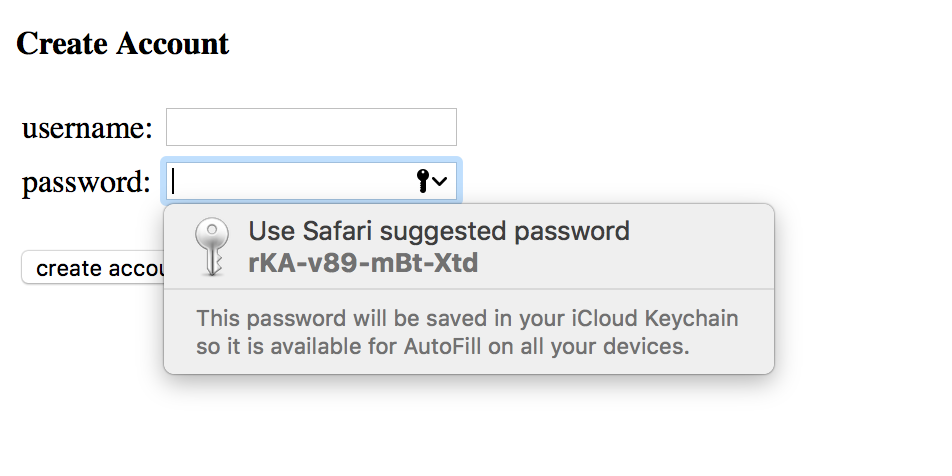
This brings up one of many interesting paradoxes of browsers. They can save passwords by default, but they won't generate strong passwords for you by default. (If your browser has a password generator you have to manually enable it)
Chrome generates strong passwords for you. I only wish there was a simple pass/fail test js function websites could use to tell chrome whether or not the auto generated password fits their ridiculous rules.
password rules have gone a bit absurd in my environment where they are considering doubling the twenty character requirement which already leads to people doing cut and paste. another option has been people storing them on their phones
with cloud computing a security company recently has shown us if they can find a hole to get the files where systems store such information they can reverse most. there is a dearth of knowledge out there how each platform stores such data and finding an in is incredibly easy at the majority of companies


For those who might not know about the Nissan.com domain story, basically one guy named Uzi Nissan owned it and fought Nissan Motors to keep the domain and succeeded [2].
However, Mr. Nissan died in 2020 from COVID complications. A story about that news was posted here on Hacker News last year[3].
Does anyone know anything about what happened here?
[1] https://web.archive.org/web/20230614052147/https://nissan.co... [2] https://en.wikipedia.org/wiki/Nissan_Motors_v._Nissan_Comput... [3] https://news.ycombinator.com/item?id=31950097