> Democrats turned on Elon during covid, as he was against lockdowns. This spread into wide distrust and complete sidelining and antagonism towards tech during the Biden administration. You can hear about it from Ben and Marc on their a16z podcast, when they explained why they are endorsing Trump.
Look, a16z basically are talking their book. They went heavily into crypto, and when the Biden administration started taking actions against crypto, they started supporting Republicans.
It's definitely not a major threat, but many/most finance people are clueless about what is and isn't possible with LLMs.
Again, unless Anthropic are taking on liability for their legal tools, this is not going to impact TR.
That being said, there probably is a potential company here that's gonna be built soon/is currently being built, but it definitely won't just be a wrapper around Claude as the recall will be way too low for these systems unaided.
> mpanies to usually notify you if they receive your data as controller (though there are some exceptions), in reality that's not really happening though (e.g. how many payments processors or acquiring banks have notified you about your credit card payments?).
Depending on why they received your data, they may not be allowed to tell you about this. The Bank Secrecy Act has had a lot of weird downstream consequences.
Yeah, but basically all of those are either standard for SMEs or no-ops.
For instance, if I run a bakery and sell baked goods online, I'm probably using Shopify who comply with this with one button.
Even if I built the baking website myself, all I need is email address and physical address to send delicious baked goods to you. I need to keep the payment records for a long time (for dispute prevention if nothing else) but that's it.
Where is the GDPR hassle in this case?
Just stop collecting data you don't need (or make sure it's for a good reason, like fraud prevention) and you'll be fine.
If said bakery creates accounts, it's a little more involved but basically you just need to implement soft delete to comply with your obligations.
I'm not sure this is a massive hit, can you help me understand what SMEs exactly are going to be hit by complex GDPR compliance?
No, a bakery using Shopify will not spare them having these documents. You show a respectable amount of ignorance only to then claim GDPR won't be a hassle in this case. It absolutely is a hassle, which you would know, had you familiarized yourself with the subject.
Even stating "just stop collecting data you don't need" shows, that you did not care to read my response before you replied to it, and how little you generally know about the topic.
Not repeating what I said, I will add this: if you do collect personal data (and you WILL if you do anything online, write invoices or just have a security camera on premises) than you will have to have these documents ready.
Most of the information relates to online marketing, which does tend to come with more GDPR compliance requirements. My wife runs a business through Shopify and the only thing we need to worry about is email addresses.
Can you help me understand what you see as the issues around GDPR compliance here?
In fact, "free" markets are downstream of them. Political stability and rule of law are important everywhere, whereas a fetish for free markets is something that's only important in some places.
We rarely get better results from healthcare or education (or infrastructure) from a free market system, and yet those are fundamental ingredients towards most human development (which can, but does not require free markets).
And anyway, what does a free market mean? Do regulations make markets less free or just shape them?
> From the outside it looks like the field is an intellectual circular firing squad that produces little of tangible value.
The biggest value of economists is that they provide stories around the accumulation and destruction of capital.
It's always been odd to me that we took just one social science (with a massive case of physics envy) and use it to explain the world. Like, what would the world look like if we'd picked sociology instead?
Arguably, we'd have fared worse: we'd be starting our days by taking a power stance while listening to the TV broadcast of lists of positive words to prime ourselves into greatness, then we'd go out and salute people with "Most people in your neighbourhood are having a great day". All exams would be not-eating-marshmallows exams. Only upshot I can think of is HN would be called PHackerNews.
No, if there's one social science we should have picked, it's anthropology I tell you.
> Arguably, we'd have fared worse: we'd be starting our days by taking a power stance while listening to the TV broadcast of lists of positive words to prime ourselves into greatness, then we'd go out and salute people with "Most people in your neighbourhood are having a great day".
This is all psychology research (which presumably you know). (I definitely do as I have a PhD in it).
> No, if there's one social science we should have picked, it's anthropology I tell you.
I actually agree with this, will update my rant to include this next time.
Yes... I should have come up with jokes about deconstructing the power dynamics inherent to lunch, but I don't know many egregious examples of retracted sociology studies, so I chose to not only disregard HN rules but also to do so lazily...
Will do better when I reply to your anthropology-fueled rant.
> Yes... I should have come up with jokes about deconstructing the power dynamics inherent to lunch, but I don't know many egregious examples of retracted sociology studies, so I chose to not only disregard HN rules but also to do so lazily...
To be fair, this is more a function of psychology having a lot of experimental studies (as you can normally run them on individuals) which tend to get lots of press, and they're badly conducted because most psychologists suck at stats (and the incentives are towards publishing or perishing). That being said, it's really good that we now know lots of them were garbage and is a sign of decent science being done.
Sociology OTOH (rather like economics) typically deals with observational data which is less flashy and prone to all kinds of errors that make it harder to figure out what a replication would even look like (we can't generate another 100 countries to test, unfortunately).
> What I don't understand is the concept of NATO or the EU: why would a group of countries willingly band together as "happy vassals
NATO: Russia is a threat to both Europe and the US, lets band together to make sure we can fight them.
EU: Europe keeps fighting wars, lets make our economies more inter-dependent so that doesn't happen as much.
For NATO, I can see the happy vassals thing (and that's what the Belgian PM was referring to), but can you explain who is the overlord in the EU example?
The EU would be very very different if that were the case. Like, since the UK left we'd have a common corporate taxation system. Prior to that, we'd have had a military since the 70s, and only one stock market (in London, obvs) and all data-collection would've been made illegal.
(This is mostly satire, even if I think 2 of the 3 second things were and are great ideas).
And importantly, this is clearly published by Grok, rather than the user, so in this case (obviously this isn't the US) but if it was I'm not sure Section 230 would apply.
if you can be sued for billions because some overbearing body, with a very different ideology to yours, can deem your moderation/censorship rules to be "unreasonable" then what you do is err on the side of caution and allow nearly nothing
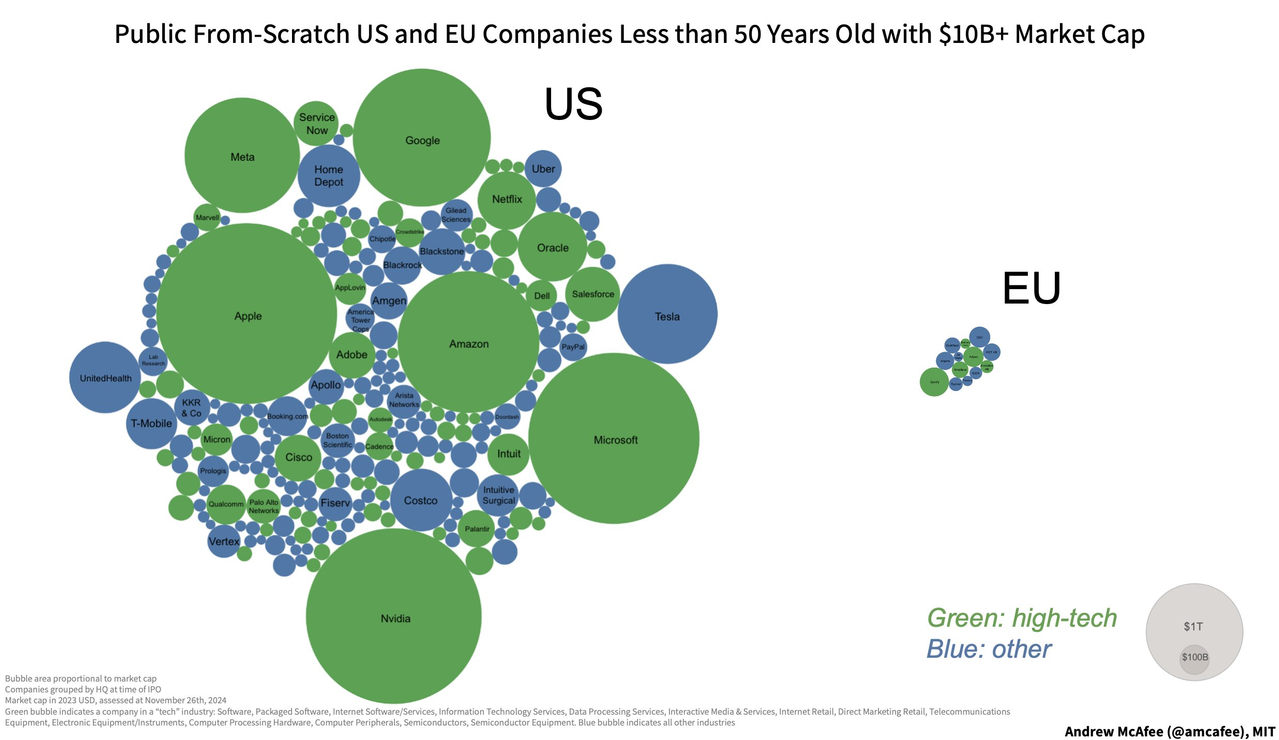
this is not compatible with that line of business - perhaps one of the reasons nothing is done in Europe these days
> this is not compatible with that line of business - perhaps one of the reasons nothing is done in Europe these days
Except for 40% of all Big Tech products and a vast industrial network of companies, and the safe airplane building and decent financial services that don't take 3% of everything, then yeah, I guess nothing is done in Europe these days.
And wait, wasn't most of Google's AI stuff acquired from a European country?
Honestly, while Europe has a lot of problems, this notion that many US people have that literally nothing happens there is wildly off-base.
Like, this is a function of fragmented capital markets rather than anything else. Ryanair would 100% have a market cap of 50bn+ if it had a US listing.
Anyway, market cap is a really really bad metric for basically anything. Like Walmart has a market cap of over 1tn now, do you think its business has materially changed since 2021 (when it was half that)?
Meta has basically doubled since then, and again, their business is basically the same as it was 5 years ago.
As another example, Stripe is valued at about 100bn, while both OpenAI and Anthropic are 3.5-5x that. Which ones would you rather put your money in?
(apologies I figured the OECD would have better data but this was the best I could find).
So, on average it would take a low-income person half the time to become upper income in Denmark versus the US. Is this a better metric? Certainly for a low income person with unlimited mobility options.
The vast majority of the EU is not common law, so "reasonable" in this instance is different.
What you describe already happens in the USA, that why MLB has that weird local TV blackout, why bad actors use copyright to take down content they don't like.
The reason why its so easy to do that is because companies must reasonably comply with copyright holder's requests.
Its the same with CSAM, distributing it doesn't have first amendment protection, knowingly distributing it is illegal. All reasonable steps should be taken to detect and remove CSAM from your systems to qualify for safe harbour.
> Its the same with CSAM, distributing it doesn't have first amendment protection, knowingly distributing it is illegal. All reasonable steps should be taken to detect and remove CSAM from your systems to qualify for safe harbour.
nice try, but nobody is distributing or hosting CSAM in the current conversation
people trying to trick a bot to post bikini pictures of preteens and blaming the platform for it is a ridiculous stretch to the concept of hosting CSAM, which really is a transparent attack to a perceived political opponent to push for a completely different model of the internet to the pre-existing one, a transition that is as obvious as is already advanced in Europe and most of the so-called Anglosphere
> The vast majority of the EU is not common law, so "reasonable" in this instance is different.
the vast majority of the EU is perhaps incompatible with any workable notion of free speech, so perhaps America will have to choose whether it's worth it to sanction them into submission, or cut them off at considerable economic loss
it's not a coincidence that next to nothing is built in Europe these days, the environment is one of fear and stifling regulation and if I were to actually release anything in either AI or social networks I'd do what most of my fellow Brits/Europoors do already, which is to either sell to America or flee this place before I get big enough to show up in the euro-borg's radar
> nice try, but nobody is distributing or hosting CSAM in the current conversation
multiple agencies (Ofcom, irish police IWF, and what ever the french regulator is) have detected CSAM.
You may disagree with that statement, but bear in mind the definition of CSAM in the UK is "depiction of a child" which means that if its of a child or entirely generated is not relevant. This was to stop people claiming that massive cache of child porn they had was photoshoped.
in the USA CSAM is equally vaguely defined, but the case law is different.
> EU is perhaps incompatible with any workable notion of free speech
I mean the ECHR definition is fairly robust. But given that first amendment protection has effectively ended in the USA (the president is currently threatening to take a comedian to court for making jokes, you know, like the twitter bomb threat person in the UK) its a bit rich really. The USA is not the bastion of free speech it once was.
> either sell to America or flee this place before I get big enough to show up in the euro-borg's radar
Mate, as someone whos sold a startup to the USA, its not about regulations its about cold hard fucking cash. All major companies comply with EU regs, and its not hard. they just bitch about them so that the USA doesn't put in basic data protection laws, so they can continue to be monopolies.


Look, a16z basically are talking their book. They went heavily into crypto, and when the Biden administration started taking actions against crypto, they started supporting Republicans.
Not everything needs to be complicated.
reply