While I agree with the general thrust of your comment, the machines used by the TSA are not "focused" in the same way. It would take much greater effort to create hazardous conditions like these patients experienced.
The TSA systems (at least the backscatter X-ray) do use a focussed moving beam to build up an image. They rely on the continual movement of the beam to limit the dose.
There are a number of safety systems to prevent the machine leaving the beam on should the mechanism stick.
And of course they are operated by the finest trained experts with a comprehensive background in nuclear physics and the ability to react in the fraction of a second before a notifiable dose was delivered
I think that article was essentially a propaganda piece, albeit unintentionally. My guess is that Newsweek puts out blurbs like that in order to reach out to a targeted demographic, in this case women.
The whole question of media bias really comes down to the bottom line. If a format of words plus carefully chosen images favored traditionally conservative causes (which for the most part they don't) there would be widespread complaints about right wing media bias. AS it is, I think there is very little remanent of journalistic ethics in mass media.
Sometimes life is unfair, but I hold as an article of faith that almost anything can be made better by getting off your butt and working hard. For me personally, there's almost nothing of value in that study. It wouldn't change my approach to life.
This article isn't so much about individuals and their decisions but society. The claim isn't that "hard work doesn't pay off". The claim is that "hard work pays of more for some than others based on non-merit factors."
Even if they are correct, this shouldn't affect our behavior. We should still try to climb to the peak of our local maxima. Even if hard work pays off more for others, it makes sense economically for me to work hard if it pays off some.
This doesn't mean we should ignore the study either. It is important as a society to continually self-evaluate to ensure that the systems we have in place are moving us toward our ideals. The purpose of a paper like this isn't (necessarily) to push a set of ideals, but to help us self-evaluate.
Why what? Why climb? Or why "local maxima"? Or just a general why, for the heck of it? If it's the latter, then my answer would be the following question: Is there any reason not to?
It would only have value to you if you were concerned with social justice. (not meant as an insult, but I'm guessing it's not terribly important to many people)
The article points out that although hard work might pay off, owning appreciating assets pays off with significantly more consistency in the US economic system.
And unlike hard work, one can inherit appreciating assets.
I agree and I remember the days of being a grad student and scouring the pages of High Tc Update looking for the next super-material. It seemed like every other quarter there was a hint of room T superconductivity and it was always dashed by the next quarter.
It sounds like you're asking asking whether some regions of a sample could be superconducting while others are normal phase. This can occur in heterogeneous materials as in a Josephson's junction. Pretty cool stuff when you look at it. An unknown 23 yr old grad student faced down a two-time Nobel prize winner and was right!
A model of an atom can be likened to a solar system
Um, no. Electrons do not have well-defined trajectories. Quantum particles should not in any way be compared to classical macroscopic objects.
I love fractals and finding examples of them in nature and science, but posts like these annoy me a bit. Saying that there are fractals everywhere is a bit like saying that we don't live in the Platonic plane.
I agree with the sentiment of your point, but this does represent "normal mental faculties" in any way. They are clearly extraordinary in this one sense and that alone doesn't allow them to be classified as normal.
I watched this spot on 60 minutes and I am not convinced that these people are normal with respect to mental health. They had a very odd affect at times. Still, it was amazing to watch people recall things that happened over 20 years ago with clarity and precision.
When I was in high school, I could recite nearly 1,500 digits of pi from memory. This wasn't because I had number-memorizing superpowers, it was because I was a geek and I spent time memorizing numbers. If you look at interviews with top competitive mnemonists, you find very few who claim to have (let alone actually have) any sort of "photographic memory" or even autistic savantisms. It's just a mundane subject with strategies and tricks. People don't close their eyes and see numbers, they break them up into convenient chunks, look for symmetries and patterns, and memorize them.
You can't underestimate what people can accomplish when they have severe abnormalities in their interests. Calendar-counting to compute days of the week is not hard. Weather patterns are easily mentally compressible, with natural chunking points from the seasons. Most people's work schedules are highly regular, so it's easy to break weeks into patterns and exceptions. And so on. Everything that's demonstrated in this article is well within the realm of feasibility for a sufficiently dedicated person without superpowers.
I think the point he was trying to make is this: would you consider someone who could completely crush you at, say, basketball, to have "abnormal powers"?
I'm not talking pros, I'm talking about people who've played sports all their lives. They can probably beat most people at their chosen sports. And a lot of perfectly "normal/average" people are really good at one sport or another. We don't talk about them as if they're "abnormal".
Haven't done it, but I'm guessing that memorizing 1500 digits of pi is easier and less time consuming than getting to a decent level at some sport. Except that for most people, playing sport is fun, so they don't think about it as "extreme concentration". For the op, memorizing digits of pi was fun (I'm guessing?).
I think you're completely misunderstanding the thrust of the article. This ability goes far beyond memorizing knowledge in one specialized area. These people go through hours (up to 8 at a time) of testing about the everyday mundane events that have happened as well as the extraordinary things - there is no way for them to trick their testers. In the 60 minute piece, they could recall amazing detail about days from 20 years ago. This goes far beyond memorizing weather patterns and reconstructing information according to the regularity of a work schedule, etc.
I think what a lot of people are noticing here is that this extraordinary ability has not been commensurate with extraordinary accomplishments and it leads them to downplay the significance...
I'm not saying their abilities aren't "extraordinary" or at least very impressive compared to what one might naively imagine. I am more saying that people who spend endorsement efforts in other areas also tend to gain enormous abilities and so these are "normal" extraordinary abilities.
The point others have raised about these people not having abilities in other areas goes beyond this "unique talent" "not transferring". The point is that the people with these "abilities" spend a fair portion of their waking hours maintaining them. The memories may be accurate but they're "honed", time is spent codifying them.
Most specifically, the memories are clearly very different anything "photographic".
Just consider, if a person actually a video tape of their entire life, using said tape to answer questions about "what happen on day X" would take a few hours of mental processing. These people answer such questions instantly.
They've made themselves "experts" on one subject, themselves, and the ability give instant answers on that subject is a clue to this...
'Just consider, if a person actually a video tape of their entire life, using said tape to answer questions about "what happen on day X" would take a few hours of mental processing.'
You're making a huge pile of unsupported assertions, but this is the most egregious. You have the outline of an interesting theory, but little more. For one thing I see no evidence that there is any conscious effort made to maintain these memories, in many cases the people express every desire not to have this happen, yet it happens anyhow. At the point where your "making themselves experts" happens at a purely automatic level and against their conscious will you've stretched the words beyond any reasonable meaning, and I'm not sure your theory can even in principle be converted into something that corresponds to the real world.
The article states that some of these people don't even want to remember everything - so there obviously are people who don't spend a lot of time exercising this skill but who simply have it.
0.) Cut taxes for 95% of America (EDIT: not referring to the most recent tax legislation... these are tax cuts Obama passed a while ago: http://www.nytimes.com/2010/10/19/us/politics/19taxes.html. They truly are the tax cuts no one has heard of....).
1.) Reserved the policy of forbidding the media to photograph fallen soldiers and reversed Bush's torture policy.
2.) Signed legislation that provided health insurance to 4 million uninsured children.
3.) Prevented insurance companies from denying claims due to pre-existing conditions.
4.) Significantly expanded Pell grants.
5.) Expanded hate crime legislation to include sexual orientation and extended benefits to the same-sex partners of federal employees.
6.) Created the largest and most significant nonproliferation treaty with Russia in our lifetime.
Every single item you list has significant "catches" that basically void the entire reality of itself, they are all meaningless - off the top of my head:
0) simply renewed a republican tax plan that was proven not to work since they helped put us into recession and caved on the idea of people making over $250k actually paying proportional taxes to help pay back their incredible gains
1) allows people to still be imprisoned forever without being charged and/or in solitary confinement with inhumane conditions - refuses to prosecute Valarie Plame leaks that got informants killed but now wants to go after non-citizens that republish leaks that only make his administration look bad
2) allowed insurance companies to drop children entirely before policy applied
3) allowed insurance companies to radically raise rates to compensate for imaginary loss of future profits - made the IRS an (even more powerful) enforcement agency that everyone will literally have to fear for their lives
4) allowed student loans to be "recovered" far more aggressively
5) insists on "partnerships" being "good enough" refuses to recognize gay marriage, setting a national tone that it's okay to discriminate like that
6) this won't be likely be signed because it's too late and democratic led congress is over - he let it drag out since April
7) allowed credit card companies to max out rates months before policy went into effect
8) asked courts to keep DADT on the books, setting national tone, allowed massive caveats in replacing DADT, 60 day nonsense waiting period from a dead-senator - military dishonorably discharged have to apply all over again and get all records reviewed without compensation
I like to consider myself very progressive but I cannot wait for Obama to be gone in 2012 so we can endure the dumbfounding insanity of 16 more years of far right rule, so FINALLY, FINALLY in 2038 when all these ancient a-holes finally die off and the young progressives will take over for a more enlightened country.
5.) Disagree. Marriage is not a governmental institution and needs to be removed from our legislation and legal code in favor of civil unions.
6.) Strongly disagree. Sorry, how did he "let" that happen? Obama doesn't control Congress. He got the hard work done by, I don't know, negotiating with the Russia and writing the damn thing?!
7.) Agreed.
8.) I recognize what you're saying here, but to not support what Obama has done on DADT based on this feels like a stretch.
I'm not saying Obama has accomplished everything (my comment actually says the opposite and expresses displeasure in some parts of the job he has done). But do note that I was responding to someone who thought Obama was 100% rhetoric and no backbone, which empirically is not true. Also, I hope you realize that young people have thought the nation would be taken over by "young progressives for a more enlightened country" since the begininning of this nation. You do realize the people in power now grew up in the 60s, perhaps one of the most left-leaning decades this nation has seen?
> simply renewed a republican tax plan that was proven not to work since they helped put us into recession
Everyone else thinks that the recession was due to the collapse of housing prices and/or the credit markets.
> and caved on the idea of people making over $250k actually paying proportional taxes to help pay back their incredible gains
$250k is a pair of married mid-level individual contributors. It's also an engineering manager and a school-teacher.
BTW - what definition of "proportional" are we using? Both before and after, the marginal tax rates are progressive. (No, SSI doesn't count - it's a forced savings plan with better return for folks who contribute less.)
And, if you look at the difference between the Clinton tax rates and the Bush tax rates, you find that the Bush rates are more progressive.
Yes, compare someone who makes $300k with someone who makes $30k. You'll find that the $300k person got less than 10x the benefit from the Bush tax rate cuts that the person who made $30k.
Curiously enough, that site's founders think that the tax rate cuts are a bad idea but suggests sending the savings to charity, which reduces tax liability, instead of sending it to govt....
Regarding 8 - Don't Ask Don't Tell was never "on the books" as a law - it was a policy implemented by Clinton and continued by Bush and Obama as a de facto way to allow homosexuals to serve in the military. The relevant law (which forbids homosexuals from serving in the military) is http://www.law.cornell.edu/uscode/10/654.html
Can you point me to any information regarding Obama's stance on the issue? I hadn't been following it until recently so I'd be curious to see what he's said on the matter.
Of all the things to pick, you picked accountability and the reduction of the MIC as points of criticism?! I wonder what you think about Obama's Secretary of Defense, who is one of the most fiscally conservative SoDs in recent history, pushing for reductions in spending across the board [1]. Hell, he nuked F-22 production which is like THE symbol of the MIC in the US. I'm also curious what you think about Obama ordering that all DoD interrogations be filmed [2], the voluntary (and unprecedented) disclosure of vistor records to the White House [3], the extensive anti-lobiest legislation created by Obama [4,5,6], and the creaton of a national Declassification Center to speed up the release of documents to the public [7].
Also, how is the Nobel Obama's fault? He knew he didn't deserve it (hint: read between the lines of his acceptance speech). The idiotic committee put him in that situation and I don't think you'll hear anyone arguing it was actually deserved.
Do you really expect people to engage in a conversation with you when you demonstrate such a clear lack of preparation and knowledge of the issues in question? It's a drain for all those involved. Dijkstra had something to say about this....
Military Construction was 19% more in 2010 than 2009 at $24 billion [1]. Sure he nuked the F-22.. but we are still spending in 2011 $11.4B on F-35s, $5.4B on Virginia class submarine(+28%), and $3B on the Arleigh Burke class destroyer(+19%)[2]. You cannot pretend Obama isn't playing super nice with the Military-Industrial complex.
Naming a dozen good to decent things Obama has done, with or without citations, doesn't come close to dimming the fact that Obama ran on a platform of huge sweeping change toward a more rational, peaceful world--and has in fact delivered on some token items but not even touched the core issues of imperliasism, state distributed misinformation, and a corporate-government marriage (it remains to be seen if Obama's anti-lobbying bill will be followed/enforced/effective).
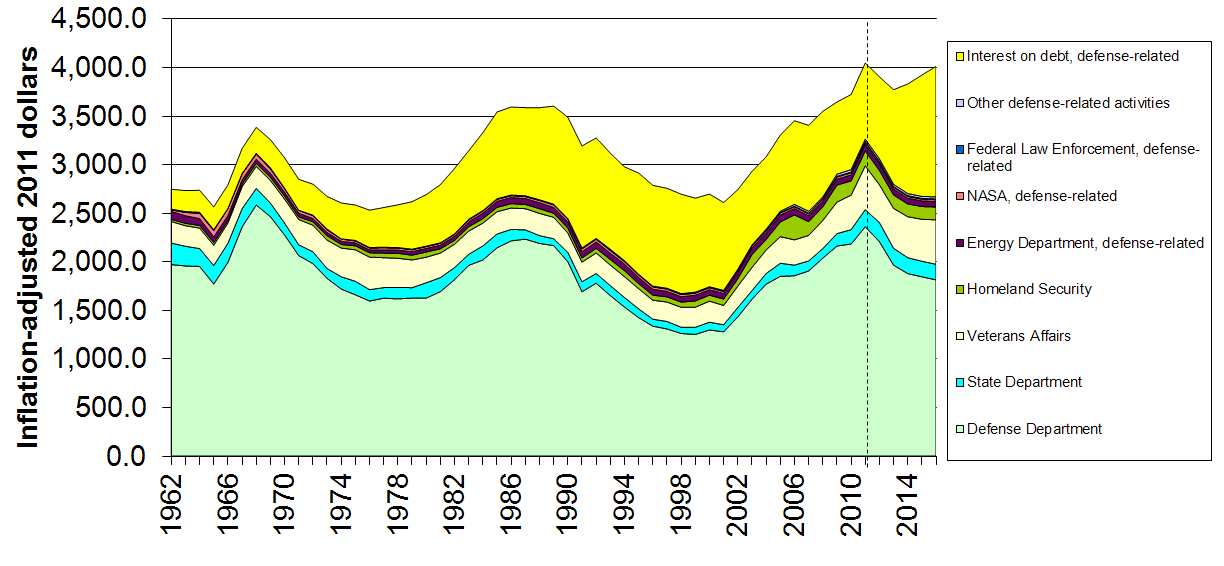
Awful, awful manipulation of statistics. I'm not even sure what subcategory of military spending Military Construction represents. How about we just consider all defense related expenditures instead of just the slice that fits your preconceived notions? Take a nice, hard look at this graph: http://upload.wikimedia.org/wikipedia/commons/c/cd/PerCapita.... None how every single measure that is not interest being paid on past debt goes WAY DOWN when Obama becomes President. You're trying to claim that Obama is playing "super nice with the MIC" when the fact is he has instituted massive reductions compared to the last decade.
Your partisanism and preconceived notations are blinding you in this case, and I will say, it makes a conversation with you quite unenjoyable.
Oh. Do you happen to mean the imaginary budget projections for 2012-2014 go down? Because when I look in the 2008-2010 range all the curves are heading up pretty sharply.
Gates, as SecDef, has been pushing for many of those changes since he took office in 2006. There's quite a bit to give Obama credit for, but Gates as SecDef is not one of them.
Patently false. Gates introduced these changes in April of 2009: http://www.cnn.com/2009/POLITICS/04/06/gates.budget.cuts/ind.... I'd be interested in any sort of proof that Gates was working on changes like this during the Bush years, because as I recall, programs like missile defense were being expanded not cut during that time.
What, like the fact that he didn't replace Gates like had been done with almost every single Secretary Of Defense in the past? Note how in recent years new presidents typically have appointed a new SoD [1]. Not replacing Gates was a de facto appointment.
Well, 0 is slightly off. Ge extended the Bush tax cuts, so he quite literally cut taxes for 100% of America and not the talking point number of 95. Also, failing to raise the taxes on those top 2% puts a huge tarnish on the rest of his achievements. Add this to that tarnish. Sorry, but he failed on his most important mandates. No public option, successful blackmail by the republicans and now most likely, no net neutrality.
The Republicans were not going to allow Obama's preferred tax cut version to get through congress, and because the mid-term elections swelled Republican ranks better prospects in the new year with the next congress would be even more unlikely. But don't take my word for it. That's what Bill Clinton said, along with endorsing the tax cut deal by saying he didn't believe there was a better deal out there. See here: http://www.youtube.com/watch?v=DYHDPxohkrc
He failed on his most important mandates? In the middle of a historic financial catastrophe which nearly triggered a full-blown depression (which under his watch the freefall was stopped successfully and the stock market is now largely recovered) he gets a historic healthcare law passed which had been attempted and failed at for more than 50 years. And because it's only 90% instead of 100% of the desired outcome it's a failure? Why not give credit for what it is, and opportunity for improvement it provides? Social Security, one of the most important social safety nets we have was not what it was when it first started either. This doesn't even get into passing the biggest financial reform laws (against powerful lobbies) since the Great Depression. No, I see it another way. This president has already had a very busy two years.
Better deal, maybe not. He could've and should've forced their hand by calling out those Republicans who were pulling for the rich and against the common man. The same must be said for the assholes who are voting down the 9/11 responders bill. Why should that fall on the shoulders of Jon Stewart? The young people want Obama to do this. His failure to do so has been the greatest disappointment to me.
Something tells me it cut fairly deeply for Obama to extend all the tax-cuts, but you have to look at the larger picture. The U.S. economy has suffered a severe and historic financial fall. To recover from that it's theoretically more favorable to provide citizens with tax cuts than not. Add to that the hand Obama was dealt at the mid-term elections which tilted the scales of congress in the Republican favor, and you see much more pressure to compromise in order to govern for progress of the country rather than draw lines in the sand for gridlock.
I'm not saying Obama is Jesus in the flesh, and that he never gets anything wrong. At the same time, I don't think it's helpful for people to sit back and criticize with broad strokes. Have you called your representatives about the 9/11 responders bill? Or net neutrality? Have we, the tech experts that hang out on sites like HN, taken concrete actions to make our voice heard on things like net neutrality, or do we just wait until the verdicts are nearly in from politicians who don't understand the ramifications as well as we do, and then complain when it's not what we want?
You're right, but it's not like he didn't try. Everything you cite are things that he and the Dems push for WEEKS before "caving" because it wasn't going to pass unless they compromised with the Republicans.
Again, I agree with the sentiment, but not with the blame assigned.
Let's lump (2), (3) and (6) under a category of idealogical disagreement. I think if you believed in the ideology behind them you would agree these steps represent concrete progress being made. Although I will say you're objections to (6) don't make any sense. Congress hasn't approved the treaty yet, so of course nothing has happened.... However the measure is regarded by the international community as a measure that will "foster more favourable conditions for actively promoting security and cooperation and strengthening international stability". [1]
As for (8), how is that Obama's fault? He got the Secretary of Defense and the chairman of the Joint Chiefs on board, he called for the removal during the State of the Union (note that the SotU is probably one of if not the most watched speech in the world), and then pressured Congress to take action. The difficulty comes from the Legislative Branch, which, thanks to the separation of powers, Obama has no control over.
And considering that the President, you know, doesn't make telecom law. I have no problem complaining about a disconnected Congress and a corrupt FCC, but bashing Obama for this is silly and cheap.
Haha, I love that site and agree with many of the complaints there. I just hate the unsubstantiated "Obama hasn't done anything" stance when Congress screws stuff up. He's sold out on plenty, no doubt. 4th Amendment and Gitmo are enough to send me up a wall. Right now DADT is much more important to me though.
Obama has to sign bills and can veto them. I agree though this is a pointless reason to bash Obama; but I also think Obama is completely worth bashing in general--given his dialogue and what he has actually delivered.
My only beef with his interesting post is that he uses graphics of completely understandable stuff like diagonalizing a matrix or the map of the phase space map of the logistic equation and then talks about current developments in math. Anything new is almost completely incomprehensible to me - a couple of years ago, I got a book about fractional calculus. I read about 5 pages away and gave it to a mathematician friend of mine...